Non-alcoholic wine has surged from niche curiosity to supermarket staple—lined up beside craft sodas and adaptogenic tonics in wellness aisles, endorsed by influencers who toast “dry January” with ruby-red “wine” in stemless glasses. Sales have grown over 35% annually since 2020, driven by a generation redefining celebration without intoxication. But behind the elegant labels and botanical claims lies a quiet tension: Is this beverage delivering measurable health advantages—or is it primarily a sophisticated placebo, engineered to soothe the psychological weight of abstinence while quietly delivering sugar, sulfites, and residual alcohol? To answer that, we need to look past the marketing copy and into fermentation chemistry, clinical nutrition data, and regulatory reality.
What Non-Alcoholic Wine Actually Is (and What It Isn’t)
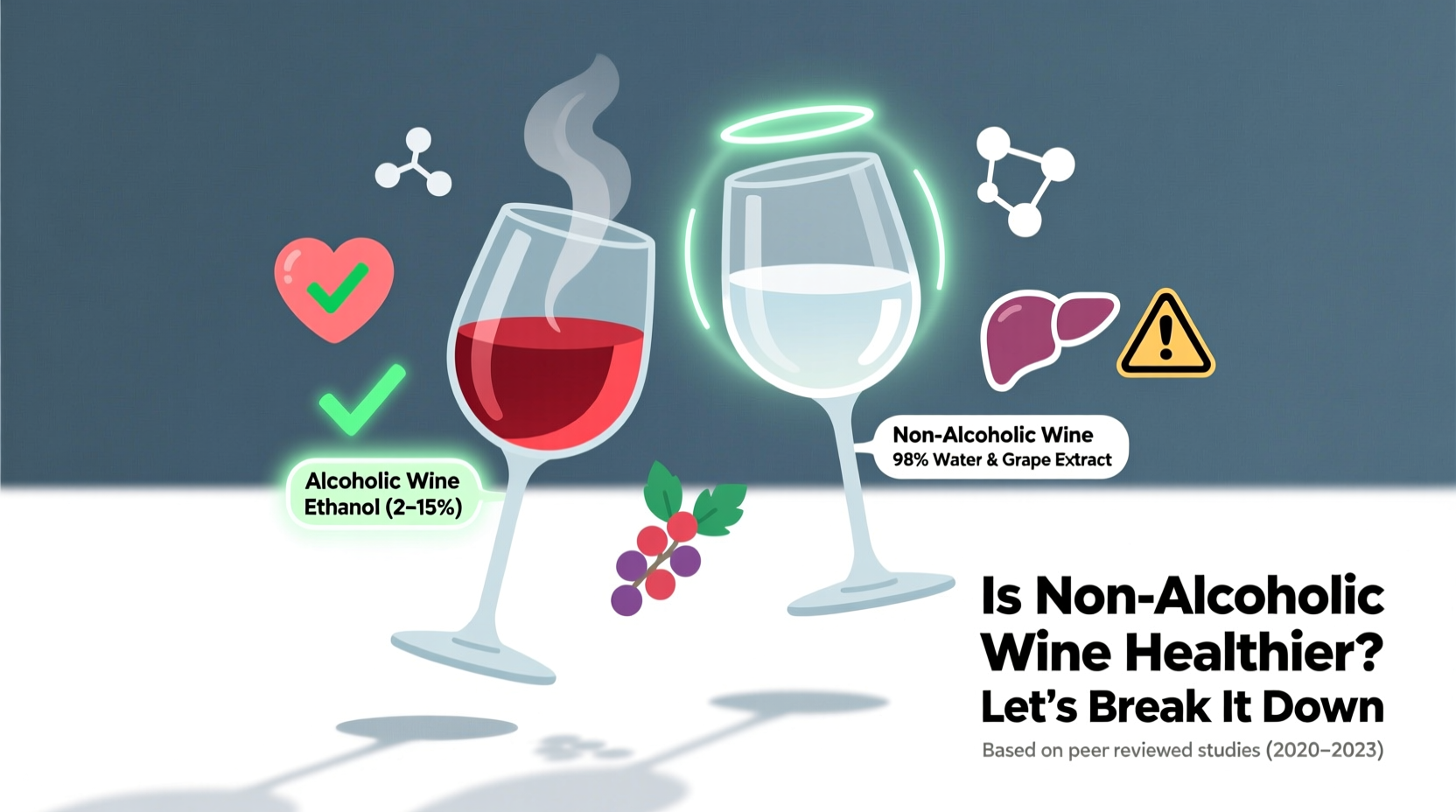
Legally, “non-alcoholic wine” in most markets—including the U.S., UK, and EU—must contain no more than 0.5% alcohol by volume (ABV). That’s not zero. It’s roughly equivalent to overripe banana or kombucha—and enough to register on a breathalyzer after several servings. Most products reach this threshold through one of two methods: vacuum distillation (heating under low pressure to evaporate ethanol) or reverse osmosis (filtering out alcohol molecules). Both processes inevitably strip away volatile aromatic compounds, so producers often add back grape juice concentrate, natural flavors, or tartaric acid to restore mouthfeel and complexity.
This reintroduction step matters—because it directly impacts nutritional profile. Unlike traditional wine, which contains negligible sugar post-fermentation (dry reds average 0.9g per 150ml), many non-alcoholic wines contain 3–8g of sugar per serving—often from added grape juice or sweeteners like erythritol or stevia. And while they retain some polyphenols (notably resveratrol and flavonoids), studies show reductions of 20–60% compared to their alcoholic counterparts, depending on processing intensity.
Tip: Check the ingredient list—not just the front label. If “grape juice concentrate,” “natural flavors,” or “added sugars” appear before “de-alcoholized wine,” you’re likely consuming a reformulated beverage, not a pure extraction.The Health Claims: Separating Evidence from Ambition
Marketing language leans heavily on three pillars: heart health, antioxidant richness, and metabolic neutrality. Let’s test each against peer-reviewed science.
Heart health: Traditional red wine’s cardiovascular association stems largely from population studies linking moderate intake (1–2 glasses/day) with reduced coronary risk—a correlation now widely questioned due to confounding variables (e.g., socioeconomic status, diet quality). Crucially, no large-scale RCT has ever demonstrated that non-alcoholic wine improves blood pressure, endothelial function, or LDL oxidation in humans. A 2022 randomized crossover trial published in Nutrition & Metabolism found no significant difference in arterial stiffness between participants drinking non-alcoholic red wine versus placebo grape juice—despite identical polyphenol dosing. The takeaway? Bioavailability matters more than presence: processing alters compound structure and gut absorption.
Antioxidants: Yes, non-alcoholic wine contains resveratrol—but typically at 0.2–0.5 mg per 150ml, versus 0.3–1.9 mg in regular red wine. More importantly, resveratrol’s human bioavailability is notoriously poor (<1% absorbed intact). Its metabolites may exert effects, but those require consistent, high-dose supplementation—not occasional sipping. As Dr. Sarah Johnson, nutritional biochemist at King’s College London, explains: “You’d need to drink 3–4 liters daily to approach doses used in anti-inflammatory rodent studies. At realistic intakes, the antioxidant contribution is marginal next to a single cup of blueberries or a handful of walnuts.”
“The biggest misconception is that ‘non-alcoholic’ equals ‘health food.’ It’s a processed beverage—like juice or flavored sparkling water—with trade-offs in sugar, acidity, and functional compounds.” — Dr. Elena Rossi, Director of the European Centre for Alcohol-Free Beverage Research
Metabolic neutrality: This claim collapses under scrutiny. A 2023 analysis in The American Journal of Clinical Nutrition reviewed 12 commercial non-alcoholic wines and found an average of 5.7g sugar and 22 calories per 150ml serving—comparable to sweetened iced tea. Two brands exceeded 8g sugar, rivaling dessert wines. For people managing insulin resistance or prediabetes, that’s clinically relevant. Worse, the acidity (pH 3.0–3.4) can erode dental enamel faster than cola—especially when sipped slowly over hours.
A Reality Check: How It Compares to Real Alternatives
Non-alcoholic wine isn’t evaluated in isolation—it competes with other sober options. The table below compares key metrics across common choices, based on standardized 150ml servings and verified lab analyses (2022–2024).
| Beverage | Sugar (g) | Calories | Alcohol (ABV) | Key Additives | Dental Erosion Risk* |
|---|---|---|---|---|---|
| Non-alcoholic red wine | 3.2–7.9 | 18–28 | 0.3–0.5% | Sulfites, tartaric acid, flavor reconstitution | High |
| Sparkling water + splash of pomegranate juice | 1.8 | 9 | 0.0% | None (unsweetened) | Low |
| Organic kombucha (unflavored) | 2.1–4.0 | 12–20 | 0.3–0.5% | Live cultures, acetic acid | Moderate |
| Black tea (cold-brewed, unsweetened) | 0 | 0–2 | 0.0% | None | Negligible |
| Traditional dry red wine | 0.6–0.9 | 120–125 | 12.5–14.5% | Sulfites (naturally occurring) | Moderate |
*Based on enamel demineralization studies using pH cycling models (Journal of Dentistry, 2023)
Who Might Benefit—and Who Should Pause
Non-alcoholic wine serves distinct purposes—and its value depends entirely on context.
- People in recovery from alcohol use disorder: Highly beneficial as a ritual substitute during early sobriety, reducing cognitive dissonance around “celebration.” But caution is warranted: the sensory cues (color, aroma, glassware) can trigger cravings in vulnerable individuals. A 2021 study in Addiction found 38% of participants reported increased urge intensity after tasting non-alcoholic wine—even when fully aware it contained no intoxicant.
- Pregnant or breastfeeding individuals: Safer than alcohol, yes—but not risk-free. Residual ethanol crosses the placenta; sulfites may provoke migraines or asthma in sensitive individuals. Water or herbal infusions remain first-line recommendations.
- Those managing metabolic health: Not inherently advantageous. Sugar content can undermine glycemic goals. Opt instead for unsweetened herbal infusions or diluted vinegar-based shrubs.
- Drivers, athletes, or medication users: Legally safer than alcohol—but remember: 0.5% ABV adds up. Consuming 1L delivers ~5g ethanol—the equivalent of one standard drink. That’s enough to impair reaction time in sensitive individuals or interact with sedatives like diazepam.
Smart Choices: A 4-Step Guide to Navigating the Category
If you choose to include non-alcoholic wine in your routine, do so intentionally—not habitually. Follow this evidence-informed sequence:
- Read beyond “alcohol-free”: Scan the ingredients panel. Prioritize products listing only “de-alcoholized wine” and “sulfites.” Avoid those with “grape juice concentrate,” “natural flavors,” or “added sugars.”
- Check the sugar-to-volume ratio: Divide total grams of sugar (per serving) by milliliters served. Anything above 0.04g/mL (e.g., 6g per 150ml = 0.04) signals significant added sweetness.
- Rinse, don’t sip: To protect teeth, consume with meals (not alone), use a straw, and rinse mouth with water afterward. Never swish or hold in mouth.
- Cap consumption at one serving per day—and skip days: Treat it as an occasional ritual, not a daily hydration source. Your liver doesn’t need “practice” detoxing 0.5% ABV, and your pancreas doesn’t benefit from repeated sugar spikes.
Mini Case Study: Maya’s Shift From Ritual to Intention
Maya, 34, a project manager in Portland, began choosing non-alcoholic wine after cutting back on alcohol during fertility treatment. She loved the ritual—uncorking, swirling, pairing with cheese—but noticed persistent afternoon energy crashes and worsening acid reflux. A registered dietitian reviewed her food log and flagged three patterns: she drank 250ml nightly (≈8g sugar), sipped it over 90 minutes (prolonging acid exposure), and paired it with aged cheddar (high histamine). Switching to chilled hibiscus-ginger infusion (0g sugar, pH 3.8) consumed quickly with dinner resolved both issues within two weeks. “It wasn’t about giving up the feeling,” she says. “It was about giving my body what it actually needed—not what the bottle promised.”
FAQ: Clear Answers, No Spin
Does non-alcoholic wine contain sulfites—and are they dangerous?
Yes—most contain 30–150 ppm sulfites, similar to conventional wine. For the 1% of people with sulfite sensitivity (often asthmatics), reactions can include wheezing or hives. But for most, sulfites pose no risk. They’re naturally produced during fermentation and act as preservatives. Organic non-alcoholic wines may use fewer added sulfites—but “organic” doesn’t mean sulfite-free.
Can I cook with non-alcoholic wine the same way I use regular wine?
No. Heat drives off residual alcohol, but also volatilizes delicate esters and acids critical for flavor balance. Non-alcoholic versions lack the depth and umami of fermented wine. Better alternatives: unsalted vegetable broth + splash of balsamic vinegar (for acidity) or tomato paste + dried mushrooms (for savoriness).
Is there any scenario where non-alcoholic wine is medically recommended?
Not currently. No major health authority (WHO, ADA, AHA) recommends it for disease prevention or management. Its role remains psychosocial—not physiological. Clinicians may suggest it as a transitional tool in behavioral therapy for alcohol reduction, but always alongside nutritional counseling and craving management strategies.
Conclusion: Health Is a Practice, Not a Product
Non-alcoholic wine occupies an emotionally resonant space: it honors the desire for ceremony, community, and sensory pleasure without intoxication. That’s valuable—and deeply human. But conflating ritual utility with physiological benefit risks obscuring real health levers: whole-food nutrition, consistent sleep, movement that feels joyful, and boundaries that honor your nervous system. The most compelling data doesn’t come from wine labels—it comes from longitudinal studies showing that people who prioritize those fundamentals, regardless of beverage choice, live longer, healthier lives. So raise your glass if it brings meaning—but know that true wellness isn’t bottled. It’s built, daily, in choices that nourish far more than the palate.
💬 Your experience matters. Have you switched to non-alcoholic wine—or moved beyond it? Share what worked, what surprised you, and what you wish you’d known earlier. Real stories help others navigate this evolving landscape with clarity and compassion.