The smoky signature of mezcal—earthy, campfire-like, sometimes medicinal or charred—is what distinguishes it from tequila and captivates drinkers worldwide. Yet a persistent misconception lingers: that this bold flavor is injected, infused, or chemically enhanced after distillation. It is not. The smoke in authentic mezcal is entirely natural—a direct imprint of centuries-old production philosophy, geology, and human craft. Understanding why requires stepping into the palenque: the open-air distillery where fire, earth, and agave converge.
This article clarifies the origin of mezcal’s smoke—not as an additive, but as a non-negotiable expression of process. We’ll examine how traditional pit-roasting transforms agave chemistry, why industrial shortcuts fail to replicate it, how regulation protects authenticity, and what to watch for when selecting a bottle that honors this legacy. No marketing spin. Just agronomy, anthropology, and distillation science—grounded in real-world practice across Oaxaca, Guerrero, and Michoacán.
How Traditional Pit-Roasting Creates Smoke Flavor Naturally
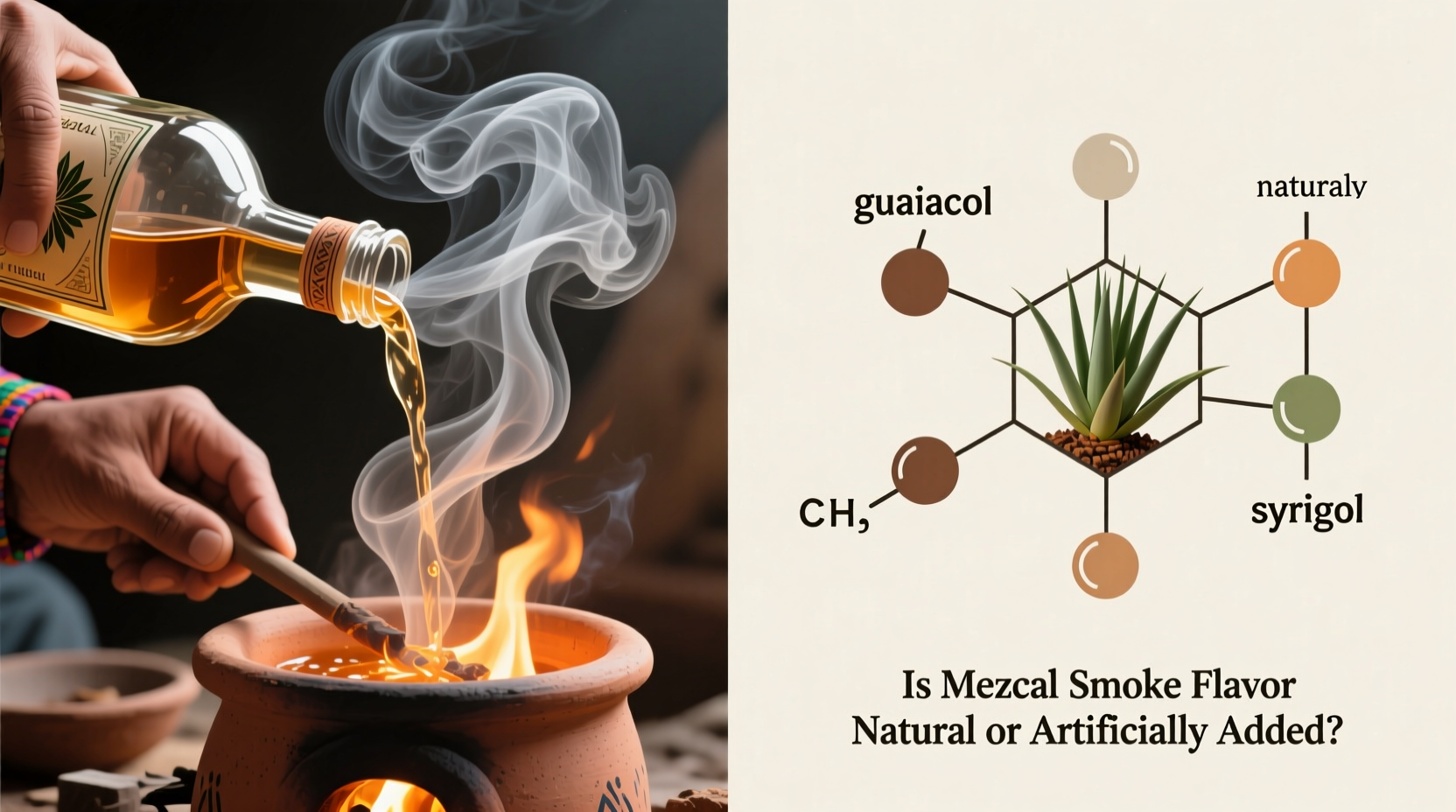
Unlike tequila, which uses steam ovens (autoclaves or brick hornos), most mezcal begins with horno de tierra: an earthen pit oven dug 3–5 feet deep into volcanic or clay-rich soil. Large stones—often basalt or river-rounded granite—are heated for 8–12 hours using native hardwoods like oak, mesquite, or copal. Once glowing red, the stones are covered with layers of agave piñas (the heart of the plant), then sealed under maguey leaves, damp burlap, and thick layers of earth.
Over 3–7 days, the piñas bake slowly at low, fluctuating temperatures (typically 60–90°C). This prolonged, anaerobic roasting triggers complex Maillard reactions and caramelization—but crucially, it also allows volatile phenolic compounds—guaiacol, syringol, cresols, and eugenol—to migrate from the smoke-saturated earth, wood ash, and charred stone surfaces directly into the fibrous agave tissue. These compounds are water-soluble and alcohol-soluble, so they carry forward through fermentation and distillation.
Chemical analysis confirms this: studies by the Universidad Tecnológica de la Mixteca (2021) found guaiacol concentrations in traditionally roasted espadín mezcal averaging 127 µg/L—nearly 8× higher than in autoclave-cooked agave spirits. Crucially, these compounds appear *only* in the roasted agave itself—not in the distillate if unroasted agave is used. There is no post-distillation “smoke infusion” step in certified artisanal production.
Tip: If a mezcal label lists “smoked agave” or “pit-roasted,” it refers to this natural thermal process—not flavoring. Avoid bottles that list “natural smoke flavor” or “liquid smoke” in ingredients; those are not authentic mezcal.Why Artificial Smoke Addition Violates Mezcal’s Legal and Cultural Framework
Mexico’s Denomination of Origin (DO) for mezcal—regulated since 2003 and enforced by the Consejo Regulador del Mezcal (CRM)—explicitly prohibits the addition of any flavoring agents, including smoke essences. Article 4.2.3 of the Official Mexican Standard NOM-070-SCFI-2016 states: “No additives, colorants, flavorings, or aroma enhancers may be added at any stage of production.” Violation results in loss of DO certification and legal inability to label the product as “mezcal.”
Beyond legality, artificial smoke contradicts the core cultural principle of terroir expresado—the belief that mezcal must express the land, climate, wood source, and maker’s hands. As maestro mezcalero Fortino Hernández of San Baltazar Guelavía (Oaxaca) explains:
“The smoke isn’t something we add—it’s what the earth gives back when we honor it. If you put liquid smoke in the still, you haven’t made mezcal. You’ve made flavored alcohol. The fire teaches patience. The pit teaches respect. That’s why we don’t rush it.” — Fortino Hern��ndez, third-generation palenquero, CRM-certified artisan
Even producers who use modern alternatives—such as above-ground brick ovens (hornos de ladrillo)—must still roast agave with wood fire and cannot introduce exogenous smoke compounds. The CRM verifies compliance through on-site audits, lab testing for synthetic markers (e.g., 2-ethylphenol, a common adulterant), and mandatory batch traceability from field to bottle.
What’s Not Smoke—and Why Confusion Persists
Not all perceived “smokiness” in mezcal comes from roasting. Several other natural elements contribute to layered, complex aromas often misattributed to smoke alone:
- Agave varietal character: Tobalá and Tepeztate naturally express iodine, wet stone, or medicinal notes that blend with smoke to create a “medicinal smoke” impression.
- Fermentation microbes: Wild yeasts and bacteria native to the palenque environment produce esters and phenols (e.g., 4-ethylguaiacol) that echo smoky, spicy, or clove-like tones.
- Distillation cuts: Heads fractions contain volatile aldehydes (like acetaldehyde) that can read as sharp, green smoke; tails contain heavier fusel oils that lend leathery, burnt sugar depth.
- Aging in wood: While most mezcal is bottled joven (unaged), some reposado or añejo expressions mature in used whiskey, wine, or French oak barrels—adding toasted vanilla, char, or tannic smoke, but this is distinct from the foundational roasted-agave smoke.
Confusion arises because many consumers taste “smoke” broadly—as a sensory umbrella covering char, ash, leather, tobacco, or even rubber. But only the first 48–72 hours of pit-roasting generate the signature phenolic backbone. Everything else supports or reframes it.
How to Identify Authentic, Naturally Smoked Mezcal
Authenticity isn’t guessed—it’s verified through observable indicators. Below is a practical checklist for buyers, bartenders, and enthusiasts:
Checklist: Confirming Natural Smoke Origin- ✅ Label verification: Look for “100% agave,” “hecho en México,” and CRM certification seal (a stylized “M” inside a circle).
- ✅ Production method: Phrases like “horno de tierra,” “pit-roasted,” “roasted over wood fire,” or “traditional earthen oven” indicate natural smoke.
- ✅ Producer transparency: Reputable brands name the palenque, maestro, municipality, and agave species (e.g., “Espadín, San Juan del Río, Oaxaca”).
- ✅ Taste profile consistency: Natural smoke integrates smoothly—no harsh, one-dimensional “campfire candy” note. It evolves: initial smoke → sweet roasted agave → herbal/earthy finish.
- ❌ Red flags: “Smoked flavor added,” “natural smoke essence,” vague origins (“crafted in Mexico”), or price under $45 USD for 750ml (true artisanal pit-roasting is labor- and time-intensive).
Mini Case Study: The 2022 San Luis del Río Batch – When Smoke Tells a Story
In early 2022, palenquero Martina Sánchez in San Luis del Río (Oaxaca) faced drought conditions that stunted her espadín harvest. Rather than delay, she adapted: using smaller, denser piñas and extending pit-roast time to 5 days instead of 3. She burned only fallen encino (oak) branches—no green wood—to maintain clean, low-resin smoke.
The resulting mezcal revealed how natural smoke carries narrative. Tasters noted restrained, elegant smoke—less aggressive than usual—with pronounced notes of roasted chestnut, dried fig, and violet. Lab analysis showed elevated syringol (a compound associated with gentle oak smoke) and lower guaiacol than her typical batch, confirming the impact of wood type and roast duration. No adjustment was made post-distillation. The variation wasn’t inconsistency—it was fidelity. As Martina told CRM auditors: “The agave spoke. I listened. The smoke is its voice.”
This batch sold out in 72 hours—not because it was “smokier,” but because its nuanced, site-specific expression resonated with connoisseurs seeking authenticity over intensity.
Do’s and Don’ts: Navigating Smoke Claims Responsibly
Understanding mezcal’s smoke is only useful if applied thoughtfully. The table below distills best practices for producers, retailers, and consumers:
| Action | Do | Don’t |
|---|---|---|
| Labeling | Specify roast method (“pit-roasted with oak”) and agave origin | Use vague terms like “smoky profile” without process context |
| Tasting | Compare side-by-side: pit-roasted vs. brick-oven vs. autoclave agave (if available) | Assume “more smoke = better mezcal”; balance and integration matter more than intensity |
| Purchasing | Ask importers or retailers for CRM batch numbers and palenque details | Rely solely on front-label aesthetics or influencer reviews without verifying provenance |
| Storing | Keep bottles upright, away from heat/light—smoke compounds degrade faster than ethanol | Store near strong odors (garage, spice cabinet); porous cork can absorb ambient scents |
| Serving | Use a copita or tulip glass; let rest 60 seconds after pouring to soften volatile phenolics | Serve ice-cold or with mixers that mask structural nuance (e.g., cola, heavy citrus) |
FAQ: Clarifying Common Smoke Misconceptions
Can “cold-smoked” mezcal be authentic?
No. Cold-smoking—exposing distilled spirit to smoke without heat—is prohibited under NOM-070. It introduces inconsistent, surface-level phenols that lack the integrated depth of roasted agave. Any mezcal labeled “cold-smoked” either violates DO rules or is mislabeled (e.g., a flavored liqueur, not mezcal).
Why does some mezcal taste barely smoky—even when pit-roasted?
Smoke perception depends on multiple variables: agave maturity (younger piñas absorb less smoke), roast temperature (lower temps yield subtler phenolics), soil composition (volcanic ash imparts more minerality than clay), and distillation precision (over-refluxing strips volatile smoke compounds). A light smoke profile often signals exceptional control—not absence of tradition.
Are there mezcals with zero smoke flavor?
Yes—but they’re rare and intentional. Some palenques in coastal Guerrero use steam-assisted roasting (still wood-fired, but with controlled steam injection) to preserve floral, citrus-forward agave notes in varieties like Jabalí or Madrecuixe. These are still certified mezcal, as long as no flavorings are added and wood fire remains the primary heat source.
Conclusion: Smoke as Witness, Not Ingredient
The smoke in mezcal is not a seasoning. It is evidence—a sensory archive of fire, soil, time, and intention. It records the weight of volcanic rocks, the resin of oak branches, the humidity of a mountain valley at dawn, and the calloused hands that uncovered the piñas after days underground. To ask whether it’s “natural or artificial” is to misunderstand mezcal’s essence: it is never manufactured. It is coaxed, respected, and revealed.
When you next pour a glass, pause before sipping. Inhale deeply—not just for smoke, but for the quiet labor behind it. Then seek out producers who name their palenque, list their agave, and honor the pit. Support CRM-certified bottles, ask questions at your local shop, and share what you learn. Authentic mezcal doesn’t need embellishment. Its truth is already written—in ash, in earth, in every complex, lingering note of natural smoke.
💬 Have you tasted a mezcal whose smoke told a clear story of place and process? Share the producer, region, and what surprised you—your insight helps others discover integrity in every pour.