For decades, the “French Paradox” — the observation that French populations enjoyed relatively low rates of cardiovascular disease despite diets rich in saturated fats — kept red wine in the spotlight as a potential health elixir. More recently, attention has shifted to the gut: Could moderate wine consumption support microbial diversity, strengthen the intestinal barrier, or reduce inflammation? The answer is neither simple nor binary. Emerging science reveals a nuanced interplay between wine’s bioactive compounds — especially polyphenols like resveratrol, quercetin, and anthocyanins — and the trillions of microbes residing in our colon. Yet alcohol, even in small amounts, exerts its own physiological effects — some beneficial, others potentially disruptive. This article synthesizes high-quality, human-focused studies published between 2020 and 2024, including randomized controlled trials, longitudinal cohort analyses, and mechanistic microbiome profiling. We cut through the hype to clarify what’s supported, what’s overstated, and what remains unknown — all with practical takeaways for people who enjoy wine and care about digestive resilience.
What the Gut Microbiome Actually Responds To in Wine
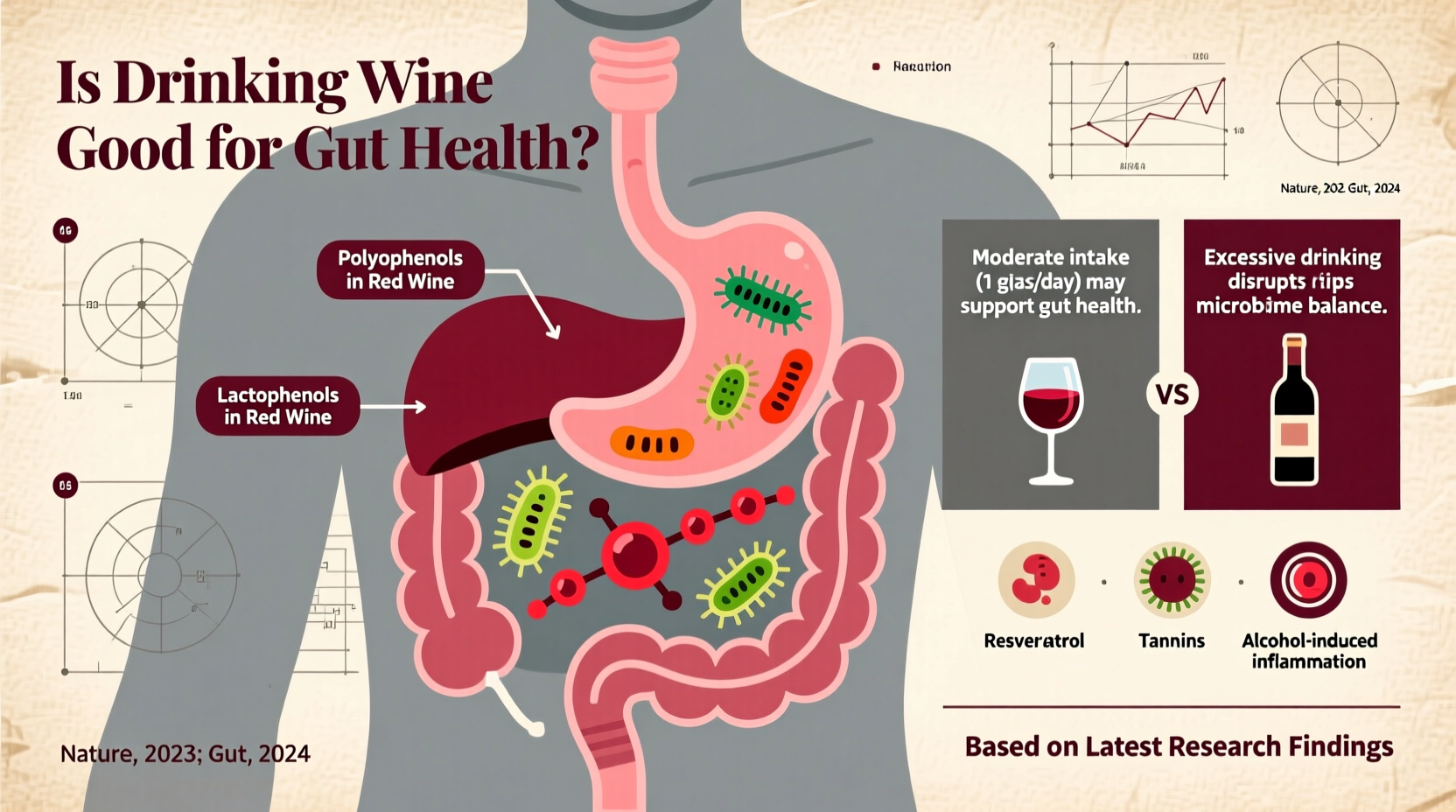
Wine is not a single compound but a complex matrix: ethanol (typically 11–15% by volume), organic acids (tartaric, malic), sugars (residual or added), sulfites, and, most critically for gut health, over 300 identified polyphenols. These plant-derived molecules are largely indigestible by human enzymes but serve as potent prebiotics — fuel for select beneficial bacteria. Research now confirms that wine polyphenols resist gastric digestion and reach the colon intact, where they’re metabolized into smaller, bioactive phenolic acids (e.g., protocatechuic acid, urolithins) by microbes such as Bifidobacterium, Lactobacillus, and Akkermansia muciniphila.
A landmark 2023 double-blind, placebo-controlled trial published in Gut Microbes tracked 67 adults with mild dysbiosis over 8 weeks. Participants consumed either 150 mL of organic Tempranillo red wine daily (13.5% ABV, high in anthocyanins and flavonols) or an alcohol-free, polyphenol-matched control beverage. Fecal metagenomic sequencing revealed that only the wine group showed statistically significant increases in Akkermansia abundance (+37%, p = 0.008) and butyrate-producing Faecalibacterium prausnitzii (+29%, p = 0.014). Crucially, these shifts correlated with improved intestinal permeability markers (serum zonulin decreased by 18%) and reduced plasma LPS-binding protein — a sign of lower endotoxin translocation.
But ethanol matters. A 2022 study in Nature Communications compared three interventions in healthy volunteers: no alcohol, 15 g ethanol/day (≈1 standard glass of wine), and 30 g ethanol/day (≈2 glasses). Only the 15 g group showed increased alpha diversity and enrichment of Ruminococcaceae — a family linked to anti-inflammatory short-chain fatty acid production. The 30 g group exhibited transient reductions in Bifidobacterium and elevated fecal calprotectin, suggesting low-grade mucosal irritation. This reinforces a critical threshold: benefit appears dose-dependent and narrow.
Red vs. White vs. Rosé: Does Variety Matter?
Polyphenol concentration varies dramatically across wine types — not just by color, but by grape variety, terroir, fermentation method, and aging. Red wines contain significantly higher levels of skin- and seed-derived polyphenols because fermentation occurs with skins intact. White wines, fermented without skins, have markedly lower concentrations — typically 10–100 times less resveratrol and 5–20 times less total phenolics than reds. Rosé falls in between, depending on maceration time.
However, recent work challenges the assumption that “more polyphenols always equals better gut outcomes.” A 2024 comparative analysis in Frontiers in Nutrition evaluated 12 commercial wines (4 red, 4 white, 4 rosé) using standardized in vitro colonic fermentation models. While Cabernet Sauvignon and Syrah extracts consistently stimulated Akkermansia growth, certain high-acid, low-pH white wines (e.g., dry Riesling, Albariño) demonstrated unexpectedly strong prebiotic activity — likely due to synergistic effects of tartaric acid and low-molecular-weight phenolics like hydroxycinnamic acids. Notably, oak-aged Chardonnay showed diminished microbial benefits, possibly due to ellagitannin degradation or vanillin interference.
| Wine Type | Avg. Total Polyphenols (mg/L) | Key Gut-Relevant Compounds | Observed Microbial Effects (Human Studies) |
|---|---|---|---|
| Red (Tempranillo, Pinot Noir) | 1,800–2,800 | Resveratrol, anthocyanins, proanthocyanidins | ↑ Akkermansia, ↑ F. prausnitzii, ↑ butyrate |
| Rosé (Grenache-based) | 400–900 | Small anthocyanins, gallic acid | Mild ↑ Bifidobacterium; inconsistent diversity changes |
| White (Riesling, Sauvignon Blanc) | 150–350 | Tartaric acid, caftaric acid, quercetin glucosides | ↑ Lactobacillus strains; modest SCFA elevation |
| Sparkling (Traditional Method) | 200–500 | Lees-derived peptides, low-dose CO₂ | ↑ microbial richness in 1 small pilot; mechanism unclear |
The takeaway is not that white wine is “bad,” but that its mechanisms differ. Its lower alcohol content (often 11–12.5% ABV) may offer a safer margin for regular intake, while its organic acid profile may support gastric motility and bile acid metabolism — indirect contributors to gut homeostasis.
Alcohol’s Double-Edged Sword: When Benefit Turns to Risk
It is impossible to discuss wine and gut health without confronting ethanol. At low doses, ethanol may enhance polyphenol absorption and exert mild anti-inflammatory effects via NF-κB pathway modulation. But beyond ~10–12 g per day (≈1 standard drink), ethanol begins disrupting gut integrity through multiple pathways: it increases intestinal permeability by degrading tight junction proteins (occludin, claudin-1), suppresses antimicrobial peptide secretion (e.g., defensins), and alters bile acid conjugation — promoting dysbiosis and endotoxin release.
A pivotal 2021 longitudinal study in Gastroenterology followed 2,143 adults over 5 years using repeated stool metagenomics and serum biomarkers. Researchers found a U-shaped association between alcohol intake and gut diversity: those consuming ≤1 drink/day had 12% higher Shannon diversity than abstainers (p = 0.02), while those consuming ≥3 drinks/day had 23% lower diversity and 3.1× higher risk of Enterobacteriaceae overgrowth (p < 0.001). Importantly, the protective effect vanished entirely in participants with pre-existing IBS-D or IBD — suggesting baseline gut status determines whether wine acts as a modulator or a stressor.
Tip: If you have diagnosed IBS, IBD, or chronic bloating, skip wine entirely for 4 weeks. Reintroduce only if symptoms remain stable — and never exceed one 125 mL glass, 3–4 days/week.Real-World Application: A 4-Week Gut-Conscious Wine Protocol
Translating research into practice requires intentionality. Based on current evidence, here’s a step-by-step protocol designed to maximize microbial benefit while minimizing ethanol-related disruption. It assumes no contraindications (e.g., liver disease, alcohol use disorder, pregnancy, or medication interactions).
- Week 1: Baseline Assessment — Record bowel habits (Bristol Stool Scale), bloating severity (1–10 scale), energy levels, and sleep quality daily. Note current wine intake pattern (frequency, type, volume).
- Week 2: Elimination & Reset — Abstain completely from all alcohol. Prioritize fiber-rich whole foods (30+ g/day), fermented foods (kefir, sauerkraut), and adequate hydration. This reduces background inflammation and establishes a clean baseline.
- Week 3: Strategic Reintroduction — Begin with one 125 mL serving of high-polyphenol red wine (e.g., organic Tempranillo, Malbec, or Pinot Noir) on Monday, Wednesday, and Friday — always consumed with food, never on an empty stomach. Monitor symptoms closely.
- Week 4: Observation & Refinement — Continue the same pattern. If no adverse symptoms (gas, reflux, fatigue, disrupted sleep), maintain. If mild symptoms occur, reduce to two servings/week. If symptoms persist, discontinue and consult a gastroenterologist or registered dietitian specializing in microbiome health.
This protocol emphasizes consistency, context, and individualization — rejecting the notion of universal “health benefits” in favor of personalized tolerance and response.
Expert Insight and Clinical Realities
While population-level data suggest modest benefits for some, clinicians emphasize that wine is not medicine — and should never replace evidence-based interventions for gut disorders. Dr. Elena Rodriguez, a board-certified gastroenterologist and microbiome researcher at the University of Navarra, clarifies the clinical perspective:
“The idea that ‘a glass of wine a day keeps the gastroenterologist away’ is dangerously misleading. In my practice, patients with SIBO, histamine intolerance, or mast cell activation syndrome often report symptom flares after even small amounts of wine — not because of polyphenols, but due to biogenic amines (like tyramine), sulfites, or histamine released during fermentation. For them, wine is a trigger, not a tonic. Science supports nuance, not dogma.” — Dr. Elena Rodriguez, MD, PhD, Director of Microbiome Translational Research, Clínica Universidad de Navarra
This aligns with findings from a 2023 patient-reported outcomes survey (n = 1,842) published in Neurogastroenterology & Motility, where 41% of respondents with functional gut disorders listed wine among their top three dietary triggers — second only to gluten and dairy. The implication is clear: benefit is conditional, not guaranteed.
FAQ: Addressing Common Concerns
Does organic or natural wine offer greater gut benefits?
Not inherently — but it may reduce unintended exposures. Organic certification limits synthetic pesticides (some of which act as microbiome disruptors in animal models), and “natural” wines typically avoid added sulfites and commercial yeasts. However, polyphenol content depends on grape variety and terroir, not certification. A conventionally farmed Cabernet can be richer in resveratrol than an organic Pinot Grigio. What matters more is low-intervention fermentation, which preserves native yeast diversity and may yield more complex, gut-active metabolites.
Can I get the same gut benefits from grapes or grape juice instead?
Partially — but not equivalently. Whole grapes provide fiber and polyphenols, but lack ethanol’s absorption-enhancing effect. Grape juice (especially pasteurized) loses heat-sensitive compounds and often contains added sugar, which can feed pathobionts like Candida or Proteobacteria. A 2022 head-to-head trial found that participants consuming red wine showed 2.3× greater increases in fecal butyrate than those drinking equivalent-polyphenol grape juice — likely due to synergistic ethanol–polyphenol interactions in the colon.
What about dealcoholized wine?
Emerging evidence is promising but limited. A 2024 pilot study (n = 32) found that dealcoholized red wine (0.5% ABV), consumed daily for 6 weeks, increased Bifidobacterium counts and reduced systemic IL-6 — though effects were ~30% weaker than full-strength counterparts. The key advantage is safety for those who must avoid ethanol entirely. Choose brands verified to retain >85% of original polyphenols (look for third-party lab reports).
Conclusion: Drink Mindfully, Not Magically
Wine is neither a gut panacea nor a universal toxin. The latest research affirms that moderate, consistent intake of high-polyphenol red wine — approximately one 125 mL glass, 3–4 days per week, always with food — can positively influence microbial composition, barrier function, and inflammatory signaling in many healthy adults. Yet this benefit exists within tight biological boundaries. Exceed the threshold, ignore personal sensitivities, or overlook foundational gut-supportive habits — like sufficient fiber, sleep, and stress regulation — and wine quickly shifts from ally to antagonist. There is no substitute for listening to your body: bloating, reflux, disrupted sleep, or fatigue after consumption are reliable signals that your gut is not benefiting. Science continues to evolve, but one principle remains constant: gut health is built daily, meal by meal, sip by sip — with awareness, not assumption.
💬 Your experience matters. Have you noticed gut changes with wine — positive or negative? Share your observations in the comments. Real-world insights help refine our collective understanding far beyond any single study.