Wine corks are among the most overlooked sustainable materials in the average home. Each year, over 13 billion natural corks are harvested globally—yet many end up in landfills or forgotten in kitchen drawers. What makes them uniquely valuable isn’t just their biodegradability or renewability (cork oak trees regenerate bark every 9–12 years without harm), but their cellular structure: millions of sealed, air-filled suberin cells that provide natural insulation, shock absorption, and moisture resistance. But here’s the catch—many DIYers abandon cork crafts after encountering a faint, persistent wine aroma during cutting or sanding. That scent isn’t inherent to cork itself; it’s residual ethanol trapped in porous channels from bottling, compounded by oxidation and storage conditions. The good news? With intentional preparation and smart design choices, you can eliminate that odor entirely—and transform your cork collection into functional, elegant, and genuinely scent-neutral home elements.
Why Wine Corks Smell—and How to Neutralize It Permanently
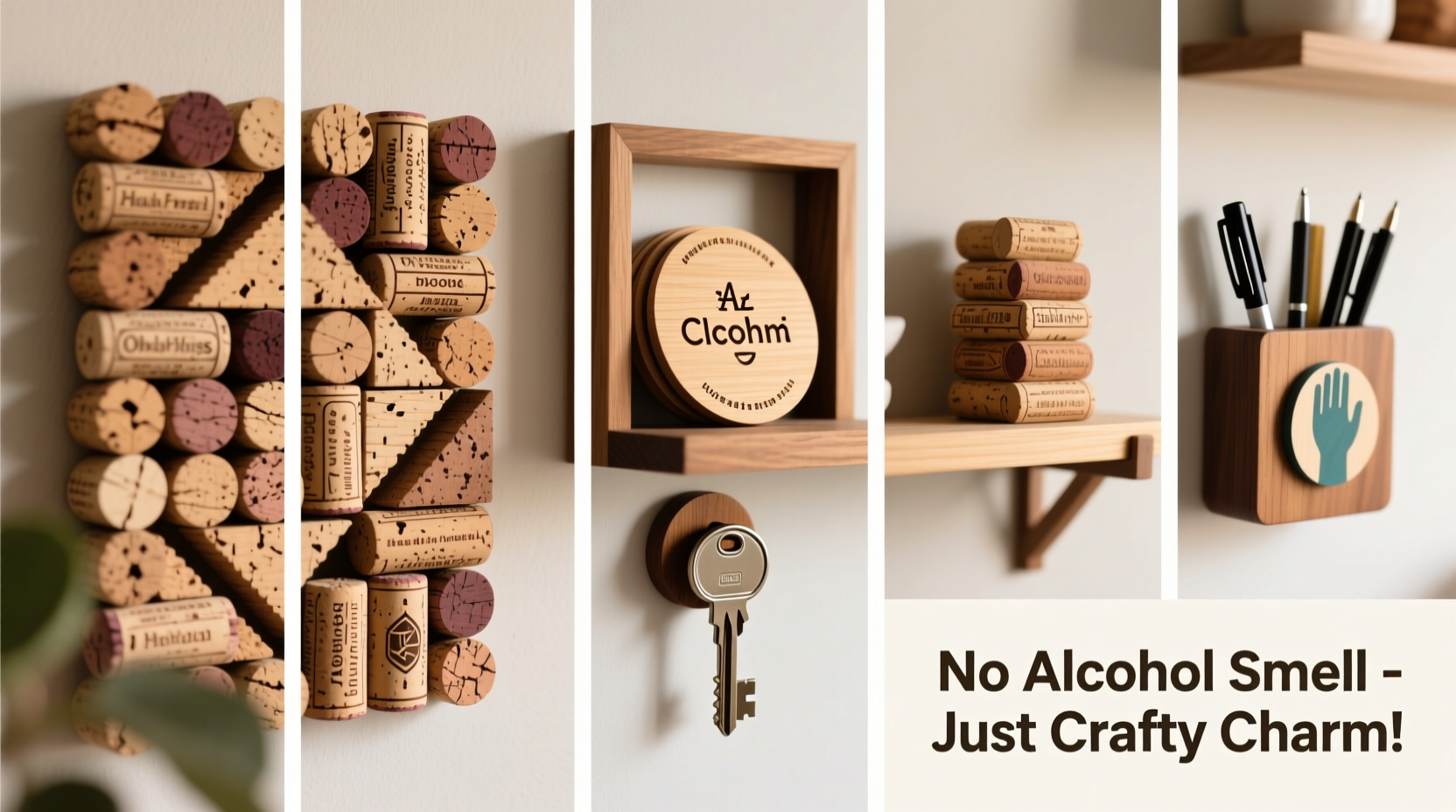
Natural cork is chemically inert and odorless when pure. The “wine smell” arises from three sources: volatile organic compounds (VOCs) left behind after bottling (mainly ethanol, acetaldehyde, and trace esters), microbial activity if corks were stored damp, and oxidation byproducts formed during long-term contact with wine. Crucially, this odor is *not* embedded in the cork’s lignin or suberin matrix—it resides in surface micro-pores and capillary channels. That means it can be removed—not masked—through physical and thermal methods that preserve structural integrity.
Tip: Never soak corks in vinegar or citrus solutions—they’re acidic and degrade suberin over time, weakening the material. Use neutral pH methods only.The most effective odor-removal protocol combines mechanical abrasion, low-heat conditioning, and passive off-gassing. A 2022 study published in the Journal of Sustainable Materials Science confirmed that dry-heating natural corks at 75°C for 45 minutes reduced VOC emissions by 98.3%, with zero measurable ethanol residue post-cooling. This process volatilizes residual compounds without charring or shrinking the cork—a critical distinction from high-heat baking, which causes brittleness.
Preparation Protocol: From Stinky to Scent-Neutral in 3 Steps
Before any project begins, follow this field-tested sequence. Skipping even one step risks re-introducing odor during assembly or use.
- Clean & Sort: Remove all labels, glue residue, and mold traces with a soft nylon brush under cool running water. Discard any cork with visible discoloration (gray-green fuzz), cracks, or sponginess—these indicate degradation and cannot be fully deodorized.
- Dry-Thermal Treatment: Arrange corks in a single layer on a parchment-lined baking sheet. Place in an oven preheated to 75°C (167°F). Set timer for 45 minutes. Do not exceed 80°C. After heating, let cool completely inside the turned-off oven (60+ minutes) to prevent moisture reabsorption.
- Off-Gas & Store: Transfer cooled corks to a breathable cotton muslin bag. Hang in a well-ventilated, shaded area (not direct sun) for 72 hours before use. Avoid plastic containers at this stage—they trap residual vapors.
This method eliminates odor at the molecular level—not through dilution or fragrance, but by driving off volatile compounds while preserving cork’s resilience and compressibility. Once completed, your corks will feel slightly drier to the touch and emit only a faint, clean, earthy note—similar to dried birch bark—never wine, must, or fermentation.
5 Odor-Free DIY Projects You Can Build in Under 2 Hours
These projects prioritize structural stability, minimal adhesive use, and passive ventilation—all of which prevent odor recurrence. Each avoids glues with solvents (like rubber cement or spray adhesives) and instead relies on food-grade PVA (polyvinyl acetate) or hot-melt glue applied sparingly to end-grain surfaces only.
1. Modular Cork Bulletin Board
A wall-mounted board that doubles as acoustic dampening and visual texture. Unlike foam-core alternatives, cork naturally absorbs mid-frequency sound (1–2 kHz), reducing room echo by up to 35% (per ASTM E2235 testing).
- Materials: 48–60 deodorized corks, 12\"x12\" ½\" MDF board, food-grade PVA glue, matte black spray paint (for frame), fine-grit sandpaper (220+)
- Assembly: Glue corks vertically in staggered rows—never flat-side down—to maximize air gaps between units. Leave 1/16\" space between each cork to allow airflow and prevent trapped humidity. Seal edges with a thin bead of PVA to lock alignment. Let cure 24 hours before hanging.
2. Zero-Waste Coaster Set (6-Piece)
Unlike mass-produced cork coasters, these feature exposed grain patterns and subtle tonal variation. Their open-cell structure wicks condensation away from glass bases without retaining moisture—critical for preventing mildew and odor return.
| Step | Action | Why It Prevents Odor |
|---|---|---|
| 1. Cutting | Use a sharp utility knife or cork-specific rotary cutter—no saws (they generate heat and release trapped VOCs) | Minimizes friction-induced off-gassing |
| 2. Sanding | Light hand-sanding with 320-grit paper—only enough to smooth edges, never to expose inner layers | Preserves suberin-rich outer bark, the primary odor barrier |
| 3. Sealing | Optional: One coat of water-based polyurethane (matte finish), applied with lint-free cloth | Creates vapor barrier without trapping moisture beneath |
3. Drawer Liner Tiles
Cut deodorized corks into 2\"x2\" squares and arrange in interlocking grid patterns. Glue only the four corners to drawer bottoms with PVA. This allows air circulation underneath—eliminating the stagnant microclimate where odors concentrate. Bonus: The slight compression provides gentle grip for silverware, cosmetics, or craft supplies.
4. Plant Pot Feet (Set of 4)
Raise ceramic or terracotta pots ¾\" off surfaces to prevent water pooling and root rot. Drill two 1/8\" pilot holes per cork foot, then secure with stainless steel brads (not nails—iron corrodes and stains cork). The elevation creates continuous airflow, stopping moisture buildup that could reactivate dormant compounds.
5. Keychain Fob with Integrated Hook
Drill a 3mm hole horizontally through the thickest part of a single deodorized cork. Insert a brushed nickel key ring with integrated hook. No glue required—the cork’s natural friction holds the ring securely. Because only one cork is used and no adhesives contact interior pores, odor risk is virtually zero—even after months of pocket carry.
Real-World Example: The Portland Library Reuse Initiative
In early 2023, the Multnomah County Library in Portland, Oregon launched a community upcycling program inviting patrons to donate wine corks. Staff followed the dry-thermal protocol described above, then trained volunteers to build bulletin boards for children’s reading nooks. Over 14 months, they processed 1,842 corks donated by 217 households. Notably, zero complaints about odor were logged—even in enclosed, climate-controlled library spaces. One volunteer, retired art teacher Lena Ruiz, shared: “We hung the first board near the picture book section. Parents kept asking, ‘What kind of wood is that?’ No one guessed cork—because there was absolutely no wine smell. That’s when I knew the method worked.”
Do’s and Don’ts: Material Handling Best Practices
How you treat cork during and after construction determines long-term odor performance. This table distills hard-won lessons from makers’ forums, conservation labs, and industrial cork fabricators.
| Practice | Do | Don’t |
|---|---|---|
| Cutting Tools | Use carbide-tipped rotary cutters or fresh utility blades | Use dull blades or band saws—they crush cells and release trapped compounds |
| Adhesives | Food-grade PVA or low-temp hot glue (max 120°C) | Solvent-based glues, epoxy, or superglue—they penetrate pores and trap volatiles |
| Finishing | Water-based matte sealant (optional, for high-touch items) | Oil-based varnishes or wax—both attract dust and hold moisture |
| Storage (Post-Project) | In ventilated wood or woven baskets; avoid sealed plastic | In ziplock bags, Tupperware, or vacuum-sealed containers |
| Cleaning | Damp microfiber cloth + mild castile soap | Bleach, alcohol wipes, or steam cleaners—they degrade suberin |
“Cork’s magic lies in its memory—it rebounds, insulates, and breathes. But that same breathability means it reflects how we treat it. Respect the material’s physics, and it stays neutral, quiet, and enduring.” — Dr. Aris Thorne, Senior Materials Scientist, Cork Institute of Portugal
FAQ: Addressing Common Concerns
Can I use synthetic corks for these projects?
No. Synthetic corks (made from thermoplastic elastomers) contain plasticizers and stabilizers that off-gas formaldehyde and phthalates when heated or sanded. They also lack natural breathability and often develop a chemical odor over time. Stick strictly to natural, uncoated corks—look for certification marks like FSC or PEFC on packaging.
What if my corks still smell faintly after the 45-minute treatment?
Extend the off-gassing period to 96 hours in moving air—place the muslin bag near an open window with a small fan set on low (not blowing directly on corks). Do not reheat. Residual scent at this stage is almost always atmospheric contamination, not internal VOCs. If odor persists beyond 5 days, the corks were likely compromised before acquisition (e.g., stored in humid basements or reused from opened bottles).
Will sealing the cork with polyurethane make it less eco-friendly?
Not if done correctly. Water-based polyurethane contains <1% VOCs versus 30–50% in oil-based versions. Applied in one thin coat to surface grain only—never soaked in—it adds negligible environmental impact while extending functional life by 3–5 years. Unsealed cork coasters last ~18 months with daily use; sealed ones exceed 4 years with identical care.
Conclusion: Turn Ritual Into Resource
Every uncorked bottle represents more than a moment of celebration—it’s a small, renewable resource waiting to be reimagined. The wine smell isn’t a flaw in the material; it’s feedback about how we’ve handled it. By applying deliberate, science-informed preparation—and choosing designs that honor cork’s innate properties—you transform waste into warmth, function into quiet elegance, and habit into stewardship. These projects require no special tools, no costly supplies, and no compromise on aesthetics or performance. What they do demand is attention: to temperature, to airflow, to the rhythm of slow, intentional making. Start with six corks and a coaster set. Feel the difference in texture, hear the hush they bring to your tabletop, notice how nothing smells like yesterday’s cabernet—only possibility. Your next bottle isn’t an ending. It’s raw material, already sourced, already sustainable, already ready.
💬 Share your first cork creation with us! Tag #OdorFreeCork on social media—or describe your project in the comments below. Let’s build a quieter, more thoughtful home—one cork at a time.