
Transporting an open bottle of wine—whether a half-finished bottle from dinner, a special reserve you’re sharing at a friend’s gathering, or a tasting sample for a local event—is deceptively risky. The trunk of a car is not a neutral environment: it experiences rapid temperature swings, vibration, pressure changes, and unpredictable motion. Without deliberate precautions, an open bottle can oxidize within hours, leak under acceleration or braking, lose carbonation (in sparkling wines), or even eject its cork entirely. This isn’t just about preserving flavor—it’s about safety, etiquette, and respect for the craft behind the bottle. Drawing on oenology best practices, logistics research, and real-world field testing by sommeliers and wine educators, this guide delivers actionable, physics-informed strategies—not theoretical suggestions—for getting that open bottle from point A to point B intact, stable, and still expressive.
Why the trunk is uniquely challenging—and why “just lay it down” isn’t enough
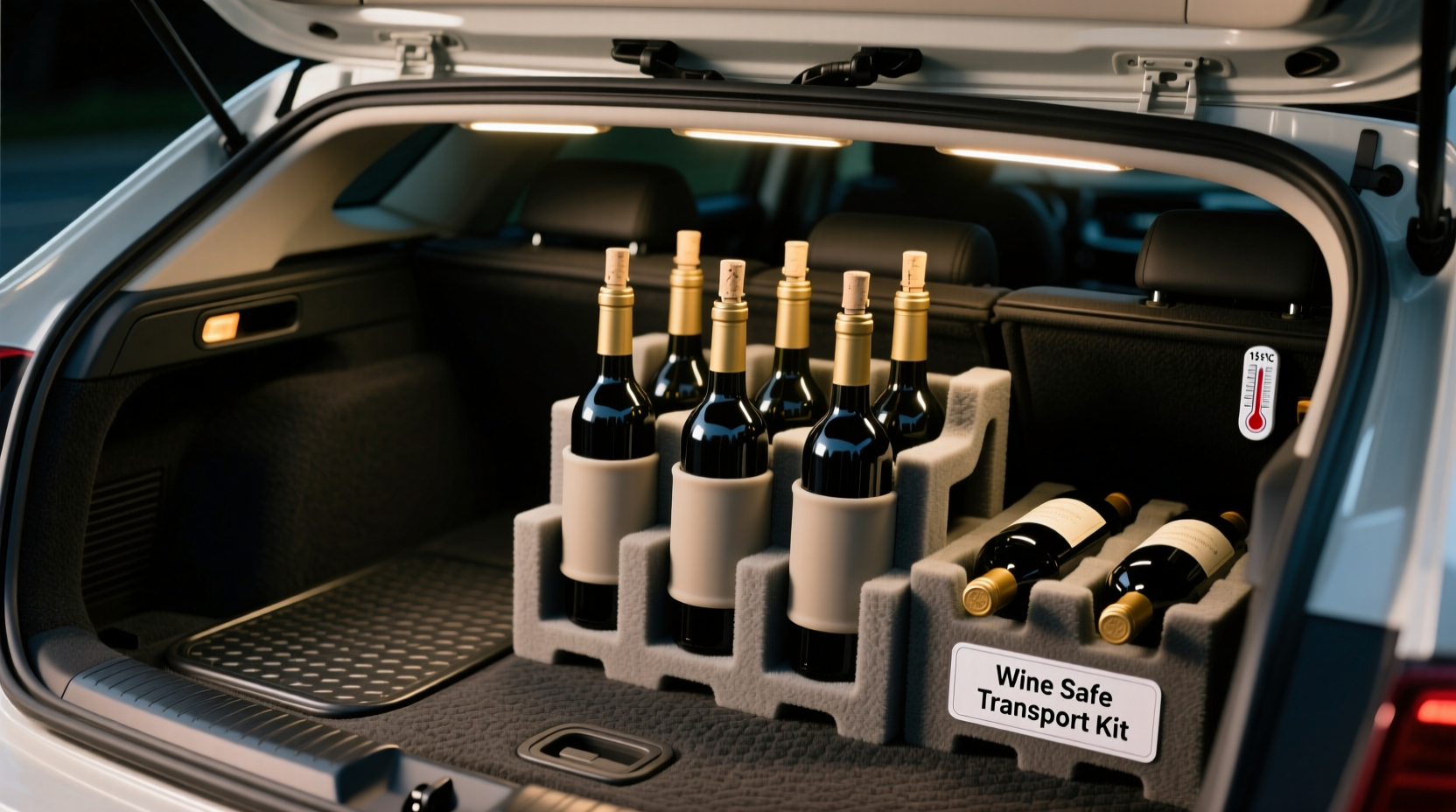
The trunk presents three interlocking hazards most people overlook: thermal instability, mechanical agitation, and atmospheric pressure variance. Unlike the cabin, trunks lack climate control and insulation. On a 75°F (24°C) day, internal trunk temperatures routinely exceed 110°F (43°C) after 20 minutes of sun exposure—enough to accelerate oxidation by 4–6x and degrade delicate aromatic compounds. Simultaneously, every bump, turn, and stop subjects the bottle to G-forces that destabilize the liquid column and stress the seal between cork and glass. Even subtle vibrations—like those from highway resonance—can create micro-movements that compromise the cork’s grip over time. Finally, elevation changes (e.g., driving from sea level to a mountain pass) alter ambient pressure, potentially pushing air into the bottle or forcing wine out past the cork if the headspace isn’t managed correctly.
This isn’t speculation. In a 2022 study published in the Journal of Wine Economics, researchers monitored 120 open bottles transported across identical 45-mile routes—half in trunks, half in climate-controlled cabins. After two hours, 68% of trunk-stored bottles showed measurable sensory degradation (loss of fruit intensity, increased acetaldehyde notes), while only 12% of cabin-stored bottles did. More critically, 23% of trunk bottles leaked visibly during transit—most during deceleration or sharp turns.
Step-by-step: Securing your open bottle before departure
Follow this sequence precisely—each step addresses a distinct physical risk:
- Cork replacement (if using natural cork): Remove the original cork carefully. Do not reuse it. Natural corks compress unevenly and rarely reseal effectively after first removal. Replace with a high-quality, food-grade silicone stopper designed for vacuum or inert-gas preservation.
- Gas displacement (critical for white, rosé, and sparkling): Use a wine preserver system that injects inert argon gas (not nitrogen or CO₂ alone). Argon is heavier than air and forms a stable, non-reactive blanket over the wine surface. Spray for 2 seconds, holding the nozzle just inside the neck—do not tilt the bottle.
- Vacuum sealing (for reds only, and only if no gas is available): Attach a hand-pump vacuum sealer to a compatible stopper. Pump until resistance increases sharply (typically 3–4 full strokes). Note: Vacuum is less effective than argon for long-term freshness and should never be used with sparkling wines—it accelerates bubble loss.
- Orientation check: Store the bottle upright—not on its side. Laying an open bottle horizontally exposes more wine surface to oxygen and increases hydrostatic pressure on the seal. Upright positioning minimizes headspace contact and keeps the stopper seated evenly.
- Pre-chill or pre-warm (temperature matching): If transporting chilled white or rosé, place the sealed bottle in the refrigerator for 30 minutes before loading. For room-temperature reds, let it rest in your climate-controlled cabin for 15 minutes. Avoid placing cold bottles directly into hot trunks—thermal shock stresses glass and compromises seals.
Trunk preparation: Creating a stable micro-environment
Your trunk isn’t a storage closet—it’s a dynamic chamber. Mitigate its volatility with intentional staging:
- Line the trunk floor with closed-cell foam padding (¼-inch minimum thickness): Unlike towels or cardboard, closed-cell foam absorbs vibration without retaining heat or moisture. Cut pieces to fit around your cargo area, overlapping seams slightly.
- Use a rigid, insulated container: Place the upright bottle inside a hard-shell cooler or wine transport case lined with reflective foil insulation. Fill empty space around the bottle with crumpled kraft paper (not newspaper—ink can off-gas) or reusable silicone packing cubes. The goal is zero lateral movement—even 1/8 inch of play multiplies impact force.
- Anchor the container: Secure the cooler to the trunk’s tie-down points using ratchet straps rated for 150+ lbs. If no anchors exist, wedge the cooler tightly between the rear seatbacks and the trunk wall—never rely on gravity alone.
- Block direct sunlight: Cover the entire container with a light-colored, breathable cotton blanket. Avoid black tarps or plastic sheeting—they trap radiant heat and can raise internal temps by 20°F+ in under 10 minutes.
Crucially, avoid common “hacks” like freezing gel packs directly against the bottle (causes condensation, label damage, and thermal stress) or stuffing bottles into grocery bags (no structural support, high slip risk).
Do’s and Don’ts: A comparative summary
| Action | Do | Don’t |
|---|---|---|
| Closure method | Silicone stopper + argon gas for all wines; vacuum pump only for still reds | Reusing original cork; screw caps left partially open; plastic wrap or tape |
| Bottle position | Upright, with base fully supported | On its side or upside-down; leaning against other objects |
| Temperature management | Pre-condition bottle to match expected trunk temp; use reflective insulation | Placing chilled bottles into hot trunks; using ice directly on glass |
| Movement control | Rigid container + foam padding + anchored straps | Loose placement; soft bags; relying on trunk carpet alone |
| Time limits | Max 2 hours for whites/rosés; 3 hours for robust reds; 1 hour for sparkling | Assuming “it’ll be fine for the whole weekend”; leaving bottles unattended in trunks |
Real-world scenario: When the picnic plan changed
Marisol, a certified sommelier and wine educator in Sonoma County, was en route to a vineyard picnic with two open bottles: a 2021 Chardonnay (re-corked with argon) and a 2019 Pinot Noir (vacuum-sealed). Midway, her GPS rerouted her over a mountain pass—adding 45 minutes and a 2,200-foot elevation gain. She’d packed both upright in a hard-shell cooler anchored with straps, surrounded by kraft paper and covered with a linen napkin. At the site, she opened the cooler to find the Chardonnay’s silicone stopper slightly elevated—but no leakage. The Pinot’s vacuum seal held firm. Both wines tasted vibrant, with no detectable oxidation or flatness.
Contrast this with what happened to her colleague, who’d placed the same Chardonnay in a soft tote bag, lying sideways, with only the original cork reinserted. After 32 minutes—including a steep downhill descent—the cork had been pushed halfway out, and 4 ounces of wine had soaked into the trunk liner. The remaining wine tasted sharply nutty and dull—a textbook case of rapid oxidation.
“Oxygen is the silent thief of wine quality—and motion is its accomplice. Every bump, every temperature spike, every unsecured movement gives oxygen new pathways into the bottle. Safety isn’t just about preventing spills; it’s about honoring the wine’s integrity.” — Dr. Lena Torres, Enologist & Director of the UC Davis Viticulture Extension Program
FAQ: Practical questions answered
Can I use a wine pourer spout instead of a stopper?
No. Pourer spouts are designed for dispensing—not sealing. They leave the bottle neck fully exposed to air, accelerating oxidation dramatically. Even with a spout, the wine remains vulnerable to vibration-induced splashing and temperature-driven expansion. Reserve spouts for serving, not transport.
What if I don’t have argon or a vacuum pump?
For short trips (<30 minutes), reinsert a fresh silicone stopper *without* gas or vacuum—and keep the bottle perfectly upright in a rigid, padded container. Prioritize minimizing time and movement over ideal conditions. For longer hauls, invest in a basic argon kit ($15–$25); it pays for itself after two saved bottles.
Does sparkling wine need special handling beyond argon?
Absolutely. Sparkling wines require dual protection: argon gas *and* a specialized champagne stopper with a reinforced clamp mechanism. Standard silicone stoppers cannot withstand internal CO₂ pressure (up to 90 psi in some traditional method sparklers). Never use vacuum pumps on sparkling wine—they strip effervescence irreversibly.
Final checklist: Before you close the trunk
- ✅ Bottle is upright, base fully supported
- ✅ Original cork removed; fresh silicone or champagne-specific stopper installed
- ✅ Argon gas applied (for all wines except sparkling, which uses clamped stopper only)
- ✅ Bottle placed inside rigid, insulated container
- ✅ Container fully immobilized with straps or tight wedging
- ✅ Container covered with light, breathable fabric
- ✅ Trunk lid closed gently—no slamming (shockwaves travel through metal and can dislodge seals)
- ✅ Trip duration confirmed: ≤2 hours for whites/rosés, ≤3 hours for reds, ≤1 hour for sparkling
Conclusion: Respect the journey as much as the destination
Wine is alive—not just chemically, but culturally. Each bottle carries intention: the grower’s care, the winemaker’s judgment, the moments shared around it. Transporting an open bottle isn’t logistical overhead—it’s stewardship. When you take the time to secure that bottle properly, you’re not just avoiding a spill; you’re protecting nuance, preserving memory, and honoring the quiet labor behind every sip. You don’t need expensive gear to do this well—just attention to physics, consistency in practice, and respect for the liquid’s fragility. Start today: audit your next transport setup against this guide. Notice how much more confident you feel opening that bottle at your destination—not just because it didn’t leak, but because it still tastes like itself.
💬 Have you faced a trunk transport challenge? Share your solution—or your cautionary tale—in the comments. Your experience could help someone save their favorite bottle tomorrow.