
Cutting fresh parsley correctly is more than a simple kitchen task—it’s a foundational skill that affects flavor distribution, texture, and visual appeal in dishes ranging from soups and sauces to salads and garnishes. Many home cooks treat parsley as an afterthought, chopping it haphazardly or using pre-cut versions that sacrifice freshness and aroma. But when handled with care, fresh parsley elevates a dish from ordinary to exceptional. The way you cut parsley influences its release of essential oils, surface area exposure, and integration into food. Whether you're preparing a Middle Eastern tabbouleh, a French persillade, or simply garnishing grilled fish, mastering the technique ensures consistent results and maximizes culinary impact.
Definition & Overview
Parsley (Petroselinum crispum) is a biennial herb in the Apiaceae family, widely used in global cuisines for both its aromatic leaves and subtle vegetal flavor. Native to the central Mediterranean region, it has become a staple in European, Middle Eastern, American, and Latin American cooking. Unlike strong-flavored herbs such as rosemary or thyme, parsley offers a clean, slightly peppery, grassy taste that enhances rather than dominates. It functions primarily as a finishing herb but also plays a structural role in mirepoix, sofrito, and bouquet garni.
There are two main cultivated varieties: curly parsley and flat-leaf (Italian) parsley. While they differ in appearance and intensity, both benefit from proper cutting techniques to preserve their integrity and maximize utility. Fresh parsley should never be treated like dried herbs; its value lies in its moisture, color, and volatile compounds, all of which degrade rapidly if mishandled.
Key Characteristics
| Attribute | Details |
|---|---|
| Flavor Profile | Grassy, mildly peppery, slightly bitter with herbal brightness |
| Aroma | Fresh green, reminiscent of celery and chervil with citrus undertones |
| Color/Form | Bright green; curly (ruffled) or flat-leaf (serrated edges) |
| Heat Sensitivity | Loses vibrancy quickly when exposed to prolonged heat; best added at end of cooking |
| Culinary Function | Flavor enhancer, garnish, base ingredient in compound mixtures (e.g., gremolata) |
| Shelf Life (Fresh) | 5–10 days refrigerated when stored properly |
Practical Usage: How to Cut Fresh Parsley Correctly
The goal when cutting parsley is uniformity, minimal bruising, and efficient yield. A poorly chopped bunch leads to uneven flavor distribution and limp, oxidized pieces. Follow this professional-grade method for optimal results:
- Wash and Dry Thoroughly: Rinse the parsley under cold running water to remove dirt and grit, especially between the leaves. Soak for 1–2 minutes if particularly sandy. Then, use a salad spinner to dry completely. Wet parsley clumps during chopping and promotes spoilage during storage.
- Remove Tough Stems: Hold the bunch by the stem ends and run your fingers upward along the stalks to strip off the leafy portions. Discard thick lower stems—they’re fibrous and unpleasant to eat. Reserve tender upper stems only if using immediately in cooked applications where texture matters less.
- Gather Leaves for Chopping: Pile the leaves loosely on the cutting board. Avoid compressing them, as this can crush cell walls and cause browning.
- Use a Sharp Chef’s Knife: A dull blade tears instead of slices, releasing enzymes that accelerate oxidation. A sharp 8-inch chef’s knife allows smooth rocking motion with control.
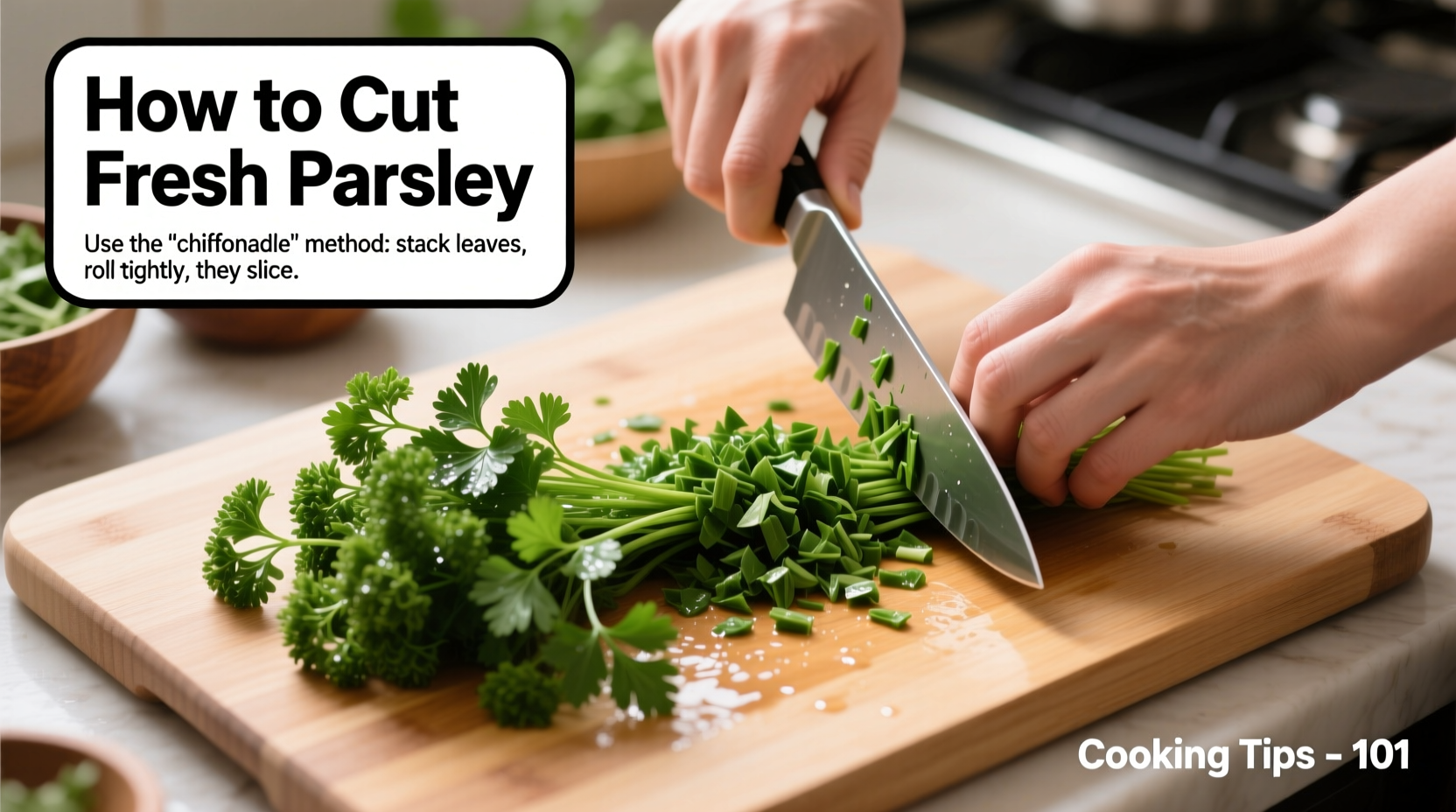
- Rock-Chop Technique: Place the tip of the knife on the board and rock the blade up and down through the pile while guiding it with your non-dominant hand. For fine mince, rotate the pile periodically to ensure even size. Do not rush—precision trumps speed.
- Check Consistency: Finished parsley should be uniformly minced, typically 1–3 mm in size depending on application. Larger chop (~1/4 inch) works for rustic stews; fine mince suits dressings or raw preparations like tabbouleh.
Pro Tip: To prevent slipping, dampen a paper towel and place it under your cutting board. This stabilizes the surface and protects countertops.
When to Use Different Cuts
- Coarse Chop (1/4 inch): Ideal for soups, stews, braises, and stocks where parsley contributes background flavor without being eaten in large quantities.
- Fine Mince (1–2 mm): Best for uncooked dishes like salsa verde, chimichurri, or tabbouleh, where texture directly impacts mouthfeel.
- Whole Leaf (no chop): Used for plating elegance—think butter-poached lobster or roasted chicken. Blanched whole leaves make excellent decorative garnishes.
- Chiffonade-Style (stacked and rolled): Less common with parsley, but useful when pairing visually with basil or mint in composed salads or herb blends.
Variants & Types of Parsley
Understanding the differences between parsley types informs not only selection but also preparation methods.
Flat-Leaf Parsley (Italian Parsley)
This variety features broad, serrated leaves with a stronger, cleaner flavor compared to curly parsley. It holds up better to handling and mild heat, making it preferred by chefs for cooking. Its flatter structure allows easier stacking and more efficient chopping. Due to higher essential oil content, it releases more aroma when cut.
Curly Parsley (Parsley Moss Curled)
Distinguished by its ruffled, compact foliage, curly parsley is often considered milder and more ornamental. It’s commonly used as a plate garnish but is fully edible and adds textural contrast in salads. However, its crinkled surface traps water and dirt, requiring extra attention during washing. When chopped finely, it integrates well into meatloaf, stuffing, or egg dishes.
Japanese Mitsuba vs. European Parsley
Though sometimes substituted, mitsuba (Cryptotaenia japonica) is a different species altogether, with a more delicate, celery-like flavor. It should not be confused with true parsley and requires gentler handling due to its fragile stems.
| Feature | Flat-Leaf Parsley | Curly Parsley |
|---|---|---|
| Flavor Intensity | Stronger, more aromatic | Milder, slightly sweet |
| Cooking Suitability | Excellent for sautéing, simmering | Best raw or briefly heated |
| Chopping Efficiency | Easier, faster | More time-consuming due to texture |
| Storage Longevity | 7–10 days | 5–7 days |
| Common Culinary Use | Sauces, marinades, grain salads | Garnishes, potato salads, dips |
Comparison with Similar Ingredients
Parsley is frequently mistaken for other green herbs, leading to incorrect substitutions and imbalanced flavors.
- Cilantro (Coriander Leaf): Often confused due to similar leaf shape, but cilantro has a pungent, citrusy-lime aroma and polarizing soapy note (due to genetic sensitivity). Parsley lacks these characteristics and is far more neutral.
- Italian Parsley vs. Culantro: Culantro (Eryngium foetidum) has long, saw-toothed leaves and a much stronger scent. It withstands prolonged cooking and is used in Caribbean and Southeast Asian cuisines. Never substitute one for the other cup-for-cup.
- Flat-Leaf vs. Basil: While both have broad leaves, basil is highly perishable, sweeter, and develops bitterness when over-chopped. Parsley tolerates mechanical action better and doesn’t blacken as quickly.
“In my kitchen, we treat parsley like salt—essential, functional, and never decorative-only. If you wouldn’t season with salt blindly, don’t toss parsley without intention.” —Chef Ana Ruiz, Executive Chef at Terra Bistro
Practical Tips & FAQs
Should I include the stems when chopping parsley?
Tender top stems near the leaves can be included when making pesto, sauces, or stocks, as they contain concentrated flavor. However, discard the thick, woody lower stems—they won’t break down during chewing and add no benefit.
Can I chop parsley in a food processor?
You can, but proceed with caution. Pulse briefly—two to three pulses max—to avoid turning parsley into a wet paste. Always pat dry before processing, and use immediately. Over-processing generates heat and accelerates oxidation.
How do I store freshly cut parsley?
Place chopped parsley in an airtight container lined with a dry paper towel. Store in the refrigerator for up to 3 days. For longer storage, freeze in olive oil cubes—ideal for dropping into soups or sautés.
Why does my chopped parsley turn brown so fast?
Browning occurs due to oxidation and moisture retention. Ensure parsley is fully dry before chopping, use a sharp knife, and avoid aluminum or reactive bowls. Glass, ceramic, or stainless steel containers help maintain color.
What are some classic dishes that rely on properly cut parsley?
- Tabbouleh (Lebanese bulgur salad): Requires equal parts parsley and bulgur, finely minced.
- Gremolata (Italian condiment): Equal parts lemon zest, garlic, and finely chopped parsley, served over osso buco.
- Chimichurri (Argentinian sauce): Coarsely chopped parsley blended with vinegar, oil, oregano, and chili flakes.
- Persillade (French garlic-parsley mix): Finely minced garlic and parsley used to finish meats or enrich butter.
Is there a difference between \"chopping\" and \"mincing\" parsley?
Yes. Chopping produces larger, irregular pieces (~1/8 to 1/4 inch), suitable for heartier dishes. Mincing creates tiny, uniform particles (<1/8 inch), ideal for even dispersion in dressings, marinades, or raw applications where texture must be seamless.
How much parsley equals one bunch?
A standard bunch (about 2–3 oz or 60–85g) yields approximately 1 cup loosely packed leaves. After trimming and chopping, this reduces to about 3/4 cup. Always measure after washing and drying for accuracy.
Storage Hack: Treat fresh parsley like flowers. Trim the stems and place upright in a glass with 1 inch of water. Cover loosely with a plastic bag and refrigerate. Change water every two days. This extends shelf life to 10 days.
Expert Techniques from Professional Kitchens
In high-volume restaurant environments, consistency and efficiency are paramount. Line cooks often prepare parsley in bulk using standardized procedures:
- Batch Trimming: Lay multiple bunches side-by-side and use a rocking knife motion to shear off lower stems simultaneously.
- Herb Rocker Method: Some kitchens use a dual-handled mezzaluna knife, especially for gremolata or pesto bases, achieving rapid mince with minimal effort.
- Pre-Measured Containers: Chopped parsley is portioned into small deli cups, labeled with date and contents, and rotated using FIFO (first in, first out) principles.
One Michelin-starred kitchen in Lyon employs a “cold prep zone” for delicate herbs: chilled marble counters, pre-cooled tools, and ambient temperatures below 60°F (15°C) to slow enzymatic degradation during large-scale prep.
Summary & Key Takeaways
Cutting fresh parsley properly is a deceptively important skill that influences flavor, presentation, and shelf life. Begin with high-quality, vibrant bunches and handle them gently throughout the process. Wash thoroughly, dry completely, and remove fibrous stems. Use a sharp knife and controlled technique to achieve consistent cuts tailored to your recipe’s needs—fine mince for raw dishes, coarse chop for cooked ones.
Choose flat-leaf parsley for most cooking applications due to its superior flavor and ease of use, reserving curly parsley for garnish or textural contrast. Understand that parsley is not merely decorative; it plays a vital role in balancing and brightening complex dishes.
Store unused portions carefully—either in water like cut flowers or frozen in oil—to preserve freshness. Avoid substituting parsley for stronger herbs like cilantro or culantro without adjusting proportions. And above all, respect the herb’s volatility: chop it just before use whenever possible to capture peak aroma.
Next time you reach for parsley, pause and consider how you’re cutting it. A few deliberate strokes with a sharp knife can transform an overlooked garnish into a defining element of your dish. Master this small act, and you’ll elevate everything you cook.