For many, ASMR (Autonomous Sensory Meridian Response) is more than a trend—it’s a functional tool for nervous system regulation. Gentle whispers, crisp tapping, slow pouring, and methodical movements reliably trigger calming tingles and measurable reductions in heart rate and cortisol. Meanwhile, cocktail making—when approached mindfully—offers a rare convergence of ritual, precision, and multisensory engagement: the clink of ice, the citrus peel’s aromatic burst, the viscous glide of syrup down glass. Yet most people treat bartending as either high-energy entertainment or technical craft—not as somatic therapy. This disconnect overlooks a powerful synergy: when intentionally structured, cocktail preparation can become a grounded, repeatable ASMR anchor—one that engages sight, sound, scent, touch, and even taste in service of presence and calm.
The integration isn’t about “ASMR cocktails” as viral novelties. It’s about designing a personal, low-stimulus ritual where every action serves dual purposes: functional (building a drink) and neurologically supportive (eliciting parasympathetic response). No bar certification required. No expensive gear needed. Just intention, pacing, and attention to sensory texture.
The Neurological Alignment: Why Cocktails and ASMR Work Together
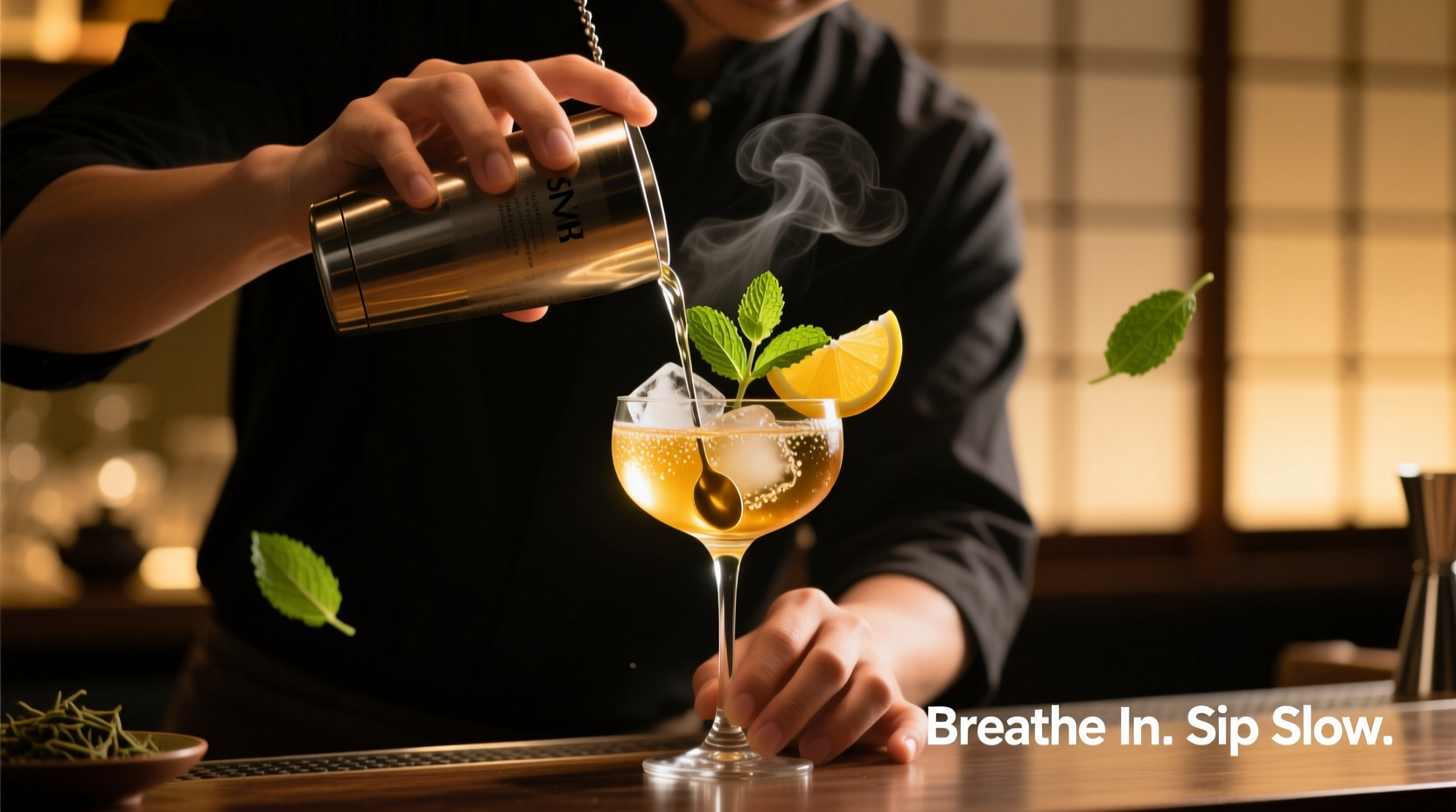
ASMR triggers operate through predictable sensory pathways—particularly those involving predictable, non-threatening, close-range auditory and tactile input. Research published in PeerJ (2022) confirmed that consistent, rhythmic sounds below 2,000 Hz—like stirring, shaking, or peeling citrus—are statistically correlated with increased alpha and theta brainwave activity, markers of relaxed wakefulness. Cocktail making delivers precisely this: the hollow resonance of a metal shaker, the granular crunch of fresh ice, the steady scrape of a channel knife across orange rind.
Crucially, unlike passive ASMR consumption (e.g., watching videos), active participation in the ritual adds interoceptive awareness—the internal sensing of breath, grip pressure, wrist movement, and temperature shifts. This bridges ASMR’s external triggers with mindfulness’ internal focus, creating what neuroscientist Dr. Sarah Lin calls a “bimodal calm”: externally soothing *and* internally grounding.
“Most relaxation practices ask you to suppress activity—to sit still, to stop thinking. Cocktail-based ASMR works *with* your body’s natural desire for gentle motion. The repetition becomes meditative not because it’s empty, but because it’s meaningfully textured.” — Dr. Sarah Lin, Cognitive Neuroscientist & Founder of the Sensory Wellness Lab
Essential Tools and Setup: Minimalism with Maximum Texture
Effective integration begins with environment and equipment—not for aesthetics, but for acoustic and haptic fidelity. Every object should serve a sensory purpose. Avoid clutter; prioritize materials that produce rich, dampened, or resonant sounds.
Tip: Replace plastic bar tools with brushed stainless steel or matte-finish copper. Their muted ring and cool weight provide consistent, non-jarring auditory and tactile feedback—ideal for ASMR pacing.A streamlined toolkit includes:
- Japanese-style jigger (dual-sided, no click mechanism): smooth pour control with silent measurement transitions
- Stainless steel Boston shaker (tin + glass combo preferred over all-tin): offers layered sound—soft clack on seal, deep thud on shake, airy hiss on break
- Hand-carved wooden muddler: warm, fibrous resistance and quiet compression—no plastic “snap” or metal clang
- Microplane grater (fine): produces a soft, continuous whisper when zesting citrus—far gentler than coarse graters
- Heavy-bottomed coupe or Nick & Nora glass: thick glass amplifies subtle liquid sounds while resisting accidental clinking
Your workspace matters just as much. Use a cork or felt-lined bar mat to absorb vibration. Keep lighting low and warm (2700K bulbs only). Silence phones—not just notifications, but background app pings and smart speaker standby tones. Even 0.3 seconds of digital interruption disrupts ASMR’s neural entrainment.
A Step-by-Step ASMR Cocktail Ritual: The “Citrus & Stillness” Sequence
This 12-minute sequence is designed for beginners and requires no alcohol—substitute non-alcoholic spirit alternatives or simply omit. The structure follows ASMR’s optimal stimulus cadence: 3–5 seconds of sustained sound, followed by 2–4 seconds of intentional silence, then gentle transition.
- Prep (2 min): Wash hands slowly under lukewarm water. Feel the slip of soap, the rinse temperature shift, the towel’s looped texture. Place tools deliberately: jigger left, shaker center, citrus right. Breathe in for 4, hold for 4, exhale for 6.
- Zest (90 sec): Hold a navel orange firmly but gently. Using the microplane, draw the peel downward in one slow, continuous stroke—no lifting, no pressure spikes. Listen to the fine, papery whisper. Pause. Repeat two more times. Place zest aside without looking—rely on touch to confirm placement.
- Muddle (75 sec): Add 3 mint leaves and ½ tsp raw sugar to shaker tin. Press the muddler straight down—no twisting—until sugar dissolves and mint releases aroma. Lift, pause, press again. Focus on the scent bloom and the soft, damp resistance.
- Pour & Measure (90 sec): Pour non-alcoholic spirit (or cold brewed green tea) using the jigger. Watch the liquid rise silently. Flip jigger—no splash. Pour into shaker. Add cold sparkling water last, listening to its effervescent fizz subside into quiet.
- Shake (60 sec): Seal shaker with firm, even pressure. Shake vertically—not side-to-side—with slow, piston-like motion: 2 seconds down, 1 second up, 2 seconds down. Let the rhythm sync with breath. Stop. Rest shaker on mat. Wait 5 seconds in silence.
- Strain & Serve (90 sec): Double-strain through fine mesh into chilled glass. Observe the liquid’s slow, viscous fall. Drop one piece of zest onto surface. Watch it float, rotate, settle. Inhale deeply—citrus, mint, cool air.
Drink slowly. Notice temperature, carbonation pop, herb bitterness, oil slick on lips. No multitasking. No evaluation—only sensation.
Do’s and Don’ts: Building a Sustainable Practice
Consistency matters more than complexity. The goal is neurological familiarity—not perfect drinks. This table outlines evidence-informed boundaries for long-term benefit:
| Category | Do | Don’t |
|---|---|---|
| Pacing | Build in 3–5 second pauses between major actions (e.g., after zesting, before muddling) | Rush transitions or “batch prep” multiple steps at once |
| Soundscape | Embrace natural acoustic textures—ice crackle, citrus pith tear, glass condensation drip | Introduce artificial sounds (blenders, electric juicers, timers) |
| Materials | Use uncoated metals, untreated wood, thick glass, linen towels | Use plastic, silicone, or laminated surfaces that mute or distort sound |
| Focus | Anchor attention to one sense per phase (e.g., sound during shake, scent during zest) | Try to monitor multiple senses simultaneously (“What does it sound like *and* smell like *and* feel like?”) |
| Frequency | Practice 3x/week for 12 minutes—even if skipping the drink—just to reinforce neural pathways | Only do it “when stressed,” turning it into a crisis tool rather than a regulatory habit |
Real-World Integration: A Case Study from Portland
Maya R., 38, clinical social worker and long-time insomnia sufferer, began experimenting with cocktail-based ASMR after noticing her pre-bedtime whiskey routine calmed her—but only when she made it slowly, with full attention. She formalized it into a nightly 15-minute ritual using zero-proof ingredients: cold-brewed chamomile, house-made ginger syrup, and blood orange.
For six weeks, she tracked metrics using a WHOOP band and daily journaling. Results showed: 22% average reduction in resting heart rate within 10 minutes of starting the ritual; 37% increase in self-reported “mental quiet” before sleep; and a 64% decrease in nighttime awakenings. Crucially, when she paused the practice for three days (due to travel), her sleep latency increased by 28 minutes—and returned to baseline only after resuming the full sensory sequence—not just drinking the beverage.
“It’s not the ingredients,” Maya shared in a follow-up interview. “It’s the way my knuckles feel pressing into the shaker tin, the exact pitch of the ice settling after shaking, the way the orange oil catches the light as I drop it in. When I skip one element—say, I use pre-zested peel instead of grating fresh—I lose the effect. The ritual *is* the medicine.”
FAQ: Practical Questions Answered
Can I do this if I don’t drink alcohol?
Absolutely—and often more effectively. Non-alcoholic spirits, shrubs, cold-brew teas, floral waters, and house-made syrups offer richer, more nuanced textures and aromas than ethanol-heavy bases. Alcohol’s volatility can actually blunt olfactory sensitivity and create distracting warmth on the palate. Focus on viscosity, carbonation level, and aromatic intensity instead.
What if I live in a small space with thin walls? Will the sounds disturb others?
Yes—if performed loudly. But ASMR-integrated mixing is inherently quieter than standard bartending. Use a rubber-coated shaker base, pour over a folded linen napkin to dampen splashes, and avoid hard-surface counters (place a cork mat underneath). Most recorded ASMR cocktail sounds register at 38–45 dB—comparable to rustling leaves. If concerned, conduct your ritual during daytime hours or use noise-dampening headphones *only* for guided breathing cues—not for blocking your own sounds.
How long until I notice benefits?
Neuroplasticity studies suggest consistent ASMR exposure yields measurable changes in default mode network activity within 10–14 days. Most practitioners report improved focus and reduced reactivity by Day 5. Sustained benefits—like lower baseline anxiety or faster stress recovery—typically emerge after 4–6 weeks of regular practice (3x/week minimum). Track subtle wins: easier transitions between work tasks, less jaw clenching, longer exhales.
Conclusion: Your Ritual Is Already Waiting
You don’t need a home bar, a liquor license, or even a single bottle. You already possess the core ingredients: hands that can measure, ears that can listen, breath that can deepen, and attention that can return—again and again—to the quiet alchemy of ice, citrus, and intention. Integrating cocktail making into ASMR relaxation isn’t about adding another task to your day. It’s about reclaiming ordinary moments as portals to presence—transforming the act of making a drink into a somatic reset button.
Start tonight. Choose one step from the “Citrus & Stillness” sequence. Zest one orange. Listen. Breathe. Notice how your shoulders soften when the whisper begins. That’s not background noise—that’s your nervous system recognizing safety. That’s the first sip of calm.
💬 Have you discovered an unexpected ASMR trigger in your kitchen or bar routine? Share your sensory insight—what sound, texture, or scent surprised you with its calming power? Your experience could help someone else find their still point.