Gifting a personalized cocktail recipe book with handwritten notes is more than a gesture—it’s an act of curation, memory, and intimacy. In an age of mass-produced gifts and digital convenience, a hand-bound book filled with original recipes, personal anecdotes, and inked marginalia conveys thoughtfulness that algorithms cannot replicate. This isn’t just about mixing spirits; it’s about distilling shared moments—first dates, rooftop toasts, late-night kitchen experiments—into something tactile and enduring. Whether for a wedding, anniversary, housewarming, or simply because someone deserves to be celebrated, this gift bridges craft and connection. Done well, it becomes a family heirloom, passed down with stories as rich as the drinks themselves.
Why Handwritten Notes Elevate a Cocktail Book Beyond Utility
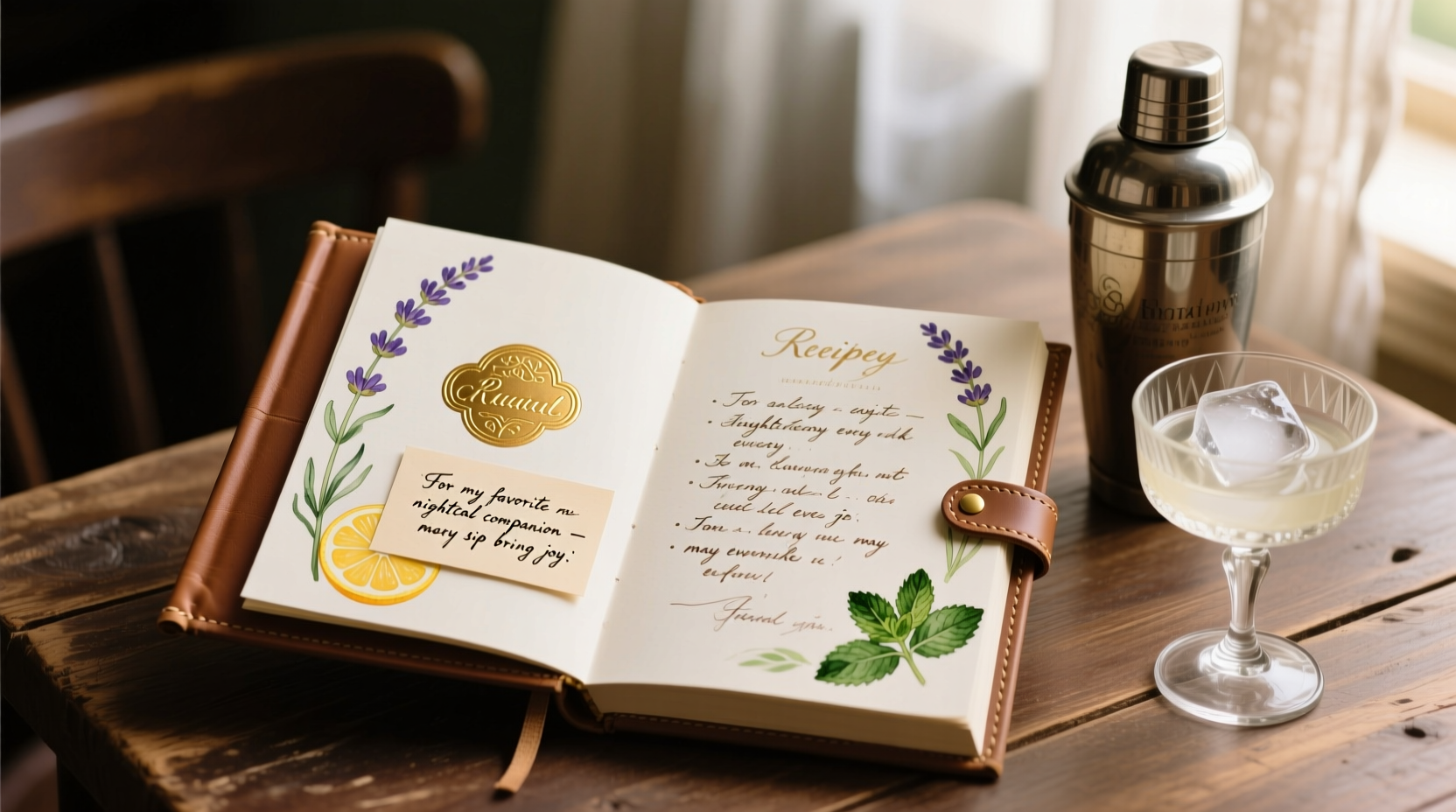
A printed recipe collection serves function. A handwritten one serves meaning. The human hand introduces rhythm, imperfection, warmth—qualities that signal care and presence. When a reader sees a smudge of ink beside a note that reads *“Sarah’s favorite on rainy Sundays—add extra lemon zest if she’s stressed,”* they don’t just learn how to stir a drink—they feel seen. Neuroscience confirms this: studies in cognitive psychology show that handwritten text activates deeper encoding in the brain, making both the writer and reader more emotionally engaged with the material (Mueller & Oppenheimer, 2014). In practice, that translates to a book that’s revisited—not just referenced.
Unlike digital apps or PDFs, a physical book with handwritten annotations invites ritual: flipping pages slowly, pausing at a coffee stain that marks the night the recipe was first tested, tracing a looping signature at the bottom of a page. It resists disposability. And crucially, it avoids the paradox of “personalized” mass production—where names are auto-filled into templates but no real attention is paid to voice, history, or idiosyncrasy.
Tip: Never transcribe handwritten notes digitally before binding—scan originals directly. The texture of pen pressure, slight variations in slant, and even the paper’s grain contribute to authenticity.Step-by-Step: Curating, Writing, and Assembling Your Book
Creating this gift demands intention—not perfection. Follow this timeline over 3–5 weeks for best results. Rushing compromises emotional resonance.
- Week 1: Define the recipient’s palate & narrative arc
Review past conversations, texts, or photos. Note recurring themes: “always orders an Old Fashioned at bars,” “hates anything overly sweet,” “learned to shake from her grandfather.” Map 8–12 recipes across moods: celebratory, comforting, adventurous, nostalgic. Avoid generic picks like “Mojito”—choose instead “The Cedar Ridge Smash (her 2022 camping trip version, with wild mint).” - Week 2: Draft recipes + handwritten notes
Write each recipe on unlined archival paper using fountain pen or pigment ink (avoid ballpoint—ink fades). For every drink, include three layers: (a) precise measurements (use metric for consistency), (b) context (“Stirred not shaken because Alex insisted it ‘preserves the juniper’s soul’”), and (c) a sensory cue (“Serve in a coupe chilled for 90 seconds—glass should fog faintly at the rim”). - Week 3: Design layout & source materials
Select acid-free paper (100 gsm minimum), linen or leather binding, and a durable cover. Reserve space for a title page, dedication, and index. Leave 1.5 cm margins for binding and future margin notes. Use consistent typography: serif fonts (e.g., Garamond) for body text, clean sans-serif (e.g., Lato) only for headings. - Week 4: Compile, bind, and refine
Arrange pages chronologically or thematically (e.g., “Summer Nights,” “Winter Warmers”). Bind professionally via saddle-stitching for under 40 pages, or case binding for longer volumes. Add a ribbon bookmark in a color meaningful to the recipient (e.g., navy for their alma mater). - Week 5: Finalize presentation
Include a small envelope tucked into the back cover containing: (a) a handwritten letter explaining why you chose each recipe, (b) a blank page titled “Your Turn” with space for their own notes, and (c) a vintage-style label reading “First Edition, [Year] — Printed in the Spirit of [Recipient’s Name].”
What to Include (and What to Skip)
Every element must earn its place. Below is a practical comparison of high-impact inclusions versus common distractions that dilute meaning.
| Element | Do | Avoid |
|---|---|---|
| Recipes | 8–12 total; include 1–2 “signature” drinks invented by or for the recipient; specify glassware, garnish technique (e.g., “express orange oil over surface, then discard peel”), and spirit brand if critical to flavor | More than 15 recipes; omitting ice type (crushed vs. cube); listing substitutions without context (“use any gin”) |
| Handwritten Notes | Contextual anecdotes (e.g., “We debated vermouth ratios for 47 minutes at The Oak Bar”); serving tips tied to memory (“Pour at exactly 7:03 p.m.—that’s when the light hits the bar just right”); gentle humor (“If this tastes bitter, blame my 3 a.m. tasting notes”) | Generic praise (“This is delicious!”); vague instructions (“Shake well”); unrelated life advice (“Remember to floss!”) |
| Design | Consistent margins; readable font size (11–12 pt); subtle decorative elements (e.g., a single line drawing of a citrus twist on title page); archival-quality materials | Over-designed covers with clip art; inconsistent spacing; glossy paper that repels ink; handwritten text scanned from lined notebook paper |
| Presentation | Hand-tied twine around the book; inclusion of a small vial of custom bitters or dehydrated garnish; pairing with a bar tool engraved with initials | Plastic wrapping; generic gift card; placing inside a store-bought box with no personalization |
Real Example: How Maya Created “The Harbor Light Book” for Her Partner
Maya gifted “The Harbor Light Book” to Leo on their fifth anniversary—a 32-page, linen-bound volume commemorating their relationship’s geography and rituals. She began by mapping locations: the dive bar where they first kissed (inspired “The Saltwater Sour,” with local sea salt rim and dill-infused gin), the coastal cottage where they weathered a storm (“The Fog Watcher’s Toddy,” with smoked honey and rye), and the farmers’ market where they bought their first shared lemon (“Lemon & Lavender Fizz,” featuring lavender syrup from her mother’s garden).
Each recipe included a Polaroid-style sketch of the location and a note in Leo’s favorite blue ink: *“You stirred this while I timed the egg white foam on my phone. We spilled half. Laughed for six minutes straight.”* She bound it herself using Coptic stitch, leaving visible thread as a nod to craftsmanship. At the back, she added a page titled “Future Pages,” with blank lines and the prompt: *“Where will we drink next? Sketch it here.”*
Leo kept the book on his home bar for two years. He added his own notes in the margins—adjustments, substitutions, even a pressed sprig of rosemary from their first herb garden. Last month, he photocopied the “Future Pages” section and mailed it to Maya with new sketches of a mountain cabin and a Tokyo rooftop bar. The gift didn’t end at delivery—it seeded continuity.
“The most resonant cocktail books aren’t technical manuals—they’re love letters written in liquid form. Handwriting transforms instruction into invitation.” — Chef Elena Ruiz, author of Barroom Memory: Crafting Drink Narratives
Essential Tools & Materials Checklist
- Paper: Acid-free, 100% cotton rag paper (e.g., Strathmore 400 Series, 100 lb weight)
- Ink: Pigment-based fountain pen ink (e.g., Noodler’s Black, Platinum Carbon Black) or archival gel pens (e.g., Uni-ball Signo DX)
- Binding: Professional case binding for durability (recommended for >30 pages) or DIY Coptic stitch kit for full visibility of spine
- Cover: Linen cloth or vegetable-tanned leather; avoid synthetic “leather” that cracks or off-gasses
- Extras: Archival glue, bone folder for crisp creases, micro-spatula for precise page alignment
FAQ
How much time does this really take?
Allow 20–25 hours total: 5 hours for research and recipe selection, 7 hours for drafting and handwriting, 3 hours for design/layout, 3 hours for binding and finishing, and 2 hours for presentation details. Spread across 3–5 weeks, this averages 1–2 focused hours per session—no marathon sessions needed.
Can I include non-alcoholic recipes without breaking the theme?
Absolutely—and you should. A thoughtful non-alcoholic section (e.g., “The Midnight Spritz,” “Maple-Ginger Shrubs”) signals inclusivity and care. Label it “Zero Proof Rituals” and treat it with equal narrative depth: *“Served after long flights when you need calm, not caffeine.”* This expands the book’s lifespan and relevance.
What if my handwriting isn’t “pretty”?
Authenticity trumps aesthetics. A slightly uneven script feels human; a perfectly uniform font feels transactional. If legibility is a concern, use a fine-tip archival pen and write slowly on lightly ruled guide sheets (remove after scanning). Readers connect with sincerity—not calligraphy.
Conclusion: Why This Gift Endures
A personalized cocktail recipe book with handwritten notes is a quiet rebellion against ephemerality. It refuses the disposable. It honors the specificity of a person—their laugh when a drink is too strong, their habit of tasting twice before approving a ratio, the way they always save the last sip for the moment the conversation deepens. This gift doesn’t sit on a shelf as decoration. It lives on the bar, stained with citrus oil and marked with fingerprints, evolving as the recipient adds their own marginalia, spills, and revisions. It becomes a living archive—not of perfect execution, but of shared humanity, one stirred, shaken, or sipped moment at a time.
Start small. Choose one recipe that matters. Write one note that’s true. Then another. The book will follow—not as a project, but as a promise made tangible. Your handwriting, your memory, your attention: these are the rarest ingredients of all.
💬 Ready to begin your first page? Share your opening recipe idea or dedication line in the comments—we’ll help you refine it. Because great cocktails start with great intention.