Designing a cocktail program that respects blood glucose management doesn’t mean serving diluted drinks in mason jars with a side of apology. It means understanding how flavor architecture works at a molecular level—how acidity lifts perception, how texture mimics richness, how botanicals and bitters deliver layered nuance without sugar’s crutch. Diabetic guests deserve more than “sugar-free” labels slapped onto tired vodka sodas. They deserve drinks with intention: balanced, memorable, and technically rigorous. This isn’t about restriction—it’s about recalibration.
The Physiology Behind the Palate: Why Sugar Isn’t the Only Path to Complexity
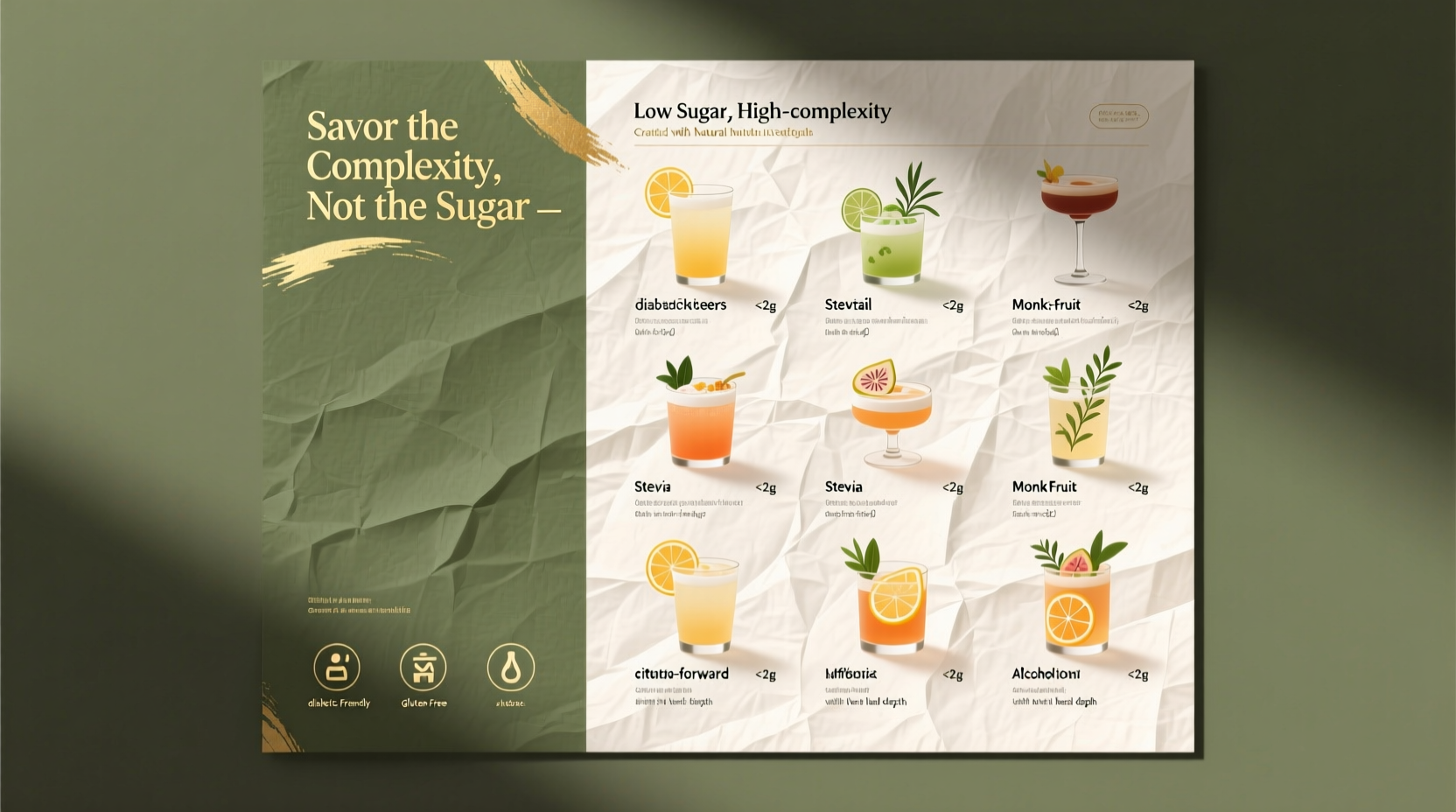
Many assume sweetness equals body, roundness, or satisfaction. But in reality, sugar often masks flaws—flattening acidity, muting herbal notes, and blunting finish. Removing it forces clarity. A well-structured low-sugar cocktail leans into five foundational pillars: acidity (citrus, verjus, shrubs), umami (dry sherry, aged rum, saline), tannin (cold-brewed tea, gentian root, oak-aged spirits), aromatic volatility (lavender, rosemary, bergamot, black pepper), and mouthfeel (xanthan gum, egg white, cold-infused honey syrup *at 1:4 ratio*, or even clarified coconut water). These elements interact synergistically: citric acid brightens volatile top notes; tannins bind to salivary proteins, creating perceived weight; umami compounds amplify savory depth and prolong aftertaste.
This approach aligns with clinical guidance. As endocrinologist Dr. Lena Torres explains:
“The goal isn’t zero sugar—it’s predictable, minimal glycemic impact. A drink with 3g of naturally occurring fructose from fresh lime juice and 0.5g from a house-made ginger shrub is metabolically distinct from one with 18g of high-fructose corn syrup. What matters is total digestible carbohydrate, rate of absorption, and co-ingestion with fat or fiber—which cocktails rarely provide. So precision in sourcing and portioning becomes non-negotiable.”
Ingredient Substitution That Actually Works (Not Just “Less Bad”)
Swapping simple syrup for agave or stevia rarely solves the problem—agave is 90% fructose (worse for hepatic metabolism), and stevia’s bitter aftertaste disrupts aromatic harmony. Instead, adopt a tiered substitution framework based on function:
| Function | High-Sugar Ingredient | Better Alternative | Why It Works |
|---|---|---|---|
| Sweetness + Body | Simple syrup (24g sugar/oz) | Blackstrap molasses syrup (1:3 dilution) | Only 6g sugar/oz; rich iron/mineral profile adds savory depth; caramelized notes pair with rye, mezcal, and amari |
| Aromatic Sweetness | Triple sec (12–15g sugar/oz) | Dry orange liqueur (e.g., Pierre Ferrand Dry Curaçao, 2.5g sugar/oz) | Distilled citrus oil + neutral spirit base; delivers brightness without cloying weight |
| Fruit Brightness | Pre-made sour mix (18g+ sugar/oz) | Fresh-squeezed citrus + 2% saline solution (0.5g salt/oz water) | Saline enhances perception of sweetness and rounds acidity without adding carbs |
| Viscosity & Mouthfeel | Honey syrup (16g sugar/oz) | Chia seed–infused aquafaba (1 tsp chia + 2 oz aquafaba, rested 15 min) | Creates stable foam and silky texture; zero sugar, high fiber, gluten-free |
| Botanical Depth | Flavored syrups (e.g., lavender, elderflower) | Cold-distilled hydrosols + glycerin-free tinctures | No residual sugars; captures volatile top notes without alcohol burn or sweetness |
A Step-by-Step Framework for Menu Development
Building a cohesive low-sugar menu isn’t about retrofitting existing drinks. It requires a deliberate, iterative process grounded in sensory science and nutritional accountability.
- Analyze your core spirit library. Identify base spirits with inherent complexity: rye whiskey (spicy, peppery), reposado tequila (vanilla/oak), dry fino sherry (almond, sea breeze), or aged rum (caramelized banana, toasted coconut). Avoid “neutral” vodkas unless barrel-finished—they lack structural backbone without sugar.
- Map flavor vectors, not just ingredients. For each proposed drink, define its primary axis (e.g., “bright-citrus-tannic” or “umami-savory-earthy”) and secondary support (e.g., “saline lift,” “herbal bitterness”). This prevents muddy combinations.
- Calculate total digestible carbs per serving. Use USDA FoodData Central or Cronometer. Include all components: juice (lime = 1.1g/oz), shrubs (typically 1.5–2.5g/oz), bitters (negligible), garnishes (1 thin lemon twist = 0.2g), and even fortified wines (dry vermouth = 0.5g/oz).
- Stress-test balance with diabetic tasters. Partner with two to three individuals managing type 1 or type 2 diabetes—not just “low-carb” enthusiasts. Ask specifically: “Does this taste complete? Does the finish linger pleasantly—or leave you craving something sweet?” Their feedback reveals physiological gaps no spreadsheet can.
- Document and standardize. Record exact weights, infusion times, straining methods, and glassware. A 0.25 oz variation in lime juice changes total carbs by 0.3g—clinically insignificant alone, but catastrophic across 120 covers on a Saturday night.
Real-World Execution: The “Veridian Hour” Case Study
At Veridian Hour, a Brooklyn bar specializing in health-conscious hospitality, owner-bartender Maya Chen overhauled her menu after a guest with insulin-dependent diabetes declined three consecutive drinks, citing “flatness” and “lingering thirst.” Rather than add a token “diabetic option,” Maya collaborated with a certified diabetes educator and a food scientist to rebuild from first principles.
The result was the Juniper Fog: 1.5 oz gin (Plymouth), 0.75 oz cold-brewed green tea (steeped 8 hrs, strained), 0.5 oz dry vermouth, 0.25 oz blackstrap molasses syrup, 2 dashes saline solution, 1 dash celery bitters. Served up in a Nick & Nora glass, garnished with a single juniper berry and lemon zest expressed over the surface.
Carb count: 2.8g total per 4.5 oz pour. Flavor profile: briny, piney, subtly earthy, with a clean, lingering finish. Within six weeks, 37% of guests ordered at least one low-sugar cocktail—not because it was “healthy,” but because it was the most interesting drink on the menu. Staff reported fewer requests for modifications, and the bar’s average check increased 12%, as guests added a second round of complex, low-sugar options instead of defaulting to beer or wine.
Crucially, Maya trained staff to articulate *why* the drink works—not just “it’s low sugar.” Servers now describe how the saline “unlocks the gin’s botanicals” and how the molasses “adds mineral depth without sweetness.” This shifts perception from compromise to craftsmanship.
Essential Do’s and Don’ts for Low-Sugar Cocktail Service
- Do use a digital scale calibrated to 0.1g for all liquid measurements—especially syrups and shrubs.
- Do serve drinks at precise temperatures: chilled (38°F) enhances perception of acidity and freshness; room-temp spirits feel heavier and more alcoholic.
- Do offer non-alcoholic “complexity pairings”: house-made kombucha vinegar spritzers, roasted beet–black pepper shrubs, or smoked cherry–thyme infusions. These reinforce the philosophy beyond alcohol.
- Don’t rely on “sugar-free” labeled products—many contain maltodextrin (a digestible carb) or artificial sweeteners that trigger insulin response via cephalic phase insulin release.
- Don’t skip garnish integrity. A dehydrated lime wheel contributes negligible carbs (0.1g) but adds essential aroma and visual sophistication. A plastic swizzle stick does neither.
- Don’t assume guests will self-identify dietary needs. Print clear, unobtrusive icons on menus (e.g., “[≤3g]” next to eligible drinks) and train staff to proactively offer guidance: “Our Juniper Fog and Oolong Sour both land under 3g net carbs—would you like tasting notes on either?”
FAQ: Addressing Real Concerns from Bartenders and Hosts
Can I use monk fruit or erythritol in cocktails?
Monk fruit extract (in pure form, not blended with dextrose) is acceptable in tiny quantities (<0.5 tsp per drink) for targeted sweetness—but it lacks mouthfeel and can mute other flavors. Erythritol crystallizes when chilled and imparts a cooling sensation that clashes with spirit warmth. Neither replaces the functional role of sugar in emulsification or viscosity. Reserve them for finishing accents only—not structural components.
What if my guest uses an insulin pump or CGM? Does that change anything?
Yes—proactively. Guests using continuous glucose monitors often prefer drinks with predictable, slow-rising curves. Prioritize drinks with fiber (chia aquafaba), fat (nut milk rinses), or protein (egg white) to blunt glucose spikes. Avoid high-glycemic-index ingredients like straight fruit juice—even orange juice (12g sugar/oz) causes sharper rises than a balanced shrub. Always ask: “Do you prefer steady energy or are you dosing for a specific carb load?”
How do I handle dessert cocktails without sugar?
Eliminate the category “dessert cocktail.” Instead, design *digestif experiences*: a 1.25 oz pour of amaro (e.g., Braulio, 3g sugar/oz) stirred with 0.25 oz rancio (oxidized grape brandy), served neat with a candied ginger sliver (0.5g sugar). Or a “chocolate” drink built on cold-brewed cocoa nibs, smoked salt, and 0.125 oz mezcal—zero added sugar, deep umami-roast character, and 0g carbs. Complexity lives in contrast, not confection.
Conclusion: Complexity Is a Choice, Not a Consequence
Creating a low-sugar cocktail menu that satisfies diabetic guests—and delights everyone else—isn’t an act of accommodation. It’s an act of refinement. It demands deeper knowledge of ingredients, sharper attention to measurement, and greater respect for how flavor functions physiologically. When you remove sugar not as a limitation but as a catalyst for innovation, you uncover textures you’d never consider, aromas you’d overlook, and balances you’d never achieve otherwise.
Start small: choose one classic cocktail (a Margarita, an Old Fashioned, a French 75) and rebuild it using the framework above. Measure every gram. Taste with intention. Document what works—and what falls flat. Then share your findings. Post your carb-calculated recipe online with full methodology. Tag a dietitian or endocrinologist for feedback. Build a community where technical rigor meets hospitality.
💬 Your menu is more than a list of drinks—it’s a statement of care. Try one substitution this week, calculate its carbs, and share your insight in the comments. Let’s raise the standard—together.