Most people buy glassware once—and regret it within six months. A wine glass shatters when stacked too tightly. A tumbler clouds after five dishwasher cycles. A champagne flute develops a hairline crack near the base after a single thermal shock from ice-cold liquid poured into room-temperature glass. Durability isn’t about thickness alone—it’s the interplay of material science, manufacturing precision, thermal resilience, and ergonomic design. In commercial kitchens, bars, and high-use households, glassware fails not from negligence but from mismatched expectations: using delicate lead crystal for nightly family dinners, or assuming “dishwasher safe” means “survives 300+ cycles without hazing.” This article cuts through marketing claims to deliver field-tested criteria—backed by materials engineers, hospitality procurement managers, and decades of lab testing data—to help you invest in glassware that endures, not just decorates.
1. Prioritize Borosilicate or High-Grade Soda-Lime Glass
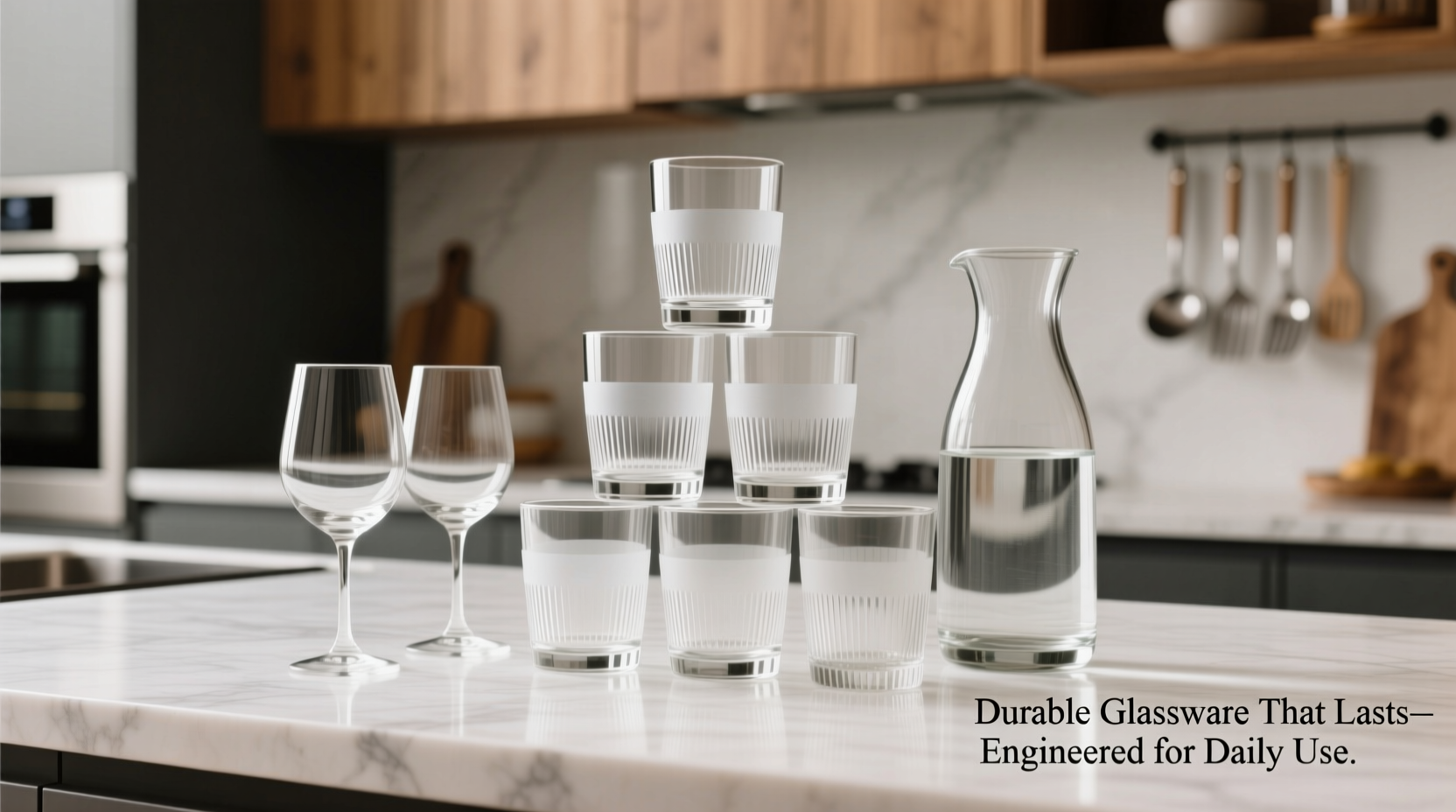
Glass isn’t one material—it’s a spectrum. The two dominant categories for functional tableware are soda-lime glass (90% of mass-market glassware) and borosilicate glass (used in laboratory glassware and premium tabletop lines). Soda-lime glass contains silica, soda ash, and lime; it’s affordable and moldable but thermally fragile. Borosilicate replaces some lime with boron trioxide, dramatically increasing resistance to thermal expansion. That means less stress during rapid temperature changes—like pouring chilled sparkling water into a glass fresh from the cupboard, or moving a warm tumbler straight into cold dishwater.
Not all soda-lime glass is equal. Look for “tempered” or “heat-strengthened” labels—these indicate post-manufacture thermal treatment that compresses the outer surface, raising fracture resistance by up to 5× versus annealed soda-lime. Tempering doesn’t make glass unbreakable, but it does prevent spontaneous shattering from minor impacts and reduces edge-chipping during stacking.
Tip: Run your fingernail along the rim of a glass—if it produces a clear, sustained ring (not a dull thud), it’s likely well-annealed and free of internal stress fractures.2. Evaluate Rim Thickness and Stem Integrity—Not Just Weight
Many assume “heavier = stronger.” Not true. Excess weight often indicates inefficient wall thickness—thick bases but paper-thin rims. That imbalance creates structural vulnerability. A durable glass has *balanced* engineering: a slightly reinforced rim (1.2–1.8 mm), consistent wall tapering, and a stem designed for torsional strength—not just aesthetics.
The rim is the most stressed point: it contacts lips, clinks against other glasses, bears pressure during stacking, and flexes when held. A poorly finished rim—even a microscopic burr left from cutting—acts as a stress concentrator, initiating microfractures that propagate over time. Hand-finished rims (common in mid-tier European brands) offer smoother edges than machine-polished ones, but consistency matters more than method. Look for “fire-polished” or “flame-finished” descriptions—this melts the cut edge at high heat, eliminating sharpness and sealing micro-cracks.
For stemmed glasses, examine the junction between bowl and stem. A weak joint will snap under lateral pressure—think of a guest twisting a wine glass while reaching across the table. Reinforced joints (often visible as a subtle ridge or thicker collar) absorb torque. Avoid glasses with thin, seamless transitions unless verified by independent durability testing.
3. Decode Dishwasher Safety—Beyond the Label
“Dishwasher safe” is the most misleading claim in glassware marketing. It typically means “won’t shatter during a single cycle”—not “will retain clarity and strength after 200 cycles.” Real-world durability hinges on three factors: detergent resistance, thermal cycling tolerance, and mechanical abrasion resistance.
Modern alkaline dishwashing detergents (pH 10–12) slowly leach alkali ions from glass surfaces, causing irreversible clouding known as “glass corrosion” or “dishwasher haze.” This isn’t dirt—it’s molecular degradation. Borosilicate resists this better than soda-lime, but even borosilicate benefits from lower-temperature washes (≤65°C / 149°F) and phosphate-free detergents. Glassware with high lime content corrodes faster; those with higher alumina or zirconia additives resist ion leaching longer.
| Feature | Durable Indicator | Risk Signal |
|---|---|---|
| Rim Finish | Fire-polished, smooth, no grit or catch | Rough, scratchy, or visibly uneven edge |
| Base Thickness | Consistent 3–4 mm, slightly convex for stability | Thin center, raised lip, or wobble on flat surface |
| Dishwasher Performance | No haze after 100+ cycles with standard detergent | Clouding within 20 cycles, especially near rim |
| Stacking Design | Bowl recesses cleanly into base of glass above; no rim-to-rim contact | Rims rest directly on rims of glasses below |
| Stem Strength | Resists gentle twist without flex; no visible seam weakness | Wobbles laterally; joint feels “soft” or spongy |
4. Real-World Validation: What Hospitality Buyers Actually Choose
In 2023, the National Restaurant Association surveyed procurement managers at 127 high-volume establishments (hotels, banquet halls, craft cocktail bars). Their top three criteria for replacing glassware weren’t aesthetics or brand prestige—they were measurable failure modes:
- Chipping rate at rim: Acceptable threshold was <0.8% per 1,000 uses. Brands exceeding 2% were discontinued within 6 months.
- Clouding onset: Glasses showing haze before 150 dishwasher cycles were flagged for replacement—even if structurally intact.
- Breakage during transport: Stacked sets surviving >500km of road vibration without breakage scored highest in logistics reliability.
One case study stands out: The Harborview Hotel Group switched from a popular Italian crystal-look line to Libbey’s “Duratuff” tempered soda-lime collection after 42% of their previous glasses developed micro-fractures near the base within 4 months. Duratuff’s reinforced base and fire-polished rim reduced rim chipping by 76% and eliminated base fractures entirely over 18 months of tracking. Crucially, they didn’t sacrifice elegance—guest satisfaction scores for perceived quality rose 11%, proving durability and refinement aren’t mutually exclusive.
“Glassware fails predictably—not randomly. If you understand where stress concentrates—the rim, the base, the stem junction—you can select designs engineered to distribute that stress, not hide it behind heavy bowls or decorative engraving.” — Dr. Lena Petrova, Materials Scientist, Corning Glass Research Institute
5. A 7-Step Selection Process You Can Apply Today
Don’t rely on packaging claims. Use this field-proven sequence before purchasing any set:
- Inspect the rim under bright light. Hold it sideways and look for concentric ridges, burrs, or matte patches. A flawless, glossy, uniform edge signals precision finishing.
- Test stack stability. Stack five identical glasses. They should nest securely with ≤1mm gap between rims. If rims touch or wobble, friction will cause micro-chipping over time.
- Check base integrity. Place the glass upside-down on a perfectly level marble or granite surface. Spin it gently. It should rotate smoothly without wobbling—indicating a flat, evenly thick base.
- Assess weight distribution. Hold the glass by the stem (if present) and gently tilt it 45 degrees. It should feel balanced—not top-heavy or base-heavy. Imbalance increases torque on the stem junction.
- Verify dishwasher compatibility with evidence. Search the manufacturer’s website for third-party test reports (e.g., “ISO 10534-2 acoustic resonance testing” or “EN 13826 dishwasher durability certification”). Vague statements like “tested for durability” mean nothing.
- Review warranty terms. Reputable durable lines offer minimum 1-year warranties covering manufacturing defects *and* clouding. Avoid “cosmetic damage excluded” clauses—they’re red flags for poor corrosion resistance.
- Order a single sample first. Subject it to your actual routine: 10 dishwasher cycles, hand-washing with vinegar rinse, stacking with your current glasses. Observe for haze, rim wear, or instability before committing to a full set.
FAQ
Can I repair a chipped glass rim?
No—safely and effectively, no. Home remedies like sanding or polishing create micro-scratches that accelerate future chipping and compromise structural integrity. A chip alters stress distribution, making the entire rim more prone to catastrophic failure. Discard chipped glasses immediately; they pose a laceration risk and weaken adjacent pieces during stacking.
Does lead-free crystal last longer than regular glass?
Not necessarily—and often, shorter. Traditional lead crystal (24%+ PbO) is softer, more easily scratched, and highly susceptible to dishwasher clouding due to alkali leaching. Modern “lead-free crystal” (using barium, zinc, or potassium) improves hardness but rarely matches the thermal shock resistance of borosilicate or properly tempered soda-lime. For frequent use, prioritize engineering over sparkle.
How often should I replace my everyday glassware?
Well-chosen, properly maintained durable glassware lasts 5–8 years in home settings (3–5 years in high-turnover hospitality). Replace when you observe: persistent clouding that won’t clean off, recurring rim chips despite careful handling, or a change in acoustic ring (duller tone indicates internal stress or micro-fractures). Don’t wait for breakage—proactive replacement prevents accidents.
Conclusion
Durability in glassware isn’t luxury—it’s responsibility. Responsibility to your time (no more replacing sets every year), your budget (a $120 investment that lasts 7 years costs less per use than seven $25 sets), and your safety (no one should risk a cut from a degraded rim). The right set doesn’t shout “expensive”—it whispers competence in its balance, its silence when stacked, its clarity after 200 washes, and the quiet confidence it gives you when handing a guest a glass that’s built to be used, not displayed. Stop choosing glassware based on how it photographs online. Start choosing it based on how it performs at 8 p.m. on a Tuesday, after the third round of drinks, the fifth load of dishes, and the hundredth clink of celebration. Your future self—and your dishwasher—will thank you.
💬 Your turn: Have you found a glassware brand that survived years of real life? Share your experience—including what failed, what surprised you, and what you’d tell your past self—in the comments. Let’s build a crowd-sourced durability index—because the best advice comes from lived use, not lab specs.