Sweetness is the most misunderstood lever in cocktail construction. Too little, and a drink tastes harsh or disjointed; too much, and it becomes cloying, one-dimensional, and fatiguing—even after just two sips. Yet many home mixologists and even some professionals default to sugar syrups as the first (and often only) solution for perceived dryness or bitterness. The result? A growing stack of half-used bottles—demerara, orgeat, lavender honey, ginger, blackstrap—each adding sugar but rarely solving the root imbalance. True balance isn’t about neutralizing bitterness with sweetness; it’s about creating structural harmony where sweetness serves acidity, alcohol, tannin, and texture—not masks them.
This isn’t theoretical. It’s what separates bar programs with consistent, memorable drinks from those where every third cocktail lands flat or sugary. The goal isn’t “less sugar”—it’s smarter sweetness: integrated, intentional, and invisible in its function. Below are field-tested methods used by award-winning bartenders, distilled into actionable principles you can apply tonight.
1. Understand Why Sweetness Feels “Overloaded” (It’s Rarely Just Sugar)
Syrup overload isn’t always about grams of sucrose. More often, it’s a symptom of three underlying issues:
- Poor acid integration: When citrus is squeezed haphazardly—or worse, pre-bottled—the pH shifts unpredictably. Weak acidity fails to cut through sugar, making even 0.25 oz of simple syrup taste like syrup water.
- Inadequate dilution: Under-shaken or under-stirred drinks retain higher alcohol perception, which amplifies perceived sweetness. A properly diluted Daiquiri (1.5 oz rum, 0.75 oz lime, 0.5 oz simple) tastes drier than the same specs shaken for only 8 seconds.
- Texture mismatch: A viscous syrup added to a spirit-forward drink (e.g., an Old Fashioned) creates a syrupy film on the palate. That’s not sweetness—it’s coating. Texture, not sugar load, drives the sensation of heaviness.
Before reaching for another syrup, ask: Is this drink *actually* sweet enough—or is it unbalanced in another dimension?
Tip: Taste your cocktail before adding any sweetener. If it tastes aggressively sour or bitter, add acid or dilution first—not sugar. Sweetness should be the final fine-tuning, not the foundation.2. Leverage Fruit’s Natural Sweet-Acid Spectrum
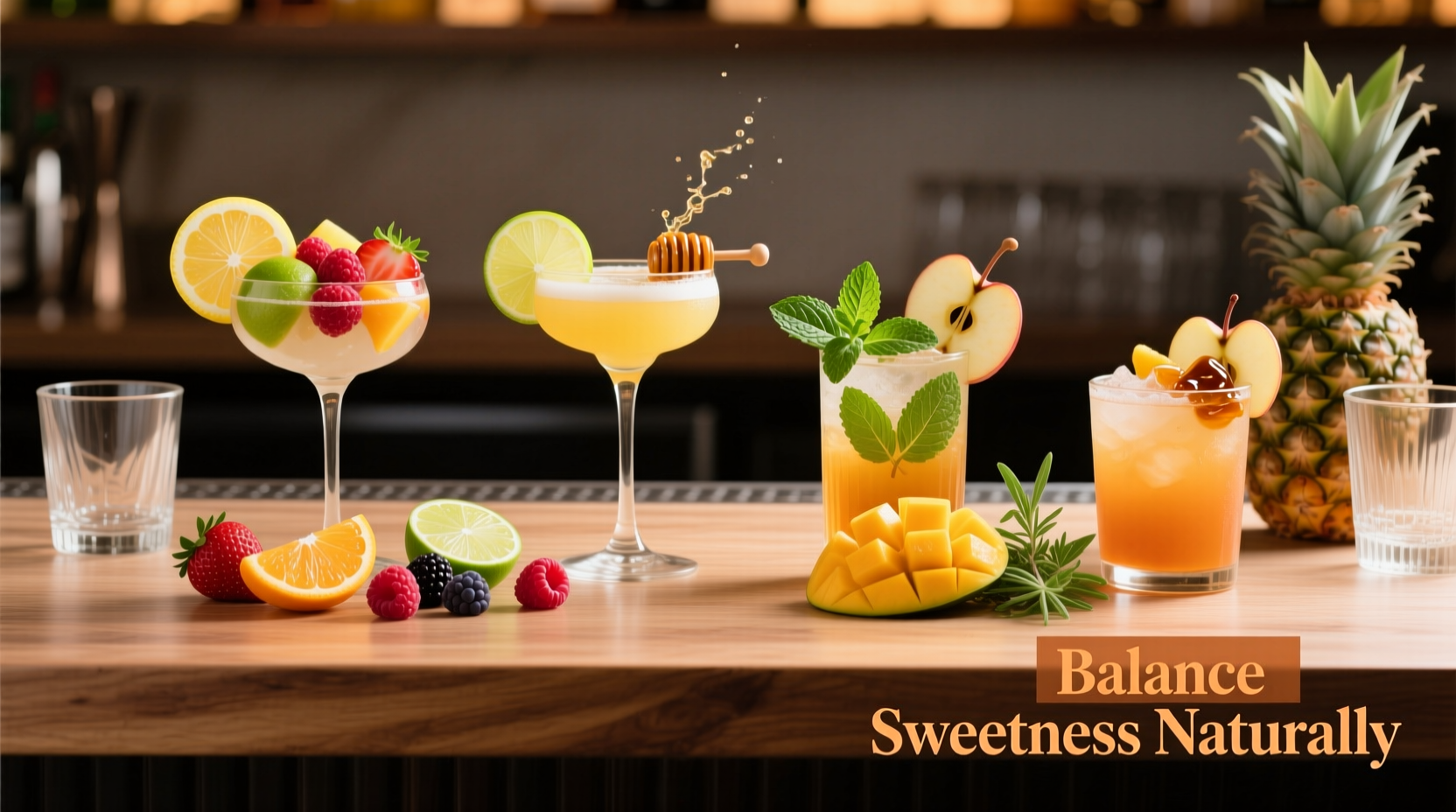
Fresh fruit delivers fructose, glucose, citric/malic acid, water, pectin, and volatile aromatics—all in one package. Unlike refined syrups, it contributes layered sweetness that reads as bright, not cloying. The key is matching fruit type to drink structure:
| Fruit | Best For | Prep Tip | Sugar Equivalent (per 1 oz purée) |
|---|---|---|---|
| Lime (juice + pulp) | Sour-based drinks (Daiquiris, Margaritas) | Roll limes firmly, juice cold, then strain pulp for texture control | 0.1–0.2 g sucrose (mostly citric acid dominant) |
| Pineapple (purée) | Tiki, tropical, or high-proof stirred drinks | Blend ripe core + flesh; fine-strain to remove fiber | 1.8–2.2 g sucrose + malic acid lift |
| Strawberry (macerated) | Aperitif cocktails, spritzes, low-ABV drinks | Macerate hulled berries with 10% cane sugar by weight for 30 min; double-strain | 1.2–1.5 g sucrose + aromatic complexity |
| Green apple (juice) | Herbal, smoky, or bitter-forward drinks (e.g., Mezcal + Campari) | Use tart varieties (Granny Smith); juice immediately; no straining needed | 0.8–1.0 g sucrose + sharp malic bite |
Note: “Sugar equivalent” here reflects measurable sucrose—not total carbohydrates. Fructose (dominant in fruits) registers as 1.2–1.8× sweeter than sucrose on the tongue, meaning less volume is needed to achieve the same perceptual impact. A 0.5 oz pineapple purée often balances a 2 oz rum base more effectively than 0.5 oz simple syrup—because it brings acid, water, and aroma alongside sweetness.
3. Acid Is Your Primary Sweetness Modulator—Not Your Enemy
Acidity doesn’t just “cut” sweetness—it reconfigures how sweetness is perceived. Citric acid (lemon/lime) enhances brightness and lifts top notes; malic acid (apple, rhubarb) adds roundness and mouthwatering depth; tartaric acid (grape, tamarind) delivers a clean, persistent finish. Using multiple acids—strategically—is how elite bars avoid syrup dependency.
Consider the Three-Acid Rule:
- Base acid (60%): Lemon or lime juice for backbone and freshness.
- Supporting acid (30%): A secondary acid (e.g., green apple juice, verjus, or even a splash of red wine vinegar in savory drinks) to add dimension.
- Finishing acid (10%): A volatile or aromatic acid (yuzu juice, passionfruit puree, or even a drop of high-quality balsamic glaze) for aromatic lift and complexity.
This approach allows you to reduce total sugar by up to 40% while increasing perceived balance. Why? Because acidity expands the palate’s capacity to register sweetness without fatigue. A drink built on 0.75 oz lemon + 0.25 oz apple juice + 2 drops yuzu needs only 0.25 oz simple syrup to harmonize—whereas the same base with 0.75 oz lemon alone might demand 0.5 oz.
“Sweetness without acidity is noise. Acidity without sweetness is pain. But when they’re calibrated at the molecular level—through pH, titratable acidity, and volatile compounds—that’s where flavor becomes architecture.” — Javier Mendoza, Beverage Director, Atelier Crenn Bar Program & Co-author of *The Acid Test: Modern Cocktail Balance*
4. Mini Case Study: Reviving the “Too-Sweet” Boulevardier
At The Rookery, a neighborhood bar in Portland, the Boulevardier was consistently flagged in staff tastings as “cloying” and “unbalanced.” The original spec called for 1.5 oz bourbon, 1 oz sweet vermouth, 0.75 oz Campari, and a barspoon of simple syrup—a legacy holdover from when lower-proof vermouths were standard.
The team diagnosed the issue: modern Italian sweet vermouths (e.g., Cocchi Vermouth di Torino) now contain 14–16% residual sugar—up from ~10% a decade ago. Campari’s bitterness had also intensified slightly due to botanical sourcing changes. The result? A drink where sugar and bitterness competed instead of conversed.
They tested four iterations:
- Version A (reduce syrup): Removed syrup entirely → too bitter, hollow midpalate.
- Version B (add lemon): 0.25 oz lemon juice → improved brightness but clashed with Campari’s orange oil.
- Version C (add verjus): 0.25 oz verjus (unfermented grape juice) → preserved Campari’s citrus while adding clean, grape-derived tartaric acid → immediate improvement.
- Version D (verjus + dilution adjustment): Reduced vermouth to 0.85 oz, increased Campari to 0.85 oz, added 0.25 oz verjus, and extended stir time by 15 seconds → richer mouthfeel, seamless bitterness-to-sweet transition, zero syrup needed.
Version D became the new standard. Guest feedback shifted from “too sweet” to “complex but refreshing”—proving that recalibrating acid and dilution solved the problem syrup reduction alone could not.
5. Build a Low-Syrup Toolkit: 7 Alternatives That Deliver Function, Not Just Flavor
Replace syrup dependency with ingredients that contribute sweetness *plus* functional properties. Here’s what to keep stocked—and how to use each:
Tip: Never substitute syrups 1:1. Adjust based on function: if replacing simple syrup with fruit purée, reduce other liquids by 10–15% to compensate for added water content.- Fermented grape must (e.g., Saperavi or Lambrusco must): Adds subtle sweetness, natural tannin, and umami depth. Use 0.25 oz in amaro-forward drinks or stirred red-wine cocktails.
- Roasted pear purée: Caramelized fructose + pectin = viscosity without stickiness. Ideal for smoky spirits (Mezcal, Scotch). Strain after roasting with thyme and black pepper.
- Dry vermouth reduction: Simmer 4 oz dry vermouth until reduced to 1 oz. Concentrates herbal bitterness and subtle grape sugar. Use 0.125–0.25 oz to add structure to Martinis or Manhattans.
- Black tea infusion (cold-brewed, 12 hours): Tannins soften perceived sweetness while adding aromatic complexity. Replace 0.25 oz of syrup with 0.5 oz strong tea in whiskey sours or highballs.
- Sherry vinegar (manzanilla or fino): Tiny amounts (1–2 drops) add salinity and volatile acidity that lift sweetness without sourness. Use in savory or briny cocktails (e.g., Bloody Mary variations).
- Coconut water (unflavored, no additives): Natural electrolytes and mild sweetness (4.5 g/100ml) provide body and roundness. Substitute for part of the dilution water in shaken tropical drinks.
- Smoked salt brine (1:1 salt:water, smoked over cherrywood): Salt suppresses bitterness and enhances sweet perception. Add 1 dash to spirit-forward drinks needing depth—not sweetness per se, but balance.
6. Step-by-Step: Rebalancing a Syrup-Heavy Classic (The Whiskey Sour)
The traditional Whiskey Sour (2 oz bourbon, 0.75 oz lemon, 0.5 oz simple) often feels syrupy because the simple syrup dominates the acid’s short finish. Here’s how to rebuild it with zero added sucrose:
- Start with fresh, cold lemon juice: Roll lemons, juice immediately, and measure precisely. Warm or oxidized juice loses acidity.
- Add texture and roundness: Shake with 0.25 oz roasted pear purée (strained) and 0.25 oz coconut water instead of simple syrup.
- Adjust acid profile: Add 0.125 oz verjus to extend the finish and integrate the pear’s sweetness.
- Control dilution: Dry shake first (no ice), then wet shake vigorously for 14 seconds with large, cold cubes.
- Strain and assess: Taste before garnishing. If still sharp, add 1 dash smoked salt brine—not more sugar.
- Garnish intentionally: A dehydrated lemon wheel expresses oils that enhance brightness, further reducing need for residual sugar.
Result: A Whiskey Sour with perceptible sweetness, vibrant acidity, creamy mouthfeel, and zero cloying aftertaste—using 80% less added sugar than the classic.
7. FAQ: Addressing Real Home Bartender Concerns
Can I use honey or maple syrup instead of simple syrup to “make it healthier”?
No—and not just because of calories. Raw honey contains enzymes and volatile compounds that clash with citrus and oxidize rapidly in cocktails, creating off-flavors within hours. Maple syrup adds distinct woody notes that overwhelm delicate spirits. Both are viscous and coat the palate, worsening the very “syrup overload” sensation you’re trying to avoid. If using, always dilute 1:1 with hot water and use within 24 hours.
Why does my homemade simple syrup make drinks taste “flat” compared to bar versions?
Most home syrups are boiled, which volatilizes aromatic compounds and promotes sucrose inversion (breaking into glucose + fructose). This increases perceived sweetness but reduces complexity. Professional bars use cold-process syrups (dissolving sugar in room-temp water with agitation) or employ precise temperature control (<40°C) to preserve integrity. Also: many bars use demerara or turbinado sugar, whose molasses notes add depth simple syrup lacks.
How do I know if my drink is *actually* balanced—or just “not too sweet”?
True balance means no single element dominates after three seconds on the palate. Swirl the drink in your mouth. Does the finish echo the aroma? Does the middle palate feel rounded—not thin or heavy? Does the bitterness (if present) resolve cleanly into sweetness, not fight it? If you catch yourself thinking “I wish this had more lime” or “that Campari hit too hard,” it’s not a sweetness issue—it’s an acid or dilution issue. Train your palate to diagnose, not just adjust.
Conclusion
Balancing sweetness isn’t about restraint—it’s about respect. Respect for the raw materials, for the physics of dilution and temperature, for the biochemistry of taste receptors, and for the drinker’s experience across multiple sips. Syrups have their place: orgeat in a Mai Tai, rich demerara in a Rum Old Fashioned, house-made ginger in a Dark ’n’ Stormy. But when sweetness becomes the crutch instead of the catalyst, cocktails lose breath, nuance, and longevity.
Start tonight—not by throwing out your syrups, but by tasting your next drink before adding any sweetener. Measure your citrus. Time your shakes. Try verjus instead of extra lime. Stir longer. Notice how texture changes perception. You’ll discover that balance isn’t found in the bottle you reach for last—it’s revealed in the silence between the first and second sip, when nothing fights, nothing overwhelms, and everything belongs.
💬 Your turn: Which cocktail have you successfully rebalanced without syrup? Share your tweak, your “aha” moment, or your toughest balancing challenge in the comments—we’ll feature the most insightful tips in next month’s deep-dive column.