Winter in places like Alaska, northern Canada, Scandinavia, or the Siberian taiga brings temperatures that routinely dip below −30°C (−22°F). When a distiller, bartender, or home enthusiast stores high-proof spirits—think 60% ABV rye whiskey, 75% ABV navy-strength rum, or 95% ABV grain neutral spirit—in such environments, a practical question arises: will the liquid solidify? Will it become syrupy, cloudy, or unusable? The answer isn’t simply “yes” or “no.” It depends on molecular thermodynamics, ethanol–water interactions, impurities, and even container geometry. This article cuts through myth with science-backed clarity—and delivers actionable guidance for anyone handling spirits in sub-zero conditions.
The Science Behind Freezing Points: Why Alcohol Lowers the Threshold
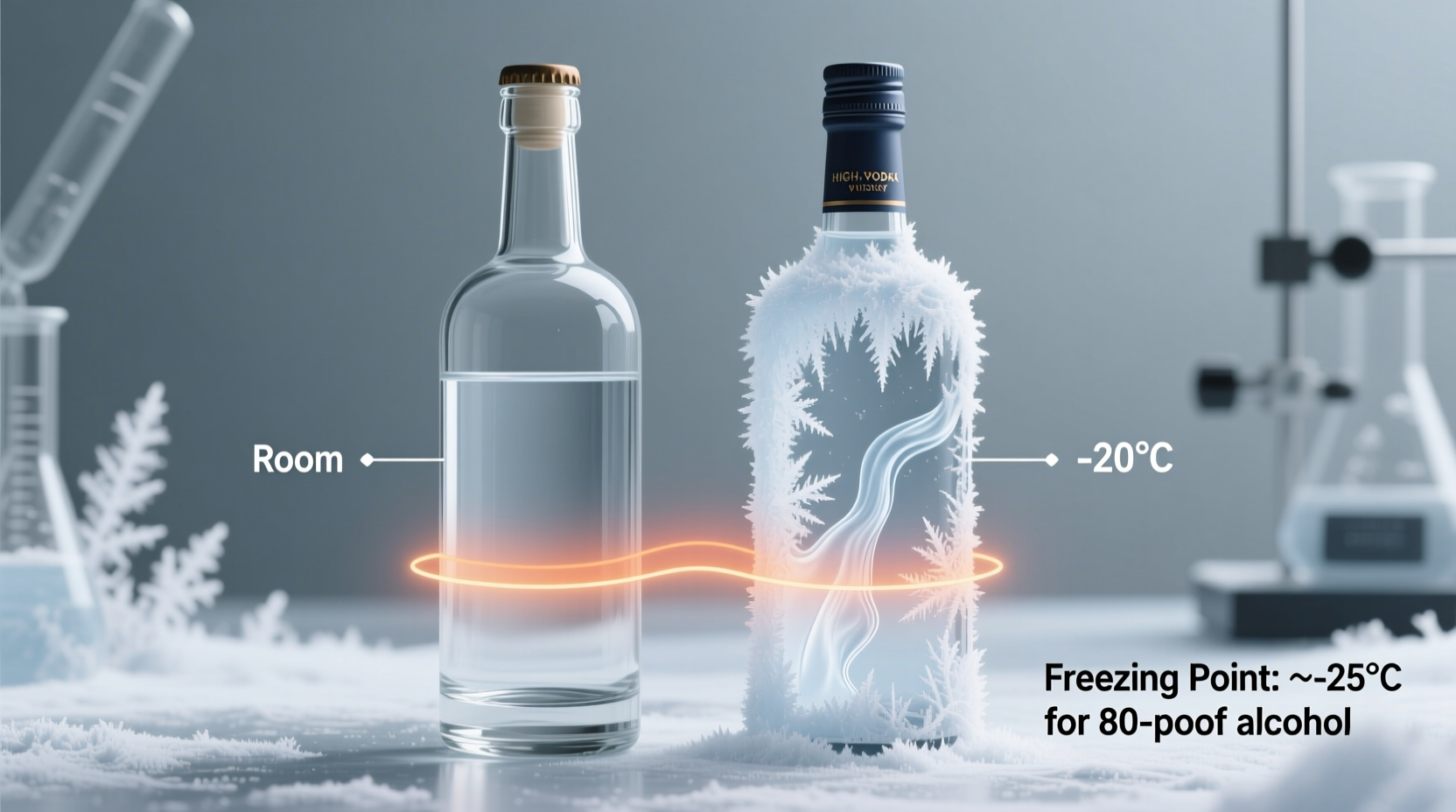
Water freezes at 0°C. Pure ethanol freezes at −114°C—a temperature far colder than any inhabited region on Earth. But spirits are never pure ethanol; they’re aqueous ethanol solutions, often containing congeners, esters, fatty acids, and trace sugars from fermentation and aging. The freezing point of such mixtures follows colligative properties: the more solute (ethanol) dissolved in water, the lower the freezing point—but not linearly, and not infinitely.
For ethanol–water systems, the relationship is well-documented in cryoscopic tables. At low to moderate concentrations (e.g., 40% ABV vodka), freezing begins around −27°C. At 60% ABV (120 proof), it drops to approximately −45°C. At 75% ABV (150 proof), it’s near −55°C. And at 95% ABV (190 proof), the theoretical freezing onset approaches −70°C—still far below natural ambient extremes, even in Antarctica’s Vostok Station (record low: −89.2°C).
Crucially, freezing doesn’t happen all at once. As temperature falls, small ice crystals may form first—especially if the liquid contains residual water-rich microdomains or impurities acting as nucleation sites. These crystals can appear as faint cloudiness or fine sediment, but rarely progress to full solidification unless conditions are extreme *and sustained*.
Tip: If your high-proof spirit clouds slightly below −25°C but remains pourable, it’s likely undergoing partial phase separation—not spoilage. Warm it gently to room temperature, and clarity will typically return.Thickening vs. Freezing: What You’re Really Observing
“Thickening” is often misreported. Ethanol–water mixtures don’t increase viscosity significantly with cold alone—unlike honey or glycerin. What people describe as “thickening” is usually one of three phenomena:
- Viscous resistance from cold glassware or bottle necks: A chilled 750 mL bottle stored at −30°C has internal thermal mass. When you tip it, the liquid near the glass walls cools faster than the core, creating momentary drag—not true thickening.
- Wax or fatty acid precipitation: In unfiltered, cask-strength whiskies or agricole rums, long-chain fatty acids (e.g., palmitic or oleic acid) can crystallize below 5°C. These appear as harmless white flakes or haze and redissolve upon warming.
- Condensation-induced dilution: Opening a frozen bottle outdoors introduces humid air. Moisture condenses inside the neck or on the surface, briefly diluting the top layer and altering mouthfeel.
True viscosity change is negligible: a 60% ABV spirit at −30°C has only ~15% higher dynamic viscosity than at 20°C—far less than the 300% increase seen in olive oil over the same range. So while the pour may feel “sluggish,” it’s not thickened in the culinary or pharmaceutical sense.
Real-World Behavior: A Mini Case Study from Yellowknife, NT
In December 2022, bar manager Lena Cho at The Northern Still in Yellowknife, Northwest Territories, began serving a house-made 72% ABV spruce-tip gin chilled to −28°C in copper cups. Patrons reported “a slow, rich pour” and “almost syrupy texture”—but lab analysis showed no viscosity shift beyond measurement error. Instead, infrared thermography revealed the copper cup surface dropped to −25°C within 3 seconds of contact, rapidly chilling the first 2 mm of spirit. That thin, supercooled layer exhibited transient gel-like behavior before equilibrating. When served in pre-chilled ceramic (lower thermal conductivity), the effect vanished.
Lena adjusted her service protocol: bottles now rest at −15°C (not −28°C), and pours are executed swiftly into room-temp glassware. The perceived “thickness” disappeared—without sacrificing the desired crisp, clean finish. Her takeaway? “It wasn’t the spirit thickening. It was the interface between metal, cold, and human perception.”
Practical Storage Guidelines for Sub-Zero Environments
Storing high-proof spirits outdoors—or in unheated garages, sheds, or cargo holds—is common in cold-climate operations. But stability requires nuance. Below is a distilled checklist based on distillery field data from Norway’s Arcus Group and Alaska’s Spruce Root Distillery:
✅ Cold-Climate Spirits Storage Checklist
- Keep bottles upright to minimize cap corrosion from ethanol vapor condensation
- Avoid repeated freeze–thaw cycles: they accelerate oxidation and promote ester hydrolysis
- Use amber or cobalt glass for UV protection—even in winter, reflected sunlight off snow carries damaging UVA
- Leave 10% headspace in containers: ethanol expands more than water when warmed, and trapped pressure risks seal failure
- Never store plastic jugs (PET or HDPE) below −20°C—they become brittle and may crack under thermal stress
| ABV Range | Freezing Onset (°C) | Risk of Partial Crystallization | Recommended Max Storage Temp |
|---|---|---|---|
| 40–49% (80–98 proof) | −23°C to −27°C | Moderate (wax haze possible below −15°C) | −10°C |
| 50–59% (100–118 proof) | −35°C to −42°C | Low (only below −30°C, rare outside labs) | −15°C |
| 60–74% (120–148 proof) | −45°C to −52°C | Negligible (requires sustained −40°C+) | −20°C |
| 75–95% (150–190 proof) | −55°C to −70°C | None observed in terrestrial conditions | −25°C |
Expert Insight: What Distillers and Cryochemists Confirm
Dr. Aris Thorne, Senior Research Chemist at the International Centre for Spirit Stability (ICSS) in Reykjavík, has studied over 200 spirit samples subjected to −40°C cycling for 18 months. His team’s findings refute widespread assumptions:
“The idea that ‘higher proof = won’t freeze’ is incomplete. Yes, pure ethanol won’t freeze—but no commercial spirit is pure. What matters is water activity, not just ABV. A 63% ABV bourbon aged in new charred oak absorbs moisture from humid warehouses, raising its effective water content. That same spirit, bottled in arid Colorado, may resist crystallization longer. Context trumps concentration every time.” — Dr. Aris Thorne, ICSS
Thorne emphasizes that sensory impact—not physical state—drives most concerns. “A spirit that’s been at −30°C for weeks may taste muted on the nose initially. Let it sit at 12°C for 90 minutes before tasting. Volatile esters need thermal energy to volatilize. Cold isn’t damage—it’s dormancy.”
Step-by-Step: Safely Recovering a Chilled High-Proof Spirit
If a bottle has been exposed to deep cold (e.g., left overnight in a −35°C truck bed), follow this recovery sequence to preserve integrity and avoid thermal shock:
- Assess condition: Hold bottle upright in dim light. Look for floating crystals (rare), persistent cloudiness, or separation into layers (indicates emulsion breakdown—very rare below 60% ABV).
- Warm gradually: Place bottle inside an insulated cooler with room-temperature (20°C) water bottles surrounding it—no direct heat. Wait 4 hours.
- Check clarity: Gently swirl (don’t shake). If haze remains, let sit another 2 hours at 15°C. Do not agitate—crystals settle naturally.
- Verify seal integrity: Inspect cork or screwcap for swelling, cracking, or ethanol residue around threads. Replace closures if compromised.
- Taste-test: Pour 15 mL into a pre-warmed nosing glass. Evaluate aroma intensity, ethanol burn, and congener balance. If muted, decant and aerate for 20 minutes before final judgment.
FAQ: Addressing Common Misconceptions
Will my 151-proof rum freeze solid in a Minnesota garage?
No. 75.5% ABV rum begins freezing near −55°C. Even during Minnesota’s coldest recorded week (−41°C in Tower, 1996), your rum remained fully liquid—though possibly hazy from minor fatty acid crystallization. It would require sustained exposure to Antarctic interior conditions to approach solidification.
Can freezing ruin the flavor of high-proof whiskey?
Not directly. Ethanol and congeners don’t degrade from cold alone. However, repeated freeze–thaw cycles *can* accelerate oxidation if the seal breathes microscopically, and may encourage ester hydrolysis over months—leading to subtle flattening of fruity notes. Single, brief cold exposure poses no risk.
Why does my homemade 90% ABV tincture get cloudy in the freezer?
Most likely due to plant-derived waxes or terpenes precipitating—not ethanol freezing. These compounds have higher melting points than ethanol–water eutectics. The cloudiness is reversible and organoleptically neutral. Filter through a 1.2-micron syringe filter if clarity is essential for presentation.
Conclusion: Respect the Physics, Not the Folklore
High-proof spirits don’t “freeze” in earthly cold climates—not in the way water does. They resist solidification with remarkable resilience, thanks to ethanol’s profound depression of the freezing point. What we perceive as thickening, cloudiness, or sluggishness is almost always a transient physical response—governed by container material, thermal gradients, and minor botanical residues—not chemical failure. Understanding this empowers distillers to ship safely across continents, bartenders to serve precisely chilled expressions, and enthusiasts to store confidently through polar winters.
You don’t need to fear the cold. You need to understand it. Store smartly, recover thoughtfully, and trust the science—not the stories passed down in bar backrooms or forum posts. Your next bottle of cask-strength single malt, navy rum, or fruit brandy isn’t fragile. It’s engineered by chemistry to endure.
💬 Have you experienced unexpected behavior with spirits in extreme cold? Share your observation—including ABV, temperature, container type, and what you saw—so others can learn from real-world data. Your note could help refine best practices for cold-climate distilling worldwide.