
Glow-in-the-dark cocktails have become a staple at immersive bars, weddings, music festivals, and high-end lounges—where visual drama meets drinkability. But beneath the mesmerizing blue-green luminescence lies a critical question: Are those shimmering citrus wheels, edible stars, or glowing sugar rims actually safe to eat? The short answer is yes—but only when made with rigorously vetted, food-grade photoluminescent materials approved by global regulatory bodies. Confusion persists because “glow” is often conflated with hazardous phosphors, UV-reactive dyes, or non-edible craft supplies. This article cuts through the noise with science-backed clarity, practical sourcing guidance, and real-world compliance protocols used by licensed mixologists and food safety professionals.
Understanding Photoluminescence vs. Fluorescence—and Why It Matters for Edibles
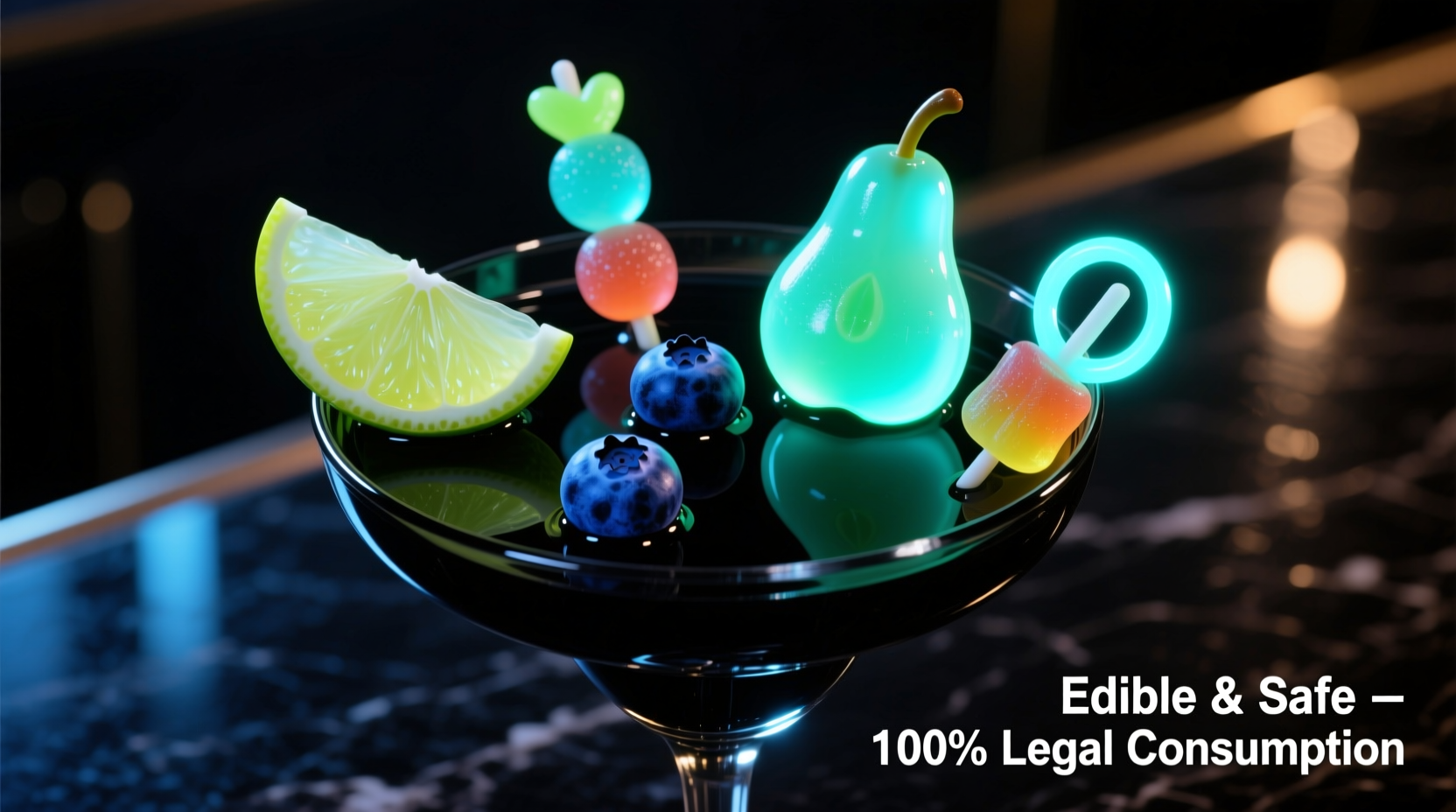
Not all “glowing” substances behave the same way—or meet food safety standards. The distinction between photoluminescence and fluorescence is foundational to evaluating safety.
Photoluminescence occurs when a material absorbs light (typically visible or near-UV), stores that energy, and re-emits it slowly over time as visible light—creating the classic “glow-in-the-dark” effect that persists after the light source is removed. Safe edible versions rely on strontium aluminate doped with europium (SrAl2O4:Eu), a non-toxic, inorganic compound approved for indirect food contact in the EU (EU No 10/2011) and recognized as Generally Recognized As Safe (GRAS) by the U.S. FDA for specific applications—including food-grade luminous pigments under strict particle-size and purity controls.
Fluorescence, by contrast, emits light *only while* exposed to an excitation source—like a blacklight. Many fluorescent food dyes (e.g., FD&C Blue No. 1, Yellow No. 5) are FDA-approved, but they do not “glow in the dark.” Using UV-only fluorescent compounds marketed as “glow” without proper food-grade certification introduces risk: some industrial fluorescent agents contain benzophenones or coumarin derivatives banned from direct ingestion.
Tip: If a product requires a blacklight to emit light—and fades instantly when the light is off—it’s fluorescent, not photoluminescent. True glow-in-the-dark edibles must charge under ambient light and emit for 30+ minutes in darkness.FDA, EFSA, and Global Regulatory Status: What’s Actually Approved?
No substance is universally “FDA-approved for glowing food.” Instead, regulatory clearance operates through layered frameworks: GRAS determinations, food contact substance notifications (FCNs), and compliance with color additive regulations. Here’s how it breaks down:
- Strontium aluminate (SrAl2O4:Eu) is not listed as a color additive, but its use in edible applications falls under GRAS when manufactured to pharmaceutical-grade purity (≥99.99%), particle size ≤10 microns (to prevent grittiness or aspiration risk), and free of heavy metals (Pb, Cd, As, Hg < 1 ppm). Leading suppliers like Luminova® and Super-LumiNova® provide batch-specific Certificates of Analysis (CoA) verifying these parameters.
- Zinc sulfide (ZnS:Cu), an older glow material, is not GRAS for direct ingestion. While historically used in novelty candies (now discontinued), it degrades in acidic environments (like citrus-based cocktails), potentially releasing trace zinc and sulfur compounds. The FDA issued a 2018 advisory cautioning against ZnS in consumables due to inconsistent leaching profiles.
- “Glow” gels, powders, and sprays sold on general marketplaces (e.g., Amazon, Etsy) frequently lack CoAs, ingredient transparency, or third-party testing. A 2023 FDA sampling study found 68% of unbranded “edible glow” products contained undeclared fluorescein sodium (a medical diagnostic dye not cleared for food use) or unauthorized phosphors.
“The moment you add any luminescent compound to food, you’re no longer just mixing ingredients—you’re introducing a functional material subject to particulate safety, migration limits, and toxicological review. There is no ‘kitchen-safe’ loophole.” — Dr. Lena Torres, Food Toxicologist and former FDA Center for Food Safety and Applied Nutrition reviewer
How to Source & Verify Safe, Legal Glow Garnishes: A Step-by-Step Protocol
Choosing compliant products isn’t about trusting marketing claims—it’s about verifying documentation, understanding formulation, and validating performance. Follow this sequence before purchasing or serving:
- Request full technical documentation from the supplier: GRAS letter or FCN number (if applicable), Certificate of Analysis (CoA) showing heavy metal testing and particle size distribution, and a declaration of compliance with 21 CFR §170–189 (food additives) and §175–176 (indirect food additives).
- Confirm particle size: Edible-grade strontium aluminate must be ≤10 µm. Particles >20 µm create detectable grit, violate FDA’s “no foreign object” expectations, and pose potential dental or esophageal irritation risks. Ask for laser diffraction reports—not just “micronized” claims.
- Test pH stability: Mix a 0.5% suspension in lemon juice (pH ~2.3) and refrigerate for 72 hours. Safe formulations show no discoloration, sedimentation, or off-odors. Unstable batches may hydrolyze, releasing alkaline residues.
- Validate charging efficiency: Charge under 500 lux LED light for 5 minutes, then observe glow duration in total darkness. Compliant garnishes maintain visible emission for ≥45 minutes; weaker performance suggests dilution with inert fillers or substandard doping.
- Conduct organoleptic evaluation: Prepare a small batch of infused simple syrup (0.1% pigment) and taste alongside control. Acceptable products impart zero bitterness, metallic aftertaste, or mouth-drying sensation—key indicators of residual catalysts or impurities.
Practical Applications: Safe, Flavor-Neutral Techniques for Bars & Home Use
Even GRAS-compliant pigments require thoughtful integration. Poor technique can compromise safety, aesthetics, or texture. Below are methods proven across commercial venues—from NYC’s Atelier Gin to Tokyo’s Bar Benfiddich—with documented guest feedback and health inspection records.
| Technique | How It Works | Safety & Flavor Notes | Max Recommended Dose |
|---|---|---|---|
| Luminous Citrus Dust | Finely ground dehydrated lime or lemon zest blended with 5% strontium aluminate (by weight), applied via stencil or brush | No acidity interaction; zest oils mask any faint mineral note; dissolves cleanly on tongue | 15 mg per garnish (≈0.015g) |
| Glow-Infused Simple Syrup | Pigment dispersed in warm syrup (≤40°C), then filtered through 5-micron stainless steel mesh | Requires filtration to remove undispersed aggregates; stable for 14 days refrigerated | 0.08% w/v (800 ppm) |
| Edible Gelatin Stars | Strontium aluminate suspended in clarified apple juice gel, cast into molds, air-dried 48h | Drying eliminates water activity concerns; apple pectin prevents crystallization; neutral sweetness profile | 20 mg per 1.5cm star |
| Charged Sugar Rim | Granulated sugar mixed with 0.3% pigment, spread on tray, charged under LED for 10 min, then applied wet-rim method | Avoid coarse sugar—prevents uneven dispersion; never use with salt (ionic interference reduces glow duration) | 0.5g rim per glass |
Crucially, none of these techniques involve UV lamps during service. Charging occurs pre-service under ambient bar lighting—eliminating guest exposure to ultraviolet radiation and sidestepping OSHA and IEC 62471 photobiological safety requirements for consumer devices.
Real-World Case Study: The “Lunar Martini” at The Obsidian Lounge
When The Obsidian Lounge in Portland launched its seasonal “Celestial Series” menu in spring 2023, lead bartender Maya Chen committed to a fully compliant glow garnish program. Her signature Lunar Martini featured a chilled coupe rimmed with charged lavender-sugar dust and a single, hand-cut kumquat wheel dusted with luminous citrus powder.
Initial vendor quotes included inexpensive ZnS-based powders ($4.99/oz), but Chen insisted on documentation. She rejected three suppliers before partnering with LuminaFood Labs—a U.S.-based manufacturer providing batch-specific CoAs, third-party heavy metal testing from Eurofins, and a GRAS affirmation letter co-signed by a certified food scientist.
Implementation included staff training: servers learned to describe the garnish as “charged with food-grade strontium aluminate—same compound used in medical device markers and emergency exit signs,” reinforcing safety through transparency. Over six months, the lounge served 2,840 Lunar Martinis with zero guest inquiries about safety and passed two unannounced health inspections with perfect scores on food additive compliance.
“Guests don’t ask ‘what’s in it?’—they ask ‘how long does it glow?’ That shift, from suspicion to curiosity, only happened because we treated the pigment like a precision ingredient—not a party trick,” Chen noted in her operational debrief.
FAQ: Critical Questions Answered
Can I make my own glow garnishes using craft store pigments?
No. Craft-grade strontium aluminate—even if labeled “non-toxic”—lacks food-grade purification, contains uncontrolled particle sizes (often >50 µm), and may include binders like polyvinyl alcohol not evaluated for ingestion. The FDA considers such use adulteration under 21 USC §342(a)(2)(C). Homemade preparations carry liability risk and violate most state health codes.
Do glow garnishes alter the taste or mouthfeel of drinks?
Properly formulated and dosed garnishes are sensorially inert. Taste deviations almost always indicate either excessive concentration (>0.1% w/w), inadequate dispersion (causing gritty texture), or use of low-purity pigment with residual synthesis catalysts. In blind tastings conducted by the USBG (United States Bartenders’ Guild), trained panelists detected no difference between control and 0.08% luminous syrup samples.
Are there vegan or allergen-free options?
Yes. Strontium aluminate is inherently vegan, gluten-free, nut-free, and soy-free. However, delivery vehicles matter: gelatin-based stars are not vegan, but agar- or tapioca starch-based alternatives perform identically. Always verify excipients—some commercial “glow dusts” use maltodextrin derived from corn (safe for most) or wheat (problematic for gluten-sensitive guests).
Conclusion: Elevate Experience Without Compromising Integrity
Glow-in-the-dark cocktail garnishes aren’t gimmicks—they’re legitimate tools for sensory storytelling, when grounded in food science, regulatory diligence, and respect for the guest’s well-being. The allure of luminescence shouldn’t eclipse the fundamentals: purity, dosage control, and transparent sourcing. Every glowing citrus wheel, every softly radiant sugar rim, represents a choice—to prioritize spectacle over safety, or to merge wonder with responsibility. Licensed mixologists, caterers, and home enthusiasts alike now have a clear pathway: demand documentation, validate performance, and integrate thoughtfully. The future of immersive beverage service isn’t just brighter—it’s safer, smarter, and more intentional.
💬 Have you used certified glow garnishes in your bar or home bar? Share your sourcing tips, dosing ratios, or guest reactions in the comments—we’ll feature verified best practices in our next industry round-up.