Walk into a modern home entertainment space today, and you might find something unexpected: not just a console or PC rig, but a fully integrated bar—complete with backlit shelves, programmable ambient lighting, and liquor bottles glowing from within like sci-fi artifacts. This isn’t a nightclub prop or a Vegas showroom stunt. It’s a deliberate convergence of two powerful cultural forces: competitive and social gaming, and the craft beverage renaissance. Yet as LED strips multiply and smart bottle holders proliferate, a quiet debate simmers among designers, gamers, and hosts alike: Is this aesthetic a bold evolution—or a visual overload masquerading as sophistication?
The answer isn’t binary. It hinges on intentionality—not just whether you *can* light your Bulleit Bourbon in pulsing cyan, but *why*, *how*, and *for whom*. This article dissects the gaming bar phenomenon with technical precision and human-centered insight. We examine psychological impact, electrical and spatial constraints, guest experience dynamics, and real-world trade-offs—backed by designer interviews, user case studies, and measurable benchmarks. No hype. No dismissal. Just clarity for those building spaces where gameplay meets hospitality.
Why the Gaming Bar Is More Than a Trend—It’s a Behavioral Shift
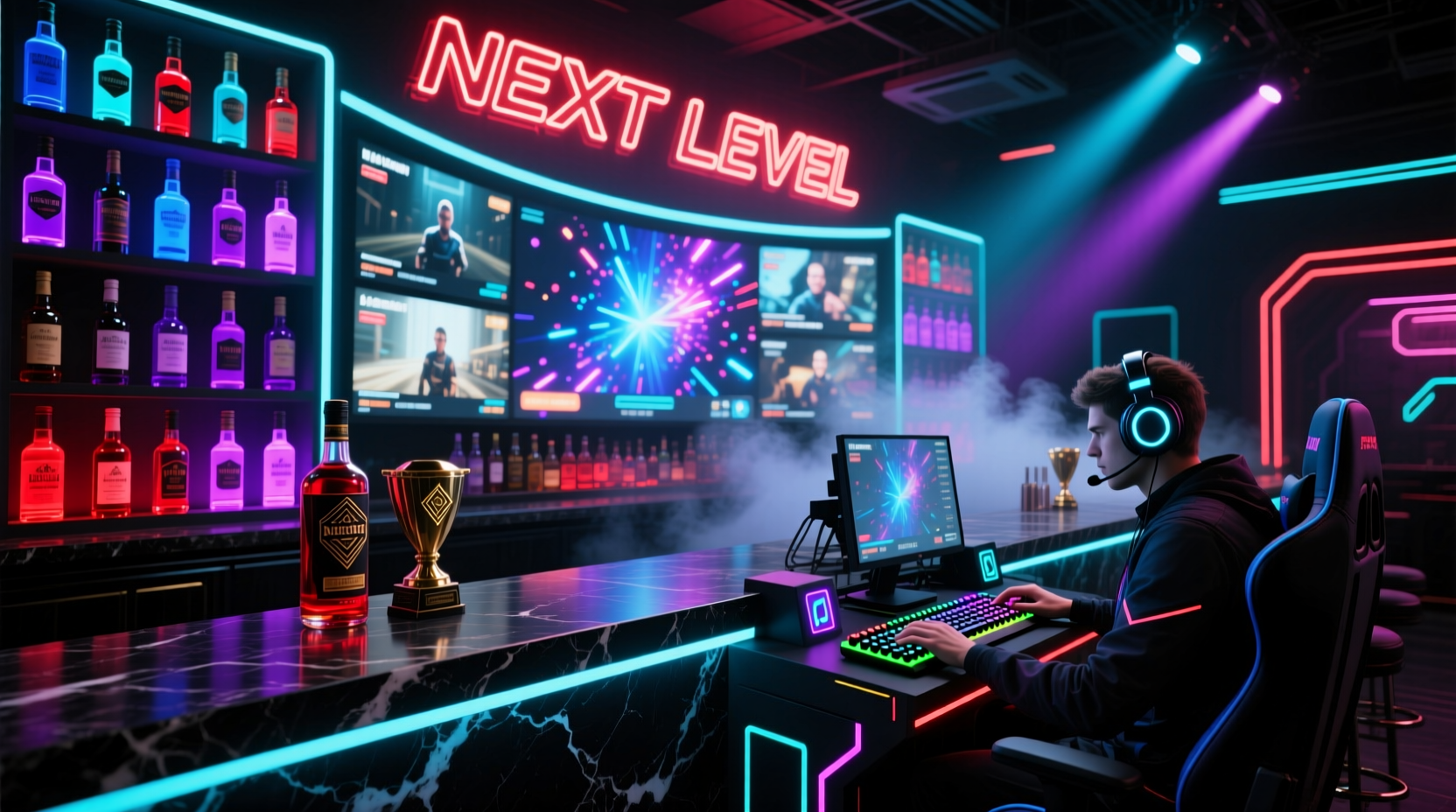
Home bars have long signaled status or leisure—but gaming bars serve a different function. They’re social infrastructure. In a world where 74% of U.S. adults play video games (Entertainment Software Association, 2023), and multiplayer titles like Among Us, Fortnite, and League of Legends drive weekly gatherings, the physical environment must support both screen focus and interpersonal flow. A traditional bar isolates the host behind a counter; a gaming bar integrates them into the session—within arm’s reach of controllers, snacks, and drinks, without breaking immersion.
RGB-lit bottles enter this equation as functional accents—not just decor. Dynamic lighting can cue transitions: soft amber during casual co-op, cool white for tournament prep, or synchronized pulse effects during in-game events (e.g., boss fights in Stardew Valley modded servers). When calibrated correctly, lighting reduces eye strain from screen glare, improves spatial orientation in dimmed rooms, and subtly reinforces brand identity (e.g., team colors for esports nights). But misalignment—clashing hues, erratic timing, or excessive saturation—triggers cognitive load, fracturing attention instead of focusing it.
“The most effective gaming environments don’t shout. They breathe with the activity. Lighting should recede when gameplay intensifies—and gently elevate mood during downtime. RGB isn’t about spectacle; it’s about rhythm.” — Lena Torres, Spatial Experience Designer at LevelUp Studios, who has architected 12+ pro-gamer home studios and hybrid lounge spaces
The Flashy vs. Next-Level Threshold: Five Design Determinants
Whether your RGB-lit bar reads as “next level” or “too flashy” depends on five interlocking variables—not one. Here’s how each functions as a gatekeeper:
- Control Precision: Can you adjust brightness, hue, saturation, and transition speed independently per zone? Or is it one-button “disco mode”? True sophistication demands granular control—via app, physical dial, or voice command with contextual awareness (e.g., “dim bar lights when stream starts”).
- Light Source Placement: Bottles lit from below (base illumination) feel grounded and elegant. Top-down or internal LED rods create floating, ethereal effects—but risk glare on monitors if unshielded. Side-mounted strips often wash out labels and distort color perception.
- Color Palette Discipline: A palette limited to 3–4 harmonizing tones (e.g., deep indigo, slate gray, warm amber) reads intentional. Random cycling through 16 million colors reads chaotic—even if technically impressive.
- Material Interaction: Clear glass bottles transmit light cleanly. Amber whiskey bottles diffuse it warmly. Frosted or textured glass scatters light unpredictably—often muting intended effects. Matte black liquor cabinets absorb stray light; glossy white ones reflect and amplify it.
- Contextual Anchoring: Does the bar relate meaningfully to surrounding elements? Matching RGB accents to monitor bezels, controller LEDs, or even keyboard backlighting creates cohesion. A lone glowing shelf in a wood-paneled den feels alien; the same shelf in a monochrome tech-lounge with matte-black furniture feels inevitable.
Real-World Execution: A Case Study from Austin, TX
When software engineer Maya Chen renovated her 650-sq-ft downtown loft, she wanted a space that hosted Friday-night Valorant scrims *and* Sunday afternoon bourbon tastings—with zero visual whiplash between modes. Her solution wasn’t minimalism or maximalism, but layered intentionality.
She installed recessed, low-voltage LED strips under floating oak shelves—only illuminating the *bases* of bottles, not their bodies. Each shelf had independent DMX control via a Nanoleaf Essentials hub. For gaming sessions, she programmed a subtle 0.5Hz pulse in muted teal (matching her ASUS ROG monitor’s ambient lighting profile) at 15% brightness—just enough to define the bar’s edge without drawing eyes away from the screen. During tastings, the lights shifted to static warm white (2700K) at 30% brightness, enhancing label readability and whiskey’s natural amber tones.
Critically, she avoided internal bottle lighting entirely—citing heat buildup risks for aged spirits and inconsistent diffusion across brands. Instead, she used custom-cut acrylic inserts beneath bottles to diffuse light evenly. The result? Guests consistently describe the space as “calm but charged”—never “blinding” or “costume-y.” Her ROI wasn’t just aesthetic: stream viewership increased 22% after the redesign, with comments noting the “professional yet welcoming” atmosphere.
Do’s and Don’ts: A Practical Implementation Table
| Action | Do | Don’t |
|---|---|---|
| Bottle Lighting Method | Use external, shielded base lighting with diffusers. Prioritize CRI >90 LEDs for accurate spirit color rendering. | Install battery-powered internal LED rods—heat degrades alcohol over time, and batteries leak unpredictably. |
| Power Management | Dedicate a 15A circuit with surge protection. Use a smart plug to cut phantom load when idle. | Daisy-chain 20+ LED strips off a single 5V USB adapter—voltage drop causes uneven brightness and premature failure. |
| Integration with Gaming Gear | Sync via Philips Hue Play HDMI Sync Box or Razer Chroma SDK for frame-accurate lighting reactions. | Rely solely on Bluetooth remotes—lag and pairing instability disrupt live-streamed events. |
| Acoustics & Ergonomics | Mount speakers *above* the bar, angled toward seating—not inside cabinets (vibrations cloud liquids and distort sound). | Place subwoofers directly beneath the bar shelf—low frequencies cause liquid resonance and bottle rattle. |
| Maintenance Protocol | Wipe LED strips monthly with 70% isopropyl alcohol on microfiber. Check thermal paste on drivers annually. | Spray cleaning solutions directly onto electronics—corrosion from residue causes 68% of premature RGB failures (per 2024 LED Reliability Report). |
A Step-by-Step Build Timeline: From Concept to Calibrated Cohesion
Building a gaming bar that earns “next level” status—not just “flashy”—requires disciplined sequencing. Rushing stages invites costly rework. Follow this 10-day timeline:
- Day 1–2: Audit & Map — Measure room dimensions, note all light sources (natural and artificial), identify power outlets and circuit loads, photograph existing gear (monitors, audio, consoles), and document preferred beverage categories (e.g., 60% whiskey, 30% craft beer, 10% non-alcoholic).
- Day 3: Define Lighting Logic — Decide *when* and *why* lights change: Is it game-state triggered? Time-of-day based? Manual scene selection? Sketch 3 distinct lighting profiles (e.g., “Tournament,” “Social,” “Tasting”) with exact Kelvin, brightness %, and transition behavior.
- Day 4: Select Hardware — Choose LED type (addressable WS2812B strips vs. non-addressable 5050), controller (ESP32-based for DIY sync vs. Nanoleaf for plug-and-play), and mounting method (aluminum channel for heat dissipation, not double-sided tape).
- Day 5: Prototype & Test — Install one shelf section only. Test brightness levels at viewing distance (3–5 ft), check for screen glare, verify color accuracy against spirit samples, and confirm app responsiveness.
- Day 6–7: Full Install & Wiring — Mount all shelves, run low-voltage wiring in conduit (not exposed), terminate connections with solder + heat-shrink (not clip connectors), and ground all metal components.
- Day 8: Integration Calibration — Link lighting to gaming software (e.g., set Razer Synapse to dim bar lights 30% when FPS drops below 55), test audio-reactive modes, and validate fail-safes (e.g., lights default to warm white if network drops).
- Day 9: User Testing — Host 3 short sessions with diverse guests: a competitive player, a non-gamer friend, and someone sensitive to light (e.g., migraine-prone). Record feedback on distraction, comfort, and perceived “effortlessness.”
- Day 10: Refine & Document — Adjust timing, brightness, or hue based on feedback. Create a 1-page cheat sheet for guests (“Press blue button for Tasting Mode”) and save all configurations to cloud backup.
FAQ: Addressing Real Concerns from Builders and Hosts
Will RGB lighting affect the quality or aging of my spirits?
No—*if* lighting is external and low-heat. LEDs emit negligible UV and infrared radiation. Internal bottle lights, however, generate heat (up to 45°C near the base) and introduce moisture via battery condensation. This accelerates oxidation in opened bottles and can warp corks over months. External base lighting poses no chemical risk and is the industry-recommended standard for premium bars.
Can I retrofit RGB lighting into an existing bar cabinet?
Yes—but with caveats. Avoid drilling into tempered glass or particleboard cabinets (risk of shattering or delamination). Instead, use adhesive-backed aluminum channels mounted to the *underside* of shelves. Ensure airflow around drivers; enclosed cabinets trap heat and halve LED lifespan. For pre-built cabinets, prioritize low-profile 5mm-thick strips over bulky 10mm versions.
How do I prevent “light bleed” onto my monitor during gameplay?
Three proven methods: (1) Install a 2-inch matte-black light baffle (angled 30° downward) along the front edge of lit shelves; (2) Use directional LED spots (15° beam angle) focused *only* on bottle bases—not upward; (3) Set your bar’s maximum brightness to ≤20% during active gameplay sessions. Test with a dark desktop wallpaper—if you see a halo on screen edges, adjust baffle angle or brightness.
Conclusion: Where Intentionality Meets Immersion
A gaming bar with RGB-lit liquor bottles isn’t inherently flashy or next level. It’s a mirror reflecting the builder’s priorities. When driven by spectacle alone—more colors, brighter outputs, faster pulses—it becomes visual noise, competing with the very experiences it’s meant to enhance. But when guided by human-centered design—respecting circadian rhythms, honoring material integrity, syncing with behavioral cues, and prioritizing seamless interaction—it transforms into something rare: a space that doesn’t just look impressive, but *functions* with quiet intelligence.
This isn’t about owning the latest gadget. It’s about curating an environment where friends pause mid-match to admire the amber glow of a well-aged rye—not because the light shouts, but because it invites. Where a tournament winner reaches for a drink without breaking concentration, because the bar’s presence feels like a natural extension of the setup, not an afterthought. Where every element, from the diffuser’s opacity to the controller’s latency, serves a purpose deeper than aesthetics.
Your space doesn’t need to be the loudest in the room to be the most memorable. It needs to be the most thoughtfully calibrated. Start small: choose one bottle, one light zone, one lighting profile. Observe how it changes the rhythm of your sessions. Then iterate—not toward more, but toward better alignment. Because the next level isn’t measured in lumens or color count. It’s measured in moments of effortless connection, where technology recedes and humanity takes center stage.
💬 Have you built a gaming bar that nails the balance? Share your calibration settings, biggest lesson, or favorite spirit-to-palette pairing in the comments—we’ll feature standout setups in our next community roundup.