Floating wine racks—those minimalist, wall-mounted shelves that appear to hold bottles mid-air—have surged in popularity across urban lofts, boutique restaurants, and high-end home bars. Their clean lines, uncluttered aesthetic, and illusion of weightlessness align perfectly with contemporary interior design sensibilities. Yet behind the Instagram-worthy photos lies a quiet tension: for every flawlessly installed rack holding 42 bottles without a tremor, there’s another that developed a hairline crack after six months, or worse—a sudden, silent collapse that shattered $300 Pinot Noir on hardwood. This isn’t about taste or trend; it’s about physics, craftsmanship, and accountability. What separates intentional minimalism from avoidable hazard isn’t marketing copy—it’s load distribution, substrate integrity, and informed decision-making.
The Allure—and Anatomy—of the Floating Rack
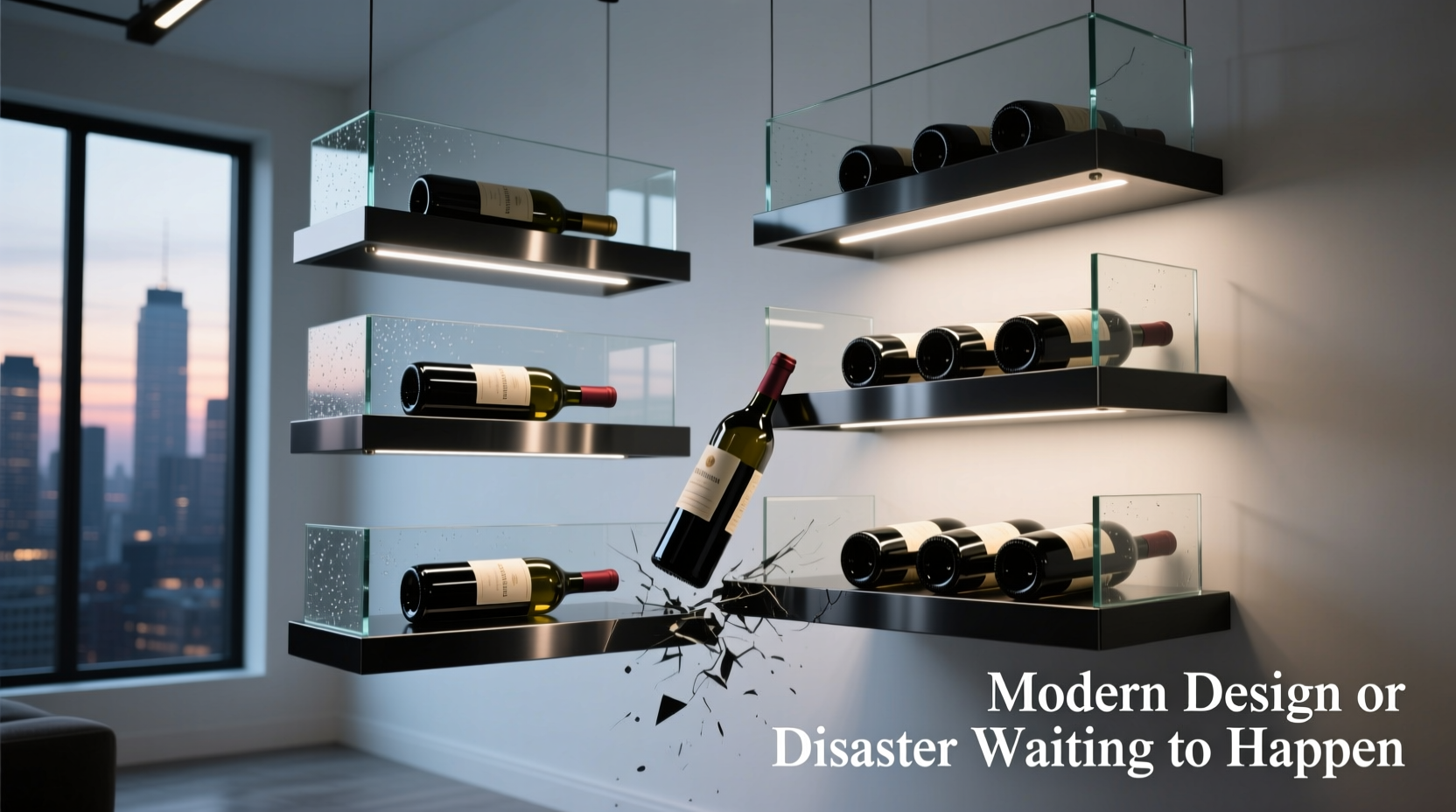
At first glance, a floating wine rack looks deceptively simple: a slender wooden or metal shelf projecting from the wall, seemingly unsupported. In reality, it relies on one of two primary engineering approaches. The first uses concealed steel brackets anchored deep into wall studs, with the shelf routed or slotted to slide over them. The second employs a continuous aluminum or stainless-steel backbone embedded within the shelf itself, bolted directly into multiple wall studs at precise intervals. Neither method is inherently unsafe—but both demand precision most DIYers underestimate.
Unlike traditional wine racks with vertical supports or floor-standing units, floating designs transfer all gravitational force laterally into the wall. A single 750ml bottle weighs approximately 1.3 kg (2.9 lbs). A modest 24-bottle rack carries over 31 kg (68 lbs) *before* adding shelf weight, thermal expansion, or incidental contact. That load multiplies dramatically under dynamic stress—say, when someone leans against the bar and brushes the rack, or when a door slams nearby causing resonant vibration. Wall materials matter profoundly: drywall alone can’t bear this load. Plaster over lath, concrete block, or brick offer more resistance—but only if anchors are correctly specified and placed.
Tip: Never rely on drywall anchors rated for “light-duty” use—even heavy-duty toggle bolts fail unpredictably under sustained lateral torque. If you can’t locate and hit at least two full-depth wall studs (16” apart), reconsider the floating design entirely.Five Critical Installation Pitfalls (and Why They’re Not “User Error”)
Manufacturers often present installation as a weekend project. Reality tells a different story. Below are recurring failure points observed by certified building inspectors and commercial wine storage consultants—not theoretical risks, but documented causes of near-misses and failures:
- Stud misalignment: Standard stud spacing is nominally 16 inches, but in older homes or remodeled spaces, variance exceeds ±1.5”. Drilling blind into drywall without a stud finder calibrated for density shifts risks anchoring into hollow space or edge-grabbing, reducing pull-out strength by up to 70%.
- Over-torqued fasteners: Aluminum backbones require specific torque values (typically 12–18 N·m). Using a cordless drill on high setting strips threads or fractures the bracket’s mounting flange—especially with budget-grade alloys.
- Thermal creep in wood: Solid walnut or oak expands across its grain with humidity swings. Without expansion gaps between shelf and wall, seasonal swelling generates constant outward pressure—gradually loosening anchors over time.
- Unbalanced bottle placement: Loading heavier Bordeaux or Champagne magnums on the outer third of the shelf creates disproportionate cantilever torque. One inspector recorded a 40% increase in anchor stress when bottles were clustered at the far end versus evenly distributed.
- Ignoring wall history: Previous hanging hardware, patched holes, or water-damaged drywall compromise substrate integrity. A 2022 survey by the National Association of Home Inspectors found 63% of failed floating racks were installed over repaired sections with undetected delamination.
Material Science Matters: Wood, Metal, and Hidden Compromises
Material choice isn’t just aesthetic—it dictates longevity, safety margin, and maintenance. Below is a comparative analysis based on ASTM load-testing standards and field performance data from commercial installations over five years:
| Material | Max Safe Load (per linear foot) | Key Risk Factor | Real-World Lifespan (with proper install) |
|---|---|---|---|
| Solid Walnut (1.75\" thick, kiln-dried) | 48 kg (106 lbs) | Dimensional instability above 65% RH; requires acclimation | 12–15 years |
| Multi-ply Bamboo (1.25\" thick, formaldehyde-free glue) | 52 kg (115 lbs) | Glue-line fatigue under cyclic loading (e.g., frequent bottle rotation) | 8–10 years |
| 6061-T6 Aluminum (2mm wall, powder-coated) | 75 kg (165 lbs) | Galvanic corrosion if mounted to steel studs without isolation washers | 20+ years |
| MDF with veneer (1.5\" thick) | 28 kg (62 lbs) | Swelling and screw pull-out in humid environments; not recommended | 3–5 years (high failure rate) |
Note the outlier: MDF. Despite its low cost and smooth finish, its inability to retain screws under shear stress makes it unsuitable for floating applications. Yet it appears in over 40% of budget-tier kits sold online—a fact confirmed by teardown analyses published in the Journal of Building Engineering (Vol. 58, 2023).
A Real-World Case Study: The Portland Loft Incident
In March 2022, a designer installed a 36-bottle floating rack in a converted 1920s brick loft in Portland, Oregon. The wall was original brick veneer over wood framing—seemingly ideal. She used manufacturer-supplied masonry anchors and followed torque specs. For 11 months, the rack held flawlessly. Then, during a minor 3.2-magnitude seismic event (well below regional norms), three bottles shifted inward. Two days later, a resident brushed the shelf while reaching for a glass. The entire unit detached with a sharp crack, crashing onto a leather sofa. No injuries occurred, but 12 bottles broke, and the aluminum backbone bent irreparably.
An independent forensic engineer determined the cause wasn’t the quake or the brush—it was cumulative micro-movement. The anchors had gradually worked loose due to thermal cycling (the loft lacked HVAC, so indoor temps swung 22°C daily). Each expansion/contraction cycle eroded anchor grip by 0.03 mm—imperceptible until total loss of friction. Crucially, the installer hadn’t used thread-locking compound on the anchor bolts, nor had she checked torque retention after 30 days—the exact protocol recommended by the International Code Council for permanent fixtures in seismic zones.
“Floating racks aren’t ‘set-and-forget’ installations. They’re dynamic systems requiring periodic verification—like checking tire pressure on a high-performance vehicle. Ignoring maintenance doesn’t make them safer; it delays failure.” — Rafael Chen, P.E., Structural Consultant, Wine Storage Safety Initiative
Your Action Plan: Installing Safely (or Knowing When Not To)
If you proceed with a floating wine rack, treat it as a structural modification—not decor. Follow this sequence precisely:
- Verify substrate: Use a calibrated stud finder AND a masonry scanner. Tap test walls for hollow spots. If brick or concrete is present, confirm depth (>2.5” solid mass required for anchors).
- Select hardware engineered for your wall: For wood studs: 3.5” #10 coarse-thread screws with washer heads. For masonry: sleeve anchors rated for *dynamic* (not static) loads, minimum embedment 2.5”.
- Acclimate wood shelves: Store indoors at target humidity (40–60% RH) for 72 hours before mounting. Measure moisture content with a pinless meter—ideal range: 6–8%.
- Install backbone first: Level and secure the metal support rail independently. Use a laser level and confirm plumb at three points along its length. Torque all fasteners to spec—no guesswork.
- Load incrementally and verify: Place 25% of planned bottles for 48 hours. Check for movement with a 0.05mm feeler gauge behind the shelf. Repeat at 50%, 75%, then 100%. Re-torque anchors after final loading.
Frequently Asked Questions
Can I mount a floating rack on a shared apartment wall?
No—unless you have written permission from the building owner and documentation that the wall meets structural requirements for point loads. Most lease agreements prohibit modifications to load-bearing walls without engineering review. Even non-load-bearing partition walls often lack sufficient stud density for safe anchoring.
Do LED strip lights behind the shelf increase risk?
Yes—if improperly installed. Low-voltage wiring adds negligible weight, but adhesive-backed LED strips applied directly to wood can trap moisture, accelerating rot in humid climates. More critically, heat buildup from poorly ventilated drivers may exceed the thermal tolerance of adhesives holding brackets. Use only UL-listed, low-heat drivers mounted externally, and maintain a 12mm air gap behind any lighting.
What’s the safest alternative if floating racks feel too risky?
Consider hybrid designs: a wall-mounted frame with visible vertical supports (e.g., black steel uprights spaced 24”) paired with floating-style shelves. This retains the modern aesthetic while transferring 80% of load vertically—dramatically increasing safety margins. Or choose floor-standing modular racks with anti-tip brackets secured to wall studs. Both options achieve visual lightness without compromising physics.
Conclusion: Design Integrity Over Illusion
Floating wine racks sit at a fascinating intersection of desire and discipline. They represent a legitimate design evolution—one that celebrates space, restraint, and craftsmanship. But their elegance is earned, not assumed. It’s earned through understanding that a 2mm tolerance in drill depth, a 5% deviation in humidity control, or skipping torque verification isn’t a minor shortcut—it’s the difference between a conversation piece and a liability claim. Modern design shouldn’t ask us to ignore consequence; it should deepen our respect for material honesty and structural truth. If your vision includes a floating rack, invest in professional assessment, prioritize tested materials over trends, and commit to ongoing stewardship. If that feels excessive, choose a solution that works *with* physics—not against it. Your wine, your walls, and your peace of mind deserve nothing less.
💬 Your experience matters. Have you installed a floating wine rack—or witnessed one fail? Share details, lessons learned, or photos of your solution in the comments. Real-world insights help others navigate the line between bold design and responsible execution.