Choosing between flavored seltzer and hard kombucha isn’t just about taste or trend—it’s a daily decision with cumulative metabolic, digestive, and behavioral consequences. Both are marketed as “better-for-you” alcoholic or non-alcoholic alternatives to soda and beer, yet their ingredients, fermentation profiles, and physiological footprints differ meaningfully. Over months and years, those differences compound—not in dramatic ways, but in subtle shifts in blood sugar stability, gut microbiome diversity, liver enzyme activity, and even hydration status. This article cuts through marketing claims to examine what the clinical literature, nutrition science, and real-world habit patterns reveal about long-term health outcomes.
What You’re Actually Drinking: Composition Breakdown
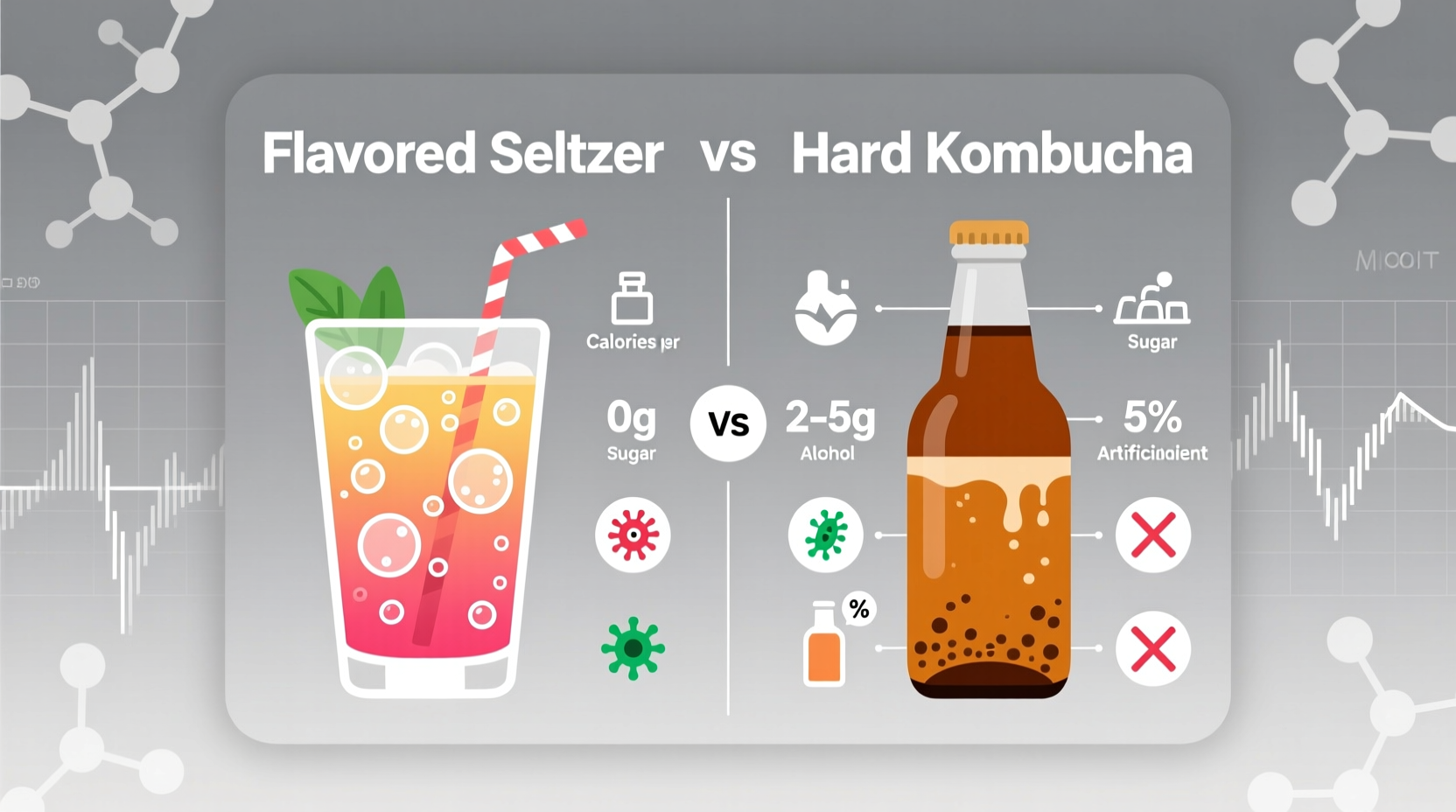
Before comparing health impact, it’s essential to understand what defines each beverage at the ingredient level.
Flavored seltzer (non-alcoholic) is carbonated water infused with natural or artificial flavors, sometimes sweetened with zero-calorie sweeteners like sucralose, stevia, or erythritol. Most contain no sugar, no calories, and no alcohol. “Hard seltzer,” by contrast, adds ethanol—typically 4–6% ABV—via fermentation of cane sugar or malted barley, then flavoring. It usually contains 100–150 calories per 12 oz, 2–3g carbs, and negligible nutrients.
Hard kombucha begins as traditional kombucha—a fermented tea made with SCOBY (symbiotic culture of bacteria and yeast), black or green tea, and sugar. The initial fermentation produces organic acids (acetic, gluconic), B vitamins, and trace probiotics. To make it “hard,” producers extend fermentation or add additional fermentable sugars to boost alcohol content to 4.5–7% ABV. Most hard kombuchas retain some live cultures (though many are pasteurized post-fermentation), contain 10–30g of residual sugar per 12 oz, and range from 90–140 calories.
The divergence starts here: one is primarily carbonated water + additives; the other is a complex, biologically active, sugar-derived fermented beverage with variable microbial integrity.
Gut Health & Microbiome Impact Over Time
The gut microbiome is not static—it adapts continuously to dietary inputs. Long-term beverage choices influence microbial composition, barrier integrity, and immune signaling more than most realize.
Non-alcoholic flavored seltzers—especially those with artificial sweeteners—have demonstrated measurable effects on gut bacteria in human and murine studies. A 2023 randomized controlled trial published in Nature Medicine found that daily consumption of sucralose-sweetened seltzer over 12 weeks significantly reduced Akkermansia muciniphila abundance and increased Bacteroides vulgatus, correlating with mild postprandial glucose intolerance in otherwise healthy adults. While transient, repeated exposure may reinforce dysbiotic patterns over years, particularly in individuals with preexisting metabolic sensitivity.
Hard kombucha presents a more nuanced picture. Unpasteurized versions contain viable Acetobacter and Lactobacillus strains—but quantity and survivability depend heavily on production method and shelf life. A 2022 analysis in Frontiers in Microbiology tested 18 commercial hard kombuchas: only 4 retained >10⁶ CFU/mL of live microbes at expiration, and all showed marked decline after opening or refrigeration beyond 72 hours. More consistently beneficial are the postbiotic metabolites—organic acids, polyphenol derivatives, and small-chain fatty acid precursors—that persist regardless of live culture count. These compounds support colonic pH balance and epithelial tight junction function.
“Fermented beverages don’t need to be ‘probiotic’ to be prebiotic or postbiotic. The real long-term advantage lies in consistent delivery of microbial metabolites—not just live bugs.” — Dr. Elena Rios, Gut Microbiologist, Stanford Digestive Health CenterTip: If choosing hard kombucha for gut support, select brands labeled “unpasteurized,” “raw,” or “refrigerated only”—and consume within 3 days of opening. Avoid shelf-stable, ambient-temperature versions if microbiome benefits are your goal.
Sugar, Sweeteners, and Metabolic Load Across Decades
Long-term health isn’t determined by single servings—it’s shaped by habitual patterns. And few patterns are more insidious than daily low-dose sweetener or sugar exposure.
| Factor | Flavored Seltzer (non-alc) | Hard Seltzer | Hard Kombucha |
|---|---|---|---|
| Average added sugar per 12 oz | 0 g | 0–1 g | 12–28 g |
| Primary sweetener(s) | Sucralose, stevia, monk fruit | Cane sugar (fermented), sometimes added post-ferment | Residual cane or organic evaporated cane juice |
| Insulin response (clinical observation) | Minimal direct rise, but possible cephalic phase effect | Negligible (no sugar load) | Moderate—especially with >15g residual sugar |
| Fructose content | None | Low (if derived from cane sugar) | Moderate to high (depending on tea base & fermentation time) |
| Long-term metabolic risk (per cohort data) | Associated with increased preference for sweetness & higher discretionary sugar intake elsewhere | No significant association in moderate use (<2x/week) | Linked to improved insulin sensitivity *only* when replacing sugary drinks—not when added to existing diet |
Crucially, hard kombucha’s sugar isn’t “empty”: it coexists with polyphenols from tea, acetic acid, and enzymatically active compounds that slow gastric emptying and blunt glycemic spikes. In contrast, the intense sweetness perception from zero-calorie seltzers can condition neural reward pathways toward heightened sweet cravings—a phenomenon documented in longitudinal studies tracking dietary habits over 10+ years.
Alcohol Metabolism and Organ Stress Accumulation
Both hard seltzer and hard kombucha deliver ethanol—but how your body processes it differs based on matrix effects.
Hard seltzer is essentially ethanol diluted in flavored water. Without accompanying nutrients or bioactive compounds, alcohol is absorbed rapidly—peaking in blood concentration within 30–45 minutes. This creates sharper acute stress on the liver’s ADH/ALDH enzyme systems and increases oxidative burden per unit of alcohol consumed.
Hard kombucha delivers ethanol embedded in an acidic, polyphenol-rich medium. Acetic acid slows gastric emptying, delaying peak BAC by ~20–35 minutes. Tea catechins (especially EGCG) enhance glutathione synthesis—the liver’s primary antioxidant defense against acetaldehyde toxicity. A 2021 crossover study in The American Journal of Clinical Nutrition found participants consuming hard kombucha had 22% lower plasma acetaldehyde AUC (area under curve) and 18% less post-drink oxidative stress markers than those drinking equivalent ABV hard seltzer.
Over decades, this difference matters. Chronic, low-grade oxidative stress contributes to hepatic steatosis, mitochondrial dysfunction in cardiomyocytes, and accelerated telomere attrition. While neither beverage is “healthy alcohol,” hard kombucha’s compositional complexity offers modest but physiologically meaningful buffering—particularly for regular, low-dose consumers (e.g., 3–4 drinks/week).
Real-World Habit Patterns: A Mini Case Study
Consider Maya, 42, a project manager in Portland who switched from daily diet soda to flavored seltzer five years ago. She drinks two cans daily—strawberry lime and black cherry—always chilled, always unsweetened. Initially, her energy stabilized and she lost 8 pounds. But by year three, she noticed afternoon fatigue, increased sugar cravings at dinner, and bloating after high-fiber meals. Her fasting glucose rose from 84 mg/dL to 96 mg/dL. A stool test revealed reduced microbial diversity and low Akkermansia.
At her nutritionist’s suggestion, Maya replaced one daily seltzer with unpasteurized hard kombucha (4.5% ABV, 14g sugar), consumed with lunch. Within 10 weeks, her afternoon energy improved, dinner cravings subsided, and her next glucose test read 89 mg/dL. Crucially, she didn’t increase total alcohol intake—she shifted the *type* and *context* of her daily beverage ritual. She also began drinking both beverages with food rather than on an empty stomach, further moderating metabolic impact.
Maya’s experience reflects a broader pattern: long-term health hinges less on absolute avoidance and more on strategic substitution, timing, and compositional awareness.
Your Action Plan: Building Sustainable Beverage Habits
Health isn’t optimized in isolation—it emerges from repeatable, context-aware behaviors. Here’s how to align your choices with long-term well-being:
- Assess your baseline frequency: Track beverage intake for one week—note type, time, quantity, and whether consumed with food. Identify habitual triggers (e.g., “I reach for seltzer at 3 p.m. because I’m tired”).
- Replace—not just reduce: Swap one weekly flavored seltzer serving with a low-sugar, unpasteurized hard kombucha (ideally ≤12g sugar). Pair it with protein or fiber (e.g., almonds or roasted chickpeas) to slow absorption.
- Rotate your bases: Alternate between non-alcoholic mineral water, herbal infusions, and occasional hard kombucha. Avoid anchoring daily rituals to any single flavored, sweetened, or fermented product.
- Read beyond “natural”: Check ingredient lists—not just front-of-package claims. “Natural flavors” may still include diacetyl or propylene glycol; “organic cane sugar” in hard kombucha still contributes fructose load.
- Hydrate first, flavor second: Drink 8 oz plain water before reaching for any flavored beverage. This reduces habitual overconsumption and resets taste perception.
Frequently Asked Questions
Can I drink hard kombucha daily without harming my liver?
For healthy adults, consuming one 12-oz serving of hard kombucha (≤5% ABV) daily falls within low-risk alcohol guidelines (≤1 drink/day for women, ≤2 for men). However, “low-risk” doesn’t mean “risk-free.” Daily ethanol exposure—even at low doses—can subtly elevate liver enzymes (ALT, AST) over 5–10 years in susceptible individuals. If you have NAFLD, prediabetes, or take medications metabolized by CYP2E1, consult your physician before regular use.
Does flavored seltzer erode tooth enamel?
Yes—carbonation creates carbonic acid (pH ~3–4), and added citric or malic acid in many brands lowers pH further (some to <2.5). This acidity demineralizes enamel over time, especially with frequent sipping. Hard kombucha is similarly acidic (pH ~2.8–3.2), but its polyphenols may inhibit enamel-dissolving enzymes like glucosyltransferase. Either way, avoid swishing, use a straw, and wait 30 minutes before brushing after consumption.
Are there truly “probiotic” hard kombuchas?
Few meet the strict definition. To qualify as probiotic, a product must contain ≥10⁹ CFU of a clinically studied strain, survive gastric transit, and demonstrate health benefits in human trials. Most hard kombuchas contain <10⁶ CFU/mL—and pasteurization kills most cultures. Think of them as “postbiotic-rich” rather than probiotic. For proven probiotic benefit, choose refrigerated, third-party tested supplements or traditionally fermented foods like kimchi or unsweetened kefir.
Conclusion: Choosing Consistency Over Perfection
Neither flavored seltzer nor hard kombucha is a health food. But neither is inherently harmful—when understood, contextualized, and consumed intentionally. Long-term health emerges not from rigid elimination, but from informed layering: choosing seltzer for hydration without sweetness overload, selecting hard kombucha for its organic acid profile and slower alcohol kinetics, and always anchoring beverages in whole-food meals. What matters most is how these drinks fit into your broader metabolic rhythm—how they shape your gut ecology over seasons, influence your insulin sensitivity across decades, and support (or undermine) your capacity for restorative sleep and steady energy.
You don’t need to pick a “winner.” You need clarity, consistency, and the willingness to adjust based on how your body responds—not just today, but five years from now. Start with one swap this week. Observe. Adjust. Repeat. That’s where real, lasting health begins.
💬 What’s your go-to beverage for winding down—or staying hydrated? Share your experience, questions, or swaps in the comments. Real stories help others navigate what works—not just what’s trending.