The martini is not merely a cocktail—it’s a litmus test. A single pour reveals whether a bartender understands balance, history, and intention. At its core, the martini is a dialogue between spirit and aromatized wine. And the most consequential voice in that conversation isn’t the gin or vodka—it’s the vermouth. Yet decades of oversimplification have reduced this relationship to a binary: “dry” equals “less vermouth,” “sweet” equals “old-fashioned.” Neither is accurate. And neither tells the full story of what makes a martini *work*. The real question isn’t which vermouth is “better”—it’s which vermouth serves the structure, palate, and purpose of the martini you’re aiming to build.
What “Dry” and “Sweet” Actually Mean (Beyond Sugar Content)
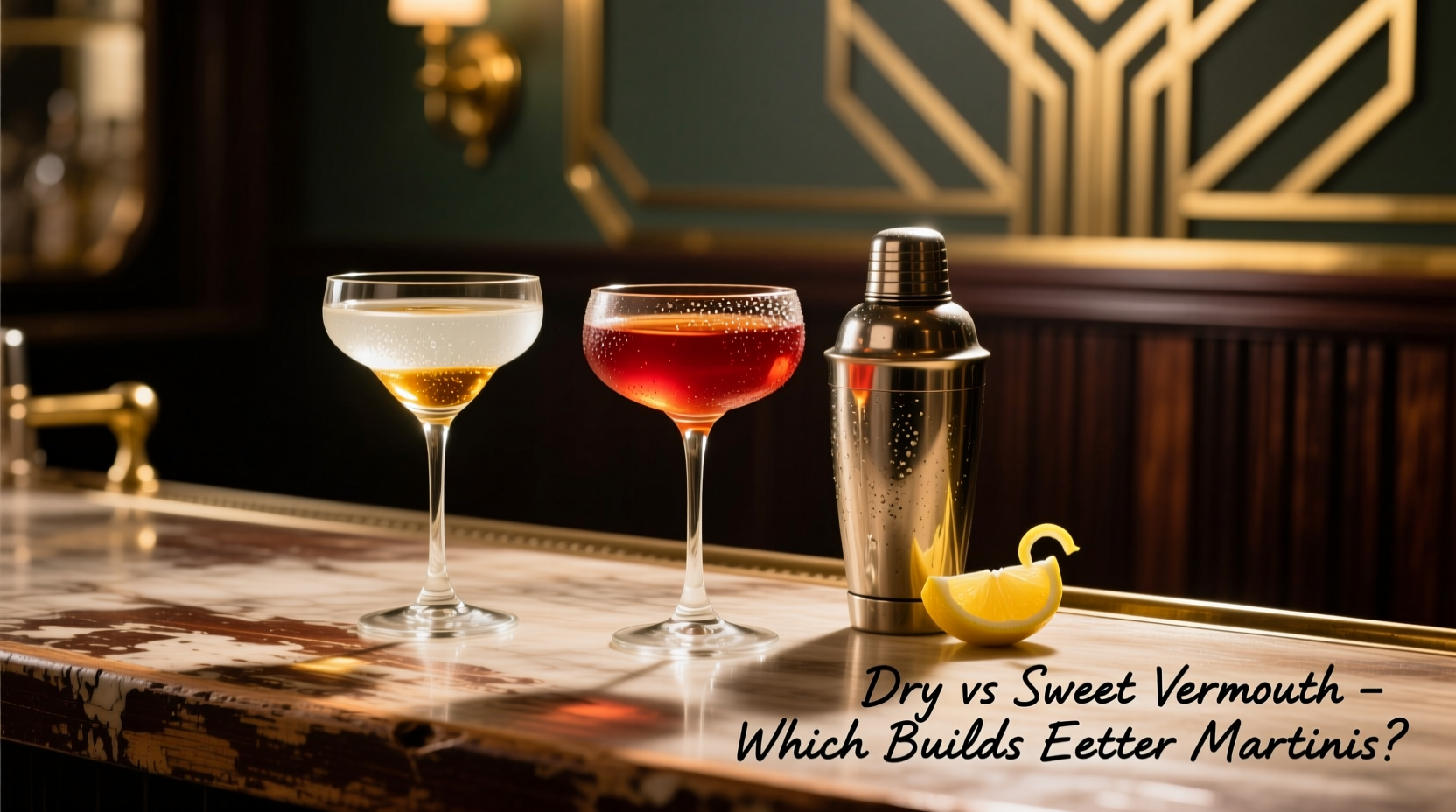
“Dry” and “sweet” refer first to residual sugar levels—but that’s only the entry point. Dry vermouth typically contains less than 4 grams of sugar per liter (often 0–2 g/L), while sweet vermouth ranges from 100–150 g/L. That’s a 50-fold difference—not subtle, but not decisive on its own. What matters more are the botanical profiles, oxidation levels, and structural roles each plays.
Dry vermouths—like Noilly Prat Original, Dolin Dry, or Taylor Dry—are built around crisp, high-acid white wines (often Picpoul, Clairette, or Ugni Blanc), fortified with neutral grape spirit, then aged briefly in stainless steel or neutral oak. Their bitterness comes from gentian root and wormwood; their aroma leans citrus-peel, chamomile, and green almond. They’re linear, bright, and functionally acidic—like a splash of lemon juice with botanical depth.
Sweet vermouths—such as Carpano Antica Formula, Cocchi Vermouth di Torino, or Punt e Mes—are based on richer red or amber wines (often Moscato or Trebbiano), aged longer in wood, and layered with caramelized sugar, vanilla, clove, cinnamon, and bitter orange peel. Their viscosity, oxidative notes (think dried fig, leather, toasted walnut), and pronounced bittersweet finish give them structural heft—more akin to a fortified wine than a mixer.
Tip: Never judge vermouth by color alone. Some dry vermouths (e.g., Lustau Dry) are amber; some sweet vermouths (e.g., Cinzano Rosso) appear deceptively light. Always check the label for sugar content or consult the producer’s technical sheet.The Martini’s Structural Truth: It’s Not About Preference—It’s About Architecture
A well-built martini balances three pillars: spirit intensity, aromatic complexity, and acid-driven lift. The vermouth doesn’t “dilute” the spirit—it modulates it. Dry vermouth sharpens the gin’s juniper or vodka’s neutrality with acidity and herbal cut. Sweet vermouth rounds edges, adds mid-palate weight, and introduces counterpoint bitterness that prevents cloyingness.
Consider the classic 6:1 gin-to-dry-vermouth ratio. At that proportion, the vermouth contributes ~14% of total volume—but contributes nearly 100% of the drink’s aromatic top note and 80% of its perceived acidity. Reduce it to 12:1, and you lose lift; increase to 3:1, and the drink becomes herbaceous and tea-like—closer to a vermouth-forward aperitif than a martini.
With sweet vermouth, the architecture shifts entirely. A 3:1 gin-to-sweet-vermouth ratio yields a drink with deeper resonance, slower evolution on the palate, and a finish that lingers with spice and tannin. It’s not “sweeter” in the dessert sense—it’s *bittersweet*, like dark chocolate or Campari-soaked orange peel. This version demands a sturdier base spirit: London Dry gins with bold citrus and coriander (e.g., Beefeater, Tanqueray) or rich, barrel-aged gins hold up best.
Historical Context: Why the “Dry Martini” Took Over (and Why It Wasn’t Always the Ideal)
The earliest published martini recipes—from the 1888 Bar-Tender’s Guide by Harry Johnson—called for equal parts Old Tom gin and sweet vermouth, garnished with lemon twist. It was a robust, rounded, almost negroni-adjacent drink. By the 1910s, bartenders began reducing vermouth to emphasize gin’s character—a trend accelerated by Prohibition-era bootleg gin’s harshness. Less vermouth meant less exposure to off-notes.
The “dry martini” as we know it crystallized in the 1930s–40s, championed by figures like Bernard “Bert” Laverne, who famously stirred martinis for six minutes to “chill the soul.” But even then, “dry” meant “using dry vermouth”—not “using less vermouth.” A 1934 Savoy Cocktail Book recipe specifies “1/2 jigger dry vermouth” to 2 jiggers gin—a 4:1 ratio, far wetter than today’s norm.
What changed wasn’t taste—it was availability. Post-war, mass-produced dry vermouth (like Martini & Rossi Extra Dry) dominated shelves. Its lower price, longer shelf life, and aggressive marketing positioned it as the “modern” choice. Sweet vermouth receded into Manhattan and Rob Roy territory—misclassified as “for old people” rather than recognized as a distinct, sophisticated tool.
“The idea that a martini must be dry is a 20th-century myth. Pre-1920 martinis were sweet, complex, and deeply aromatic. Today’s ‘perfect’ martini is often just under-seasoned.” — David Wondrich, cocktail historian and author of Imbibe!
Practical Decision Framework: Which Vermouth Serves Your Goal?
Choosing between dry and sweet vermouth isn’t about personal taste alone—it’s about aligning with your objective. Use this table to match vermouth type to intent:
| Your Goal | Best Vermouth Choice | Why It Works |
|---|---|---|
| Highlight crisp, citrusy, or floral gin (e.g., Hendrick’s, The Botanist) | Dry vermouth (Dolin Dry or Noilly Prat) | Acidity lifts volatile top notes; gentian bitterness cleanses the palate without competing. |
| Balance bold, juniper-forward gin (e.g., Plymouth, Broker’s) | Dry vermouth at 4:1 or 3:1 ratio | Provides enough structure to support intensity without muting botanicals. |
| Create a sipping martini with depth and warmth (ideal for colder months or after-dinner) | Sweet vermouth (Carpano Antica or Cocchi) | Vanilla and spice notes harmonize with aged spirits; oxidative character adds savory length. |
| Accommodate lower-proof or softer gins (e.g., Sipsmith V.J.O.P., Ford’s) | Sweet vermouth at 5:1 ratio | Adds body and mouthfeel where the spirit lacks alcohol-derived texture. |
| Build a vodka martini that isn’t one-dimensional | Dry vermouth (with expressed lemon oil) | Vodka provides blank canvas; dry vermouth supplies essential aromatic contrast and acidity. |
Mini Case Study: How One Bar Transformed Its Martini Program
In early 2022, The Marlowe in San Francisco retrained its bar team on vermouth fundamentals. Previously, all martinis used Dolin Dry at a rigid 6:1 ratio—regardless of gin, season, or guest request. Guest feedback noted consistency but also monotony: “Always tastes the same,” read one Yelp review. “Like drinking gin with a whisper of something else.”
The bar manager introduced a dual-vermouth system. Staff learned to taste each gin for dominant notes (citrus, pine, spice, earth), then matched vermouth accordingly. For floral gins like Monkey 47, they switched to a 4:1 ratio with Dolin Dry. For heavier, spiced gins like Uncle Val’s Botanical, they offered a “Marlowe Reserve” option: 3:1 Plymouth Gin to Carpano Antica, stirred 45 seconds, served with an orange twist.
Within three months, martini sales increased 37%. More significantly, 62% of guests ordering the Reserve option returned within two weeks—citing “the one that actually tastes like a *drink*, not just cold gin.” The lesson wasn’t that sweet vermouth was “better.” It was that matching vermouth to structural need created intentionality—and intentionality builds loyalty.
Step-by-Step: Building Your First Intentional Vermouth-Martini
- Taste your base spirit neat. Note dominant botanicals (e.g., “juniper forward with lemon pith and black pepper”) and texture (thin vs. oily, sharp vs. round).
- Select vermouth based on profile match: Citrus/floral gins → dry vermouth; spicy/earthy gins → sweet vermouth; neutral vodkas → dry vermouth + citrus oil.
- Choose ratio deliberately: Start at 4:1 for dry, 3:1 for sweet. Adjust in 0.25 oz increments next time based on balance.
- Stir—not shake—with large, dense ice for exactly 35–45 seconds. This chills without over-diluting, preserving vermouth’s delicate aromatics.
- Garnish with intention: Lemon twist for dry (enhances brightness); orange twist for sweet (complements spice); olives only if the drink has sufficient fat/bitterness to support brine.
FAQ
Can I use both dry and sweet vermouth in one martini?
Yes—and it’s historically grounded. The “Perfect Martini” uses equal parts dry and sweet vermouth (e.g., 1.5 oz gin, 0.25 oz dry, 0.25 oz sweet). This hybrid delivers both lift and depth, ideal for gins with layered profiles like Bombay Sapphire East or Ransom Old Tom. Just ensure both vermouths are fresh: opened dry vermouth lasts 3–4 weeks refrigerated; sweet vermouth, 6–8 weeks.
Does vermouth quality really matter in a 12:1 martini?
Absolutely. At ultra-low ratios, flaws become magnified. A cheap dry vermouth with artificial citrus oil will taste medicinal and flat. A high-quality one like Dolin Dry or Noilly Prat brings nuanced herbs and clean acidity—even at 0.125 oz. Think of it like salt in soup: a pinch of Maldon transforms; table salt dulls.
Why does my dry-vermouth martini taste hollow after five minutes?
Vermouth’s volatile aromatics dissipate rapidly when exposed to air and warmth. Serve immediately in a pre-chilled Nick & Nora or coupe glass. Never let it sit. If serving multiple drinks, stir and strain one at a time—not in batches.
Conclusion
There is no universal “better” vermouth for martinis—only better choices for specific purposes. Dry vermouth excels when clarity, precision, and refreshment are paramount. Sweet vermouth shines when depth, resonance, and contemplative sipping are the goal. The craft lies not in dogma but in discernment: tasting, adjusting, and understanding how botanicals interact across the spectrum of sugar, acid, and bitterness. A great martini doesn’t shout its ingredients—it invites you to listen closely to their conversation. So open both bottles. Taste them side by side. Stir one with attention, then the other. Notice how the same gin transforms—how juniper softens into warmth, how citrus sharpens into brilliance. That awareness is where mastery begins.
💬 Your turn: Try a 3:1 martini with Carpano Antica tonight—and compare it to your usual dry version. Then share what shifted for you in the comments. Let’s rebuild the martini, one intentional pour at a time.