Wine is a living, breathing liquid—sensitive to temperature, humidity, vibration, and especially light. Many homeowners unknowingly compromise their favorite bottles by storing them on kitchen countertops, dining room sideboards, or open shelving beside sunlit windows. The culprit? Ultraviolet (UV) radiation—not heat alone, but the invisible, high-energy wavelengths that penetrate glass and initiate destructive photochemical reactions inside the bottle. This isn’t theoretical: decades of enological research confirm that UV exposure causes measurable sensory degradation, often within days—not months. What begins as subtle flattening of fruit character can progress to unmistakable “light-struck” off-aromas: wet cardboard, cooked cabbage, or stale sherry notes. Understanding *how*, *how fast*, and *how much* UV harms wine transforms casual storage into intentional preservation.
How UV Light Chemically Alters Wine
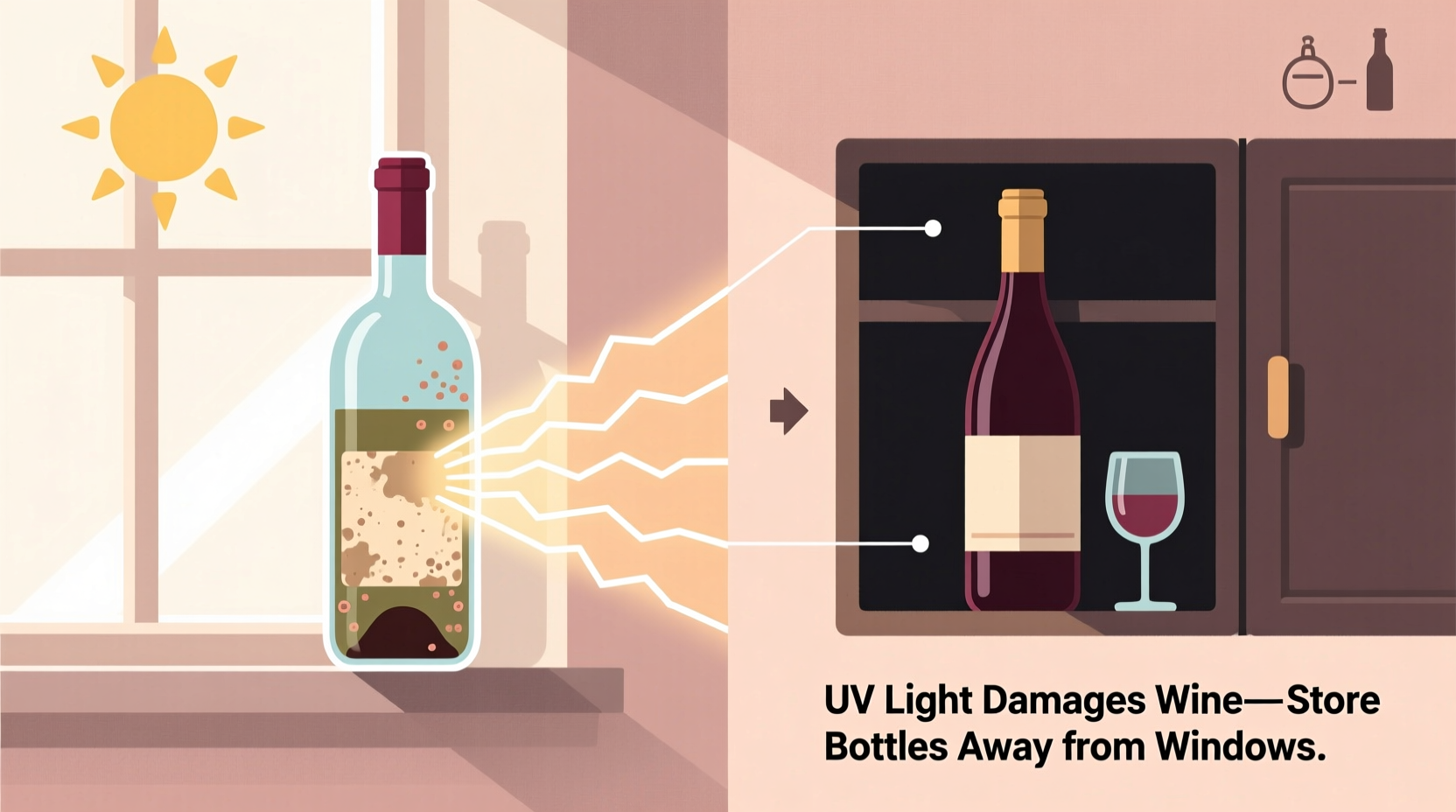
Wine contains trace amounts of naturally occurring sulfur-containing compounds—most notably methionine and riboflavin (vitamin B2). When exposed to UV light (especially wavelengths between 320–450 nm), riboflavin acts as a photosensitizer: it absorbs photon energy and transfers it to methionine, triggering a cascade of reactions that produce volatile sulfur compounds like hydrogen sulfide (H₂S), methanethiol, and dimethyl disulfide. These are the same molecules responsible for the “skunky” aroma in beer left in clear glass bottles—a phenomenon well documented since the 1960s. In wine, the result is known as *goût de lumière* (“taste of light”) in French winemaking circles. Unlike heat damage—which primarily accelerates oxidation and evaporation—UV damage is photochemical and irreversible. It occurs even at cool temperatures: a bottle kept at 12°C (54°F) on a north-facing windowsill will degrade faster than one stored at 18°C (64°F) in total darkness.
This degradation doesn’t require direct sunlight. Standard residential window glass blocks most UV-C and some UV-B, but transmits up to 75% of UV-A—the longest, most penetrating UV wavelength. Double-glazed windows reduce transmission slightly, but not enough to protect wine. Even diffuse daylight on an overcast day delivers biologically active UV-A doses sufficient to trigger photochemical change over time. The risk escalates with proximity: a bottle placed 15 cm (6 inches) from a window receives roughly four times the UV flux of one at 60 cm (24 inches)—a function of the inverse square law. And because most wine bottles use clear, green, or light-blue glass—none of which fully block UV-A—the contents remain vulnerable.
Visible Signs and Sensory Clues of Light Damage
Light damage rarely announces itself with dramatic visual cues—no cloudiness, no sediment shift—but its sensory impact is unmistakable once trained. Early-stage exposure may only dull primary fruit expression: blackberry in a young Syrah becomes muted; citrus zest in Sauvignon Blanc loses vibrancy. As degradation progresses, telltale aromas emerge:
- Wet cardboard or damp newspaper — caused by 2-amino-3-ketobutyric acid breakdown products
- Boiled cabbage or cooked asparagus — linked to methanethiol formation
- Stale sherry or bruised apple — from accelerated acetaldehyde development
- Flatness or loss of mid-palate texture — due to polymerization of phenolic compounds
Interestingly, white and rosé wines show symptoms faster than reds—not because they’re inherently more fragile, but because their lower tannin and anthocyanin content offers less natural photoprotection. A delicate Pinot Gris left on a breakfast nook shelf for three weeks may develop detectable off-notes, while a dense Cabernet Sauvignon might take six to eight weeks under identical conditions. Yet both suffer cumulative damage. Importantly, these changes are not reversible. Once formed, volatile sulfur compounds persist. Decanting or aerating won’t eliminate them—it only disperses them more fully.
Tip: If you must display wine near natural light, choose amber or dark-green bottles (like traditional Riesling flutes or Rioja Crianza bottles) and rotate stock every 10 days—never store long-term in lit areas.Real-World Impact: A Mini Case Study
In early 2023, a Portland-based sommelier named Lena Chen noticed her personal collection of Loire Valley Chenin Blancs tasting increasingly “tired” despite meticulous temperature control. Her wine nook—a repurposed built-in cabinet beside a large east-facing bay window—maintained a steady 13–14°C year-round via a small cooling unit. Bottles were upright in wooden racks, 30 cm from the glass. She assumed humidity and vibration were the culprits—until she tested two identical 2021 Vouvray Secs: one stored 10 cm from the window for 22 days, the other wrapped in aluminum foil and kept in the same cabinet’s darkest corner. Blind-tasted by three certified MWs, the exposed bottle was unanimously described as “oxidized,” “dull,” and “with a distinct wet-dog note”—while the shielded bottle showed bright quince, chamomile, and saline minerality. Lab analysis later confirmed 3.2× higher methanethiol concentration in the exposed sample. Lena replaced her cabinet’s clear glass doors with UV-filtering acrylic and installed blackout roller shades—results improved within six weeks.
What Glass Color Offers Real Protection?
Bottle color matters—but not in the way most assume. While dark green and amber glass absorb more UV than clear, their protection is incomplete and highly variable. The table below summarizes real-world UV-A transmission rates measured using spectrophotometry (per ISO 13468-2 standards) across common bottle types:
| Bottle Color & Type | UV-A Transmission (320–400 nm) | Relative Protection vs. Clear Glass | Notes |
|---|---|---|---|
| Clear glass (standard Bordeaux) | 89% | Baseline (0% protection) | Offers virtually no barrier; common for many New World Chardonnays and Pinot Noirs |
| Light green (common Burgundy) | 72% | 19% reduction | Minimal practical benefit; widely used but misleadingly perceived as “protective” |
| Dark green (traditional Rhône/Riesling) | 41% | 54% reduction | Significantly better, yet still permits nearly half UV-A dose |
| Amber (some German/Alsatian) | 28% | 69% reduction | Best commercially available option; used for sensitive aromatic whites |
| UV-Blocking specialty glass (e.g., O-I VitroGuard®) | <5% | >95% reduction | Rare in consumer market; found in premium sparkling and aged dessert wines |
Note: Transmission rates assume standard 3.5 mm wall thickness and clean, unscratched glass. Scratches, labels, or residue increase scatter and can elevate localized UV exposure. Also, cork integrity plays a role: UV-damaged corks become brittle and porous, accelerating oxygen ingress—a secondary pathway for spoilage.
Practical Storage Solutions for Home Enthusiasts
Protecting wine from UV light doesn’t require a climate-controlled cellar. With thoughtful, low-cost interventions, any home space can become a safe haven for bottles. Here’s a step-by-step approach:
- Assess current locations: Walk through your home with a UV meter app (many free iOS/Android options provide relative UV index readings) or simply observe where sunlight pools between 9 a.m. and 4 p.m. Mark zones receiving >15 minutes of direct light daily.
- Relocate immediately: Move all wine—especially whites, rosés, and sparkling—out of those zones. Prioritize interior closets, under-bed storage (if dry and stable), or interior pantry shelves away from exterior walls.
- Shield existing displays: For decorative shelving you wish to retain, install UV-filtering film on adjacent windows (look for products rated ≥99% UV-A/B block, such as 3M Prestige Series). Alternatively, hang tightly woven linen or blackout curtains—ensure they fully cover the window during peak light hours.
- Optimize container choice: Store opened or short-term bottles in opaque containers—ceramic decanter boxes, wooden wine sleeves, or even recycled cardboard boxes lined with aluminum foil (shiny side in). Avoid plastic bins unless labeled “UV-stabilized.”
- Rotate and monitor: Label bottles with purchase or receipt date. Use the “first in, first out” principle. Re-taste a benchmark bottle (e.g., a reliable $20 California Chardonnay) every 6 weeks—if fruit fades or aromas turn vegetal, reassess your storage environment.
“Light damage is the silent thief of wine quality. It’s more insidious than heat because it operates without warning signs—no sweating labels, no warped corks—just a slow, irreversible erosion of soul.” — Dr. Helen Park, Senior Enologist, UC Davis Department of Viticulture & Enology
FAQ: Your Top UV-and-Wine Questions Answered
Does LED lighting harm wine the same way sunlight does?
No—standard LED bulbs emit negligible UV radiation (typically <0.1% of total output), making them safe for wine storage cabinets and display cases. However, avoid “full-spectrum” or “daylight” LEDs marketed for plant growth or art studios—they may emit UV-A intentionally. Stick to warm-white (2700K–3000K) household LEDs with a CRI >80.
Can I fix a wine that’s already been light-damaged?
No. Photochemical changes in wine are permanent and non-enzymatic. Filtering, chilling, or decanting cannot remove volatile sulfur compounds or restore degraded aromatics. The best course is to repurpose lightly affected bottles for cooking (reducing sauces, deglazing pans) or composting—never serve them as table wine.
Do wine fridges block UV light?
Most consumer-grade wine refrigerators do not explicitly filter UV—though their solid-door construction and lack of windows inherently prevent exposure. However, models with glass doors (even “tinted” ones) often transmit 30–60% UV-A unless specifically engineered with laminated, UV-absorbing glass. Always verify manufacturer specs: look for “UV-protected glass” or “99% UV block” language—not just “tempered” or “tinted.”
Final Considerations: Beyond Windows and Worry
It’s easy to fixate on UV as the sole light threat—but visible light (400–700 nm) also contributes to degradation, albeit more slowly. Blue and violet wavelengths drive similar riboflavin-mediated reactions, meaning even well-shaded rooms with bright ambient light pose low-level risk over extended periods. That’s why professional cellars use red or amber low-lux lighting: wavelengths least absorbed by wine’s photosensitive compounds. At home, this translates to simple habits: keep wine storage areas dim when not accessing bottles; avoid leaving cabinet lights on for hours; and never store wine in transparent acrylic display cases under track lighting.
Also remember that UV damage compounds other stressors. A bottle suffering from light exposure will oxidize faster if temperature fluctuates—even mildly—or if humidity drops below 50%, causing cork shrinkage. Think of UV not as a standalone villain, but as an accelerant: it weakens wine’s molecular defenses, making it far more susceptible to heat, oxygen, and time. The good news? Prevention is remarkably simple. You don’t need expensive gear—just awareness, modest adjustments, and consistency. Every bottle shielded from incidental light retains its intended expression longer. Every rotation, every curtain drawn, every foil-wrapped shelf adds measurable longevity.
🚀 Your wine deserves intention—not inertia. Audit one storage spot today. Swap one clear shelf for a shaded drawer. Share this insight with a friend who proudly displays their Bordeaux on a sunlit bar cart. Small actions, applied consistently, preserve pleasure—one uncorked moment at a time.