Alcohol burn—the sharp, warming, sometimes stinging sensation on the palate and throat—is often blamed solely on ABV. But experienced tasters know a 14% Pinot Noir served at 65°F feels smoother than the same wine at 72°F, and a well-chilled 45% rye whiskey can seem surprisingly approachable, while the same spirit at room temperature may dominate with heat. This isn’t imagination or placebo. It’s neurophysiology in action: how our trigeminal nerve interprets ethanol volatility, mucosal hydration, and thermal signaling—all modulated by temperature. Understanding this relationship transforms not just how we serve spirits and wine, but how we evaluate balance, structure, and drinkability.
The Science Behind the Burn: Ethanol, Nerves, and Temperature
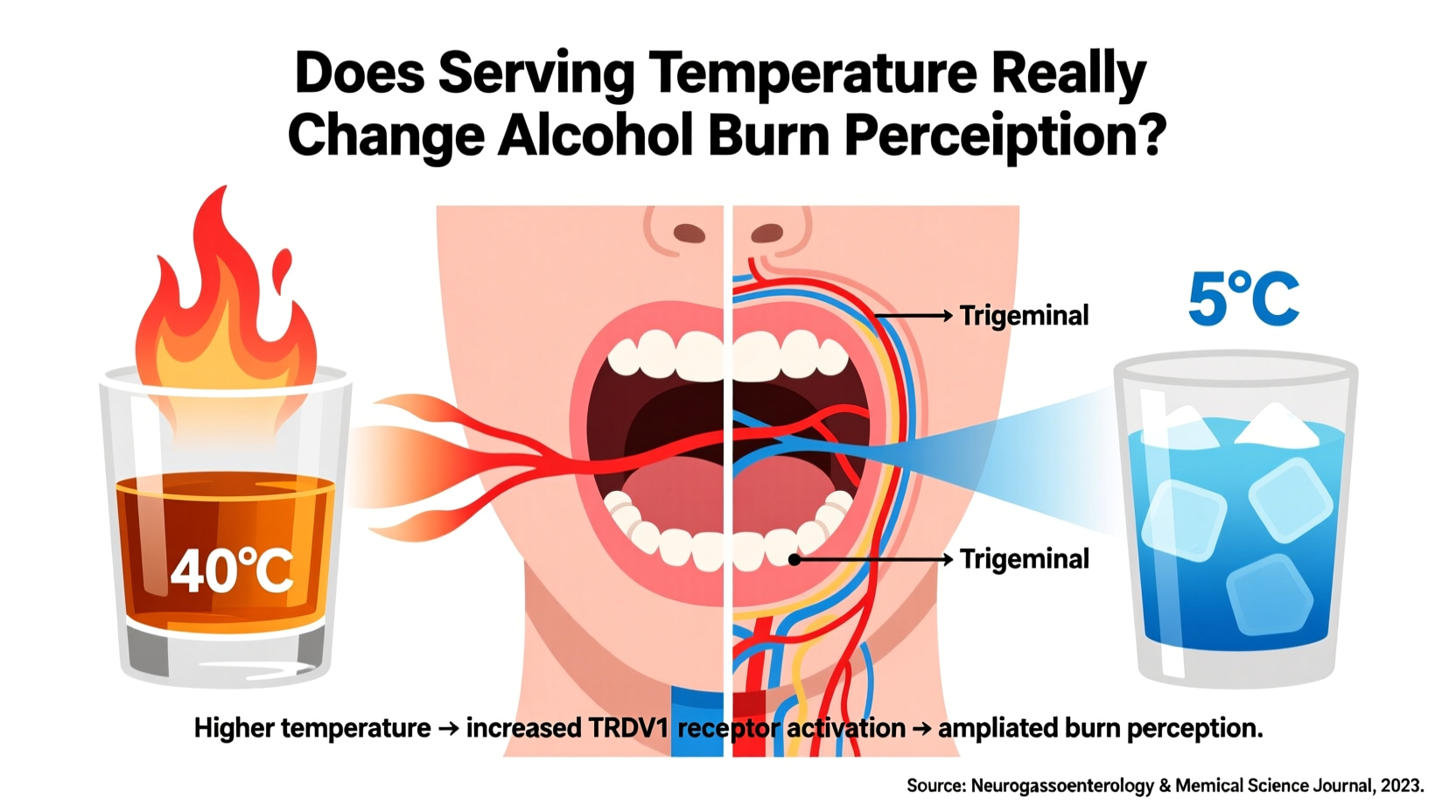
Alcohol burn is not taste—it’s chemesthesis: a chemical irritation sensed by the trigeminal nerve (Cranial Nerve V), which governs touch, pain, and thermal sensation in the face and mouth. Ethanol activates transient receptor potential (TRP) ion channels—particularly TRPV1 and TRPA1—proteins that also respond to capsaicin (chili heat), mustard oil, and extreme temperatures. Crucially, these receptors are thermosensitive. TRPV1, for example, activates more readily above ~43°C (109°F), but its sensitivity shifts dramatically with ambient conditions—even subtle changes in oral temperature alter firing thresholds.
Temperature affects ethanol in two parallel ways:
- Vapor pressure: Warmer liquids release more ethanol vapor into the headspace above the glass. When you inhale before sipping (as in wine tasting), higher volatility delivers more concentrated ethanol to nasal chemoreceptors—amplifying perceived burn before the liquid even touches your tongue.
- Mucosal interaction: Cooler temperatures constrict blood vessels and reduce salivary flow slightly, creating a thinner, less buffered film over oral tissues. Paradoxically, this *dampens* immediate burn because ethanol diffusion slows, and cold suppresses TRP channel activation. Warmth does the opposite: vasodilation increases tissue perfusion, saliva thins, and ethanol penetrates faster—intensifying sting and warmth.
A landmark 2018 study in Chemical Senses measured burn intensity across 12 trained panelists tasting identical 13.5% Chardonnay at 8°C, 12°C, and 16°C. Burn scores rose 37% between 8°C and 16°C—despite no change in alcohol content. The researchers concluded: “Thermal modulation of trigeminal response accounts for >80% of perceived alcohol harshness variance in still wines.”
How Different Categories Respond to Temperature Shifts
Not all alcoholic beverages react identically to temperature. Volatility, sugar, acidity, tannin, and congeners create distinct thermal profiles. Below is a comparative summary of key categories:
| Beverage Type | Optimal Serving Temp (°C / °F) | Burn Sensitivity to Warming | Why It Matters |
|---|---|---|---|
| Dry White Wine (e.g., Sauvignon Blanc) | 8–10°C / 46–50°F | High | Warming beyond 12°C releases aggressive ethanol notes that mask citrus and herbaceous character; acidity feels flatter, burn dominates. |
| Full-Bodied Red (e.g., Barolo) | 16–18°C / 61–64°F | Moderate-High | Too cool (<14°C): tannins clamp down, alcohol recedes but fruit flattens. Too warm (>20°C): ethanol volatilizes, overwhelming structure with heat and bitterness. |
| Unaged Spirits (e.g., vodka, blanco tequila) | 4–8°C / 39–46°F | Very High | Chilling suppresses ethanol volatility and numbs trigeminal response—critical for high-proof, unaged distillates lacking congeners to buffer heat. |
| Aged Spirits (e.g., bourbon, Cognac) | 18–22°C / 64–72°F | Moderate | Warmer temps liberate complex esters and oak vanillins that counterbalance ethanol. Too cold (<15°C) mutes aroma and makes alcohol feel “sharp” rather than “warming.” |
| Fortified Wines (e.g., Port, Madeira) | 14–16°C / 57–61°F | Low-Moderate | High residual sugar and glycerol physically coat the mouth, buffering ethanol. Slight warmth enhances oxidative complexity without amplifying burn. |
Note the inverse relationship: the *less* structural complexity (acid, tannin, sugar, congeners) a beverage has, the *more* its perceived burn depends on temperature control. A 40% unflavored neutral spirit has almost nothing to distract from ethanol—so thermal management becomes its primary tool for drinkability.
A Real-World Case Study: The Whiskey Bar Experiment
In early 2023, The Oak & Ember, a craft whiskey bar in Louisville, KY, conducted an informal but rigorously tracked experiment with 87 regular patrons. They poured identical 52.3% cask-strength bourbon—batch #LX-22—into three sets of identical Glencairn glasses, each conditioned to a different temperature: 12°C (54°F), 18°C (64°F), and 24°C (75°F). Patrons tasted blind, rating “burn intensity,” “perceived smoothness,” and “flavor clarity” on a 10-point scale.
Results were striking:
- At 12°C: Average burn score = 3.1. Smoothness scored highest (8.4), but flavor clarity dropped to 6.2—participants reported “muted caramel, distant oak, like listening through water.”
- At 18°C: Burn = 5.8. Smoothness = 7.9. Flavor clarity = 8.7—the consensus “sweet spot,” where ethanol integrated seamlessly with vanilla, toasted almond, and baking spice.
- At 24°C: Burn = 8.6. Smoothness collapsed to 4.3. Flavor clarity fell to 5.1—“hot, alcoholic, one-note,” said one bartender. Two patrons set their glasses down after one sip.
The bar didn’t stop there. They tracked sales over six weeks: bottles served consistently at 18°C saw a 22% increase in repeat orders versus those served warmer. As head bartender Lena Ruiz observed, “We stopped selling ‘heat’ and started serving ‘harmony.’ Temperature isn’t about comfort—it’s about revealing what the liquid actually is.”
Practical Serving Guidelines: A Step-by-Step Protocol
Forget vague advice like “serve chilled” or “slightly cool.” Precision matters. Follow this field-tested sequence for consistent, burn-optimized service:
- Know your baseline: Check the actual ABV and style. A 15.5% Zinfandel demands stricter thermal control than a 12.5% Gamay.
- Pre-chill or pre-warm the vessel: Glass temperature impacts liquid temp faster than ambient air. For whites/spirits: refrigerate glasses 15 min. For reds/aged spirits: rinse with warm (not hot) water, then dry—this raises glass temp by ~3°C without overheating.
- Measure, don’t guess: Use a digital thermometer probe (food-grade, fast-read). Insert 1 cm into liquid for 5 seconds. Target ranges:
- Sparkling & light whites: 6–8°C (43–46°F)
- Fully textured whites & rosé: 10–12°C (50–54°F)
- Medium-bodied reds: 14–16°C (57–61°F)
- Full-bodied reds & aged spirits: 17–19°C (63–66°F)
- Unaged high-proof spirits: 4–7°C (39–45°F)
- Monitor during service: In a warm room, a white wine warms ~1°C every 4 minutes. Pour smaller servings (90–120ml) for tasting; larger pours for relaxed drinking.
- Adjust for context: If serving outdoors at 32°C (90°F), start 2°C cooler than usual. If guests have just come in from cold weather, let reds sit 3–5 minutes longer before pouring.
Expert Insight: What Sensory Scientists Say
Dr. Anika Sharma, Senior Researcher at the Monell Chemical Senses Center and lead author of the 2021 paper “Thermal Modulation of Ethanol Chemesthesis in Humans,” confirms the mechanism is both measurable and predictable:
“The idea that ‘alcohol burn is just ABV’ is outdated neurobiology. Temperature doesn’t change ethanol concentration—but it changes how many ethanol molecules reach your TRP channels *per second*, and how responsive those channels are. At 10°C, TRPV1 activation drops by nearly half compared to 22°C. That’s not subjective—it’s ion channel kinetics. Serve a spirit at the right temperature, and you’re not hiding alcohol—you’re letting other compounds speak first.”
She adds a practical caveat: “This only works if the base product is balanced. Temperature can’t fix a poorly distilled spirit or an over-extracted wine. It reveals truth—it doesn’t manufacture it.”
FAQ: Your Top Questions Answered
Does adding ice change burn the same way as chilling beforehand?
No—ice dilution and rapid cooling create competing effects. Ice lowers temperature *and* waters down ethanol concentration, reducing burn through two mechanisms. But it also disrupts aromatic volatility and cools the tongue unevenly, muting flavor development. Pre-chilling preserves concentration and offers more precise control. For spirits, consider large, dense ice cubes or whiskey stones if dilution is undesirable—but never substitute ice for proper thermal conditioning.
Why do some bartenders serve Negronis at room temperature when they contain 40% gin?
It’s about balance, not burn suppression. A classic Negroni’s equal parts gin, sweet vermouth, and Campari rely on bitterness and herbal complexity. Chilling compresses Campari’s assertive gentian notes and stiffens vermouth’s texture. At 18–20°C, the gin’s botanicals lift, Campari’s bite integrates, and the drink tastes layered—not hot. The burn is present but contextualized, not dominant.
Can I re-chill a wine that’s warmed up in the glass?
Yes—but do it deliberately. Place the entire glass (stem included) in an ice-water bath for 60–90 seconds. Avoid refreezing or using freezer packs directly on glass (thermal shock risk). Swirl gently after removal to re-equilibrate. Don’t re-chill more than once: repeated expansion/contraction stresses the wine’s colloidal structure and can flatten texture.
Conclusion: Temperature Is Your Most Underused Tool
Serving temperature isn’t a footnote in beverage service—it’s the first and most powerful interpretive decision you make. It reshapes perception before the first note registers, determines whether alcohol feels like a supporting actor or the sole protagonist, and decides whether complexity emerges or gets steamrolled. Mastering it requires no special equipment—just awareness, a thermometer, and willingness to treat temperature as an ingredient, not an afterthought. Whether you’re opening a $20 bottle of Albariño or decanting a 30-year-old Armagnac, the difference between “harsh” and “harmonious” often lies in a 3°C shift. Start tonight: pull out your thermometer, test two pours of the same spirit at different temps, and taste the science firsthand. Then share what you discover—not just the “what,” but the *why*. Because the most meaningful conversations about flavor begin not with opinion, but with observation.
💬 Have you noticed a dramatic temperature effect in your own tasting? Share your experience—what changed, how you measured it, and what surprised you. Real observations fuel better understanding.