Home fermentation has surged in popularity—from sourdough starters to fruit wines and small-batch meads. But when curiosity turns toward higher-alcohol beverages—like 12%+ wines, 14%+ ciders, or even spirit-base washes—the question inevitably arises: “Can I just use the yeast from my pantry?” The short answer is yes, you *can* ferment with baker’s yeast—but what you *get*, how *safely* you get it, and whether it qualifies as “strong alcohol” requires careful distinction between biological capability, practical yield, and regulatory reality. This isn’t about prohibition-era myths or YouTube hacks. It’s about understanding yeast metabolism, ethanol toxicity thresholds, contamination risks, and why “strong” doesn’t always mean “better”—or even “legal.”
How Yeast Turns Sugar into Alcohol—And Why Not All Strains Are Equal
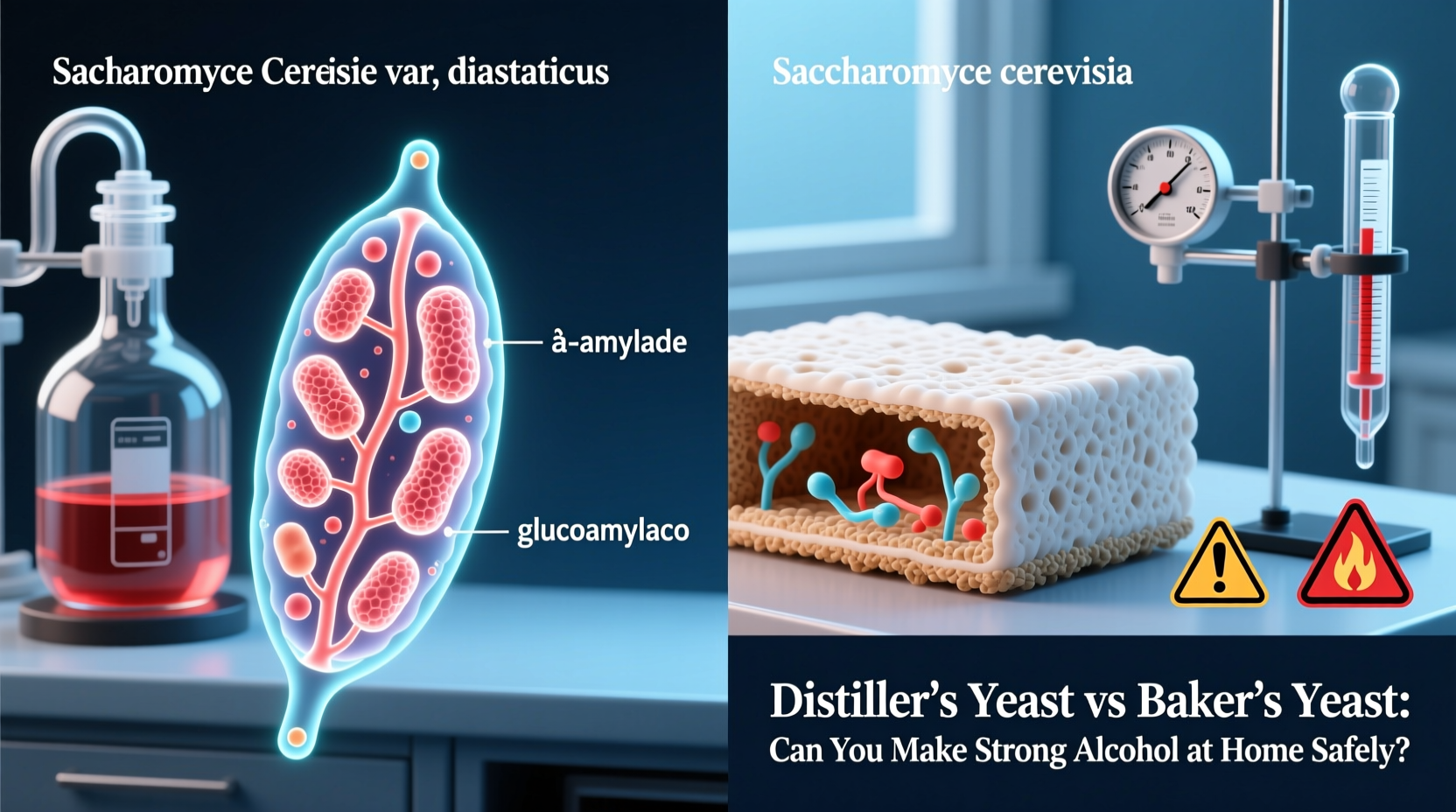
Fermentation is a metabolic process where yeast consumes simple sugars (glucose, fructose, sucrose) and produces ethanol and carbon dioxide as primary byproducts. But this process isn’t uniform across species—or even across strains of Saccharomyces cerevisiae, the species that includes both distiller’s and baker’s yeast. What separates them is evolutionary adaptation: baker’s yeast was selected over centuries for rapid CO2 production and dough-rising vigor; distiller’s yeast was bred for ethanol tolerance, temperature resilience, nutrient efficiency, and clean flavor profiles under high-sugar, high-alcohol stress.
Baker’s yeast typically tolerates up to 6–8% ABV before viability drops sharply. Beyond that, ethanol becomes cytotoxic—it disrupts membrane integrity and halts enzyme function. Distiller’s yeast strains (e.g., Safspirit C-70, Fermentis EC-1118, Red Star DADY) are engineered to survive—and ferment—up to 16–18% ABV under optimal conditions. That difference isn’t incremental; it’s physiological. A strain that stops at 7% won’t “push through” with more sugar or time. It will stall, then die off—leaving residual sugar, off-flavors, and an open door for spoilage organisms like Acetobacter (which turns alcohol into vinegar) or Pediococcus (which creates sour, buttery, or medicinal notes).
Tip: Never assume “more yeast = more alcohol.” Overpitching baker’s yeast increases ester and fusel alcohol production—leading to harsh, solvent-like aromas—not higher ABV.What You Can *Actually* Achieve at Home—Realistic ABV Expectations
Legally and practically, “making strong alcohol at home” means different things depending on geography and method. In the U.S., federal law permits individuals to produce up to 100 gallons of wine or beer per adult per year (200 gallons per household), but distillation is strictly prohibited without a federal permit. That means no stills—no moonshine, no homemade vodka or rum, no reflux columns. Period. What *is* permitted is fermentation-only production: wine, beer, cider, mead, sake, and similar beverages. Their natural ABV ceiling depends on sugar source, yeast strain, temperature control, and nutrient management—not equipment.
Here’s what’s biologically achievable—and commonly observed—in home fermentation settings:
| Yeast Type | Typical Max ABV (Real-World) | Common Use Cases | Risk Profile |
|---|---|---|---|
| Baker’s yeast (active dry) | 5–8% ABV | Simple fruit ferments, ginger beer, low-gravity “wine” from juice | High risk of stuck fermentation, acetic acid formation, sulfur off-notes (rotten egg), and inconsistent clarity |
| Wine yeast (e.g., EC-1118, 71B) | 13–15% ABV | Grape must, apple cider, honey must (mead), high-sugar fruit blends | Low risk if nutrients & pH managed; may require staggered nutrient additions |
| Distiller’s yeast (e.g., Safspirit C-70) | 14–16% ABV | Wash for distillation (not for direct consumption), high-Brix molasses or corn mashes | Moderate-to-high risk of excessive fusel alcohols if fermented above 30°C or without proper aeration/nutrients |
| Champagne yeast (e.g., Prise de Mousse) | 12–14% ABV | Sparkling wines, traditional method ciders, bottle-conditioned beers | Very low off-flavor risk; excellent flocculation and cold tolerance |
Note: These figures assume controlled conditions—consistent temperature (18–24°C for most wine/beer yeasts), adequate nitrogen (yeast assimilable nitrogen, or YAN), proper pH (3.2–3.8 for wine), and absence of wild microbes. Without these, even premium distiller’s yeast will underperform.
The Hidden Dangers: Methanol, Fusels, and Contamination
“Strong alcohol” carries legitimate safety concerns—not just legal ones. Two compounds dominate risk discussions: methanol and fusel alcohols.
Methanol forms naturally during fermentation, primarily from pectin breakdown in fruits (especially apples, stone fruits, citrus). Baker’s yeast does not produce significantly more methanol than wine yeast—but poor temperature control *does*. High-temperature fermentations (>32°C) accelerate pectinase activity and increase methanol yield. Crucially, methanol is *not* removed by boiling or aging; it remains in solution. While typical home ferments produce methanol well below toxic thresholds (the FDA limit for commercial wine is 0.4 g/L), uncontrolled, high-pectin ferments with erratic temperatures can approach concerning levels—especially in small batches where concentration isn��t diluted.
Fusel alcohols (isoamyl alcohol, propanol, phenylethanol) are higher-order alcohols formed when yeast is stressed—by high sugar, high temperature, low nutrients, or low oxygen. They contribute “hot,” “solvent,” or “nail polish” notes—and in excess, cause severe hangovers and gastric distress. Baker’s yeast, under high-gravity stress, produces notably higher fusel levels than purpose-bred wine or distiller’s strains. One 2021 study published in the Journal of the Institute of Brewing found baker’s yeast ferments at 12% ABV generated 3.2× more isoamyl alcohol than EC-1118 under identical conditions.
“Yeast selection isn’t about ‘strength’—it’s about metabolic fidelity. A strain that pushes to 16% ABV cleanly is safer than one that stalls at 9% while dumping fusels and hydrogen sulfide.” — Dr. Lena Torres, Fermentation Microbiologist, UC Davis Department of Food Science
A Real-World Example: The Backyard Blackberry Experiment
In late summer 2023, Mark R., a homebrewer in Oregon, attempted a high-alcohol blackberry wine using only ingredients from his kitchen: 12 lbs of fresh blackberries, 3 lbs of cane sugar, lemon juice, and two packets of generic active-dry baker’s yeast. He followed a viral blog recipe claiming “14% ABV guaranteed.” Fermentation began vigorously—but slowed after day 5. By day 10, airlock activity ceased. Hydrometer reading: 1.018 (≈8.2% ABV), with noticeable residual sweetness and a sharp, vinegary tang. Lab testing (via a local co-op lab) revealed 0.31 g/L methanol (within safe range), but volatile acidity at 0.82 g/L (above the 0.65 g/L threshold for table wine)—and elevated isoamyl alcohol (248 mg/L vs. typical wine range of 40–120 mg/L). The wine was drinkable but harsh, with a lingering burn. When Mark repeated the batch using Lalvin 71B wine yeast, proper yeast nutrient, and temperature control at 21°C, he achieved 13.6% ABV, clean aroma, and balanced acidity—despite identical fruit and sugar.
This wasn’t a failure of effort—it was a mismatch of tool to task. Baker’s yeast performed exactly as evolution designed it: fast, aerobic, CO2-focused. It was never meant for sustained, anaerobic, high-ethanol fermentation.
Your Safe, Legal, and Effective Home Fermentation Checklist
- ✅ Confirm legality first: Verify your country/state allows fermentation (most do) and explicitly prohibits distillation (U.S., UK, Canada, Australia—all do).
- ✅ Choose yeast intentionally: Use wine yeast (EC-1118, K1-V1116, 71B) for fruit wines/meads; avoid baker’s yeast unless aiming for ≤6% ABV ginger beer or kvass.
- ✅ Measure—don’t guess: Use a calibrated hydrometer or refractometer to track sugar depletion and calculate ABV. Don’t rely on time or bubbles.
- ✅ Feed your yeast: Add yeast nutrient (with DAP + micronutrients) at 1/3 sugar depletion—especially for high-sugar musts (>22°Bx).
- ✅ Control temperature: Keep fermentations between 18–24°C. Use water baths or fermentation chillers if ambient temps exceed 26°C.
- ✅ Sanitize relentlessly: Star-San or iodophor (not bleach) on all equipment pre- and post-use. No exceptions.
- ✅ Test before bottling: Check for residual CO2, stability (no renewed fermentation in sealed sample), and volatile acidity if aging >6 months.
FAQ: Your Most Pressing Questions Answered
Can I distill my homemade wine or cider into whiskey or brandy?
No—distillation without a federal permit is illegal in the United States, the United Kingdom, Canada, Australia, and most developed nations. It carries felony penalties, fines up to $100,000, and imprisonment. Even “small-scale” or “for personal use only” claims hold no legal weight. Ethanol vapor is highly flammable; amateur stills pose serious fire and explosion hazards. If you seek distilled spirits, purchase from licensed producers or enroll in certified distilling courses.
Is there any scenario where baker’s yeast outperforms wine yeast?
Yes—but only in low-alcohol, short-duration ferments where speed and gas production matter more than purity or strength. Examples include fresh ginger beer (3–5 days, 4–5% ABV), traditional Ethiopian tej (honey wine, often 7–9% ABV with added gesho), or Eastern European kvass (1–2% ABV, lactic + alcoholic fermentation). In these cases, baker’s yeast’s rapid onset and robustness in variable conditions are assets—not liabilities.
What’s the safest way to boost ABV beyond 12% without distillation?
Three evidence-based methods: (1) Use a high-tolerance yeast (e.g., Safspirit C-70 or Lalvin ICV-D254) with proper nutrient staging; (2) Employ step-feeding—adding sugar incrementally as fermentation progresses, avoiding osmotic shock; (3) Start with a high-Brix must (e.g., dried fruit infusion, concentrated apple juice, or honey-water blend) while maintaining pH 3.3–3.6 and YAN ≥250 mg/L. Never exceed 16% ABV without professional lab analysis—beyond that, stability and safety degrade rapidly.
Conclusion: Strength Lies in Knowledge, Not Just Alcohol Content
You *can* make alcohol at home. You *can* achieve impressive ABV—with the right tools, knowledge, and respect for microbiology. But “strong” shouldn’t be the goal. Clarity should be. Safety must be. Flavor integrity is non-negotiable. Choosing baker’s yeast for high-alcohol wine isn’t frugal—it’s inefficient. It wastes time, sugar, and fruit while increasing risk of spoilage, off-flavors, and unintended toxicity. Distiller’s yeast isn’t “stronger”—it’s specialized. And using it outside its design parameters (e.g., in undistilled wine) often delivers diminishing returns and heightened fusel risk.
True craftsmanship in fermentation begins with humility before the microbe: understanding its limits, feeding its needs, and honoring its rhythms. Whether you’re pressing autumn apples, fermenting wildflower honey, or reviving a family elderberry recipe, let precision guide you—not promises of potency. Your palate, your health, and your legal standing will thank you.
💬 Have you navigated the yeast choice dilemma? Share your experience—what worked, what surprised you, or what you’d do differently next time. Your real-world insight helps others ferment smarter, safer, and with greater joy.