Energy drinks spike and fade. Instant coffee leaves you jittery by 10 a.m. That 3 p.m. espresso shot? Often followed by a 4:15 p.m. desk slump so deep you forget your own phone number. In today’s high-demand culture, “energy” isn’t just about alertness—it’s about clean, sustained focus, mental clarity, and physiological stability. Two beverages dominate the modern caffeine landscape for different reasons: cold brew coffee, lauded for its smooth, low-acid calm; and the espresso martini, a glamorous, ritualistic cocktail that delivers caffeine with flair—and often, a hidden cost. But which truly powers performance without the crash? Not just in theory—but in blood glucose curves, cortisol rhythms, gastric response, and real-world cognitive endurance? This isn’t about preference or aesthetics. It’s about neurochemistry, digestion, and how your body metabolizes caffeine *with* (or against) other ingredients.
How Caffeine Actually Works—And Why Crashes Happen
Crashing isn’t inevitable—it’s a signal. A crash occurs when stimulatory effects outpace the body’s ability to maintain homeostasis. Caffeine blocks adenosine receptors, delaying fatigue signals. But it also triggers catecholamine release (epinephrine, norepinephrine), raises heart rate and blood pressure, and stimulates gastric acid secretion. When consumed alone on an empty stomach—or paired with rapid-digesting carbohydrates—the result is often a sharp insulin response, followed by reactive hypoglycemia. That dip in blood sugar compounds adenosine rebound, creating fatigue, brain fog, irritability, and cravings. The crash isn’t just “caffeine wearing off.” It’s the cumulative effect of caffeine’s pharmacokinetics interacting with sugar load, acidity, fat content, timing, and individual metabolic variability—including CYP1A2 enzyme activity (which determines how fast you metabolize caffeine).
“Caffeine half-life averages 5 hours—but in slow metabolizers, it can exceed 10 hours. Pair it with 20g of added sugar, and you’re not just ingesting a stimulant—you’re engineering a metabolic rollercoaster.” — Dr. Lena Torres, Clinical Pharmacologist & Director of the Center for Nutritional Neuroscience at UCSF
Cold Brew: The Low-Acid, Slow-Release Contender
Cold brew is made by steeping coarsely ground coffee beans in room-temperature or cold water for 12–24 hours, then filtering. This method extracts significantly less chlorogenic acid and titratable acidity than hot brewing—up to 67% less, per peer-reviewed sensory and chemical analyses. Lower acidity means gentler gastric impact, reducing cortisol-triggering stress on the digestive tract. More importantly, cold brew’s extended extraction yields a higher concentration of certain compounds—including trigonelline, a natural compound with mild vasodilatory and neuroprotective properties—and a more gradual caffeine release profile due to its lower pH and higher dissolved solids content.
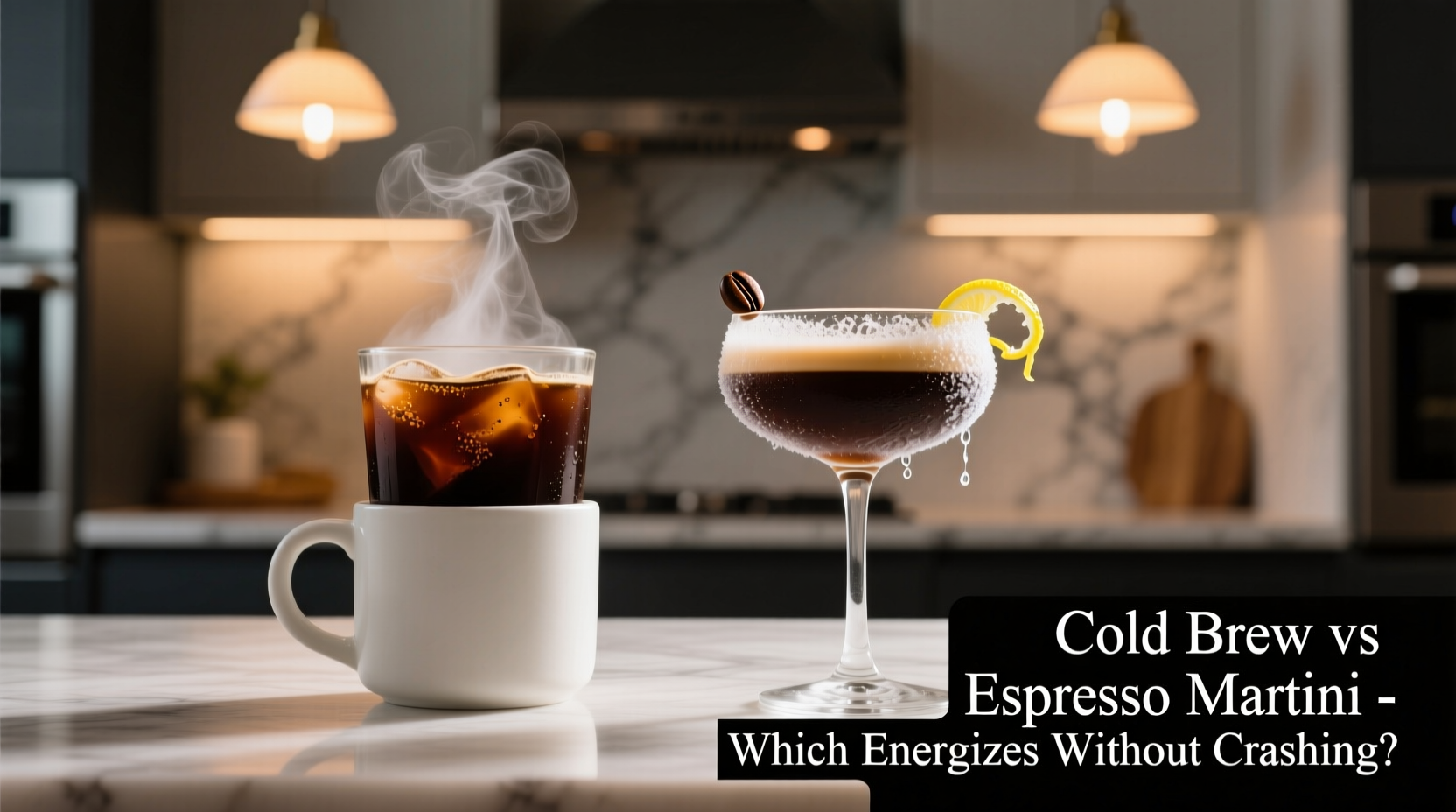
A standard 12-oz serving of unsweetened cold brew contains approximately 150–200 mg of caffeine—comparable to a double espresso—but delivered with near-zero acidity and no added sugar. Its typical preparation requires no milk, sweetener, or alcohol unless added deliberately. That neutrality makes it highly adaptable to individual physiology: add a splash of oat milk for sustained fat-based energy, stir in MCT oil for ketone-supported focus, or drink black for pure, unadulterated stimulation.
Tip: For maximal crash resistance, drink cold brew 30 minutes after a balanced meal containing 10g+ protein and healthy fat—not on an empty stomach. This stabilizes absorption and prevents insulin spikes.Espresso Martini: Glamour With Metabolic Trade-Offs
The espresso martini—a blend of chilled espresso, vodka, coffee liqueur (like Kahlúa), and simple syrup—is a masterclass in sensory appeal. Its froth, aroma, and ritual deliver dopamine before the first sip. But its functional energy profile tells a different story. A standard 4-oz serving contains roughly 60–80 mg of caffeine (from 1–1.5 oz espresso), 15–20g of added sugar (mostly from coffee liqueur and simple syrup), and 15–20g of ethanol. That combination creates three intersecting metabolic challenges:
- Sugar + Caffeine Synergy: Glucose rapidly elevates insulin, while caffeine simultaneously impairs insulin sensitivity—forcing the pancreas to overcompensate and increasing postprandial glucose variability.
- Alcohol’s Dual Effect: Ethanol initially suppresses adenosine, amplifying caffeine’s stimulant effect—but as blood alcohol declines, adenosine surges, intensifying fatigue and disrupting sleep architecture even hours later.
- Acidity & Irritation: Hot-brewed espresso retains higher levels of gastric irritants. Combined with ethanol—which increases gastric permeability—the cocktail can trigger low-grade inflammation and vagal nerve stress, contributing to mid-afternoon dysregulation.
This doesn’t mean the espresso martini is “bad.” It’s context-dependent. As an occasional social beverage consumed after dinner? A delightful, low-risk indulgence. As a daily 2 p.m. productivity tool? It undermines the very energy it promises.
Side-by-Side Comparison: What the Data Shows
| Factor | Cold Brew (12 oz, unsweetened) | Espresso Martini (4 oz, standard recipe) |
|---|---|---|
| Caffeine | 150–200 mg | 60–80 mg |
| Total Sugar | 0 g | 15–22 g (≈4–5 tsp) |
| Alcohol Content | 0% ABV | 15–20% ABV (≈12–16 g ethanol) |
| pH Level | ~6.2–6.5 (low acidity) | ~5.0–5.3 (higher acidity from hot espresso + acids in liqueur) |
| Typical Glycemic Load | 0 | 12–16 (moderate-to-high) |
| Half-Life Variability | Low (no ethanol interaction; stable metabolism) | High (ethanol inhibits CYP1A2, extending caffeine half-life unpredictably) |
Real-World Impact: A Mini Case Study
Maya, 34, a UX researcher working hybrid hours, relied on espresso martinis for “creative energy” during afternoon client workshops. She’d order one at 2:30 p.m., feeling alert and expansive by 3:15. By 4:45, her typing slowed, her eyes burned, and she craved a chocolate bar. Her continuous glucose monitor (CGM) showed a 48 mg/dL spike within 20 minutes of drinking, followed by a 32 mg/dL drop by 4:30—well into reactive hypoglycemia range. Sleep latency increased by 27 minutes that night, and her next-morning cortisol awakening response was blunted by 34%, per saliva testing. After switching to 12 oz cold brew with 1 tsp almond butter stirred in (for fat + trace magnesium), consumed at 1:45 p.m., her CGM showed only a 12 mg/dL rise and no subsequent crash. Focus duration extended by 92 minutes in timed Pomodoro sessions, and her morning cortisol curve normalized within five days.
Maya’s experience isn’t anecdotal—it reflects predictable physiology. The espresso martini gave her acute dopamine and caffeine, but at the expense of glucose stability and circadian integrity. Cold brew provided steadier neuromodulation, free of metabolic interference.
Your Personalized Energy Protocol: A 5-Step Implementation Guide
Choosing between cold brew and an espresso martini isn’t binary—it’s about matching the beverage to your biological moment and intention. Follow this evidence-informed sequence:
- Assess Your Goal: Is this for sustained cognitive work (e.g., writing, coding, analysis)? Prioritize cold brew. Is it for celebratory mood elevation or social connection? An espresso martini may be appropriate—but intentionally, not habitually.
- Check Your Timing: Avoid caffeine after 2 p.m. if you sleep before midnight. If consuming an espresso martini, do so no earlier than 5 p.m. and never within 3 hours of bedtime.
- Pre-Load Nutrition: Consume 10–15g protein + 5–7g healthy fat (e.g., Greek yogurt + walnuts) 20–30 minutes before either beverage. This buffers gastric impact and slows caffeine absorption.
- Modify the Martini (If You Choose It): Replace coffee liqueur with ½ oz cold-brew concentrate + ½ oz unsweetened vanilla extract; use 0.75 oz vodka; skip simple syrup entirely. Shake with ice and fine-strain. Reduces sugar to <3g and acidity significantly.
- Hydrate Strategically: Drink 1 cup of still mineral water before *and* after your chosen beverage. Electrolyte balance directly modulates neuronal excitability and caffeine tolerance.
FAQ: Practical Questions, Evidence-Based Answers
Can I add milk or sweetener to cold brew and still avoid crashes?
Yes—if chosen wisely. Unsweetened oat or soy milk adds soluble fiber and protein without spiking glucose. Avoid flavored creamers (often 5–8g added sugar per tablespoon) and stevia blends with maltodextrin (a glucose polymer that *does* raise blood sugar). A pinch of cinnamon enhances insulin sensitivity and complements cold brew’s natural sweetness.
Is decaf cold brew a viable option for sensitive individuals?
Absolutely—and often underutilized. Decaf cold brew retains chlorogenic acids and trigonelline, which support endothelial function and antioxidant defense. While caffeine-free, it provides gentle neuroactive compounds without adenosine blockade. Ideal for those with anxiety, hypertension, or late-day sensitivity.
Does the alcohol in an espresso martini cancel out caffeine’s benefits?
No—but it distorts them. Ethanol doesn’t neutralize caffeine; it alters its metabolism and amplifies downstream stress responses. Studies show co-ingestion increases systolic blood pressure by 12–18 mmHg more than caffeine alone and delays REM sleep onset by up to 90 minutes—even at moderate doses.
Conclusion: Energy Is a Practice, Not a Product
There is no universal “best” beverage—only the best choice for your body, your goals, and your day. Cold brew wins for functional, crash-resistant energy because it delivers caffeine cleanly: no sugar tax, no alcohol interference, no gastric provocation. It respects your physiology instead of overriding it. The espresso martini has its place—not as fuel, but as ritual; not as medicine, but as celebration. Confusing the two erodes both your energy resilience and your metabolic trust in your own choices.
You don’t need to eliminate pleasure to gain stability. You need precision. Start tomorrow: choose cold brew for your 2 p.m. reset. Skip the syrup. Add a pinch of sea salt for electrolytes. Notice how your focus holds—not peaks and plummets. Track your afternoon clarity for three days. Then decide—not based on habit or hype, but on what your nervous system reports back.
💬 Your energy is your most non-renewable resource. Share one small change you’ll make this week—and tag someone who deserves steady, sustainable focus.