Wine has long held a cultural monopoly on the idea of graceful aging: deepening color, softening tannins, evolving into layered complexity. Beer, by contrast, is widely assumed to be ephemeral—best consumed fresh, within weeks or months of packaging. Yet this assumption overlooks centuries of brewing tradition and modern scientific understanding. Certain beers *do* age with intention and reward, transforming in ways that rival fine Bordeaux or aged Barolo—not through identical chemistry, but through parallel principles of controlled oxidation, microbial evolution, and slow esterification. The truth isn’t that “beer can age like wine,” but rather that *some beers age like certain wines*, following their own distinct biochemical pathways. What separates a cellar-worthy barleywine from a stale IPA isn’t just alcohol or hops—it’s structure, balance, and biological resilience.
Why Most Beer Doesn’t Age—and Why Some Absolutely Should
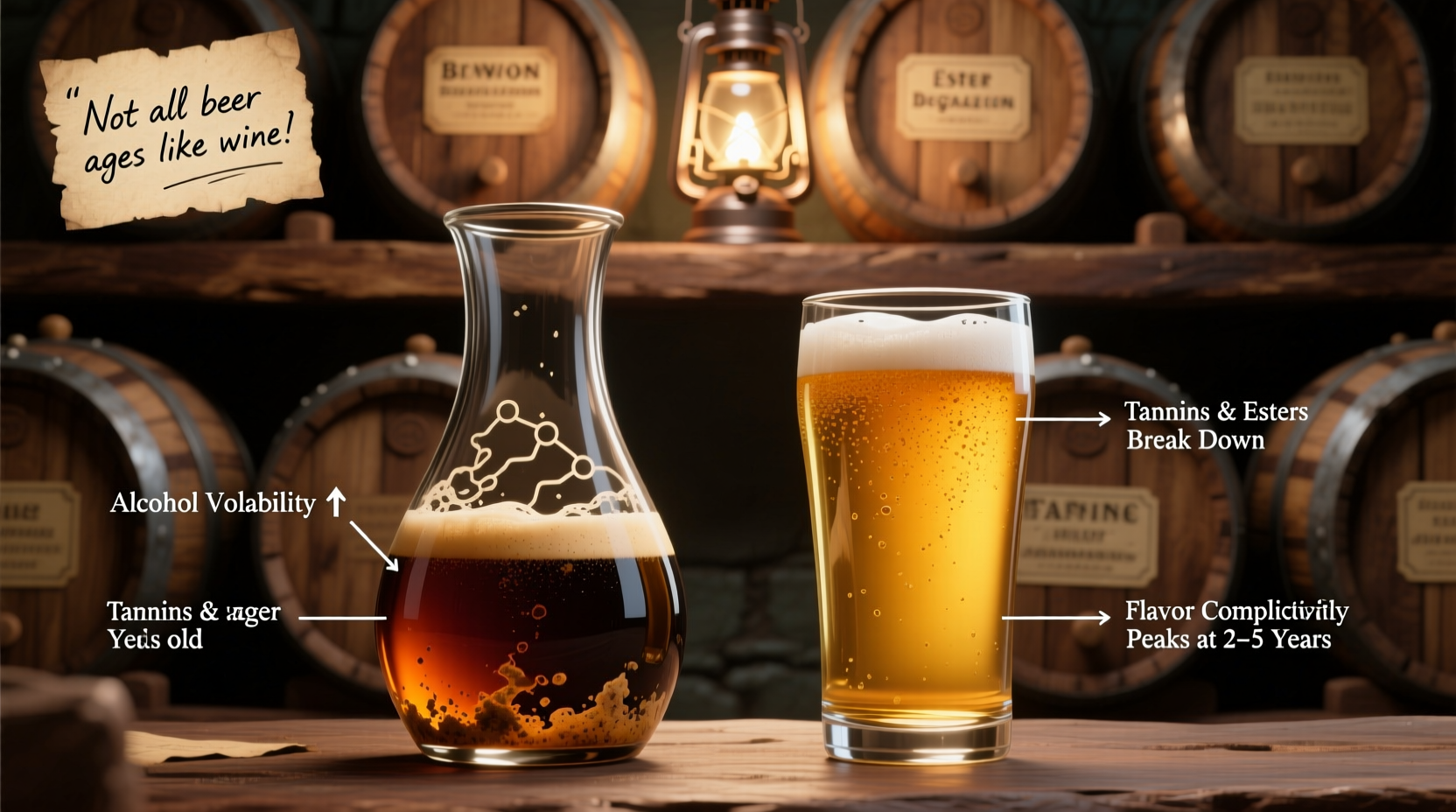
Most commercial beer is engineered for consistency and immediacy. Light lagers, pilsners, and hop-forward IPAs rely on volatile compounds—citrusy myrcene, floral humulene, delicate thiols—that degrade rapidly when exposed to oxygen, heat, or UV light. Within 60 days, even refrigerated, these beers lose aromatic brightness and develop cardboard-like trans-2-nonenal (a hallmark of staling). But aging isn’t about preserving freshness; it’s about *orchestrating change*. Beers built for longevity share three non-negotiable traits: high alcohol (typically ≥8% ABV), significant residual sugar or dextrins, and robust, stable flavor foundations—think dark malt roasts, oak-derived vanillins, or cultured Brettanomyces. These elements act as buffers against oxidation and substrates for enzymatic and microbial activity over time.
Tip: Never age a beer unless it’s explicitly brewed for it—check the label for terms like “cellarable,” “vintage,” “bottle-conditioned,” or stylistic cues like “imperial stout,” “Flanders red,” or “old ale.” If the brewery didn’t intend it, time will likely diminish, not deepen, the experience.What Actually Changes During Beer Aging: A Biochemical Timeline
Aging beer isn’t passive storage—it’s a dynamic, multi-phase biochemical process. Unlike wine, where tartaric acid and grape tannins dominate structural evolution, beer aging centers on malt-derived melanoidins, yeast metabolites, and oxidative cascades. Below is a scientifically grounded timeline of key transformations across 1–5 years:
- 0–6 months: Primary yeast autolysis begins. Dead yeast cells release proteases and lipases, gently softening harsh alcohol bite and hydrolyzing fatty acids into smoother mouthfeel compounds. Hop bitterness (iso-alpha acids) declines by ~15–20%, while perceived sweetness rises slightly due to polymerization of dextrins.
- 6–18 months: Controlled oxidation accelerates. Acetaldehyde converts to acetate esters (fruity notes), while melanoidins oxidize into deeper toffee, raisin, and leather nuances. In sour beers, Lactobacillus and Pediococcus continue slow acidification, lowering pH and enhancing tart complexity.
- 18–36 months: Maillard reactions intensify. Sugars and amino acids recombine under warmth and time, generating new roasted, nutty, and balsamic aromas. Ethanol reacts with organic acids to form ethyl esters—think dried apricot in an aged barleywine or fig jam in a vintage imperial stout.
- 3–5 years: Microbial maturation peaks in mixed-culture beers. Brettanomyces metabolizes complex sugars and residual dextrins, producing earthy 4-ethylphenol (cork, barnyard) and fruity 4-ethylguaiacol (smoke, clove). Simultaneously, oxygen exposure—when carefully managed—yields sherry-like nuttiness and umami depth, not staleness.
This progression isn’t linear or guaranteed. It requires stability: consistent temperature (10–13°C / 50–55°F), darkness, and upright storage for corked bottles (to keep corks moist) or on their side for still wines (not standard for beer). Fluctuations of ±5°C accelerate degradation exponentially.
Styles That Age Well—and Why They Succeed Where Others Fail
Not all high-ABV beers age gracefully. Success hinges on balance: enough acidity or bitterness to counteract oxidation’s sweetening effect, sufficient body to avoid thinning out, and microbiological stability. The table below compares five proven aging styles, highlighting their structural anchors and typical evolution windows:
| Style | Typical ABV Range | Key Structural Elements | Optimal Aging Window | Signature Evolution Notes |
|---|---|---|---|---|
| Imperial Stout | 9–14% | High roast melanoidins, residual dextrins, moderate IBUs (40–70) | 1–4 years | Char → molasses → blackstrap rum; hop bitterness fades, replaced by oak tannin integration and vinous acidity |
| Barleywine (English) | 8–12% | Rich caramel/toffee malt, low hop aroma, high dextrin body | 2–6 years | Fruitcake → dried cherry → Madeira; alcohol integrates, esters evolve from apple to prune |
| Flanders Red Ale | 5–7% | Acidic backbone (pH 3.2–3.5), oak-aged, mixed culture (Lacto, Pedio, Brett) | 3–10+ years | Vinegar sharpness → balanced sour cherry → leathery, balsamic complexity; color deepens to mahogany |
| Oud Bruin | 5–7% | Lower acidity than Flanders red, more malt-forward, often kettle-soured | 2–5 years | Tangy plum → brown sugar → walnut oil; develops oxidative nuttiness without excessive vinegar |
| Belgian Quadrupel | 10–14% | Dark candi sugar, phenolic spice, moderate carbonation, high alcohol | 3–8 years | Fig & clove → date syrup & tobacco → port-like viscosity and umami depth |
Note the absence of IPAs, wheat beers, and session ales—even barrel-aged variants. Their delicate hop oils and low malt density lack the chemical “scaffolding” needed to support years of transformation. As Dr. Chris Haggart, Senior Brewing Scientist at the Siebel Institute, explains:
“Beer aging isn’t about waiting—it’s about selecting for metabolic resilience. A well-aged quad doesn’t just mellow; its yeast-derived phenolics polymerize into new aromatic molecules, while ethanol acts as both solvent and reactant. You’re not preserving the beer—you’re cultivating a living system inside the bottle.” — Dr. Chris Haggart, Senior Brewing Scientist, Siebel Institute
A Real-World Example: The 2014 Founders KBS Time Capsule
In 2014, Founders Brewing Co. released its Kentucky Breakfast Stout (KBS)—a bourbon-barrel-aged imperial stout at 12.3% ABV—alongside a limited “Cellar Reserve” variant packaged in wax-dipped 750mL bottles with explicit aging guidance. A group of 12 collectors in Portland, Oregon, purchased identical cases and committed to opening one bottle every 12 months. At year one, KBS was aggressive: bold bourbon heat, raw coffee, and sharp vanilla. By year three, the heat had receded, revealing layers of maple syrup, dark chocolate, and toasted oak. At year five, the beer had transformed: viscosity thickened noticeably, flavors shifted toward blackstrap molasses and aged port, and the finish developed a subtle, savory umami reminiscent of reduced beef stock—likely from Maillard-derived pyrazines and Strecker aldehydes. Crucially, bottles stored in a basement wine fridge (12°C, no light) showed uniform evolution, while two kept in a garage (ambient temps 5–28°C) developed muted fruit and papery off-notes by year two. This case underscores that aging is as much about environment as it is about recipe.
How to Age Beer Responsibly: A Step-by-Step Cellaring Protocol
Aging beer demands precision—not just patience. Follow this validated protocol to maximize positive development and minimize risk:
- Select wisely: Choose only styles proven to age (see table above) and verify bottling date. Avoid cans unless specifically designed for aging (e.g., stainless steel-lined, oxygen-scavenging liners).
- Inspect packaging: Check for proper fill level (meniscus should sit just below the cork base in 750mL bottles), intact seals, and no signs of leakage or mold around closures.
- Store upright (for corked bottles): Prevents cork drying and oxygen ingress. Store on their side only if using wine-style corks *and* the beer is intentionally sour/mixed-culture (where slight oxygen exposure is part of the design).
- Control temperature rigorously: Maintain 10–13°C (50–55°F) with ≤±0.5°C fluctuation. Use a dedicated wine fridge—not a kitchen refrigerator (too cold and dry) or basement (too warm and variable).
- Eliminate light and vibration: Store in opaque boxes or dark cabinets. Avoid locations near furnaces, laundry rooms, or exterior walls subject to thermal cycling.
- Rotate inventory: Label each bottle with purchase date and target opening window. Open one annually to assess evolution—don’t assume “older is better.” Most peak between years 2–4.
FAQ: Addressing Common Misconceptions
Does higher ABV always mean better aging potential?
No. While alcohol inhibits spoilage microbes, excessive ABV (>14%) can create harsh, hot finishes that never fully integrate. More critical is *balance*: sufficient malt body to absorb alcohol’s burn and enough acidity or bitterness to prevent cloying sweetness over time. A 10% ABV barleywine with rich caramel malt and 35 IBUs ages more gracefully than a 13% ABV “hop bomb” with minimal malt backbone.
Can I age a hazy IPA if it’s barrel-aged or high-ABV?
Almost certainly not. Even barrel-aged hazy IPAs prioritize volatile biotransformation compounds (e.g., thiol-releasing yeast strains) that degrade rapidly. Barrel character may persist, but the core tropical/citrus hop profile—essential to the style’s identity—fades within 3–4 months. What remains is often a disjointed mix of oak, alcohol, and muted fruit, lacking the structural cohesion needed for rewarding evolution.
What’s the biggest sign a beer has aged poorly?
The definitive red flag is “wet cardboard” or “sherry-like” aroma *without* complementary richness—i.e., acetaldehyde or trans-2-nonenal dominating instead of integrating into layered nuttiness. Other warnings: excessive vinegar sharpness in non-sour styles, loss of carbonation (indicating seal failure), or a flat, lifeless mouthfeel with no lingering finish. Trust your nose first: if it smells like a damp basement or stale peanuts before tasting, it’s past its prime.
Conclusion: Embrace Time as a Collaborator, Not a Clock
Aging beer isn’t nostalgia—it’s active stewardship of fermentation’s second act. When done right, it reveals dimensions invisible in youth: the quiet depth of a 4-year-old Rodenbach Grand Cru, the haunting elegance of a decade-old Cantillon Gueuze, the profound umami resonance of a mature Russian River Supplication. These aren’t accidents of neglect; they’re triumphs of intentional design, precise storage, and patient observation. You don’t need a walk-in cellar or a sommelier’s salary to begin. Start small: buy two bottles of a reputable imperial stout or Flanders red. Store one properly. Open the first after 12 months. Taste critically—not for “better” or “worse,” but for *difference*. Note how bitterness softened, how fruit deepened, how texture thickened. Then compare it to the second bottle next year. That dialogue between time, chemistry, and perception is where true appreciation begins. Your cellar isn’t a vault for trophies—it’s a laboratory for wonder. Begin your first experiment today.
💬 Have you aged a beer that surprised you? Share your tasting notes, timelines, and lessons learned in the comments—we’ll feature standout insights in our next deep-dive on barrel-aging science.