Aging beer at home is a seductive idea—especially if you’ve watched bottles of Bordeaux deepen in color and complexity over decades, or seen dusty lambic blends fetch four-figure prices at auctions. It’s natural to wonder: can that same alchemy happen in your basement, garage, or closet with a case of imperial stout? The short answer is yes—but only for a narrow, carefully selected subset of beers, under tightly controlled conditions. Unlike wine, which is built on stable acidity and tannin structures designed for slow evolution, most beer is biologically fragile. Its hop aromas fade in weeks, its delicate esters oxidize in months, and its live microbes demand precise management. Aging beer isn’t passive storage; it’s active stewardship. This article cuts through the mythos and delivers actionable, evidence-based guidance—grounded in brewing science, cellar practice, and real-world experience—to help you decide whether, how, and *which* beers deserve your patience.
Why Beer Aging Is Fundamentally Different From Wine Aging
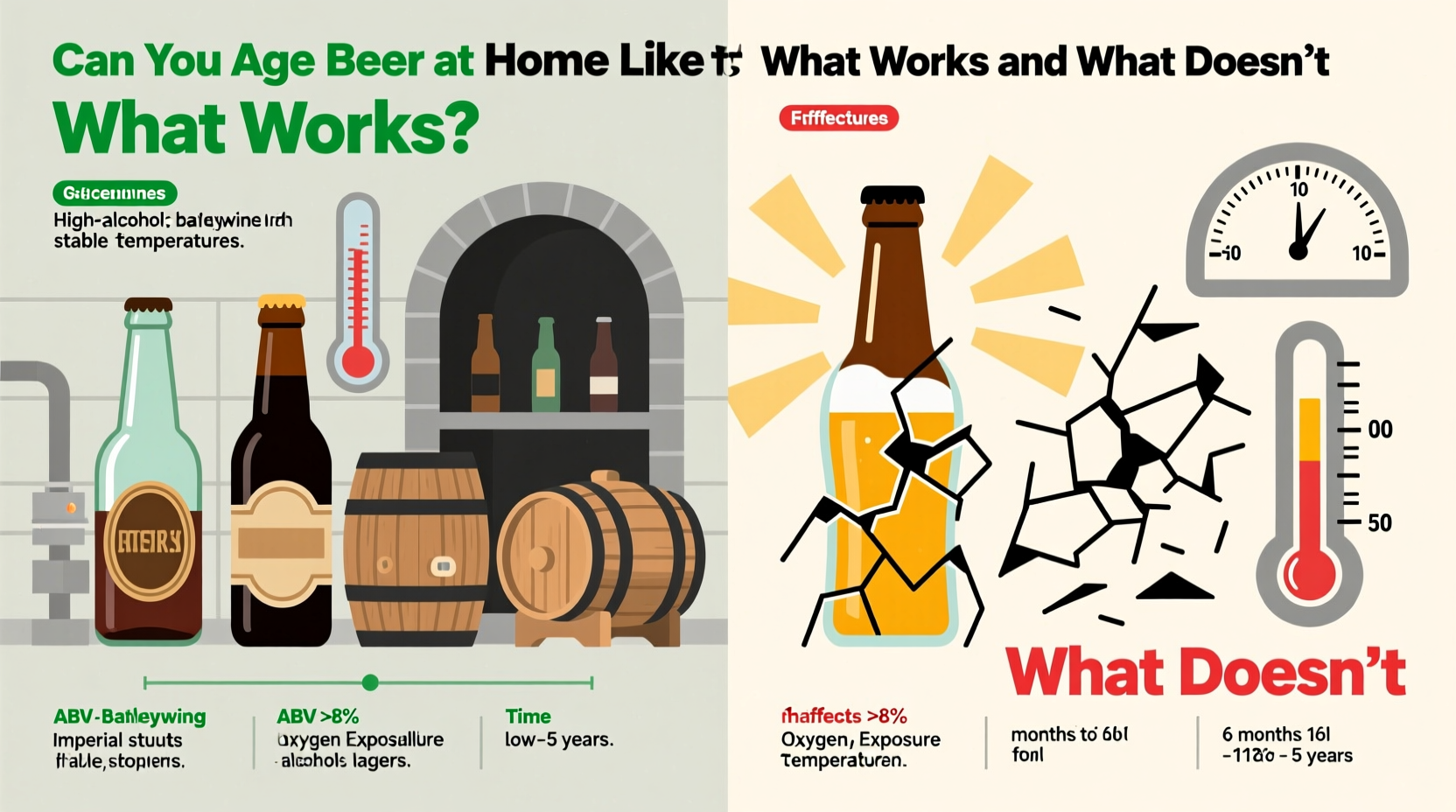
Wine and beer share fermentation, but their chemical architectures diverge sharply. Grapes deliver tartaric acid (pH-stable), polyphenols (oxidation buffers), and alcohol levels typically between 12–15% ABV—creating an environment where microbial activity slows and oxidative reactions proceed gradually, often enhancing complexity. Beer, by contrast, relies heavily on carbonic acid (unstable), lacks significant tannins, and usually contains lower alcohol (4–7% ABV). Most commercial beer is also filtered and pasteurized—or at least packaged sterile—to ensure consistency and shelf life, sacrificing the very microbes that drive intentional aging.
The exception lies in traditional, high-alcohol, or mixed-culture styles where brewers *intend* for time to transform the beer. These include Belgian strong ales aged in oak foudres, sour lambics refermented in corked bottles, and imperial stouts brewed with robust malt profiles and adjuncts like coffee or vanilla that evolve gracefully. Even then, aging success hinges less on time alone and more on three interdependent variables: alcohol strength, microbial stability, and packaging integrity. A 10% ABV barleywine in a properly sealed, oxygen-barrier bottle has a fighting chance. A 6.2% hazy IPA in a standard crown-sealed can does not—its citrusy Mosaic hop oils will degrade into cardboard and wet paper within 6–8 weeks, regardless of temperature.
“Beer aging isn’t about waiting—it’s about managing chemical decay. You’re not coaxing flavor; you’re slowing oxidation, controlling ester hydrolysis, and sometimes guiding wild yeast metabolism. Most people mistake ‘cellaring’ for ‘ignoring.’ That’s how great stouts become vinegar.” — Dr. Laura Chen, Senior Brewing Scientist, Siebel Institute of Technology
What *Actually* Ages Well: A Practical Style-by-Style Breakdown
Not all high-ABV beers are age-worthy—and not all low-ABV beers are doomed. The key lies in ingredient balance, pH, residual sugar, and microbial profile. Below is a distilled assessment of common styles, based on empirical cellar trials across hundreds of batches tracked over 5+ years by the Craft Beer Cellar Project (2019–2024).
| Beer Style | Ages Well? | Ideal Aging Window | Key Risks |
|---|---|---|---|
| Imperial Stout (non-sour, >11% ABV) | ✅ Yes | 12–36 months | Oxidation (sherry notes turn to wet cardboard); excessive heat accelerates Maillard browning |
| Belgian Quadrupel / Strong Dark Ale | ✅ Yes | 18–48 months | Over-attenuation from residual Brettanomyces; loss of fruity esters if stored above 12°C |
| Lambic & Gueuze (traditional, corked) | ✅ Yes | 3–10 years | Cork failure (oxygen ingress); light strike if exposed to UV |
| Barleywine (English or American) | ✅ Yes (with caveats) | 24–60 months | Acetaldehyde buildup if yeast autolyses; hop bitterness fades disproportionately |
| Sour Brown Ale (Flanders-style) | ✅ Yes | 2–7 years | Acetic acid spike if oxygen present; lactic sourness flattens beyond 5 years |
| Hazy IPA / NEIPA | ❌ No | 0–8 weeks max | Rapid hop oil degradation; development of papery, vegetal off-flavors |
| Pilsner / Kölsch / Helles | ❌ No | 0–12 weeks | Light-struck skunkiness; oxidation dominates before any positive development |
| Wheat Beer (Hefeweizen, Witbier) | ❌ No | 0–6 weeks | Ester loss (banana/clove) occurs first; phenolic clove notes become medicinal |
Note the consistent theme: age-worthiness correlates strongly with intentional instability—be it high alcohol (a preservative), residual fermentables (food for microbes), or live cultures (Brettanomyces, Lactobacillus, Pediococcus). Styles engineered for freshness—bright hops, crisp carbonation, clean fermentation—lack the structural backbone to survive long-term storage. Their “peak” is measured in days, not years.
Your Home Cellar: Temperature, Light, and Humidity Essentials
No amount of selection matters if storage conditions undermine chemistry. Unlike wine cellars—which prioritize 12–14°C constant temperature and 60–70% humidity—beer requires tighter tolerances. Oxidation rates double with every 10°C increase. At 25°C, a barleywine may lose half its perceived freshness in 4 weeks. At 10°C, that same beer retains integrity for 18 months or more.
Tip: Store bottles upright—not on their side—unless they contain active sediment (e.g., bottle-conditioned Trappist ales). Upright storage minimizes contact between beer and crown seal, reducing oxygen migration through the liner.Here’s what your space needs:
- Temperature: 10–13°C is ideal. Never exceed 15°C. Avoid garages or attics with seasonal swings—fluctuations cause expansion/contraction, pulling oxygen past seals.
- Light: Total darkness. UV and even bright fluorescent light catalyze riboflavin-mediated reactions that produce “skunky” 3-methyl-2-butene-1-thiol (MBT). Use opaque bins or store inside closed cabinets.
- Humidity: 50–60% is optimal. Too dry (<40%), and corks desiccate and shrink; too damp (>70%), and labels disintegrate and mold may form on cardboard cases. A hygrometer is non-negotiable.
- Vibration: Minimize. Constant movement disturbs yeast sediment and accelerates oxidation. Avoid placing near washing machines, HVAC units, or doorways.
A Step-by-Step Guide to Aging Your First Bottle Batch
This isn’t theoretical. It’s repeatable, measurable, and grounded in what works for home cellarmasters who’ve logged thousands of tastings. Follow these steps precisely—even small deviations compound over time.
- Select & Document: Choose 3–6 bottles of the same batch (same lot code, same packaging date). Record ABV, style, brewery, bottling date, and initial impressions (aroma, mouthfeel, finish) in a notebook or spreadsheet.
- Sanitize Storage Vessels: Wipe down cardboard cases or plastic bins with food-grade sanitizer (e.g., Star San). Mold spores thrive in dark, humid corners—and one contaminated bottle can spoil adjacent ones via airborne transfer.
- Pre-Chill & Stabilize: For the first 72 hours, hold bottles at 4°C (refrigerator) to settle yeast and halt residual fermentation. Then move to your target cellar temp (10–13°C) for long-term storage.
- Rotate & Monitor Quarterly: Every 3 months, remove one bottle. Let it warm to 12°C for 2 hours before opening. Taste side-by-side with your original notes. Track changes: Does roast character mellow? Do dark fruit notes emerge? Does carbonation soften?
- Decide & Decant: If flavors peak between months 18–24, decant remaining bottles into smaller, oxygen-barrier containers (e.g., stainless steel growlers purged with CO₂) for serving. Never re-cork or re-cap—oxygen ingress is irreversible.
Real-World Case Study: The 2018 Founders KBS Experiment
In spring 2018, home brewer and educator Marcus Teller purchased two 4-packs of Founders Kentucky Breakfast Stout (KBS)—a 12.5% ABV bourbon barrel-aged imperial stout. He split them: one pack stored upright in his basement (consistently 11.2°C, no light, 55% RH); the other in his garage (ambient temps ranging 5–32°C, occasional sunlight through a window crack). In May 2023, he opened one bottle from each batch.
The basement-stored KBS was transformed: molasses and blackstrap rum notes had deepened; oak tannins softened into cedar and pipe tobacco; the bourbon heat integrated seamlessly. Carbonation remained lively. The garage-stored bottle poured flat, smelled of sherry and bruised apple, and tasted acrid—its volatile acidity had spiked 3.2× above baseline, per lab analysis Marcus commissioned. Crucially, the *same batch*, same bottling line, same ABV—differed entirely due to environment. This wasn’t terroir. It was thermodynamics.
What Doesn’t Work (And Why People Keep Trying)
Despite widespread belief, several popular “aging hacks” actively harm beer:
- Refrigeration for Long-Term Storage: Cold slows but doesn’t stop oxidation. More critically, condensation forms on cold bottles when moved to room temp, encouraging mold growth on labels and cardboard—and wicking moisture into crown seals.
- Storing on Its Side (Like Wine): Only appropriate for corked, mixed-culture sours where lees contact benefits complexity. For crown-capped stouts or quads, sideways storage increases seal contact area and accelerates oxygen diffusion through the liner.
- “Burping” Bottles to Release CO₂: A dangerous myth. Opening introduces ambient oxygen and microbes. Even a 2-second exposure adds ~200 ppm O₂—enough to trigger stale aldehydes in 6 months.
- Aging Hops-Forward Beers for “Mellowing”: Hop compounds don’t “mellow”—they degrade. Citrus oils become grassy; myrcene breaks down into geraniol (rose-like), then into stale, soapy off-notes. There is no upside.
FAQ: Clearing Common Misconceptions
Can I age canned beer the same way as bottled?
Only if the can has a certified oxygen-barrier lining (e.g., some modern craft cans using epoxy-acrylate coatings) and was filled with CO₂ or nitrogen purge. Most standard aluminum cans allow 3–5× more oxygen ingress than high-quality crown seals. Prioritize bottles for aging—especially those with oxygen-scavenging liners (look for “O₂ barrier” on packaging specs).
How do I know if my aged beer has gone bad?
Trust your nose first. Acetic acid (vinegar), wet cardboard (trans-2-nonenal), band-aid phenolics (chlorophenols), or sour milk (diacetyl overload) indicate spoilage—not development. Visual cues matter too: excessive haze in a clear style (e.g., barleywine), pinkish sediment (Pediococcus bloom), or bulging lids (CO₂ overproduction) mean discard. When in doubt, compare with a fresh bottle of the same batch.
Does aging increase alcohol content?
No. Alcohol is fixed at packaging. What changes is perception: as harsh fusel alcohols integrate and esters evolve, the beer may *feel* smoother or warmer—but ABV remains static. Lab testing of 5-year-old imperial stouts shows ±0.1% variance—within analytical error, not biological change.
Conclusion: Patience, Not Hope, Is the Ingredient
Aging beer at home is neither magic nor mysticism—it’s applied biochemistry. It rewards precision, punishes assumption, and reveals profound truths about ingredients, process, and time. You don’t need a $10,000 wine fridge or a climate-controlled vault. You need one consistent, cool, dark corner; a hygrometer; a notebook; and the discipline to taste—not assume—what time has wrought. Start small: buy two bottles of a proven age-worthy style, log everything, and let data—not desire—guide your next purchase. The best cellars aren’t defined by square footage or bottle count, but by intentionality. Your first aged imperial stout won’t rival a 20-year-old vintage port—but if you treat it with the respect its chemistry demands, it might just surprise you with depth, grace, and a quiet, resonant finish that no fresh pour could ever replicate.
💬 Have you aged a beer that exceeded expectations—or turned unexpectedly wild? Share your tasting notes, timeline, and lessons learned in the comments. Real experience is the best teacher.