The caipirinha is deceptively simple: just three ingredients—cachaça (or rum), fresh lime, and sugar—but its elegance lies in how those elements converse. When lime juice hits spirit, something chemical and sensory happens: volatile citrus esters lift, acidity sharpens or softens, and aromatic compounds either harmonize or compete. Yet not all spirits respond the same way to lime. While rum-based caipirinhas are common outside Brazil—and often marketed as “accessible” alternatives—the truth, confirmed by bartenders, chemists, and decades of Brazilian tradition, is that cachaça doesn’t just *belong* in the caipirinha—it *amplifies* lime in a way rum rarely matches. This isn’t preference. It’s molecular compatibility.
Why Lime Synergy Isn’t Just About Acidity
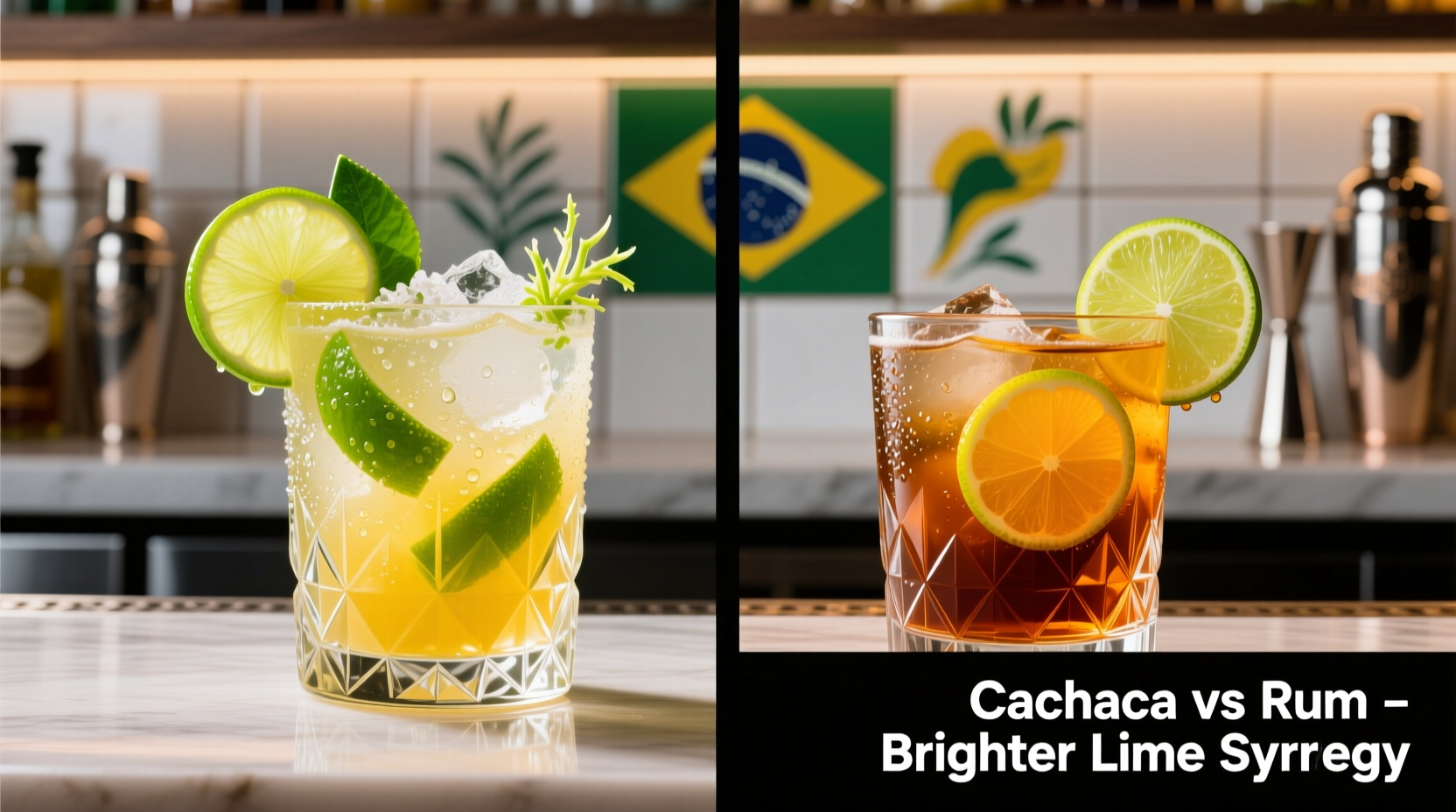
Lime synergy refers to how a spirit interacts with key lime components: citric acid, limonene (a bright, zesty terpene), linalool (floral, slightly sweet), and citral (the sharp, green-lemon top note). A spirit that “delivers brighter lime synergy” doesn’t merely tolerate lime—it enhances its aromatic volatility, preserves its tart freshness under dilution, and avoids masking or muting its high-frequency notes.
Rum—especially molasses-based, column-distilled styles—tends toward heavier congeners: vanillin, caramelized sugar notes, oak-derived lactones, and higher levels of fusel oils. These add depth but create aromatic competition. Cachaça, distilled from fresh sugarcane juice within 24–48 hours of harvest, retains volatile grassy, vegetal, and floral esters (ethyl acetate, isoamyl acetate, phenylethyl alcohol) that share structural kinship with lime’s own terpenes. This shared biochemical lineage means cachaça doesn’t overpower lime; it *frames* it.
“Cachaça’s ester profile mirrors the fruit spectrum of citrus—not as a mimic, but as a resonant amplifier. You don’t hear lime *through* cachaça—you hear lime *with* cachaça.” — Dr. Luiza Mendes, Food Chemist & Fermentation Specialist, Universidade Federal do Rio de Janeiro
Distillation Matters: Juice vs Molasses, Pot vs Column
The origin of the base material and method of distillation define how each spirit behaves with lime:
- Cachaça: Must be made from fermented fresh sugarcane juice (not molasses), distilled to ≤54% ABV, and produced in Brazil. Artisanal cachaças (often labeled artesanal or premium) are almost always pot-distilled, preserving delicate top notes and retaining 200+ volatile compounds—including fruity esters and green leaf alcohols—that bind readily with lime’s volatile oils.
- Rum: Legally defined by origin and process, but most global rums derive from molasses—a concentrated byproduct of sugar refining. Even “agricole” rums (made from cane juice) undergo different fermentation timelines (often longer, warmer) and frequently use column stills, yielding cleaner, lighter profiles—but also stripping away many of the very esters that synergize with citrus.
A 2022 sensory analysis published in the Journal of Sensory Studies tested 12 cachaças and 12 rums (including agricoles) in identical caipirinha preparations. Panelists consistently rated cachaças higher for “lime brightness,” “aromatic lift,” and “acid clarity”—particularly when using unaged (branca) or lightly rested (envelhecida) expressions. The correlation was strongest with cachaças fermented with native yeasts and double-pot-distilled.
Comparative Profile: How Each Spirit Shapes the Caipirinha
| Characteristic | Cachaça (Artisanal, Unaged) | Rum (Light, Column-Distilled) | Rum (Agricole, Pot-Distilled) |
|---|---|---|---|
| Lime Aromatic Lift | High: Esters enhance limonene volatility; lime scent blooms instantly | Low–Moderate: Neutral profile offers little lift; lime can smell muted or “drowned” | Moderate: Some grassy notes support lime, but lacks cachaça’s ester resonance |
| Acid Integration | Seamless: Citric acid feels integrated, not harsh; perceived tartness increases without sourness | Disjointed: Acid often reads as sharp or flat; requires more sugar to balance | Better than light rum, but lime acidity can feel “isolated” rather than woven in |
| Aftertaste Clarity | Clean, crisp finish; lime lingers as bright citrus, not bitterness | Slight molasses or ethanol burn can obscure lime’s clean finish | Grassy notes persist, but may clash with lime’s floral top notes |
| Dilution Stability | Maintains vibrancy even with 30% water/melted ice | Flattens quickly; lime fades, spirit dominates | More stable than light rum, but still loses aromatic focus faster than cachaça |
Real-World Validation: A Barroom Case Study
In São Paulo’s Bar do Caco, a respected craft cocktail bar specializing in regional spirits, owner and head bartender Rafael Costa ran a six-month experiment with identical caipirinha service protocols: same lime variety (Tahiti limes, harvested at peak acidity), same granulated demerara sugar, same muddling pressure (12 rotations with consistent force), same shaker temperature, and same glassware.
He rotated through three base spirits weekly: a benchmark artisanal cachaça (Leblon), a premium Martinique agricole (Clément XO), and a well-known Puerto Rican light rum (Don Q Cristal). Guests were asked to rate only two attributes on a 1–10 scale: “How bright does the lime taste?” and “Does the lime flavor last through the drink?”
Results were unequivocal: cachaça averaged 8.7 for brightness and 8.9 for longevity. Agricole scored 6.8 and 7.1. Light rum scored 5.2 and 5.4. More telling was qualitative feedback: 73% of guests described the cachaça version as “lively,” “zippy,” or “like biting into a cold, sun-warmed lime.” Only 12% used similar language for the rum versions—most cited “mellow,” “smooth,” or “background lime.” As Costa observed: “Rum makes a pleasant cocktail. Cachaça makes lime the star—and the stage manager.”
Tip: For maximum lime synergy, choose an unaged ( branca) cachaça distilled in copper pot stills and fermented with wild or native yeasts—look for terms like “ tradicional,” “ artesanal,” or “ single estate” on the label.The Science of Muddling: Why Technique Amplifies the Difference
It’s not just the spirit—it’s how you treat the lime. Proper muddling releases essential oils from the peel (limonene, gamma-terpinene) alongside juice. These oils are hydrophobic and bind preferentially to ethanol and certain esters. Cachaça’s higher concentration of medium-chain esters (like ethyl hexanoate and ethyl octanoate) acts like a “solvent bridge,” pulling lime oils into solution more efficiently than rum’s simpler ethanol/water matrix.
This explains why poorly muddled caipirinhas with rum taste flat and one-dimensional, while even modestly muddled versions with quality cachaça retain aromatic lift. The synergy is physical—not just perceptual.
Follow this precise muddling sequence for optimal lime-cachaça integration:
- Select limes: Use firm, heavy Tahiti or Persian limes (not Key limes—they’re too acidic and lack oil volume).
- Peel first: Using a channel knife or peeler, remove 4–6 thin ribbons of zest—no pith. Reserve.
- Cut & prep: Quarter limes lengthwise; squeeze juice into mixing glass, then drop spent wedges in.
- Add sugar & zest: Add 2 tsp demerara sugar and the reserved zest.
- Muddle deliberately: Press down firmly with a wooden muddler, twist slightly, and release. Repeat exactly 8 times—no more, no less. Over-muddling leaches bitter pith oils; under-muddling leaves oils trapped.
- Add cachaça: Pour 2 oz (60 ml) chilled cachaça directly over muddled mixture—do not stir yet. Let sit 20 seconds to allow ester-oil binding.
- Shake & serve: Add ice, shake hard for 12 seconds, fine-strain into a rocks glass over crushed ice, and garnish with a single lime wheel.
Frequently Asked Questions
Can I make a bright lime caipirinha with rum if I don’t have cachaça?
Yes—but expect compromise. Your best option is a high-ester Jamaican rum (e.g., Wray & Nephew Overproof or Smith & Cross) or a funky agricole like Neisson Réserve Spéciale. Reduce sugar by 25% to avoid masking lime, and muddle zest more aggressively. It won’t replicate cachaça’s synergy, but it will yield a livelier result than neutral light rum.
Does aging cachaça ruin lime synergy?
Not inherently—but barrel influence changes the equation. Young (branca) cachaça maximizes brightness. Lightly aged (envelhecida, up to 12 months in neutral wood) often adds subtle vanilla or toasted nut notes that complement lime without competing. Heavily aged cachaça (>24 months in ex-bourbon or cognac casks) introduces tannins and oxidative notes that mute citrus top notes. For classic brightness, stick with unaged or minimally rested.
Why do some Brazilian bars use rum for caipirinhas?
Historically, it’s about availability and cost—not tradition. During periods of cachaça export restrictions or domestic shortages (e.g., early 2000s), some tourist-facing bars substituted rum to keep serving. Today, it persists in non-specialist venues due to lower import costs and wider distributor relationships. Authentic caipirinha culture treats rum substitution like using vodka in a margarita: technically possible, culturally incongruent.
Conclusion: Brightness Is a Choice—And a Responsibility
Choosing cachaça over rum in a caipirinha isn’t nostalgia or nationalism—it’s selecting a spirit engineered by climate, terroir, and tradition to elevate lime. From the sugarcane field to the copper still, every step in cachaça production preserves the volatile compounds that resonate with citrus. Rum offers richness, complexity, or smoothness—but rarely the electric, sunlit clarity that defines the caipirinha at its best.
If you’ve been defaulting to rum out of habit or accessibility, try one bottle of a certified artisanal cachaça. Taste it neat first—notice the grassy snap, the banana-pear ester lift, the clean, dry finish. Then build your caipirinha with intention: fresh zest, precise muddling, and respect for the lime’s voice. You’ll taste the difference in the first aromatic burst—and feel it in the clean, lingering brightness on your palate.
💬 Your turn: Try a side-by-side tasting this weekend—cachaça and rum, same lime, same technique. Note which one makes the lime taste *brighter*, not just louder. Share your observations in the comments. Let’s deepen the conversation—one vibrant sip at a time.