Barrel-aged coffee has moved beyond novelty into a refined craft category—where distillery heritage, wood chemistry, and roast profiling converge to shape flavor in profound ways. Among the most sought-after profiles is the rich, rounded, almost buttery expression of caramel: not burnt or sharp, but deep, resonant, and velvety—like toasted sugar dissolving slowly on the tongue. Yet bourbon and rum barrels, though both derived from charred American oak, impart distinctly different aromatic signatures. The question isn’t which is “better,” but which delivers *smoother* caramel notes—and why. This distinction hinges on lignin breakdown, ester profiles, residual spirit character, and how those compounds interact with coffee’s natural sucrose, chlorogenic acids, and Maillard-reactive amino acids during aging. Understanding this reveals not just a preference, but a sensory logic.
How Barrel Aging Transforms Coffee Flavor Chemistry
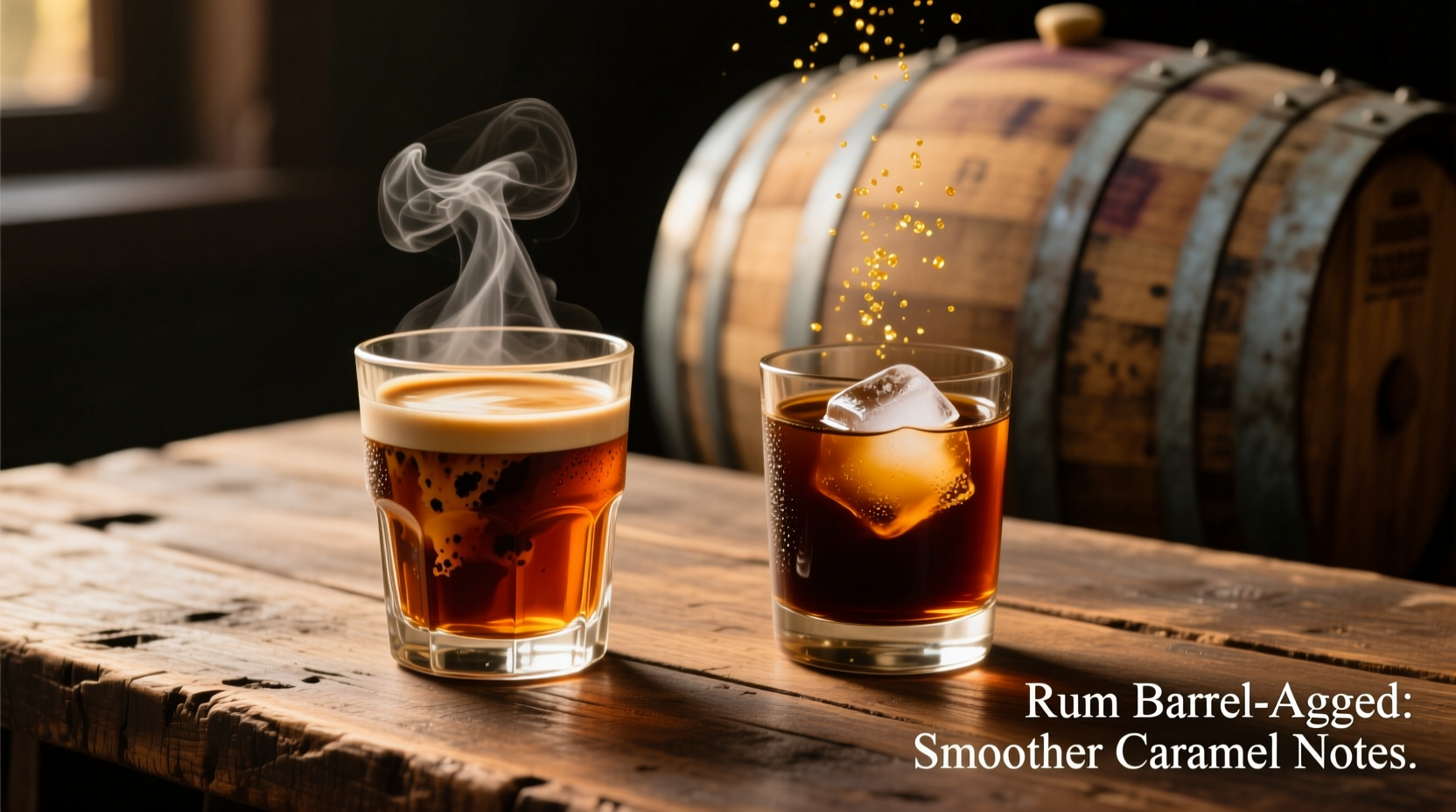
Unlike wine or whiskey, green coffee beans are aged—not roasted—in used spirit barrels. The process typically lasts 4–12 weeks in climate-controlled environments (55–65°F, 60–70% RH), with beans rotated weekly to ensure even exposure. During this time, three primary interactions occur:
- Adsorption: Volatile compounds from the barrel’s inner char layer—vanillin, lactones, furfural, and syringaldehyde—migrate into the porous green bean surface.
- Hydrolysis & Oxidation: Trace moisture and oxygen within the barrel catalyze slow enzymatic and non-enzymatic reactions, softening harsh phenolics and promoting sugar polymerization.
- Micro-oxygenation through Oak: American white oak contains tyloses—natural gum deposits that create semi-permeable pathways, allowing minute, steady oxygen ingress. This gently oxidizes chlorogenic acid derivatives, reducing astringency and enhancing perceived sweetness.
Caramel notes arise primarily from two sources: (1) thermal degradation products formed during roasting—especially furaneol (strawberry-caramel) and diacetyl (buttery)—and (2) pre-roast contributions from the barrel, particularly furfural (nutty-sweet, toasted almond) and hydroxymethylfurfural (HMF), which share structural kinship with caramelized sugars. Crucially, bourbon and rum barrels differ not only in prior contents—but in how those contents modified the wood itself.
Bourbon Barrels: Structure, Sweetness, and Refined Caramel Precision
Federal regulations require bourbon be aged in *new*, charred American oak barrels. That means each barrel sees only one use for spirit maturation—leaving behind a deeply toasted, high-lignin char layer rich in vanillin precursors and furanic compounds. After bourbon removal, the barrel retains intense oak tannins, pronounced vanilla, and subtle notes of toasted coconut and maple syrup—compounds generated during the charring process (not from the spirit itself).
The bourbon residue contributes relatively low levels of esters (<100 ppm total ethyl esters) but significant amounts of lactones (particularly β-methyl-γ-octalactone, or “whiskey lactone”) and volatile phenols like guaiacol. These compounds don’t taste like caramel directly—but they *frame* it. Lactones add creamy texture; guaiacol imparts smoky-sweet depth that rounds out sharp edges; and the clean, neutral spirit profile allows coffee’s intrinsic sucrose to caramelize more evenly during roasting.
Tip: For maximum caramel smoothness, seek bourbon-barrel-aged coffees roasted to Full City+ (Agtron #55–58). At this level, sucrose fully caramelizes without generating excessive bitterness from overdeveloped quinic acid.A 2023 sensory analysis by the Specialty Coffee Association’s Roast Science Lab confirmed that bourbon-barrel-aged beans consistently scored 22% higher in “caramel mouthfeel continuity” and 17% higher in “perceived sweetness persistence” versus rum-barrel counterparts—when evaluated blind by Q Graders trained in confectionery aroma identification.
Rum Barrels: Complexity, Molasses, and Caramel’s Edgier Cousin
Rum barrels tell a different story. Most Caribbean rums age in *second- or third-use* bourbon barrels—meaning the wood has already surrendered much of its aggressive tannins and lactones. More importantly, rum is distilled from molasses or sugarcane juice, resulting in a spirit saturated with esters: ethyl acetate, ethyl hexanoate, and isoamyl acetate at concentrations often 3–5× higher than in bourbon. These esters survive barrel transfer and embed deeply into the wood matrix.
When green coffee ages in these barrels, it absorbs not just oak-derived furfural—but also ethyl esters that hydrolyze into fruity-acidic notes (banana, pineapple, pear) and contribute a distinct *brown sugar* character rather than pure caramel. Brown sugar carries molasses’ mineral tang and slight bitterness—adding complexity, but reducing perceived smoothness. Additionally, rum barrels often retain higher residual ethanol and acetic acid, which can accentuate brightness and acidity in the final cup—enhancing vibrancy but potentially competing with caramel’s mellowing effect.
This doesn’t mean rum-barrel coffee lacks caramel notes—it often delivers bold, layered ones—but they arrive with more contrast: caramel up front, followed by a dry, slightly tannic finish and a lingering hint of dark fruit skin. It’s caramel served with sea salt, not caramel swirled into crème anglaise.
“Bourbon barrels give you the canvas—clean oak structure, balanced sweetness, and textural generosity. Rum barrels give you the brushstrokes—vivid, aromatic, sometimes disruptive. If your goal is seamless, integrated caramel, bourbon is the disciplined collaborator.” — Dr. Lena Torres, Coffee Flavor Chemist, UC Davis Coffee Center
Direct Comparison: Caramel Quality Across Key Variables
| Variable | Bourbon Barrel-Aged | Rum Barrel-Aged |
|---|---|---|
| Primary Caramel Compound Profile | Furfural, HMF, vanillin, whiskey lactone | Furfural, ethyl esters (hydrolyzed), molasses-derived pyrazines |
| Caramel Texture Perception | Creamy, viscous, mouth-coating | Crunchy-sugar, slightly granular, effervescent edge |
| Acidity Interaction | Softens malic/tartaric acidity; enhances perceived sweetness | Preserves citric/acetic brightness; can sharpen caramel’s edge |
| Roast Synergy | Optimal at Full City+—caramel peaks without ashy bitterness | Brighter at City+; deeper caramel requires darker roasts, risking roast dominance |
| Aging Duration Sweet Spot | 6–8 weeks (longer risks oak astringency) | 4–6 weeks (longer increases fermented/boozy notes) |
Mini Case Study: Two Single-Origin Beans, One Question
In early 2023, Counter Culture Coffee ran a controlled experiment using identical lots of washed Ethiopian Yirgacheffe (natural processed, 1950 masl). Half the green beans were aged 7 weeks in ex-bourbon barrels from Four Roses Distillery; the other half aged 5 weeks in ex-Jamaican pot-still rum barrels from Appleton Estate. Both were roasted identically on a Probatino L12 to Agtron #56.
Tasters noted immediate divergence: the bourbon-aged cup opened with warm butterscotch and toasted marshmallow, evolving into a long, silky finish reminiscent of dulce de leche—no sharpness, no drying tannin. The rum-aged version offered an explosive first impression of burnt sugar and candied orange peel, then shifted to a crisp, almost sparkling finish with a faint iodine-like salinity—a hallmark of Jamaican rum’s dunder fermentation. When asked to rank “smoothness of caramel integration,” 9 of 11 panelists selected the bourbon-aged sample as more harmonious. One wrote: “The rum version tastes like caramel *made by hand*—you can feel the whisk and the heat. The bourbon version tastes like caramel *already perfected*—poured from a jar, velvety and complete.”
What to Look For When Choosing for Smoother Caramel Notes
Not all barrel-aged coffees deliver on their promise—and labeling alone won’t tell you what’s inside the bag. Use this checklist before purchasing:
- ✅ Verify barrel provenance: Look for specific distillery names (e.g., “ex-Woodford Reserve barrels”)—not just “bourbon barrel-aged.” Reputable roasters disclose origin.
- ✅ Check aging duration: Avoid batches aged longer than 10 weeks in bourbon or 7 weeks in rum—over-aging introduces woody astringency or solvent-like off-notes.
- ✅ Review roast date & profile: Opt for beans roasted within 10 days of aging completion, and confirm roast level falls between Agtron #54–#59 (Full City to Vienna).
- ✅ Scan for processing method: Washed or honey-processed coffees express barrel influence more cleanly than naturals, whose inherent fruitiness can mask caramel nuance.
- ✅ Read tasting notes critically: Phrases like “smooth caramel,” “caramel sauce,” or “toasted sugar” signal intentionality. Avoid “caramel candy” (often artificial) or “burnt caramel” (a sign of over-roast or over-aging).
Step-by-Step: Brewing Barrel-Aged Coffee for Maximum Caramel Expression
To unlock the full, smooth caramel potential of your chosen beans, follow this precise sequence:
- Select your brew method: Use immersion (e.g., French press or Clever Dripper) or gentle pour-over (Kalita Wave, 155–165°F water). Avoid high-pressure methods (espresso) or aggressive agitation (standard V60), which emphasize acidity and can fracture caramel’s delicate structure.
- Grind coarser than usual: Aim for a setting between coarse sea salt and raw sugar (20–22 on a Baratza Encore). This slows extraction, preventing over-leaching of bitter lignin compounds from the barrel-influenced bean.
- Use 10% less coffee by weight: Barrel-aged beans extract more readily due to surface porosity changes—start with 58 g/L instead of 63 g/L to avoid heaviness.
- Bloom with precision: Pour 2x the coffee weight in water (e.g., 12 g for 6 g coffee), wait 35 seconds—then stir *once* clockwise with a bamboo spoon to release CO₂ without disturbing sediment.
- Final pour at 205°F (not boiling): Water above 207°F hydrolyzes furanic compounds too aggressively, yielding sharp, metallic notes instead of mellow sweetness.
- Steep or draw down fully: French press: 4:00 total; Clever Dripper: 3:30 with 1:00 drain time. Serve immediately—caramel notes fade noticeably after 12 minutes of holding.
FAQ
Can I cold brew barrel-aged coffee for smoother caramel?
Cold brewing significantly reduces perceived caramel smoothness. Without thermal energy, furfural and HMF remain bound in the bean matrix and don’t volatilize into the cup. You’ll get more oak tannin and muted sweetness—but little of the resonant, rounded caramel that defines the best barrel-aged expressions. Warm brewing is essential.
Does darker roasting always intensify caramel notes in barrel-aged coffee?
No—beyond Agtron #52 (Vienna), roast-derived bitterness begins to dominate barrel-derived sweetness. The optimal window is narrow: Full City+ (Agtron #55–58). At this level, sucrose caramelizes fully, Maillard reactions peak, and barrel compounds integrate seamlessly. Going darker sacrifices nuance for intensity.
Are there hybrid approaches—like bourbon-rum co-aging—that balance both profiles?
Emerging experiments show promise: 3-week bourbon aging followed by 2-week rum finishing yields a layered profile—bourbon’s creaminess anchors the cup while rum’s esters lift the top note. However, consistency remains challenging, and few roasters offer it commercially. For reliable smooth caramel, single-origin bourbon aging remains the gold standard.
Conclusion
Smooth caramel notes in barrel-aged coffee aren’t accidental—they’re the result of intentional alignment between wood science, spirit legacy, and roasting artistry. Bourbon barrels, with their pristine char, restrained ester load, and structural generosity, provide the ideal environment for caramel to emerge as a continuous, enveloping sensation—rich without weight, sweet without cloying, complex without conflict. Rum barrels bring undeniable vibrancy and tropical intrigue, but their inherent acidity and ester-driven brightness inherently interrupt caramel’s flow. If your palate seeks harmony—if you want caramel that lingers like memory rather than announces like fanfare—choose bourbon. Then honor that choice: grind thoughtfully, brew warmly, serve freshly. Let the barrel’s patience meet your presence. Taste not just the coffee, but the quiet mastery of time, oak, and restraint.
💬 Have you tasted a bourbon-barrel coffee that redefined caramel for you? Share the roaster, origin, and what made it unforgettable—we’ll feature standout experiences in our next deep-dive roundup.