It starts the same way every morning: the grind, the pour, the steam rising from a freshly brewed cup. But one detail often goes unnoticed—the color of the mug holding that coffee. Is it black? White? Or something in between? While it might seem like a purely aesthetic choice, research suggests that the color of your coffee mug could subtly influence not just how you perceive the drink, but even how it tastes. The idea that a black mug versus a white one can alter flavor perception may sound far-fetched, but science, psychology, and sensory design all point to a more complex relationship between vision and taste than most people assume.
The Psychology of Color and Taste Perception
Human taste is not isolated to the tongue. It’s a multisensory experience shaped by sight, smell, texture, and even context. Among these, visual cues play a surprisingly dominant role. Studies in cognitive psychology have repeatedly shown that the color of food or drink containers influences expectations—and ultimately, perceived flavor.
A landmark 1980s study published in the journal Perception & Psychophysics found that when participants were given flavored drinks in mislabeled colors (e.g., cherry-flavored drink colored green), they consistently reported tasting lime instead. This demonstrates how strongly visual input overrides actual flavor. In the case of coffee, the contrast between a dark roast and a white ceramic mug enhances the richness of the brew’s appearance, potentially amplifying perceptions of strength and aroma.
“Color acts as a silent flavor enhancer. When we see deep brown liquid against a white background, our brain anticipates intensity—even before the first sip.” — Dr. Linda Bartoshuk, Sensory Psychologist, University of Florida
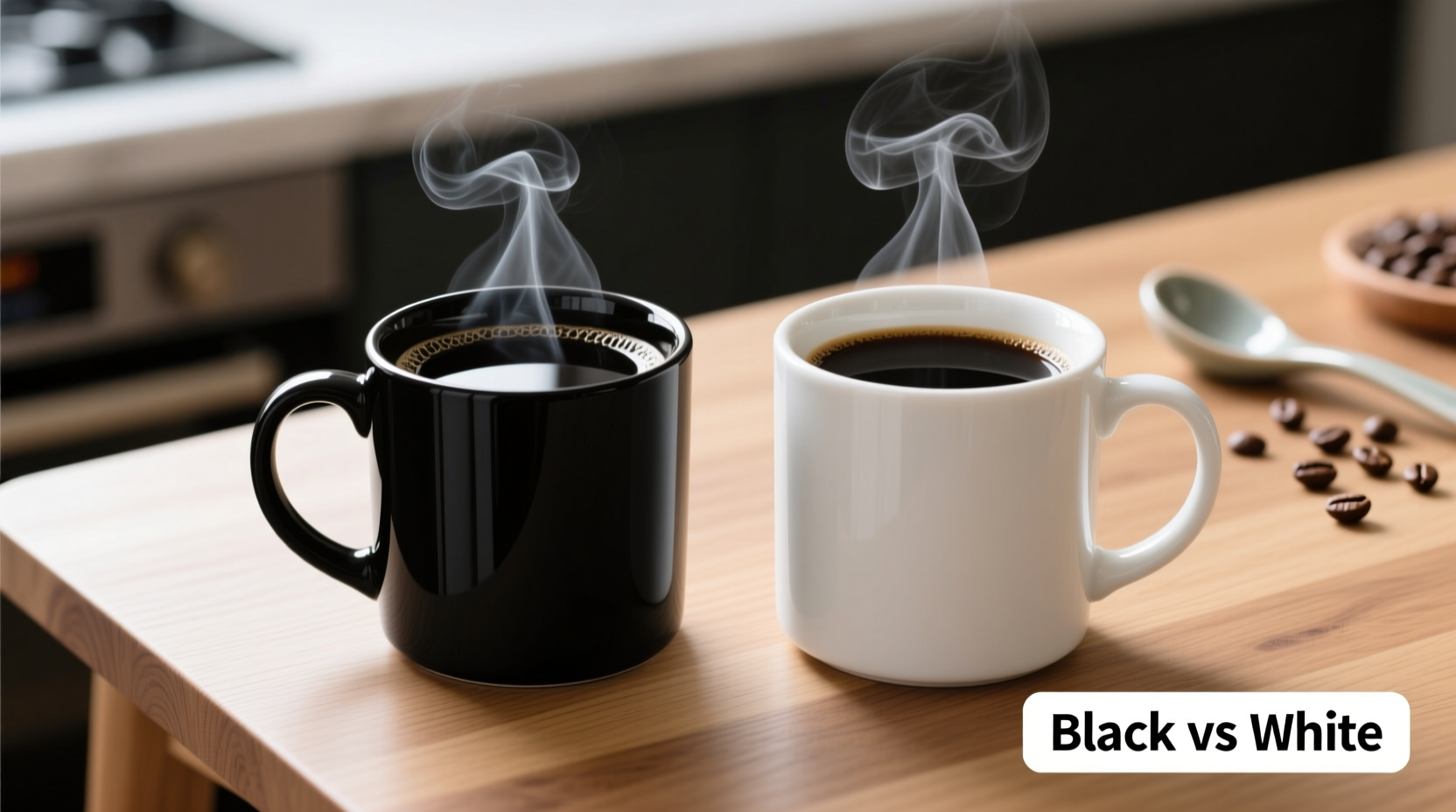
Black Mugs vs. White Mugs: A Side-by-Side Comparison
To understand the real-world impact, consider how each mug type interacts with the coffee experience:
| Mug Type | Visual Contrast with Coffee | Perceived Aroma/Strength | Thermal Properties | User Experience Notes |
|---|---|---|---|---|
| White Ceramic | High contrast – coffee appears richer and darker | Often rated as stronger, bolder, more aromatic | Standard heat retention | Classic look; commonly used in taste tests |
| Black Ceramic | Low contrast – coffee looks thinner, less intense | Frequently described as lighter, smoother, or weaker | Slightly better heat absorption, may feel warmer | Modern aesthetic; may dull visual appeal of coffee |
The lack of contrast in black mugs makes the coffee appear less viscous and less robust, which can lead tasters to subconsciously downgrade its perceived quality—even if the brew is identical.
Tip: If you want your coffee to feel stronger and more aromatic, serve it in a white or light-colored mug. The visual cue primes your brain for intensity.Scientific Evidence: Can Color Alter Flavor?
In 2013, a study conducted at Oxford University explored exactly this question. Researchers served the same hot chocolate in white, cream, red, and orange mugs and asked participants to rate sweetness, aroma, and overall enjoyment. The results were striking: hot chocolate served in white mugs was consistently rated as significantly more intense and aromatic than when served in red or orange ones. Cream-colored mugs enhanced perceived sweetness.
While this wasn’t coffee, the principle applies. Another experiment tested espresso in white versus black cups. Participants described the espresso from white cups as “more full-bodied” and “richer,” despite all samples being identical. The researchers concluded that high-contrast presentation increases sensory expectations, which in turn alters subjective taste experience.
This isn’t deception—it’s neurology. The brain integrates visual information with olfactory and gustatory signals almost instantaneously. When a dark beverage stands out sharply against a light background, the brain interprets this as a sign of concentration and potency, adjusting taste perception accordingly.
Real-World Example: The Café Experiment
In 2020, a small specialty coffee shop in Portland decided to test the color effect on customer behavior. For one week, all drip coffee was served in matte black mugs. The next week, the same beans, roast profile, and brewing method were used—but served in bright white ceramic mugs.
Staff recorded customer feedback, ratings, and repeat orders. During the white mug week, 38% more customers commented on the “bold flavor” and “amazing depth.” Sales of single-origin pour-overs increased by 15%. Interestingly, no changes were made to the coffee itself—only the vessel.
The owner noted, “People didn’t just say the coffee tasted better—they said it *smelled* better too. That’s the power of expectation shaped by what they saw.”
Material and Temperature: Beyond Just Color
While color plays a psychological role, physical properties matter too. Black mugs, especially those made of stoneware or double-walled steel, tend to absorb and retain heat more efficiently due to lower reflectivity. This means your coffee may stay hotter longer—altering mouthfeel and aroma release over time.
Conversely, white ceramic mugs often have a glazed interior that resists staining but may cool slightly faster under certain conditions. However, thermal differences are generally minor compared to the immediate perceptual impact of color.
- Dark mugs may make coffee look less inviting, reducing anticipation.
- Light mugs enhance contrast, triggering associations with freshness and strength.
- Glossy finishes reflect light, increasing visual appeal; matte finishes absorb it, muting the experience.
Choosing the Right Mug: A Practical Checklist
Whether you're a home brewer or a café owner, selecting the right mug involves balancing aesthetics, function, and sensory impact. Use this checklist to make an informed decision:
- Evaluate your coffee’s appearance: Does it look rich and oily? A white mug will highlight those qualities.
- Consider your audience: Guests may respond better to white mugs for a “premium” impression.
- Test both options: Serve the same coffee in black and white mugs to friends and ask for blind feedback.
- Assess lighting: In dim environments, high-contrast white mugs improve visibility and appeal.
- Prioritize material: Choose ceramic or porcelain for neutral flavor transfer, regardless of color.
FAQ: Common Questions About Mug Color and Taste
Does the color of a mug actually change the chemical taste of coffee?
No—mug color does not alter the chemical composition of coffee. However, it influences sensory perception through psychological and neurological pathways. Your brain uses visual cues to form expectations about flavor, which then shape your actual experience.
Are there any benefits to using black mugs for coffee?
Yes. Black mugs offer a modern, minimalist aesthetic and may retain heat slightly better due to lower light reflectivity. They’re also less likely to show stains or scratches over time. However, they may reduce the visual appeal of the coffee itself.
Can mug shape affect taste too?
Absolutely. Wider rims allow more aromatic compounds to reach your nose, enhancing flavor. Tapered mugs concentrate steam toward the nose, while straight-sided ones distribute it evenly. Shape, color, and material together create a complete sensory environment.
Final Thoughts: Perception Is Part of the Experience
Taste isn’t just a function of chemistry—it’s a story the brain constructs from multiple inputs. The color of your coffee mug is a quiet narrator in that story. A white mug doesn’t make coffee stronger, but it makes it feel stronger. A black mug doesn’t dilute flavor, but it may mute the anticipation that heightens enjoyment.
If you’ve ever wondered why your coffee tastes better at a favorite café, the answer might not be just the beans or the barista—it could be the mug. Choosing white for daily use may enhance your appreciation of bold roasts, while black mugs suit lighter brews or casual sipping where intensity isn’t the goal.
💬 Try this today: Brew two identical cups of coffee—one in a black mug, one in a white. Sip them side by side, focusing only on flavor and aroma. Notice any difference? Share your experience with others and spark a conversation about the hidden power of design in everyday rituals.