
Walk into a craft brewery taproom in Portland or a natural wine bar in Berlin, and you might encounter something that defies easy categorization: a hazy, tart, lightly effervescent pour labeled “Sour Merlot Gose” or “Raspberry Pinot Noir Cider.” These aren’t marketing stunts—they’re deliberate outcomes of a deeper shift in fermentation culture. Brewers and winemakers are no longer guarding their disciplines like guilds; they’re trading yeasts, sharing barrels, and co-fermenting grapes with malted barley. Yet for every enthusiast thrilled by the complexity of a barrel-aged pét-nat made with 30% wheat and 70% Gamay, there’s a consumer squinting at the label, wondering: Is this beer? Wine? Something else entirely? The question isn’t whether these hybrids exist—it’s whether they serve a meaningful purpose beyond novelty, and whether they deepen or dilute our collective understanding of fermented beverages.
The Terminology Trap: Why “Hybrid” Means Different Things to Different People
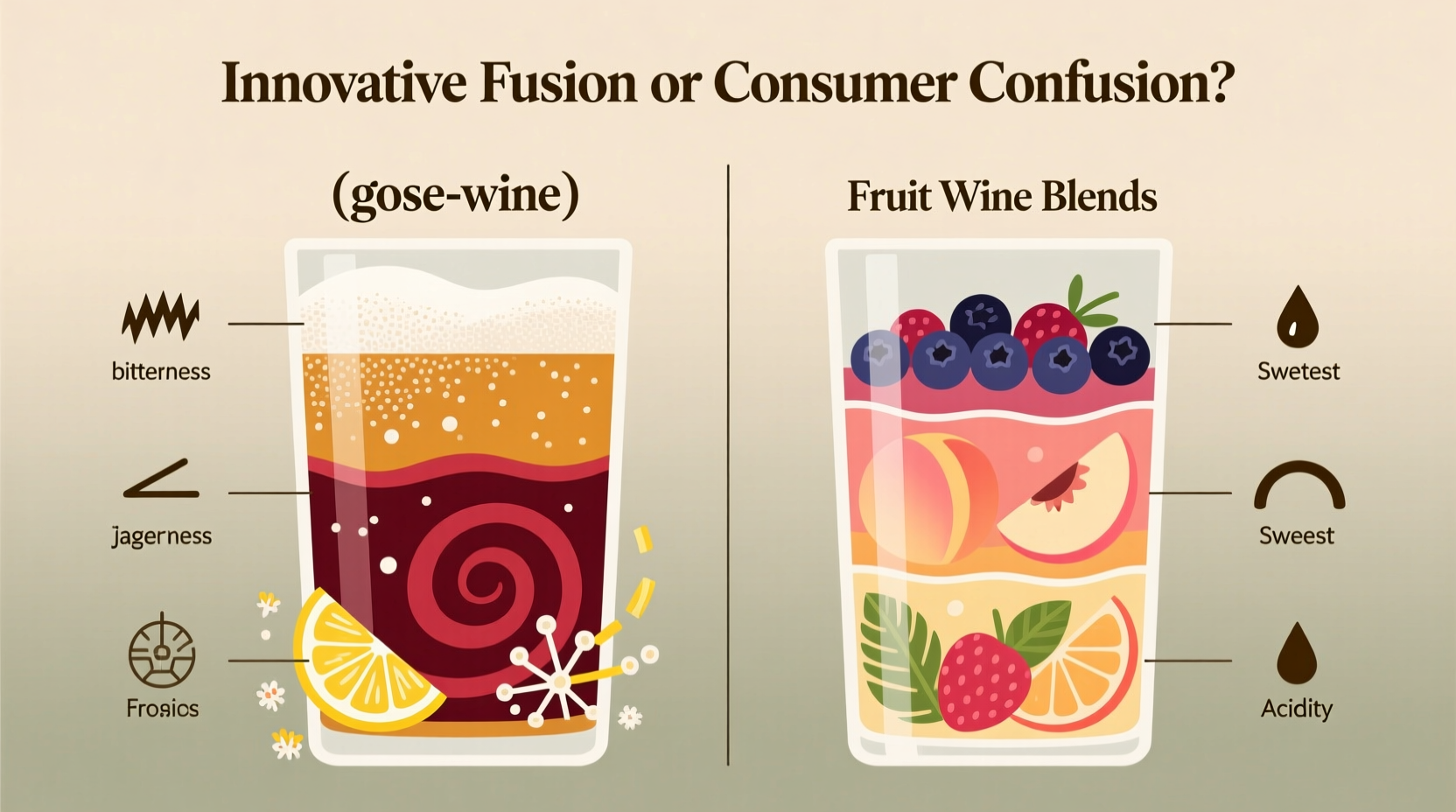
Before assessing innovation versus confusion, we must clarify what’s actually being blended—and why the language itself creates friction. “Beer-wine hybrid” is a broad, often misleading umbrella. It conflates three distinct technical approaches:
- Co-fermentation: Grapes and malted grain ferment together in the same vessel, with shared yeast strains (e.g., native Saccharomyces cerevisiae or mixed cultures). This yields integrated tannin, acidity, and phenolic structure—not just layered flavors.
- Blending post-fermentation: A finished wine is combined with a finished beer (or vice versa), often to adjust mouthfeel or acidity. This is more common in commercial products but rarely achieves true integration.
- Process borrowing: Applying winemaking techniques to beer (e.g., extended skin contact on barleywine) or brewing methods to wine (e.g., kettle souring before grape fermentation). The result may taste hybridized without containing both substrates.
Fruit wine blends—like blackberry-chardonnay or peach-malbec—fall into a different category altogether. Here, fruit is typically added as juice, concentrate, or whole fruit to a base wine, rather than serving as the primary fermentable. Legally, many U.S. states classify these as “fruit wines” only if ≥51% of fermentables come from non-grape sources—a threshold most commercial examples don’t meet. Instead, they function as flavored wines: aromatic enhancements rather than structural hybrids.
Tip: When evaluating a hybrid label, check the ingredient list—not just the front graphic. “Grape must, malted wheat, and Brettanomyces bruxellensis” signals intentional co-fermentation; “wine, beer, natural flavor” suggests post-hoc blending.What’s Actually Happening in the Fermenter?
True innovation emerges where biochemistry meets intentionality. Consider the microbial ecology: wine relies on robust, alcohol-tolerant Saccharomyces strains that suppress wild microbes, while traditional beer fermentation favors cleaner, faster S. cerevisiae or S. pastorianus under controlled conditions. But modern hybrid producers often use mixed-culture ferments—including Brettanomyces, Lactobacillus, and Pediococcus—that thrive across pH and alcohol gradients. A 2023 study published in Food Microbiology found that co-fermented grape-barley musts achieved greater ester diversity and lower volatile acidity than either substrate fermented alone, thanks to synergistic enzyme activity between fungal and bacterial populations.
This isn’t theoretical. At Jester King Brewery in Texas, the “Cuvée des Fleurs” series uses estate-grown Viognier grapes co-fermented with local wheat and native yeasts in open-top oak foudres. The resulting beverage has the floral lift of Viognier, the bready umami of wheat, and the earthy funk of spontaneous fermentation—yet clocks in at 6.8% ABV and finishes bone-dry. It resists classification not because it’s arbitrary, but because it occupies a new sensory territory: neither wine-like nor beer-like, but fermentative in its own right.
“Calling something a ‘gose-wine cross’ is like calling a violin concerto a ‘violin-piano hybrid.’ What matters is whether the elements converse—or just shout over each other. The best hybrids have a unified voice.” — Dr. Sarah Lin, Fermentation Scientist & Former Head Enologist, Ridge Vineyards
Consumer Confusion: Real, Measurable, and Rooted in Expectation
Confusion isn’t inherent to hybrids—it’s triggered when expectations clash with experience. A 2022 consumer perception study by the Beverage Marketing Corporation surveyed 1,247 adults who regularly purchased craft beer or natural wine. Key findings:
| Category | % Reporting “Strongly Confused” by Hybrid Labels | Top Reason Cited |
|---|---|---|
| Beer-wine co-ferments | 68% | “Didn’t know how to pair it or what glass to use” |
| Fruit-enhanced wines (e.g., blueberry cabernet) | 41% | “Assumed it would be sweet, but it was dry and tannic” |
| Traditional wine (control group) | 12% | “None—knew exactly what to expect” |
| Traditional craft beer (control group) | 15% | “None—knew exactly what to expect” |
The data reveals a pattern: confusion spikes when sensory cues contradict category assumptions. Consumers expect wine to be still, served at 12–16°C, and structured around grape-derived tannin and acidity. They expect beer to be carbonated, served colder, and built on malt, hops, and yeast character. Hybrids disrupt both sets of cues simultaneously. A sparkling, low-ABV, barrel-aged rosé-lambic blend may feel too light for wine drinkers and too complex for beer fans—leaving both groups uncertain how to engage.
A Mini Case Study: The Rise and Pivot of “Vinosa” in Brooklyn
In 2020, Vinosa launched as a “wine-beer fusion project” out of a shared production space in Bushwick. Their debut release, “Nebbiolo Saison,” co-fermented Nebbiolo must with Pilsner malt and saison yeast, aged 11 months in neutral Burgundian barrels. Critics praised its “tarry depth and crackling acidity,” but sales lagged. Tasting room staff reported consistent feedback: “I love it—but I wouldn’t buy it again because I don’t know where to put it in my fridge.”
By 2022, Vinosa shifted strategy—not away from hybrids, but toward clarity. They renamed the line “Fermenta” and introduced three tiers:
- Root: Single-substrate wines and beers, clearly labeled and priced accessibly.
- Bridge: Co-ferments with transparent descriptors (“Grape + Grain,” “Skin Contact + Barrel Age”)
- Edge: Experimental batches, sold only at the tasting room with staff-led flights and pairing notes.
Within six months, Bridge-tier sales grew 220%, and tasting room visit duration increased by 37%. As founder Maya Chen explained: “We stopped asking people to relearn categories—and started giving them scaffolding to explore within familiar ones.”
How to Navigate Hybrids Without Losing Your Palate (A Practical Checklist)
Whether you’re a curious consumer, a sommelier building a list, or a buyer for a retail shop, these steps reduce cognitive load and elevate enjoyment:
- Ignore the category label first. Read the full ingredient statement and fermentation notes before assuming it’s “beer” or “wine.”
- Check ABV and residual sugar. A 4.2% ABV, 12 g/L RS “wine” is functionally a fruited sour beer—even if made with 100% grape must.
- Assess carbonation level and serving temperature. If it’s highly effervescent and best at 6–8°C, treat it like a lively beer. If still and best at 14°C, approach it like a light red.
- Look for structural anchors. Does tannin come from grape skins or oak? Is acidity lactic (brewery-style) or tartaric/malic (vineyard-style)? These tell you more than the label.
- Start with Bridge-tier producers. Look for brands that explicitly separate experimental batches from core offerings—and provide clear context on their websites or labels.
Frequently Asked Questions
Are beer-wine hybrids legally recognized as either beer or wine?
No—regulatory frameworks haven’t caught up. In the U.S., the TTB requires products to declare primary fermentables and alcohol source. A co-ferment of grapes and barley must be labeled “fermented beverage” unless >51% of alcohol comes from one source. Most choose “other fermented beverage” or “mixed fermentation wine,” creating shelf-placement challenges in retail.
Do fruit wine blends age well?
Rarely. Most fruit additions (especially juices or concentrates) lack the natural preservatives—tannin, acidity, and alcohol concentration—needed for aging. Even high-quality fruit-wine blends like elderflower-chardonnay or cherry-pinot are best consumed within 12–18 months of bottling. True co-ferments with grape skins and wild microbes show far greater aging potential.
Is “natural” the same as “hybrid”?
No. “Natural” refers to minimal intervention (no added sulfites, no filtration, native fermentation). A hybrid can be conventional (e.g., lab yeast, added acid, fining agents) or natural—but the terms address process, not composition. Many of the most compelling hybrids are natural, but the overlap is coincidental, not definitional.
The Innovation Imperative: Beyond Novelty Toward Nuance
Label confusion is real—but it’s a symptom, not a verdict. Every major beverage category began as a point of confusion. Champagne was once dismissed as “the devil’s wine” for its tendency to explode in bottle. Port was considered undrinkable until English merchants fortified it for sea transport. The question isn’t whether hybrids confuse; it’s whether they offer something worth the cognitive work.
They do—when rooted in intention. A well-executed grape-barley co-ferment expresses terroir differently: the minerality of volcanic soil in the grape, amplified by the cereal’s earthy depth and the microflora’s metabolic signature. A fruit-wine blend made with whole-fruit maceration (not juice) adds textural grip and volatile compounds absent in standard varietal wines. These aren’t gimmicks. They’re expansions of the fermentation toolkit—akin to a chef using miso in a dessert or vinegar in a sauce: unfamiliar at first, then revelatory in context.
What separates lasting innovation from fleeting trend is repeatability, transparency, and respect for raw materials. The most promising hybrids don’t erase boundaries—they map new terrain between them. They ask us not to abandon our categories, but to hold them more lightly, and listen more closely to what the liquid says on its own terms.
💬 Your palate is the best critic. Try one hybrid this month—not to decide if it’s “good,” but to notice what surprises you, what confuses you, and what makes you reach for another sip. Then share your honest impression online. Real conversation, not perfect categories, is how taste evolves.