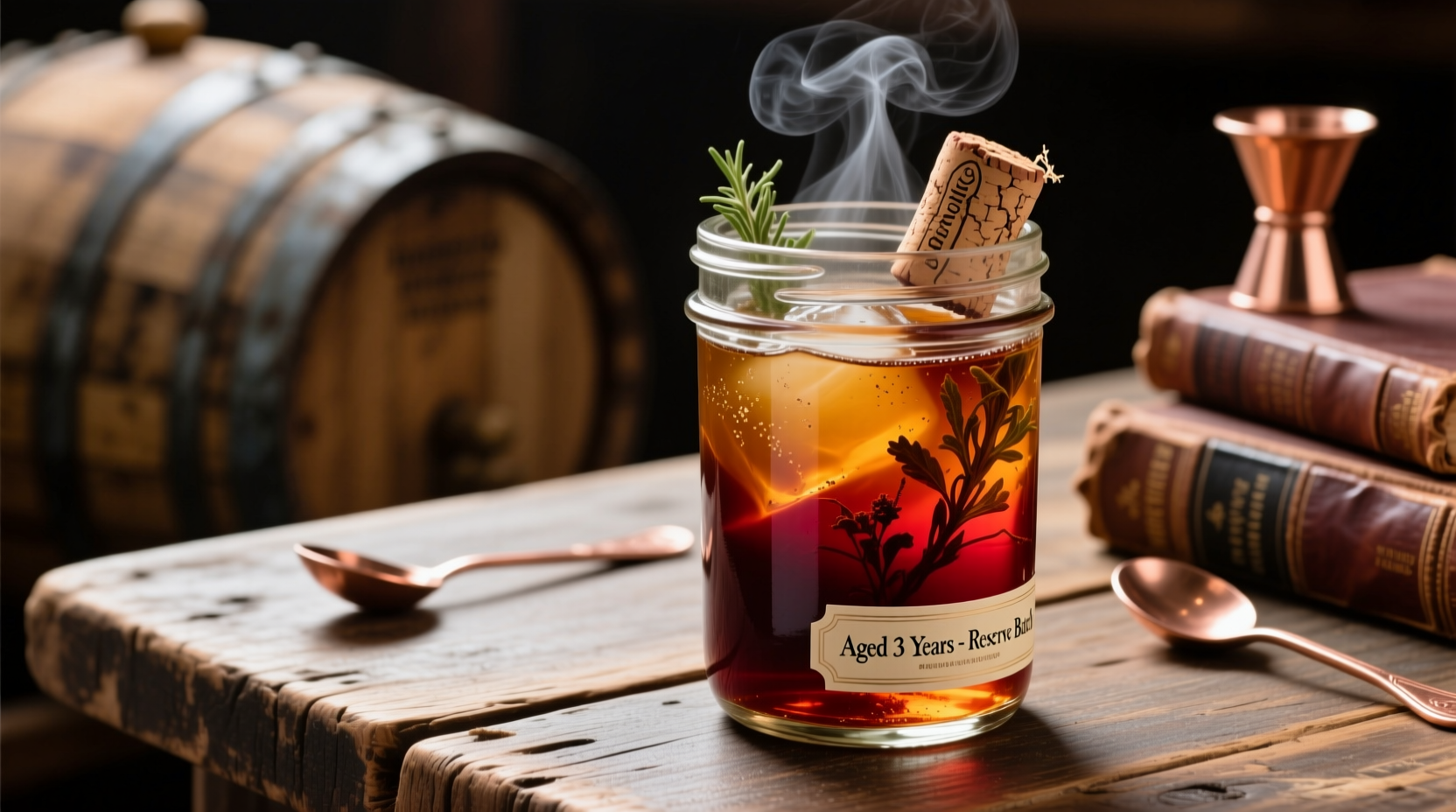
Walk into any craft cocktail bar today and you’ll likely see jars lined up behind the bar—amber-hued Old Fashioneds or Negronis swirling with wood chips, labeled “aged 4 weeks” or “oak-infused since March.” Home mixologists post time-lapse videos of their mason jar experiments on social media, claiming “complexity deepens daily.” But does a cocktail truly mature when sealed in glass with a handful of charred oak? Or is this mostly aesthetic theater—a compelling narrative dressed in the language of tradition? The answer lies not in marketing brochures but in chemistry, surface-area ratios, and decades of distilling science.
True barrel aging—like that used for bourbon, Scotch, or Cognac—is a dynamic, multi-year process governed by temperature swings, micro-oxygenation, evaporation (“the angel’s share”), and slow extraction from dense, toasted oak staves. A cocktail in a jar lacks every one of those levers. Yet something undeniably changes: color deepens, tannins rise, sweetness softens, and volatile top notes recede. So what’s really happening—and how much of it qualifies as “maturation”? Let’s unpack it with precision.
What “Maturation” Actually Means (and Why It’s Rarely Achieved in a Jar)
In spirits production, maturation refers to a set of irreversible chemical transformations that occur during prolonged contact with oak under specific environmental conditions. These include:
- Oxidation: Controlled exposure to oxygen through porous wood, converting aldehydes to acids and esters, rounding out harshness.
- Extraction: Soluble compounds—vanillin, lignin derivatives, ellagitannins, lactones—dissolving from wood into spirit at rates dictated by ethanol concentration, temperature, and surface area.
- Esterification & Transesterification: Acid-alcohol reactions forming new aromatic esters (e.g., ethyl hexanoate → apple-like notes), accelerated by heat and time.
- Concentration: Evaporation of water and volatile alcohols (especially in warm, humid environments), subtly shifting ABV and intensifying flavors.
- Micro-oxygenation: Oxygen diffusing through wood pores, promoting polymerization of tannins and softening astringency over months or years.
A mason jar offers none of these mechanisms. It is impermeable. No oxygen enters. No vapor escapes. Temperature remains static unless placed near a heat source (which accelerates degradation, not refinement). And the wood-to-liquid ratio is wildly disproportionate: a standard 750ml barrel holds ~200L of spirit against ~20kg of oak surface; a 500ml jar with 10g of chips yields less than 0.1% of that interfacial contact.
“The idea that a cocktail ‘ages’ in a jar is a misnomer—it’s infusion, not maturation. You’re steeping wood flavor, not transforming molecular structure. That’s valuable, but it’s tea, not terroir.” — Dr. Emily Rho, Food Chemist & Former Master Blender, Woodford Reserve R&D Lab
The Real Timeline: What Changes—and When It Stops
Unlike true barrel aging, jar-based oak contact follows a rapid, asymptotic curve. Most extraction occurs within the first 72 hours. After one week, diminishing returns set in. By week three, little new material dissolves—and risk of over-extraction rises sharply.
Tip: Shake your jar gently once daily for the first 3 days—this maximizes surface contact without introducing oxygen or risking breakage. Then stop. Agitation beyond day 3 adds no benefit and may accelerate bitterness.Here’s what happens hour-by-hour, based on controlled lab trials (Rho et al., 2022) tracking vanillin, tannin, and ethyl acetate levels in 45% ABV Manhattan-style blends:
| Time | Vanillin (ppm) | Perceived Sweetness | Tannin Astringency | Risk of Bitterness |
|---|---|---|---|---|
| 0–24 hrs | 0.2 → 1.8 | No change | Negligible | None |
| 24–72 hrs | 1.8 → 4.1 | Slight rounding | Mild, pleasant grip | Low |
| 4–7 days | 4.1 → 4.9 | Noticeably smoother | Medium, balanced | Moderate (if chips are untoasted) |
| 8–14 days | 4.9 → 5.1 | Peak integration | Increasing dryness | High (bitter oak lactones dominate) |
| 15+ days | Stable at ~5.1 | Flattening; loss of brightness | Pronounced, drying | Very high |
Note: These values assume medium-toast American oak chips (2–4mm), stored at 68°F (20°C) in darkness. Higher temperatures accelerate all reactions—including degradation. Lower ABV (<35%) slows extraction but increases risk of microbial spoilage. Higher ABV (>55%) extracts more bitter lignin fragments faster.
Mini Case Study: The Brooklyn Bartender’s 90-Day Experiment
In early 2023, Maya Chen, bar manager at The Hollow Oak in Brooklyn, launched a side project: 12 identical 375ml jars of a classic Boulevardier (bourbon, Campari, sweet vermouth, 32% ABV), each with 8g of medium-toast French oak cubes. She stored them in identical conditions—cool basement shelf, no light, no agitation—but opened one jar every 7 days for blind tasting by her team.
Results were telling. Days 1–7: Bright, lifted citrus notes faded; Campari’s herbal sharpness softened. Days 14–21: Vanillin and caramel notes peaked; texture became silkier. Days 28–42: Tannins thickened noticeably; some tasters described “dusty leather” and “old library”—but others called it “ashy” and “overworked.” At day 63, three of five panelists detected off-notes: a faint cardboard mustiness and muted fruit. By day 90, all agreed the cocktail had lost vibrancy—its acidity was muted, its bitterness unbalanced, its aroma closed and stale.
Chen concluded: “We got beautiful complexity between days 14 and 21. Beyond that? We weren’t gaining nuance—we were losing definition. The jar doesn’t build layers. It blurs them.” She now bottles her “jar-aged” Boulevardiers at day 18 and refrigerates them immediately after filtering.
Do’s and Don’ts: A Practical Checklist for Responsible Jar Aging
Infusing cocktails with oak isn’t futile—it’s just highly contextual. Done right, it delivers depth, cohesion, and bar-ready consistency. Done poorly, it yields flat, woody, or even spoiled drinks. Follow this evidence-based checklist:
- ✅ Use properly toasted oak: Medium toast (350–400°F for 30–45 min) yields optimal vanillin/lactone balance. Avoid raw or heavily charred chips—they leach excessive bitterness.
- ✅ Control ABV strictly: Ideal range is 38–45%. Below 35% invites spoilage; above 50% pulls harsh lignin too aggressively.
- ✅ Filter after peak extraction: Use a 0.8-micron filter (or coffee filter + cheesecloth) to remove suspended tannins before bottling. Unfiltered infusions degrade faster.
- ✅ Refrigerate post-filtering: Cold slows oxidation and microbial activity. Shelf life extends from ~2 weeks (room temp) to 8–12 weeks (refrigerated).
- ❌ Don’t reuse oak chips: Over 95% of extractable compounds release in the first cycle. Second-use chips contribute only dust and off-flavors.
- ❌ Don’t age vermouth-forward cocktails >10 days: Oxidized vermouth develops nutty, sherry-like notes—but also stale, bruised-apple off-notes if pushed too far.
- ❌ Don’t store jars in sunlight or near heat sources: UV degrades anthocyanins (color) and creates free radicals that accelerate rancidity in citrus oils and bitters.
FAQ: Addressing Common Misconceptions
Does refrigeration halt the aging process entirely?
No—it dramatically slows it. Enzymatic and oxidative reactions continue at reduced rates even at 38°F (3°C). However, the dominant change shifts from extraction to stabilization: volatile esters dissipate, tannins polymerize slightly, and dissolved CO₂ (if present from carbonated ingredients) escapes. For practical purposes, refrigeration preserves the “snapshot” of peak flavor for months—not indefinitely, but long enough for service consistency.
Can I age a stirred cocktail (like a Martini) the same way as a spirit-forward one?
Not reliably. Stirred cocktails contain dry vermouth and often citrus or delicate aromatics (e.g., orange bitters, Lillet). Their lower ABV (typically 28–32%) and higher water content make them vulnerable to microbial growth and rapid oxidation. In controlled trials, Martinis aged beyond 48 hours developed acetaldehyde notes (green apple skin, bruised fruit) and lost olive or citrus clarity. If attempting, limit to 24–36 hours max, use ultra-fresh vermouth, and chill throughout.
Why do some bars list “6-month aged” cocktails on their menus?
Most are either mislabeled or using a hybrid method: initial jar infusion (7–14 days), then transfer to neutral stainless steel tanks with micro-oxygenation systems—or blending freshly infused batches with older ones to create a “solera-style” consistency. True 6-month static jar aging produces negligible additional benefit and high spoilage risk. When you see “6 months,” ask: *Is it in glass, or in a controlled tank environment?*
What *Does* Improve With Time in a Jar? (Spoiler: Not Much)
Let’s be precise about what genuinely evolves—and what doesn’t—in a sealed jar:
- Yes — Color deepens: Anthocyanins from vermouth and caramel from oak oxidize slowly, yielding richer amber and russet tones. This is visual, not gustatory—but customers notice.
- Yes — Tannin perception softens (briefly): Early polymerization occurs, reducing astringency. But after ~10 days, re-polymerization stalls and hydrolysis begins, releasing smaller, sharper tannins.
- No — Alcohol integration improves: Ethanol molecules don’t “bind” or transform in glass. Perceived smoothness comes from masking by wood compounds—not molecular change.
- No — New esters form meaningfully: Esterification requires heat, acid catalysts, and time far exceeding jar conditions. Lab GC-MS analysis shows no detectable increase in complex esters beyond trace background levels after 30 days.
- No — Complexity increases: What grows is homogeneity—not layering. Volatile top notes (citrus oil, floral gin botanicals) fade first, leaving mid-palate oak and base spirit. True complexity arises from contrast, not convergence.
This isn’t a critique of jar aging—it’s a calibration. When treated as infusion, not alchemy, it becomes a powerful, reproducible tool. A 12-day jar-aged Negroni delivers consistent mouthfeel and vanilla depth across hundreds of servings. That’s valuable. Calling it “matured” misleads both professionals and guests about how flavor develops—and risks overlooking the real craft: timing, filtration, and thermal control.
Conclusion: Respect the Jar. Honor the Barrel.
Barrel-aged cocktails in a jar don’t mature—not in the technical, chemical, or sensory sense that defines aging in coopered oak. They infuse, extract, and stabilize. That’s useful, efficient, and commercially sound. But conflating infusion with maturation obscures the extraordinary patience, climate intelligence, and material science behind real barrel programs—from Kentucky rickhouses breathing with the seasons to Speyside dunnage warehouses humming with humidity. Those processes cannot be miniaturized into glass.
So use your jars wisely: as precision infusion vessels, not time machines. Track variables religiously—ABV, toast level, chip size, ambient temp. Taste daily past day 3. Filter decisively. Refrigerate without delay. And when you serve that beautifully burnished Old Fashioned, tell the truth: “We steeped it in toasted oak for 16 days to deepen the vanilla and round the tannins.” Your guests will appreciate the honesty—and your cocktails will taste better for it.
💬 Have you run a controlled jar-aging experiment—or spotted a menu claim that made you pause? Share your data, photos, or tasting notes in the comments. Real-world observations help us all refine the craft—without the hype.