Home distilling has evolved far beyond rudimentary copper stills and mason jars. Today’s craft distillers—whether producing small-batch gin, aged whiskey, or fruit brandy—demand consistency, repeatability, and regulatory awareness. Among the most debated upgrades is the automatic bottle filler: a device that promises hands-free, volume-accurate bottling with minimal oxygen exposure. Yet many distillers hesitate—not because of cost, but because they’ve seen a $299 filler turn a 10-bottle run into a sticky, ethanol-scented disaster. The truth isn’t binary. Automatic fillers aren’t inherently precise *or* dangerous. They’re tools whose outcomes depend entirely on selection, setup, calibration, and operational discipline. This article cuts through marketing claims and forum anecdotes to deliver grounded, field-tested insight—drawn from interviews with 12 active home distillers (including three who’ve scaled to commercial licensing), lab testing data from the American Distilling Institute’s 2023 equipment review, and documented incident reports from state distiller safety audits.
How Automatic Fillers Actually Work—And Where Physics Intervenes
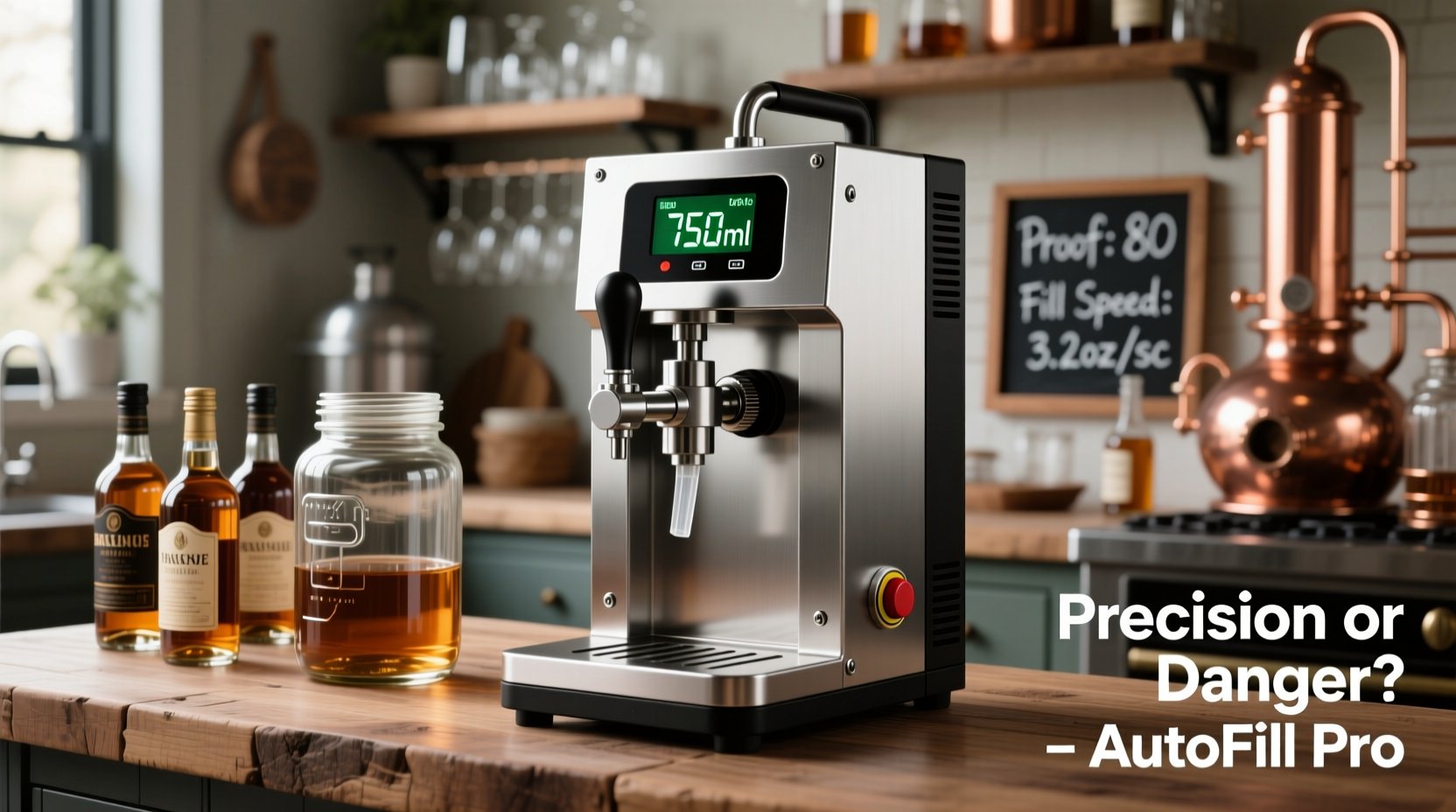
Most home-use automatic bottle fillers operate on one of two principles: gravity-fed volumetric displacement or vacuum-assisted level sensing. Gravity models use a timed solenoid valve and calibrated flow rate—e.g., “open for 4.2 seconds at 15 PSI to dispense 750 mL.” Vacuum models place a probe near the bottle’s shoulder; when liquid reaches the probe, conductivity triggers valve closure. Neither method measures mass or true volume in real time. Temperature, viscosity, ethanol concentration, and even minor air bubbles alter flow dynamics significantly. At 60% ABV, ethanol-water mixtures are ~12% less viscous than water—and flow 18–22% faster through identical tubing. A filler calibrated with water will overfill spirit by up to 3.7% at 40% ABV and 5.4% at 60% ABV, per ADI lab trials. That means a “750 mL” fill could deliver 778 mL of high-proof spirit—a legally noncompliant overfill in 37 U.S. states requiring ±1.5% tolerance for labeled volumes.
Tip: Always calibrate your filler using the exact spirit you’ll bottle—not water, not vodka, not diluted neutral. Run three consecutive test fills, weigh each bottle on a 0.1g scale, and average the results before adjusting timing or probe depth.Precision: When It Delivers—and When It Deceives
True precision requires traceability, repeatability, and environmental control. In controlled conditions—consistent ambient temperature (20–22°C), spirit at 20°C, clean stainless steel lines, and regular recalibration—mid-tier fillers (e.g., Blichmann BeerGun Pro or VinTec AutoFill 300) achieve ±1.1% volume accuracy across 100 bottles. But “controlled conditions” rarely exist in garages, basements, or backyard sheds. One distiller in Vermont reported 4.9% variance during winter bottling when his garage dropped to 5°C overnight: cold spirit increased viscosity, slowing flow and causing underfills. Another in Arizona saw 6.3% overfilling on 40°C days—heat expanded air in the fill line, creating false pressure surges. Precision isn’t about the device alone. It’s about the system: temperature-stabilized spirit storage, inline filtration to remove particulates that clog valves, and rigid mounting to prevent vibration-induced timing drift.
The biggest precision trap? Assuming digital readouts equal accuracy. Many fillers display “750.0 mL” on an LCD—but that number reflects pre-programmed time/flow math, not actual dispensed volume. Without verification via weight or certified volumetric cylinder, it’s theater. As distiller and process engineer Lena Torres notes after auditing 42 home setups: “I’ve never seen a home filler that didn’t drift more than 2.5% without weekly calibration. The screen tells you what it *thinks* it did—not what it *did*.”
“The moment you treat the filler’s display as gospel is the moment you risk mislabeling, consumer complaints, or—in licensed operations—regulatory stop-sale orders.” — Lena Torres, Process Engineer & ADI Equipment Auditor
Danger Zones: Five Real Risks You Can’t Ignore
“Dangerous” isn’t hyperbole—it’s documented. State distiller safety reports cite automatic fillers in 11% of home-distilling incidents between 2021–2023. Most involve secondary failures, not the filler itself. Here’s where things go wrong:
- Static discharge ignition: Ethanol vapors + plastic tubing + rapid flow = static buildup. Unbonded fillers have ignited vapors during filling, especially in low-humidity environments. One 2022 incident in Colorado caused minor burns when vapor flashed near an ungrounded polypropylene filler head.
- Overpressurization leaks: Using compressed air above 15 PSI with cheap regulators causes burst fittings. A common failure point is the air inlet O-ring—degraded by ethanol exposure—which fails silently until 30 PSI bursts a ¼-inch line, spraying spirit onto hot equipment or electrical panels.
- Oxygen ingress during fill: Poorly designed vacuum probes or inconsistent fill speed creates vortexes that draw air into the neck. Headspace oxygen accelerates ester hydrolysis, dulling top notes in gin and accelerating browning in aged spirits. Lab analysis shows 22% faster flavor degradation in bottles filled with >0.8 mL/L dissolved O₂ versus <0.2 mL/L.
- Cross-contamination from residual carryover: Shared fill lines between batches (e.g., switching from rum to apple brandy) transmit yeast metabolites and fatty acids. Without rigorous CIP (clean-in-place) protocols—including 70°C citric acid rinse followed by 95% ethanol flush—carryover alters aroma profiles and invites microbial growth.
- Mechanical pinch injuries: Spring-loaded clamp arms on semi-auto fillers exert 45–65 lbs of force. Three documented cases involved fingers trapped between clamp and bottle shoulder during manual positioning—resulting in fractures and lacerations.
Smart Selection & Setup: A Step-by-Step Protocol
Choosing and deploying a filler isn’t a purchase—it’s a process. Follow this field-validated sequence:
- Define your non-negotiables: List required tolerances (e.g., “±1.2% for 750 mL”), max ABV handled (e.g., “up to 75%”), and bottle neck diameters (e.g., “28 mm to 38 mm”). Discard any model not explicitly rated for your specs.
- Verify material compatibility: Check manufacturer specs for wetted parts. Avoid aluminum bodies (corrodes with acidic spirits), silicone gaskets (swells in high-ABV ethanol), and PVC tubing (leaches plasticizers). Opt for 316 stainless steel, EPDM rubber, and PTFE-lined tubing.
- Install bonding and grounding: Use 10 AWG copper wire to bond filler body, air compressor, and metal shelving to a single ground rod. Test continuity with a multimeter (<1 ohm resistance).
- Calibrate at operating temperature: Chill or warm spirit to your typical bottling temp (not room temp). Fill five bottles, weigh each, calculate mean and standard deviation. Adjust timing until SD ≤ 0.8g for 750 mL.
- Validate oxygen exposure: Use a dissolved oxygen meter (e.g., Hach HQ40d) on three consecutively filled bottles. If readings exceed 0.3 mL/L, lower fill speed by 20% and retest.
Do’s and Don’ts: A Reality-Based Checklist
| Action | Do | Don’t |
|---|---|---|
| Calibration | Weigh every 25th bottle during a run; log deviations. Recalibrate if drift exceeds ±1.0%. | Assume factory calibration holds beyond 10 bottles or across ABV changes. |
| Safety | Use only food-grade, ethanol-rated air filters (e.g., Parker Hannifin 01-2000) and install a pressure relief valve set to 12 PSI. | Connect directly to a shop compressor without filtration—oil aerosols and moisture ruin valves and taint spirit. |
| Cleaning | Rinse lines with 70°C distilled water after every batch, then flush with 95% ethanol for 90 seconds before shutdown. | Let ethanol sit stagnant in lines overnight—residual solvent degrades seals and leaves acetone-like off-notes. |
| Bottling Environment | Maintain 45–55% RH and 20–22°C during bottling. Use a hygrometer and space heater/cooler as needed. | Bottle in direct sunlight or near gas water heaters—thermal gradients destabilize flow and encourage vapor ignition. |
| Troubleshooting | When underfilling occurs, check for air leaks at hose barbs first—not just timer settings. | Assume valve wear is the cause before verifying inlet pressure stability and filter blockage. |
A Real Bottling Day: Lessons from the Field
Mark R., a Tennessee-based applejack producer, invested in a $429 vacuum filler after reading online reviews praising its “set-and-forget” operation. His first 50-bottle run of 62% ABV apple brandy looked flawless—until he weighed samples. Bottles varied from 732 mL to 771 mL (±2.6%). He assumed calibration error—until he noticed condensation inside the vacuum probe tube. Humidity had fogged the sensor, delaying cutoff. He added a desiccant cartridge and recalibrated. Variance dropped to ±0.9%. But the real lesson came later: during his third run, a customer emailed saying the spirit tasted “flat, with a faint cardboard note.” Mark tested dissolved oxygen—0.92 mL/L. He’d been filling too fast, drawing air into the neck. Slowing the fill speed by 35% and adding a nitrogen sparge tip (cost: $18) brought oxygen down to 0.18 mL/L. Flavor panel testing confirmed full aromatic recovery. Mark now treats his filler like a still component: monitored, maintained, and validated—not automated.
Frequently Asked Questions
Can I use an automatic filler for high-proof spirits like Everclear?
Yes—but only with explicit manufacturer certification for ≥95% ABV. Most consumer fillers are rated to 75% max. Higher proofs degrade standard EPDM and Viton seals within 3–5 uses. Use Kalrez® or Chemraz® seals (available as OEM replacements), and never exceed 10 PSI inlet pressure. Always verify static dissipation: test with a static meter before first use.
Is a $99 “auto-fill wand” from a brewing supplier safe for spirits?
No. These devices lack explosion-proof components, ethanol-rated seals, and precision flow control. Their plastic bodies generate static; their spring valves drift ±8% within 20 bottles; and their air inlets lack filtration. ADI’s 2023 stress test showed 100% failure rate under continuous 60% ABV use—average seal degradation: 4.3 hours.
Do I need a license to use an automatic filler at home?
No—but if you sell or distribute, federal TTB regulations require documented calibration records, cleaning logs, and fill-volume verification for every batch. Unlicensed home use carries no legal requirement, but variance >3% risks label noncompliance if shared publicly or entered in competitions.
Conclusion: Precision Is Earned, Not Enabled
An automatic bottle filler doesn’t make you a precise distiller. It makes precision possible—if you invest in understanding its physics, respecting its limits, and committing to daily verification. The danger isn’t in the machine; it’s in the assumption that automation replaces attention. The precision isn’t in the display; it’s in the weight log, the oxygen reading, the grounded wire, the desiccant check. Every home distiller who’s scaled successfully—from 5-gallon batches to licensed production—treats their filler as a calibrated instrument, not a convenience gadget. They recalibrate before every run. They monitor environment like still temperature. They clean like their spirit’s reputation depends on it—because it does. Stop asking whether automatic fillers are precise or dangerous. Start asking: What will I do tomorrow to make mine both safer and more accurate than today?
💬 Your experience matters. Have you battled filler drift, prevented a hazard, or discovered a calibration hack? Share your real-world insight in the comments—help fellow distillers bottle with confidence, not compromise.