Vintage cocktail books—think Harry Craddock’s The Savoy Cocktail Book (1930), David Embury’s The Fine Art of Mixing Drinks (1948), or Trader Vic’s Bartender’s Guide (1947)—sit on shelves like heirlooms: leather-bound, foxed at the edges, occasionally annotated in faded ink. Many assume they’re decorative artifacts—charming but obsolete in an era of sugar-free syrups, precision refractometers, and keto-certified bitters. Yet behind their sepia-toned illustrations and imperial measurements lies a rigorous, ingredient-first logic that predates industrial sweeteners by decades. These books weren’t built around syrup dependency; they were engineered for balance, acidity, dilution, and spirit clarity—principles that align more closely with today’s low-sugar imperatives than most contemporary “craft” manuals that default to house-made honey-ginger syrup as a flavor crutch.
The Structural Wisdom Embedded in Vintage Formulas
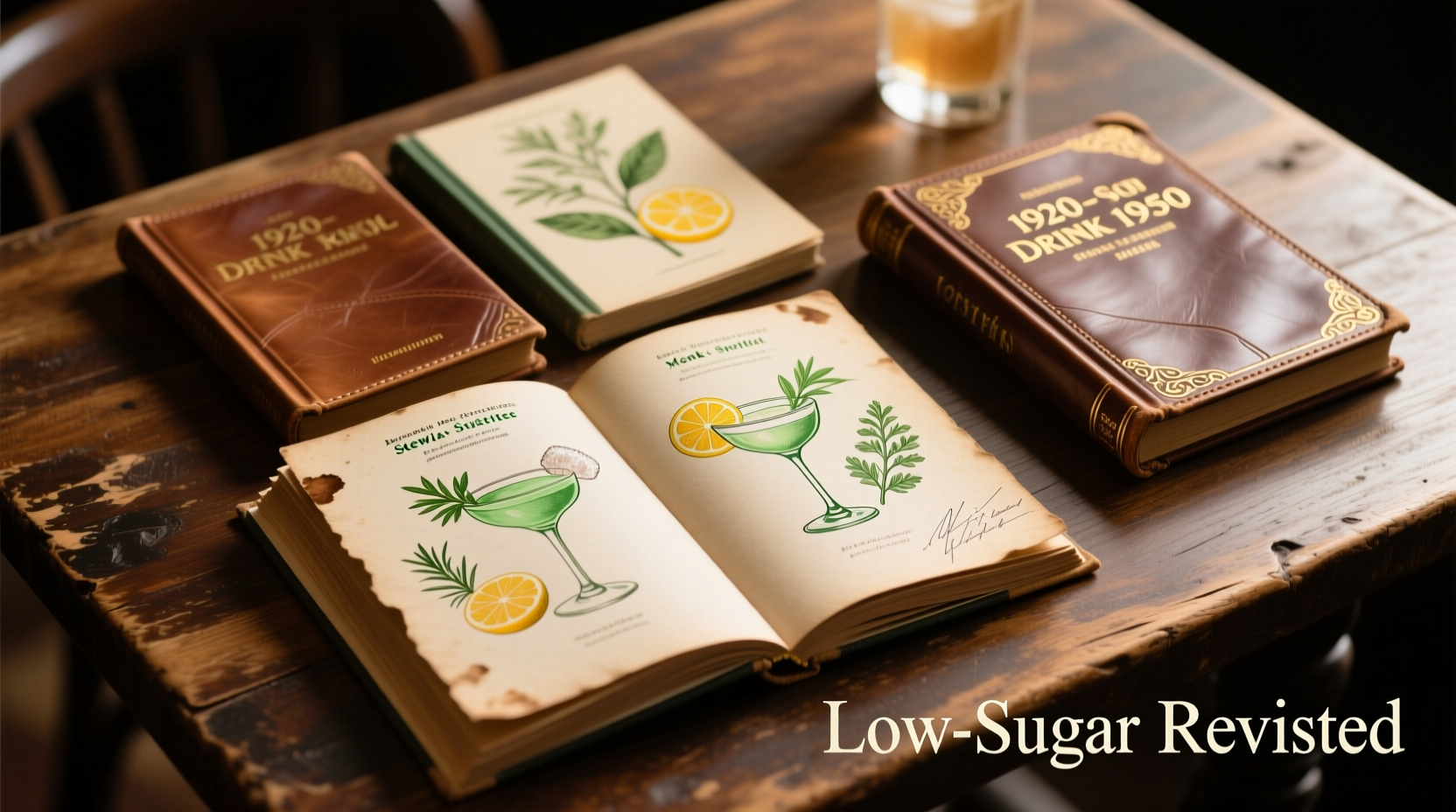
Modern low-sugar mixology often begins with subtraction: “How little sugar can I use before this tastes flat?” Vintage books approach balance differently—they begin with structure. Embury famously categorized drinks into six families based on dominant spirit and acid/sweet ratio, insisting that “a cocktail is not a mixture—it is a composition.” His “Sour” template (spirit + citrus + sweetener) wasn’t a recipe, but a framework where sweetness served function—not indulgence. A Daiquiri, for example, appears in Craddock’s 1930 edition as “rum, lime juice, sugar,” with no quantities listed beyond “1/2 jigger rum, juice of 1/2 lime, 1/2 teaspoon sugar.” That tiny amount—roughly 2.5g of sucrose—is less than half the sugar in a single commercial lemon wedge. The emphasis was on fresh citrus acidity to lift the spirit, not syrup to mask it.
This structural clarity matters because it decouples sweetness from necessity. When you understand that a Whiskey Sour works because citric acid hydrolyzes ethanol esters (enhancing aromatic volatility), not because simple syrup “makes it palatable,” you stop reaching for sugar substitutes and start optimizing extraction, temperature, and texture instead.
Tip: Replace “sweetener” with “balance agent” in your mental lexicon. In vintage frameworks, sugar isn’t flavor—it’s pH modulator, viscosity adjuster, and mouthfeel anchor. That means agave nectar, erythritol, or date paste aren’t drop-in swaps—they’re different tools requiring recalibration of citrus volume and dilution.What Modern Low-Sugar Practice Gets Wrong (and What Vintage Books Get Right)
Contemporary low-sugar bartending often falls into three traps: over-reliance on artificial sweeteners (which lack sucrose’s mouth-coating effect and can leave bitter aftertastes), neglect of dilution control (leading to harsh, unbalanced spirits-forward drinks), and underestimation of non-sugar texture agents (like egg white, gum arabic, or reduced fruit purees). Vintage books sidestep all three—not by design, but by constraint. Without shelf-stable syrups, bartenders used fresh fruit juices, shrubs (vinegar-based preserves), and clarified dairy. These ingredients deliver body and roundness without refined sugar.
Consider the Champagne Cup, a staple in 19th-century American bar guides. Its original formulation (as seen in Jerry Thomas’s 1862 Bar-Tender’s Guide) calls for “1 wine-glass brandy, 1 wine-glass curaçao, 1 wine-glass raspberry syrup, 1 piece lemon peel, 1 lump sugar, champagne to fill.” But crucially, the raspberry syrup was made by macerating fresh berries in vinegar and honey—not boiling fruit with cup upon cup of sugar. That vinegar base provided acidity and preservative power; the honey was minimal and enzymatically active, contributing subtle floral notes rather than cloying sweetness.
| Approach | Vintage Practice | Common Modern Low-Sugar Pitfall |
|---|---|---|
| Sweetness Source | Fresh fruit macerations, shrubs, small-batch honey, maple sap reductions | Artificial sweeteners (sucralose, stevia), high-intensity monk fruit blends |
| Dilution Control | Stirred/shaken to precise temperature (often tested by touch), using ice cut to consistent size | Over-shaking with crushed ice, leading to excessive water and thin mouthfeel |
| Texture & Body | Egg white, cream, clarified butter washes, gum arabic–stabilized foams | Reliance on xanthan gum alone, creating slimy or chalky textures |
| Acid Strategy | Layered acids (citrus + vinegar + tannic tea) for complexity and pH stability | Single-acid dominance (lemon only), causing flavor fatigue and palate burn |
A Real-World Application: Rebuilding the Martinez for Low-Sugar Context
In 2022, beverage director Lena Ruiz redesigned the Martinez—a pre-Prohibition gin-and-vermouth classic—for her zero-added-sugar tasting menu at Veridian Bar in Portland. Her starting point wasn’t a modern “keto cocktail” blog, but the 1887 edition of Harry Johnson’s New and Improved Bartender’s Manual, which lists the Martinez as “1/3 Old Tom gin, 2/3 Italian vermouth, 1 dash maraschino, 1 dash bitters, 1 spoonful gum syrup.” Crucially, Johnson defines “gum syrup” as “simple syrup thickened with gum arabic”—a viscous, low-sugar stabilizer that adds mouthfeel without sweetness.
Ruiz replaced the sugar-laden Old Tom gin (historically sweetened with licorice root and cane syrup) with a dry, botanical-forward London Dry. She swapped Italian vermouth for a custom barrel-aged bianco vermouth infused with dried chamomile and quince—adding tannin and umami without residual sugar. Instead of gum syrup, she used a 0.5% gum arabic solution (no sugar added) and adjusted bitters to include gentian root for bitterness reinforcement. The result? A Martinez with 0.8g total sugar per serving—87% less than the standard version—and significantly greater aromatic depth and textural resilience.
This wasn’t retro fetishism. It was forensic reconstruction: using vintage ratios as a diagnostic tool to identify where sugar was functional (gum syrup for viscosity) versus decorative (Old Tom’s sweetness, which masked poor distillation). Once that distinction was clear, substitution became purposeful—not performative.
Expert Insight: Why Historians and Modern Mixologists Agree
“The greatest misconception about vintage cocktail books is that they’re about taste. They’re about *process discipline*. Craddock measured ice melt rates. Embury calculated ideal ABV windows for aromatic perception. Those are the same metrics we use with refractometers and pH meters today—just expressed in imperial units and observational language.” — Dr. Alicia Chen, Beverage Historian and Lead Researcher, Museum of the American Cocktail
“I’ve reverse-engineered over 200 pre-1950 recipes for our low-sugar program. Not one required sugar reduction—the originals were already lean. What needed updating was ingredient sourcing: swapping oxidized vermouths for stable, low-ABV alternatives; replacing degraded orange curaçao with cold-distilled citrus oils; clarifying dairy instead of using ultra-pasteurized cream. The math was already sound.” — Marcus Bell, James Beard Award–nominated Beverage Director, The Marlowe Group
A Practical Integration Checklist: Using Vintage Books Without Getting Stuck in the Past
- ✅ Audit the ratio—not the ingredients. Note spirit-to-acid-to-sweet proportions first. Ignore “1 tsp sugar” and ask: “What role does this play? Is it for viscosity? pH buffering? Flavor bridge?”
- ✅ Cross-reference multiple editions. A recipe appearing identically in Thomas (1862), Johnson (1887), and Craddock (1930) signals structural stability—not trendiness.
- ✅ Prioritize primary sources over reprints. Later reissues often “modernize” measurements or add syrup substitutions that erase original intent. Seek facsimiles or library scans of first editions.
- ✅ Map vintage techniques to modern tools. “Shake until the shaker frosts” ≈ -2°C internal temperature; “stir until diluted 25%” ≈ 22 seconds with 1.5 oz spirit and 1.25 oz ice.
- ✅ Test acid balance separately. Make a batch of citrus juice, measure its pH, then add incremental amounts of your chosen sweetener (or substitute) while retesting. Vintage formulas assumed ~2.8–3.2 pH for citrus—don’t drift above 3.5 without compensatory tannin or salt.
FAQ: Addressing Common Skepticism
Don’t vintage recipes rely on ingredients we can’t source anymore—like genuine absinthe or pre-phylloxera vermouth?
No—what they rely on is *understanding*, not scarcity. Authentic pre-1915 absinthe had higher thujone levels, yes, but its functional role in a Sazerac was aromatic lift and anise-driven top-note contrast—not chemical potency. Today’s regulated absinthe, when dosed at 0.25 oz instead of the historical 0.125 oz, delivers equivalent aromatic impact. Likewise, modern dry vermouths (e.g., Dolin Dry, Noilly Prat Original) have lower residual sugar (0.5–1.2g/L) than many 1930s Italian vermouths (up to 40g/L). So vintage structure often works *better* with today’s cleaner, drier ingredients.
Isn’t measuring in “jiggers” and “spoonfuls” too imprecise for modern low-sugar work?
Imprecision is only a problem if you mistake the unit for the intent. A “dash” in Craddock’s book meant “enough to alter the surface tension of the liquid”—a tactile, observable outcome, not a volume. Modern bars replicate this with pipettes calibrated to deliver 0.1 mL of bitters, achieving the same functional result. The vintage language describes effect; the modern tool measures cause. They’re complementary—not contradictory.
Can home bartenders really apply this—or is it only for professionals with lab equipment?
Absolutely accessible. You don’t need a pH meter to succeed: use a digital kitchen scale (to weigh citrus juice and track yield), a calibrated jigger (15 mL = 0.5 oz), and a thermometer app on your phone (place it against the shaker tin post-shake). Track three variables across five iterations: citrus weight, shake time, and final temperature. That’s enough data to replicate vintage precision without a single specialized tool.
Conclusion: Relevance Is a Function of Interpretation, Not Age
Vintage cocktail books are neither obsolete nor sacred. They are field manuals written by practitioners solving the same core problems we face today: how to make spirit-forward drinks refreshing without sugar overload, how to build texture without dairy or gums, how to achieve longevity in flavor without preservatives. Their relevance isn’t baked into the binding—it’s activated by the reader’s willingness to interrogate ratios, decode terminology, and translate intent across centuries of ingredient evolution. When approached as engineering documents rather than nostalgic artifacts, these books become indispensable allies in constructing drinks that are structurally sound, sensorially coherent, and genuinely low in sugar—not just low in obvious sweetness.
Start with one book. Pick one drink. Measure the citrus. Time the shake. Taste before and after dilution. Notice where the balance shifts—not where the sugar hides. That’s where the real relevance begins.
💬 Your turn: Try rebuilding a classic sour this week using only fresh citrus, gum arabic solution, and your base spirit. Share your ratio adjustments and tasting notes in the comments—we’ll feature the most insightful rebuilds in next month’s deep-dive column.