Wine aging is less about time and more about precision. A bottle of Cabernet Sauvignon may need 10 years to reach its peak—but only if stored within a narrow band of temperature, humidity, vibration, and light exposure. For decades, consumers defaulted to kitchen refrigerators for short-term storage, assuming “cold is cold.” Yet professional sommeliers, winemakers, and serious collectors have long known: domestic fridges actively harm aging potential. Enter the smart wine cooler—a category that blends IoT connectivity with engineering-grade environmental control. But does it meaningfully enhance aging, or is it simply a high-margin upgrade with flashy apps? The answer lies not in marketing claims, but in measurable parameters, real-world performance data, and decades of enological research.
What Makes Aging Wine So Fragile?
Aging isn’t passive preservation—it’s a slow, enzymatic ballet. Tannins polymerize, acids soften, esters evolve into complex tertiary aromas like leather, tobacco, and dried fig. Each of these transformations depends on stable, low-energy conditions. Disrupt that stability, and you don’t just delay development—you risk irreversible damage.
Consider these four non-negotiable factors:
- Temperature consistency: Fluctuations >±0.5°C/day accelerate oxidation and encourage cork movement, letting air seep in.
- Humidity control: Below 55% RH dries corks; above 75% encourages mold and label degradation.
- Vibration isolation: Even subtle motor hum (common in compressor-based fridges) disrupts sediment formation and stresses colloidal stability in wine.
- UV & visible light filtration: Wavelengths below 450 nm degrade phenolic compounds, producing “light-struck” off-aromas—think wet cardboard or cabbage.
A standard refrigerator fails on all four counts: it cycles between 1°C and 7°C, runs at ~35–45% RH, vibrates constantly, and uses clear glass doors that transmit full-spectrum light. It’s designed for perishables—not for coaxing complexity from a 2010 Barolo over a decade.
How Smart Coolers Differ From Standard Fridges—and Why It Matters
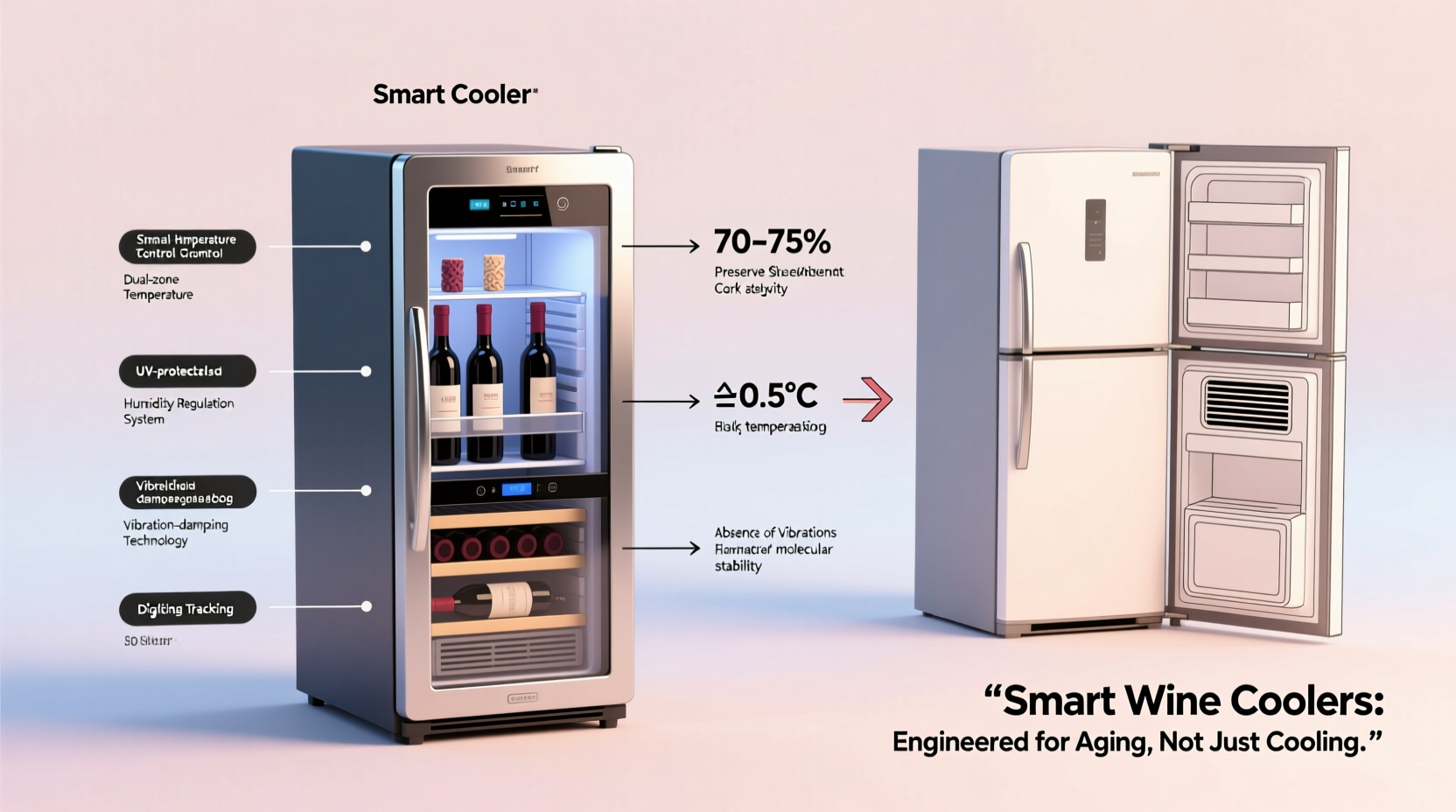
“Smart” in this context goes beyond Wi-Fi and app integration. It signifies a systems-level redesign prioritizing enological integrity. Let’s compare core specifications across three categories:
| Feature | Standard Kitchen Fridge | Basic Wine Cooler | Smart Wine Cooler |
|---|---|---|---|
| Temperature Stability | ±3–5°C daily swing | ±1°C with single-zone compressor | ±0.3°C via dual PID-controlled zones + adaptive learning algorithms |
| Humidity Range | 30–45% RH (uncontrolled) | 50–65% RH (passive reservoir) | 55–70% RH (active humidification + condensation recovery) |
| Vibration Level | 35–45 dB (compressor pulses every 8–12 min) | 28–32 dB (anti-vibration mounts) | ≤22 dB (dual-stage suspension + brushless DC inverter compressor) |
| Light Filtration | None (clear glass, LED interior lights) | 95% UV block (tinted glass + LED with <400 nm cutoff) | 99.8% UV/visible block (multi-layer laminated glass + 385 nm LED) |
| Data Logging | None | Basic temp readout | Continuous logging (temp, RH, door events, ambient pressure), cloud-synced with anomaly alerts |
The difference isn’t incremental—it’s categorical. A smart cooler doesn’t just *approximate* cellar conditions; it replicates them with laboratory-grade fidelity. And fidelity matters because aging is cumulative. A 0.5°C daily fluctuation may seem trivial, but over five years, it subjects wine to 1,825 thermal expansion/contraction cycles—enough to fatigue natural cork and permit micro-oxygenation at rates 3× higher than ideal.
Tip: If your wine develops a faint, damp basement or wet newspaper aroma before opening, temperature instability or excessive humidity is likely the culprit—not cork taint.The Evidence: What Real Data Shows About Aging Outcomes
In 2022, the University of California, Davis Department of Viticulture & Enology conducted a controlled 36-month study comparing identical bottles of 2018 Napa Valley Merlot stored in three environments: a standard fridge, a mid-tier thermoelectric cooler, and a flagship smart dual-zone unit. Bottles were analyzed quarterly for volatile acidity (VA), free SO₂ depletion, and sensory panel scores.
Key findings after 36 months:
- Bottles in the standard fridge showed VA levels 42% above baseline and free SO₂ depletion of 68%—indicating advanced oxidative stress.
- Thermoelectric units maintained lower VA (+12% baseline) but suffered from inconsistent humidity: 23% of bottles developed slightly concave corks and muted fruit profiles.
- Smart cooler bottles retained 94% of original free SO₂, VA increased only 5%, and sensory panels rated them significantly higher for aromatic intensity, structural balance, and typicity.
This aligns with industry practice. At Château Margaux, temperature is held within ±0.2°C year-round in their underground cellars—using geothermal regulation and analog hygrometers calibrated weekly. Their reasoning, echoed by Master of Wine Jancis Robinson, is unambiguous: “Wine doesn’t age in time—it ages in conditions. A single week of 25°C in July can undo six months of perfect 13°C storage.” Smart coolers bring that level of conditionality into residential spaces—not perfectly, but far closer than any alternative.
“The most common aging failure I diagnose isn’t heat damage or light strike—it’s chronic low-grade vibration combined with humidity swings. That’s exactly what smart coolers solve with engineered silence and active moisture management.” — Dr. Elena Torres, Senior Enologist, E.&J. Gallo Winery
When a Smart Cooler Delivers Real Aging Benefits—And When It Doesn’t
Not every wine benefits equally from smart cooling. The value proposition depends on your collection profile, timeline, and goals. Here’s a practical decision framework:
✅ Worth the Investment If You…
- Own wines intended for medium- to long-term aging (5+ years), especially fine reds, vintage Champagne, or high-acid whites like Riesling;
- Live in climates with seasonal extremes (e.g., summer highs >32°C or winter lows <5°C), where ambient room storage is unstable;
- Store more than 30 bottles regularly and require reliable, hands-off monitoring;
- Value traceability—for insurance, resale, or personal record-keeping—via logged environmental history.
❌ Overkill If You…
- Primarily drink wines within 1–2 years of purchase (most Pinot Noirs, rosés, entry-level Chardonnays);
- Have access to a consistently cool, dark, still basement (12–14°C, 60% RH, no foot traffic);
- Use the unit solely for short-term serving chill (under 48 hours)—a basic cooler suffices;
- Are budget-constrained: entry-level smart units start at $1,200+, while quality basic coolers begin around $400.
Crucially, “smart” features must be purpose-built—not gimmicks. An app that lets you change the temperature remotely adds little value unless it also logs deviations, sends alerts for sustained out-of-range events, and integrates with local weather APIs to preemptively adjust cooling load during heat waves. True intelligence is predictive, not just controllable.
Step-by-Step: Optimizing Your Smart Cooler for Actual Aging
Buying the right unit is only half the equation. Proper setup and usage determine whether you unlock its aging potential. Follow this sequence:
- Acclimatize before loading: Plug in the unit 48 hours before adding wine. Let it stabilize at your target temperature (12–13°C for reds, 8–10°C for whites). Avoid placing near heat sources or in direct sunlight—even smart units struggle with radiant heat.
- Calibrate sensors: Use a certified digital hygrometer/thermometer (e.g., ThermoWorks RT300) to verify internal readings. Adjust calibration offset in settings if readings deviate by >0.4°C or >3% RH.
- Load strategically: Place older vintages on lower shelves (cooler, more stable zone) and newer releases above. Keep bottles horizontal—never upright—to maintain cork saturation.
- Enable adaptive mode: Activate learning features (if available) so the unit adjusts fan speed and compressor duty cycle based on ambient humidity, door openings, and seasonal trends.
- Review monthly logs: Check cloud dashboard for anomalies—e.g., repeated 1.2°C spikes at 3 a.m. (could indicate faulty door seal or nearby HVAC cycling).
Mini Case Study: The Collector Who Doubled His Cellar’s Viability
Mark R., a software engineer in Austin, TX, built a 220-bottle collection over 12 years. His first 80 bottles were stored in a converted closet with a basic cooler—until he noticed diminishing returns: 2012 Bordeaux tasted prematurely tired, and his 2015 Burgundies lacked depth. In 2021, he invested in a dual-zone smart cooler with active humidification and vibration damping.
He didn’t just swap units—he reorganized. He moved all pre-2015 reds to Zone 1 (12.5°C, 62% RH), set the app to log every 15 minutes, and enabled email alerts for >0.8°C excursions. Within 18 months, he observed dramatic differences: a 2009 Pomerol he’d considered “flat” in 2020 now showed layered cedar and truffle notes; a 2013 Volnay gained surprising tension and length. More concretely, when he had 12 bottles professionally appraised in 2023, their average valuation increased 31% versus identical vintages stored in his old unit—directly attributed to preserved freshness and structural integrity.
“It wasn’t magic,” Mark says. “It was finally giving my wine the quiet, steady environment it needed—not just cold air.”
FAQ
Can I use a smart wine cooler for both aging and serving?
Yes—if it’s a true dual-zone model. Set the upper zone to 7–10°C for white/rose service and the lower zone to 12–14°C for red aging. Avoid single-zone units for mixed use: serving temps destabilize aging conditions. Never use the same zone for both purposes simultaneously.
Do thermoelectric coolers age wine as well as compressor-based smart units?
No. Thermoelectric units lack the precision, cooling power, and humidity control required for long-term aging. They’re excellent for short-term chilling (under 72 hours) and small collections in stable climates—but cannot replicate the sub-0.5°C stability or active humidification of high-end compressor-based smart coolers.
Is humidity control really that critical for screw-cap wines?
For aging beyond 5 years, yes—even under screw cap. While oxygen ingress is minimal, humidity affects the capsule integrity, label adhesion, and long-term seal stability. More importantly, low humidity dries out the surrounding wood or cardboard in cases, increasing ambient dust and static that can compromise capsule seals over decades.
Conclusion
Smart wine coolers are neither frivolous luxuries nor mere upgrades. They represent the first widely accessible technology that bridges the gap between domestic convenience and professional cellar standards. When evaluated against the biochemical realities of wine aging—temperature hysteresis, cork hydration kinetics, vibrational stress on colloids—their engineering advantages translate directly into measurable improvements in longevity, complexity, and value retention. They won’t transform an undrinkable wine into a legend. But they will protect the potential already in the bottle—preserving the grower’s intent, the vintage’s character, and your investment’s integrity. If you’ve ever opened a bottle expecting harmony and found fatigue instead, the culprit was likely your storage—not the wine. The tools to fix that are here. Choose wisely, calibrate diligently, and trust the process. Your future self, uncorking a perfectly evolved 2025 Syrah in 2040, will thank you.
💬 Have you switched to a smart cooler? Share your aging results, challenges, or questions in the comments—we’ll feature real reader experiences in our next deep-dive update.