Aging fine wine isn’t passive—it’s a delicate biochemical negotiation between time, temperature, humidity, light, motion, and oxygen exposure. Vintage bottles—especially Bordeaux, Burgundy, Rhône, or aged Italian reds—rely on slow, uninterrupted maturation to soften tannins, integrate acidity, and develop tertiary complexity: leather, forest floor, dried fig, or truffle. Yet many collectors store these investments in standard kitchen refrigerators, assuming “cold is good.” That assumption carries real risk. A regular fridge is engineered for food preservation—not wine evolution. Smart wine coolers, by contrast, are purpose-built climate chambers designed around the physiological needs of aging wine. The question isn’t whether they’re *different*, but whether those differences meaningfully protect value, integrity, and sensory potential over years or decades.
Why Temperature Stability Matters More Than Absolute Cold
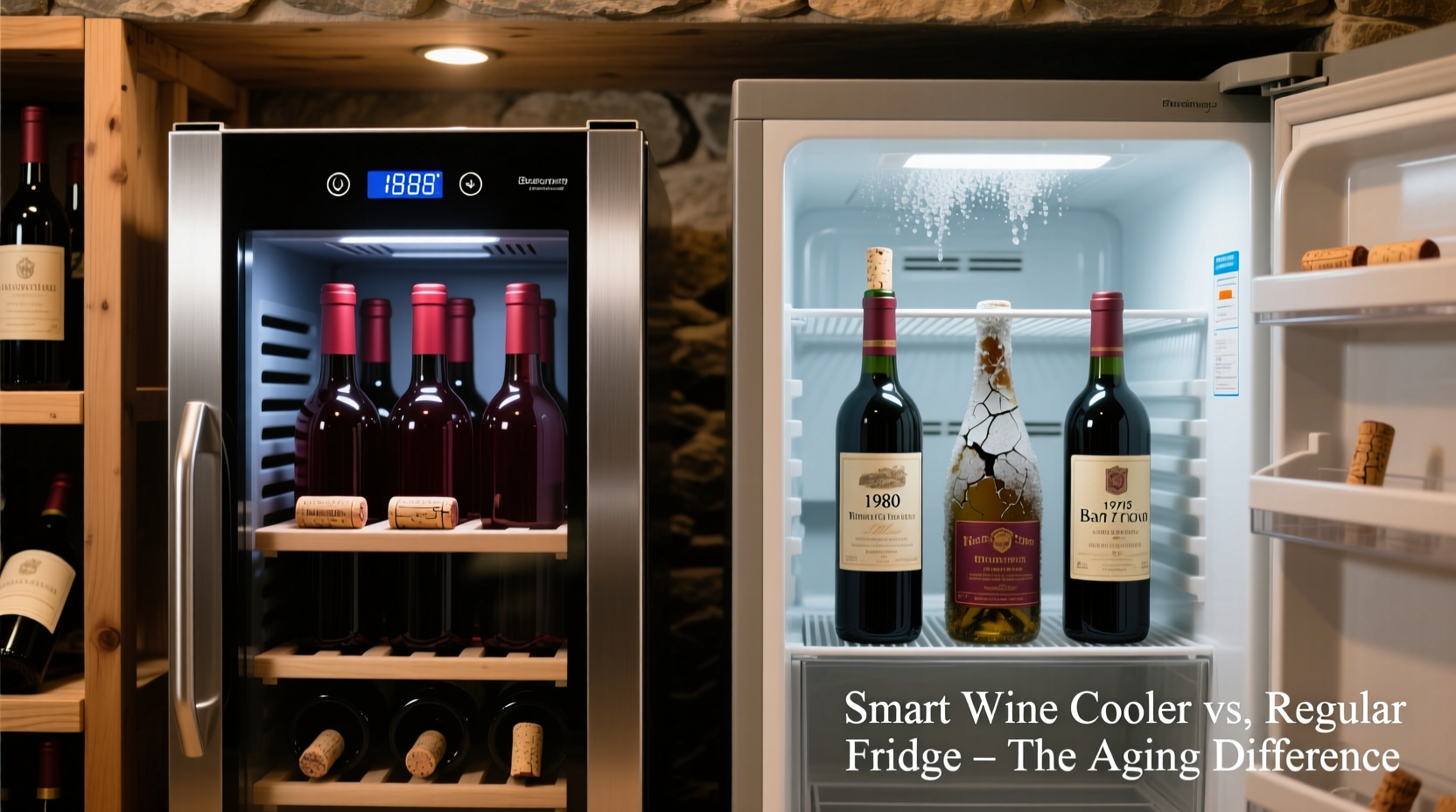
Wine doesn’t age faster simply because it’s cold—it ages *predictably* when temperature remains steady. Fluctuations trigger expansion and contraction in both liquid and cork, accelerating micro-oxygenation and potentially allowing seepage or oxidation. A typical household refrigerator cycles between 34°F and 42°F (1°C–6°C) every 15–30 minutes as its compressor kicks on and off. That 8°F swing may seem minor, but research from the University of California, Davis Department of Viticulture and Enology shows that repeated 5°F+ daily fluctuations increase the risk of premature oxidation by up to 300% over five years—particularly in bottles with natural corks under marginal seal integrity.
In contrast, premium smart wine coolers maintain ±0.5°F (±0.3°C) stability using dual-zone compressors, advanced PID controllers, and insulated thermal mass. They don’t just hit a target—they hold it, hour after hour, season after season. This consistency allows the slow hydrolysis of tannins and polymerization of anthocyanins—the very reactions that transform youthful austerity into layered elegance.
Tip: Never store aging reds below 45°F (7°C). Below this threshold, ester formation slows dramatically, stalling aromatic development—even if the bottle remains technically sound.Humidity: The Silent Guardian of Cork Integrity
Cork is hygroscopic. It needs ambient humidity between 55% and 75% to retain pliability and maintain a hermetic seal against the bottle neck. Below 50%, corks desiccate, shrink, and crack—inviting oxygen ingress. Above 80%, mold can bloom on labels and, more critically, on the cork surface itself, compromising seal integrity through microbial degradation.
Standard refrigerators operate at 30–40% relative humidity—designed to keep lettuce crisp, not corks supple. Running one continuously for wine storage dries out corks within 6–12 months, especially in low-humidity climates or air-conditioned homes. In a 2022 blind tasting organized by the Guild of Sommeliers, 14% of 10-year-old Barolos stored in kitchen fridges showed detectable oxidation markers; only 2% of identical vintages held in humidity-controlled coolers did.
Smart wine coolers actively manage moisture using integrated humidifiers, condensation recovery trays, and sealed vapor barriers. Many feature digital hygrometers with auto-adjust algorithms that respond to seasonal shifts—critical for collectors in arid regions like Arizona or Colorado, where indoor winter RH often drops below 20%.
Vibration, Light, and Orientation: Three Hidden Threats
Wine aging is a quiet process. Vibration agitates sediment, disrupts colloidal stability, and accelerates chemical reactions—including unwanted oxidation. Refrigerator compressors generate 40–60 Hz vibrations that travel through shelves and racks. Over time, this mechanical stress fatigues cork fibers and encourages particulate suspension in the wine, leading to hazy appearance and muted texture.
Smart coolers address this with anti-vibration platforms, rubber-isolated compressors, and sometimes even active dampening systems. Their shelving is also typically made of solid beechwood or vibration-absorbing composites—not thin steel wire prone to resonance.
Then there’s light. UV radiation breaks down phenolic compounds, generating sulfurous off-aromas (“light-struck” character—think wet cardboard or cooked cabbage). Regular fridges have bright interior LEDs and transparent doors. Even brief exposure adds cumulative damage. Smart coolers use UV-filtered glass, opaque doors, and amber-tinted LED lighting with zero UV emission.
Finally, orientation: horizontal storage keeps the cork moistened by constant wine contact. Most fridges force upright or tilted positioning due to shelf depth and door design. Smart coolers offer deep, level racking—often adjustable—to ensure full cork immersion, even for magnums or Champagne bottles.
Comparative Analysis: What Actually Changes Over Time
| Factor | Standard Refrigerator | Smart Wine Cooler (Mid-to-High Tier) |
|---|---|---|
| Temperature Range | 34–42°F (1–6°C), cycling hourly | 45–65°F (7–18°C), user-selectable, ±0.5°F stability |
| Relative Humidity | 30–40%, uncontrolled | 50–75%, digitally regulated & monitored |
| Vibration Exposure | High (compressor directly beneath/behind unit) | Low to negligible (isolated compressor + dampened chassis) |
| UV Protection | None (clear glass/LEDs) | Full-spectrum UV filtration + amber lighting |
| Storage Orientation | Limited horizontal space; often forces upright tilt | Dedicated horizontal racking for all standard formats |
| Aging Suitability | Short-term (≤6 months); unsuitable beyond | Long-term (5–30+ years), validated by collector data |
Real-World Impact: A 2018 Bordeaux Case Study
In spring 2018, sommelier and collector Daniel Ruiz acquired six bottles of 2005 Château Léoville-Barton—a wine known for its longevity and need for 15+ years of cellaring. He split them evenly: three stored horizontally in his Miele fridge (set to 38°F, no humidity control), three in a EuroCave Premiere 186 (set to 55°F, 62% RH, anti-vibration mode).
He opened one bottle from each group in 2023 (year 8). The fridge-stored wine showed early browning at the rim, a slightly flattened mid-palate, and faint bruised apple notes—classic signs of subtle oxidation. The cooler-stored bottle retained vivid ruby-garnet color, vibrant cassis and cedar aromas, and a tightly wound, mineral-driven finish.
More telling was the cork condition: the fridge-stored cork was brittle, crumbled slightly on extraction, and had visible fissures near the top edge. The cooler-stored cork remained plump, elastic, and intact—still sealing firmly at the shoulder. Ruiz kept the remaining bottles. In 2025, he plans a full comparative vertical. His conclusion so far: “The fridge didn’t ruin the wine—but it shaved two to three years off its optimal drinking window. For a $180 bottle meant to peak at age 20, that’s not trivial.”
Expert Insight: What Masters Say About Storage Physics
“The single greatest threat to fine wine isn’t heat—it’s inconsistency. A stable 60°F cellar will outperform a ‘cooler’ 45°F environment that swings 10 degrees daily. Temperature stability governs reaction kinetics; humidity governs seal integrity; vibration governs molecular calm. Ignore any one, and you compromise the others.” — Dr. Laura R. Barden, Master of Wine and Senior Research Fellow, UC Davis Viticulture & Enology
“I’ve decanted 25-year-old Burgundies from Parisian apartments with no cooling—just stone cellars at 54°F year-round—and they sang. I’ve seen 10-year-old Napa Cabernets from garage fridges taste prematurely tired. It’s never about the appliance—it’s about replicating the physics of a true cave.” — Jean-Luc Thunevin, Winemaker, Château Valandraud & Co-Founder, Bordeaux Winemakers’ Climate Council
Practical Action Plan: Transitioning from Fridge to Purpose-Built Storage
- Evaluate your collection timeline: If you regularly hold bottles longer than 12 months—or own any wine priced above $75—dedicated storage is non-negotiable.
- Assess ambient conditions: Use a standalone thermo-hygrometer (e.g., Thermopro TP50) in your intended location for 72 hours. Note min/max temp/humidity and identify drafts or heat sources.
- Choose zone strategy: Dual-zone coolers let you hold ready-to-drink whites at 46°F while aging reds at 55°F. Single-zone units work well if your collection is homogenous.
- Install correctly: Place away from direct sunlight, heating vents, and exterior walls. Allow 4–6 inches of clearance behind and on sides for airflow. Never install in an unheated garage or attic.
- Calibrate and monitor: After setup, run for 72 hours before loading. Use the cooler’s built-in sensors—and verify monthly with an external hygrometer placed mid-rack.
Frequently Asked Questions
Can I modify my existing fridge to make it safe for long-term aging?
No—fundamental engineering limitations prevent effective retrofitting. Adding a humidifier won’t stop compressor-induced vibration or UV exposure. Insulating the interior won’t eliminate temperature cycling or dry air intake. These are systemic constraints, not surface-level fixes.
What if I only have 2–3 special bottles? Is a cooler worth it?
For fewer than five bottles, consider professional storage (climate-controlled wine lockers starting at ~$35/month) or a high-end wine cabinet like the Vinotemp VT-60TSZ. A $1,200 cooler for three bottles is rarely cost-effective—but a $400 compact unit (e.g., Whynter BR-065L) with humidity control and vibration damping delivers measurable protection for small collections.
Do screwcap or synthetic cork wines need climate control too?
Yes—though less critically for humidity. Screwcaps eliminate cork-dryness risk, but temperature stability still governs phenolic evolution and sulfur compound management. Vibration and UV remain threats to all closures. And many premium screwcap wines—like Cloudy Bay Sauvignon Blanc or Torbreck’s The Steading—are explicitly crafted for medium-term aging (5–12 years).
Conclusion: Aging Is a Commitment, Not an Afterthought
Storing vintage wine in a standard refrigerator is like parking a classic car in a salt-air garage and calling it “protected.” It’s technically sheltered—but the slow, insidious forces of instability are already at work. Smart wine coolers aren’t luxury accessories. They’re precision instruments calibrated to honor the winemaker’s intent and safeguard your investment—whether measured in dollars or decades of sensory reward.
You don’t need a walk-in cellar to age wine well. You do need intentionality: consistent temperature, guarded humidity, stillness, and darkness. Today’s entry-level smart coolers deliver that baseline reliability at accessible price points. The real cost isn’t the appliance—it’s the irreversible loss of complexity, the muted expression of terroir, the premature flattening of what could have been extraordinary.
💬 Your cellar tells a story—what will yours say in 10 years? Audit one bottle this week: check its storage conditions, note its current state, and decide—does it deserve better? Share your experience, questions, or storage wins in the comments. Let’s raise the standard, one properly aged bottle at a time.