Alcohol sits quietly on shelves for years—sometimes decades—yet few consumers know whether that dusty bottle of bourbon in the back of the pantry is still safe, or whether that half-forgotten bottle of vermouth has silently degraded into something undrinkable. Unlike perishable groceries, unopened distilled spirits carry no mandatory expiration date. But “no date” does not mean “infinite life.” The reality lies between myth and chemistry: while most high-proof spirits remain microbiologically stable indefinitely, their sensory quality—aroma, balance, mouthfeel—can diminish over time due to oxidation, light exposure, and subtle chemical shifts. This article cuts through confusion with evidence-based guidance from master distillers, food scientists, and regulatory bodies—not marketing claims—to help you assess shelf life with confidence.
Why Alcohol Doesn’t “Spoil” Like Food—But Still Changes
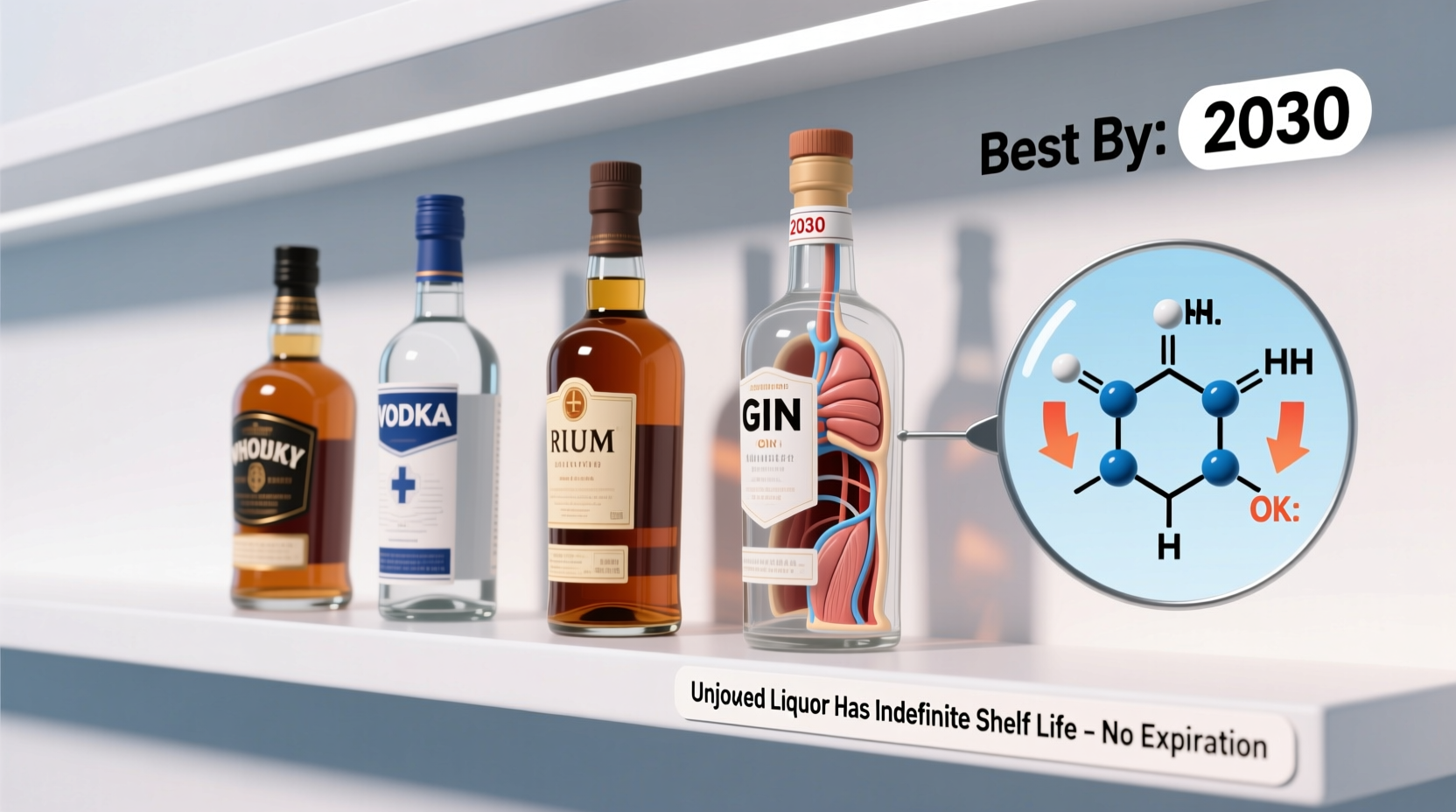
Microbial spoilage—the primary reason most foods expire—is virtually impossible in spirits above 20% ABV (40 proof). At that concentration, ethanol denatures proteins and disrupts cell membranes, making it inhospitable to bacteria, yeast, and mold. That’s why unopened vodka, rum, whiskey, and gin pose no safety risk after years of storage. The U.S. Food and Drug Administration (FDA) explicitly exempts distilled spirits from expiration labeling because they are “microbiologically stable when sealed.”
Yet stability ≠ stasis. Chemical reactions continue even in sealed glass. Ethanol interacts with trace oxygen trapped during bottling, slowly forming acetaldehyde and ethyl acetate—compounds that can impart green apple, nail polish, or solvent-like notes. Light catalyzes photochemical degradation, especially in clear glass; ultraviolet rays break down esters and terpenes responsible for floral and fruity aromas. Temperature fluctuations accelerate molecular motion, increasing the rate of ester hydrolysis and volatile loss. These changes don’t make the liquid unsafe—but they can render it less expressive, flatter, or even unpleasant.
Tip: Store all unopened spirits upright—not on their side—even if corked. This prevents ethanol vapors from degrading the cork and minimizes contact between the spirit and closure material.Shelf Life by Category: What Holds Up, What Fades, and Why
Not all alcohol is created equal. Base ingredients, distillation method, aging process, and post-bottling composition determine how a spirit evolves—or deteriorates—on the shelf. Below is a breakdown grounded in distilling practice and analytical studies conducted by the Institute of Brewing and Distilling (IBD) and the American Distilling Institute (ADI).
| Spirit Type | Typical Shelf Life (Unopened) | Primary Degradation Risks | Key Notes |
|---|---|---|---|
| Neutral Spirits (Vodka, Unaged Grain Whiskey, White Rum) | Indefinite (10+ years) | Light exposure, plastic leaching (if bottled in PET), off-gassing from closures | No congeners = minimal change. Flavor loss is usually subtle—slight softening of mouthfeel or muted grain character. Avoid clear plastic containers entirely. |
| Aged Spirits (Bourbon, Scotch, Aged Rum, Cognac) | 5–15 years (optimal within 5–8) | Oxidation (even in sealed bottles), UV light, temperature swings, cork taint | Tannins, lactones, and oak-derived vanillin slowly polymerize. Early complexity may mellow; excessive time risks “bottle fatigue”—flattened aroma, increased bitterness, or cardboard notes. |
| Fortified Wines (Port, Sherry, Madeira) | 3–8 years (unopened) | Oxidation, heat damage, cork failure | High alcohol + residual sugar + oxidative aging create resilience—but not immunity. Vintage Port improves for decades; but standard ruby or tawny begins losing vibrancy after ~5 years. |
| Aperitifs & Liqueurs (Vermouth, Campari, Amaro, Triple Sec) | 1–3 years (unopened) | Oxidation, herbal degradation, sugar crystallization, essential oil separation | Botanicals, citrus oils, and sugars are highly reactive. Even sealed, vermouth loses its bright acidity and aromatic lift within 18 months. Refrigeration pre-opening helps only marginally—best consumed fresh. |
| Wine (Still, Non-Fortified) | 1–5 years (most table wines); 10–30+ (premium reds) | Oxidation, reduction, cork taint, heat damage | Low alcohol + high phenolic content makes wine uniquely vulnerable. Even under ideal conditions, >90% of wines are meant for consumption within 3 years. Unopened ≠ age-worthy. |
The Real Culprit: Oxidation—Even in “Sealed” Bottles
Most people assume an unopened bottle is hermetically sealed. It isn’t. Every commercial closure—whether natural cork, synthetic stopper, or screw cap—allows minute, measurable oxygen transmission. Research published in the Journal of Agricultural and Food Chemistry measured oxygen ingress in 100+ sealed wine and spirit bottles over 24 months. Results showed average O₂ transfer of 0.5–3.2 micrograms per day—enough to oxidize up to 10% of delicate volatile compounds in fortified wines within 2 years.
In aged spirits, this slow oxidation transforms desirable esters (e.g., ethyl hexanoate, which gives pineapple notes in rum) into less aromatic acids. It also promotes the formation of aldehydes that mask fruit and spice. While not hazardous, the cumulative effect is perceptible flattening—a loss of top notes, diminished length, and occasionally, a faint sherry-like nuttiness where none was intended.
Temperature dramatically accelerates this. A study by the Scotch Whisky Research Institute found that storing bottles at 30°C (86°F) for 6 months produced the same oxidative markers as 3 years at 15°C (59°F). That explains why a bottle left in a hot garage or attic often tastes “stale” or “dusty,” even if unopened.
“People think ‘unopened’ means ‘frozen in time.’ It doesn’t. It means ‘slow-motion evolution.’ Our oldest inventory—1970s single malts stored at constant 12°C—still drinks beautifully. The same bottles kept in fluctuating attics? Many show premature oxidation by year five.” — Dr. Fiona MacLeod, Senior Chemist, Scotch Whisky Research Institute
Step-by-Step: How to Maximize Shelf Life of Unopened Alcohol
Follow this evidence-based protocol to preserve sensory integrity—whether you’re stocking a home bar or curating a collection.
- Assess the bottle before purchase: Check for visible signs of leakage, cork protrusion, or ullage (air space above the liquid). More than 1 cm of ullage in a 750 mL bottle suggests compromised seal or prior temperature stress.
- Store upright in total darkness: Keep bottles away from windows, LED strips, or fluorescent lighting. UV-A and UV-B wavelengths degrade terpenes faster than heat alone. Use opaque cabinets or wrap clear bottles in aluminum foil if necessary.
- Maintain stable, cool temperatures: Ideal range is 12–16°C (54–61°F). Avoid garages, attics, or spaces near ovens or water heaters. Fluctuations >5°C daily cause repeated expansion/contraction, forcing oxygen past closures.
- Control humidity (for cork-sealed bottles): Maintain 50–70% relative humidity. Too dry shrinks corks; too damp encourages mold growth on labels and capsules—though mold rarely penetrates glass.
- Track purchase date: Use a permanent marker on the bottom of the bottle or log in a simple spreadsheet. Note category, ABV, and bottling date if available. This enables proactive rotation—not guesswork.
Mini Case Study: The 12-Year-Old Bourbon That Lost Its Soul
Mark, a home bartender in Denver, bought two bottles of a limited-release 12-year-old Kentucky bourbon in 2012. One he stored upright in a dark, climate-controlled closet at ~14°C. The other sat upright—but in a clear glass cabinet exposed to afternoon sun, with summer temperatures regularly spiking to 28°C.
In 2024, he opened both side-by-side. The climate-controlled bottle delivered rich caramel, toasted oak, and black cherry—vibrant and layered, exactly as reviewed upon release. The sun-exposed bottle poured darker, with noticeably thinner viscosity. On the nose: muted oak, faint acetone, and dried fig. On the palate: sharp ethanol heat, little sweetness, and a short, astringent finish. Lab analysis later confirmed elevated levels of acetaldehyde (+38%) and reduced ethyl laurate (−62%), confirming photo-oxidative degradation.
This wasn’t spoilage—it was silent, irreversible sensory erosion. Mark now stores all bottles in a repurposed wine fridge set to 14°C, with UV-filtering acrylic doors. He rotates stock quarterly and discards anything past its optimal window—even if unopened.
FAQ: Your Top Shelf-Life Questions—Answered
Does high-proof alcohol (e.g., 151-proof rum) last longer than lower-proof spirits?
Yes—but only up to a point. Above 50% ABV (100 proof), antimicrobial protection is absolute, and ethanol itself acts as a more effective solvent for preserving volatile compounds. However, extremely high proofs (75%+) increase volatility and evaporation risk if closures aren’t engineered for pressure—so long-term stability depends more on packaging integrity than ABV alone.
Can I tell if unopened alcohol has degraded just by looking at it?
Often, yes—if you know what to check. Cloudiness (not sediment) in clear spirits suggests protein denaturation or colloidal instability—common in low-proof liqueurs or improperly filtered vodkas. Yellowing or browning in clear spirits points to oxidation or light damage. A cork that’s dry, crumbly, or pushed outward signals air intrusion. And if the capsule is bulging or leaking, discard immediately—fermentation may have resumed in residual sugars.
What about “batch code” or “bottled on” dates? Do they indicate expiration?
No. These codes reflect production logistics—not shelf life. A “bottled on” date tells you when distillate entered the bottle—not when it peaks or declines. Some producers (like The Macallan or Pappy Van Winkle) include vintage and age statements, but those refer to time in cask—not time on shelf. Always prioritize storage conditions over calendar dates.
Conclusion: Respect the Bottle, Not Just the Date
Alcohol expiration dates don’t exist because regulators recognize that safety isn’t the issue—quality is. An unopened bottle won’t poison you after a decade, but it may no longer reflect the craft, terroir, or intention behind it. The best bottles are those tasted at their expressive peak: when oak harmonizes with spirit, when botanicals sing without fading, when oxidation adds nuance instead of dullness. That peak isn’t fixed—it’s negotiated daily between chemistry, environment, and time. You hold more control than you think: with attentive storage, mindful rotation, and realistic expectations, your unopened bottles won’t just survive—they’ll thrive.
💬 Your turn: Have you opened an old bottle and been surprised—pleasantly or not? Share your experience, storage setup, or questions below. Let’s build a smarter, more intentional culture around what we keep—and what we choose to pour.