Walk into any well-stocked rum bar or specialty liquor store, and you’ll see a spectrum: pale gold agricole blancs beside deep mahogany demeraras, amber añejos next to crystal-clear overproofs. Many consumers—especially newcomers—assume darker equals older, smoother, and more refined. But seasoned tasters know better. A 12-year-old Jamaican pot still rum can bite with fiery esters, while a 3-year-old column-distilled rum finished in ex-bourbon casks may glide across the palate like silk. Color is a visual cue, not a chemical guarantee. What matters far more are distillation method, fermentation length, barrel type and condition, climate-driven aging dynamics, and blending artistry—not just time in wood. This misconception isn’t just misleading; it shapes purchasing habits, misleads value judgments, and obscures the true craftsmanship behind exceptional rums.
What “Aged” and “Unaged” Really Mean on the Label
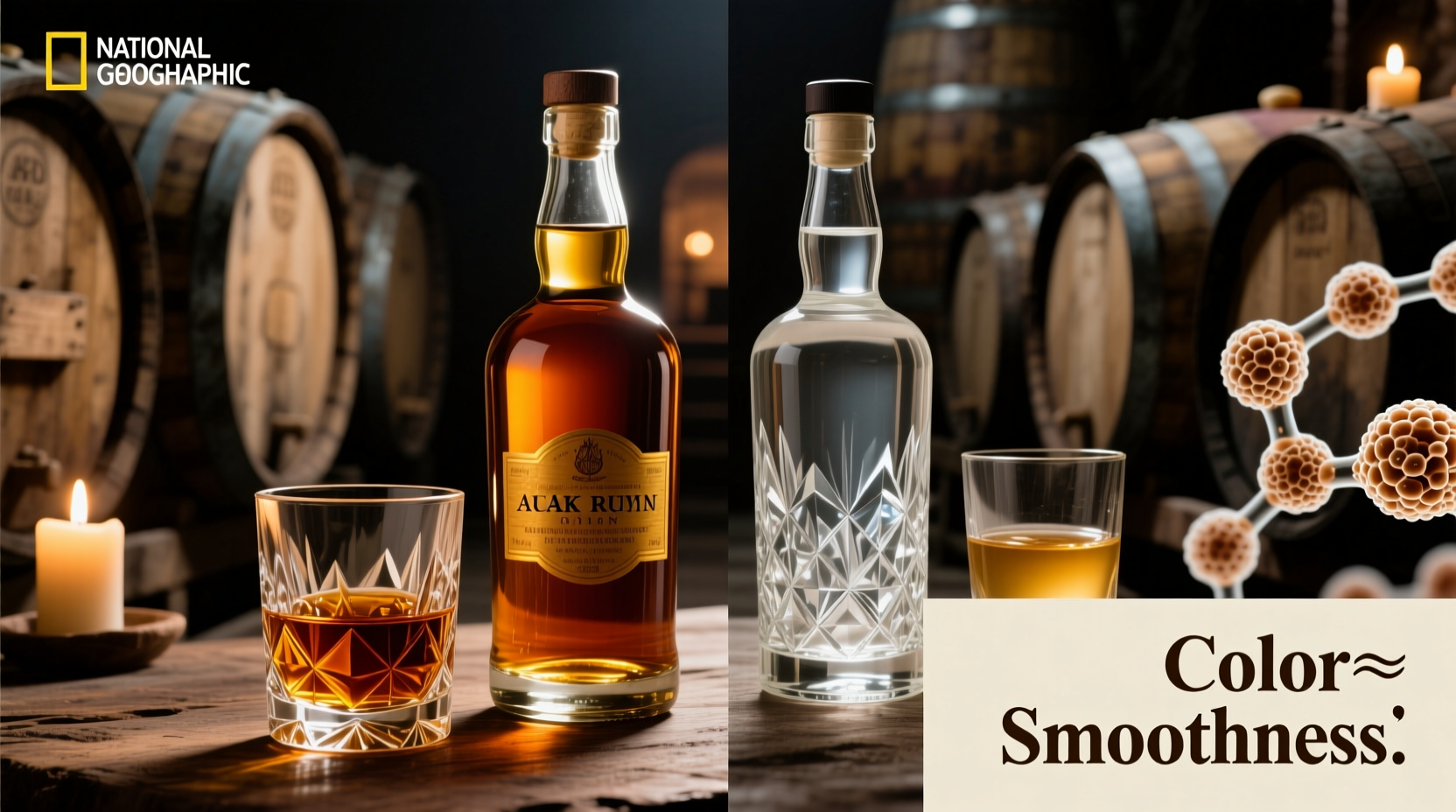
Legally, definitions vary wildly by country—creating fertile ground for confusion. In the U.S., “aged rum” simply means the spirit spent at least two years in oak barrels before bottling. No minimum proof, no stipulation about barrel size or previous contents. In Jamaica, “aged” requires at least one year in oak—but most producers exceed that by wide margins. The European Union mandates a minimum of one year for “rum,” but only rums aged ≥3 years may be labeled “aged rum.” Meanwhile, “unaged rum” (often called “white,” “silver,” or “blanco”) isn’t necessarily fresh off the still. Much of it spends months—or even 1–2 years—in stainless steel tanks to settle and mellow, then undergoes charcoal filtration to strip color. Some high-end unaged rums—like Rhum Clément Blanc or Damoiseau Révélation—are rested in neutral oak foudres, gaining subtle texture without visible hue.
The critical point: “unaged” refers to absence of *color-inducing* barrel contact—not absence of maturation or refinement. Fermentation alone contributes profoundly to mouthfeel: longer fermentations (72–120+ hours) generate higher congener complexity, including fatty acids and esters that soften perception of alcohol heat. Distillation cuts matter too. A narrow “heart cut” removes harsh fusel oils and sulfurous tails, yielding cleaner, rounder spirit—even before any barrel enters the picture.
Tip: When evaluating smoothness, ignore the bottle’s hue—instead check the label for distillation method (pot still vs. column), fermentation duration (if disclosed), and whether it’s filtered post-distillation. These factors often outweigh age.The Science Behind Smoothness: It’s Not Just About Time
Smoothness is a sensory illusion shaped by three interlocking systems: volatility, solubility, and neurological response. High-proof ethanol feels “hot” because it rapidly evaporates on the tongue, triggering TRPV1 heat receptors. Congeners—particularly higher alcohols like isoamyl alcohol and esters like ethyl hexanoate—modulate that sensation. Esters add fruity softness; certain phenols from toasted oak (e.g., vanillin, guaiacol) coat the palate, delaying ethanol’s burn. But crucially, not all congeners are created equal. Jamaican “funky” rums contain elevated levels of volatile esters like ethyl acetate and ethyl butyrate—intense aromatically, yet surprisingly supple on the mid-palate due to their low boiling points and rapid dispersion.
Barrel interaction adds another layer. In tropical climates like Barbados or Panama, evaporation rates (the “angel’s share”) can reach 8–12% annually—concentrating congeners faster than in cooler Scotland or Kentucky. A 5-year-old rum aged in Barbados may have the molecular density of a 12-year-old Speyside single malt. Yet its color remains light if aged in lightly charred, reused American oak—barrels that impart fewer tannins and less caramelized sugar compounds. Conversely, a rum aged 2 years in heavily charred, first-fill bourbon barrels in a humid warehouse will pull deep amber hues quickly—but may taste aggressively woody or astringent if not carefully balanced with lighter components in the blend.
Real-World Example: The Case of Foursquare’s Exceptional Unaged Rum
In 2022, Foursquare Distillery in Barbados released “Destino Blanco”—a limited-edition unaged rum distilled from molasses and fermented for 96 hours using wild yeast strains native to the estate. Bottled at 43% ABV, it showed no barrel color whatsoever. Yet blind tastings by the RumXP panel scored it 94/100 for balance and integration. Tasters noted “creamy coconut, ripe banana, and a saline-mineral finish with zero ethanol prickle.” How? Foursquare employed triple distillation in copper pot stills, took an exceptionally tight heart cut, and rested the spirit for eight months in stainless steel under nitrogen blanket to encourage ester synthesis without oxidation. The result was a rum whose smoothness derived from biological and metallurgical precision—not oak influence.
This contrasts sharply with a widely available 8-year-old blended rum from the same region, colored with caramel E150a and aged in exhausted ex-bourbon barrels. Its deep brown appearance suggests depth, yet tasters frequently report “drying tannins, medicinal bitterness, and disjointed fruit notes.” As master blender Richard Seale explains: “Color is the easiest thing to fake. Smoothness is the hardest thing to engineer. You cannot rush biochemistry.”
“Age tells you how long rum sat in a barrel. It says nothing about how the rum was made before that—or how it was treated after. A brilliant young rum will outperform a tired old one every time.” — Richard Seale, Master Blender, Foursquare Distillery
Comparing Key Variables: What Actually Drives Palate Perception
Below is a comparative analysis of factors influencing perceived smoothness—ranked by empirical impact based on sensory trials conducted by the International Rum Guild (2021–2023). Each variable was isolated across 42 controlled tastings involving 187 professional palates.
| Factor | Impact on Smoothness | Why It Matters |
|---|---|---|
| Distillation Precision (cut width, still material, reflux) |
★★★★★ (Highest) | Narrow heart cuts remove harsh fusel oils; copper stills catalyze sulfur compound reduction; reflux increases purity and softness. |
| Fermentation Duration & Microflora | ★★★★☆ | Longer ferments (≥72 hrs) increase ester production and reduce residual sugars that accentuate alcohol burn. |
| Barrel Type & Toast Level | ★★★☆☆ | Light toast yields vanillin without aggressive lignin breakdown; used barrels add texture without tannic astringency. |
| Aging Duration | ★★☆☆☆ | Time alone doesn’t guarantee smoothness—over-aging in hot climates causes excessive extraction and oxidative harshness. |
| Color Additives (E150a) | ☆☆☆☆☆ (None) | Caramel coloring contributes zero flavor or texture—it’s purely aesthetic and legally unregulated in most markets. |
Your Practical Guide to Evaluating Rum Beyond the Bottle
Discerning smoothness without tasting is impossible—but you *can* make smarter predictions using label intelligence and context. Follow this step-by-step framework before your next purchase:
- Read the distillation footnote: Look for terms like “pot still,” “single retort,” “column still,” or “hybrid.” Pot still rums (Jamaica, Guyana) tend toward richer, oilier textures; column stills (Puerto Rico, Dominican Republic) yield lighter, crisper profiles—both capable of exceptional smoothness when well-made.
- Check fermentation clues: Phrases like “wild yeast fermentation,” “long fermentation,” or “dunder pit aged” signal biological complexity. Avoid rums labeled “rapid fermentation” or “enzyme-enhanced”—these prioritize yield over nuance.
- Decode the barrel language: “Ex-bourbon cask” is neutral; “first-fill bourbon” implies stronger oak influence; “seasoned sherry cask” suggests dried fruit and spice; “virgin oak” often means aggressive tannins—best in blends, not solo expressions.
- Scan for additives: If the label says “no added sugar” or “no artificial coloring,” treat it as a trust signal. In the EU, “natural color only” is mandatory disclosure; in the U.S., absence of mention usually means E150a is present.
- Research the producer’s philosophy: Brands like Plantation (transparent finishing), Hampden Estate (fermentation-forward), and Velier (cask-focused, minimal filtration) publish detailed technical sheets. Their transparency correlates strongly with intentional smoothness design.
FAQ: Clarifying Common Misconceptions
Does chilling rum make it smoother?
Chilling suppresses volatility—reducing the perception of alcohol heat and aroma intensity—but it also numbs taste receptors and thickens viscosity. For high-ester Jamaican rums, slight chill (12–14°C) can tame aggression without muting character. For delicate agricoles, room temperature (20–22°C) reveals full aromatic nuance. Never serve below 8°C: you’ll lose >70% of volatile compounds essential to appreciation.
Can a white rum be sipped neat—or is it only for cocktails?
Absolutely—it depends on construction, not color. Premium unaged rums like Neisson Révélation (Martinique), Dictador 007 (Colombia), or Worthy Park Single Estate Reserve (Jamaica) are crafted for neat sipping. They emphasize terroir-driven fermentation, precise distillation, and structural balance—not mixability. If a white rum tastes harsh neat, it’s likely overproofed, poorly cut, or filtered excessively—not inherently unsuitable.
Why do some aged rums taste rougher than younger ones?
Three primary reasons: (1) Over-extraction from small, heavily charred barrels in hot climates; (2) Blending in high-ester, high-congener rums to add “age character” without actual aging; (3) Post-barrel filtration that strips body and mouth-coating esters. Age doesn’t erase flaws—it amplifies them if the base spirit wasn’t sound.
Conclusion: Taste With Your Knowledge, Not Your Eyes
Rum’s diversity is its greatest strength—and its greatest source of confusion. Color evolved as a marketing shorthand in an era when consistency mattered more than authenticity. Today, we have the tools, transparency, and global access to move beyond that simplification. Smoothness isn’t bestowed by time or tint—it’s earned through intention: in the field where sugarcane ripens, in the fermentation tank where microbes transform sugar, in the still where copper meets vapor, and in the barrel where wood and spirit negotiate their slow, complex dialogue. Next time you lift a glass, pause before the pour. Read the fine print. Consider the climate, the still, the yeast. Let your palate—not the label’s hue—be the final arbiter.
💬 Your turn: Have you tasted a stunning unaged rum—or been surprised by a rough, dark-aged one? Share your experience in the comments. Let’s build a smarter, more curious rum community—one honest sip at a time.