The louche—the milky opalescence that blooms when cold water hits aniseed spirits—is often the only distinction most drinkers notice between absinthe and pastis. But this visual similarity masks a profound divergence in origin, composition, cultural weight, and sensory truth. Confusing the two isn’t just a mixology oversight; it risks misrepresenting centuries of botanical craft, legal evolution, and regional identity. Absinthe is not merely “strong pastis,” nor is pastis a diluted absinthe. They are distinct categories born from different historical imperatives, governed by divergent EU regulations, and defined by unmistakable botanical signatures—most critically, the presence or absence of thujone-rich grand wormwood (Artemisia absinthium). Understanding what separates them requires looking past the cloud.
A Historical Divide: Banning, Blaming, and Reinvention
Absinthe emerged in late-18th-century Switzerland as a medicinal tincture, evolving into a cultural phenomenon across fin-de-siècle France. Its association with artists like Van Gogh and writers like Verlaine cemented its mystique—but also its infamy. By 1915, absinthe was banned in France, Switzerland, the U.S., and much of Europe. The prohibition wasn’t rooted in science but in moral panic: sensationalist journalism blamed absinthe for madness and societal decay, conflating chronic alcoholism with alleged “absinthism”—a syndrome later debunked by modern toxicology. Crucially, the ban targeted absinthe’s method of production: distillation with grand wormwood, green anise, and sweet fennel, and crucially, its natural thujone content.
Pastis arose directly from that vacuum. In 1932, Paul Ricard launched his aniseed aperitif in Marseille—not as a substitute for absinthe, but as a new product built for legality and mass appeal. Pastis was formulated without wormwood, used maceration instead of distillation, and relied on sugar and neutral alcohol to deliver approachability. It embraced the Mediterranean lifestyle: sun-drenched, sociable, and unburdened by Bohemian baggage. While absinthe was exiled, pastis became France’s best-selling aperitif—its success a testament not to imitation, but to deliberate reinvention.
“Pastis didn’t replace absinthe—it filled a different need. Absinthe was ritualistic, contemplative, almost sacred. Pastis is convivial, immediate, and democratic. You don’t sip pastis waiting for revelation; you share it while the olives are still warm.” — Dr. Laurence Dufour, Historian of French Spirits, Université Aix-Marseille
Botanical Truth: The Wormwood Line in the Sand
The single most definitive botanical difference lies in Artemisia absinthium—grand wormwood. True absinthe must contain it. Not as a trace ingredient, but as a foundational botanical, contributing bitterness, complexity, and its signature herbaceous backbone. Grand wormwood contains thujone, a monoterpene once falsely accused of hallucinogenic properties. Modern analysis shows thujone levels in pre-ban absinthes were modest (typically 10–50 mg/L), and today’s EU-regulated absinthes cap thujone at 35 mg/L for bitters and 10 mg/L for other spirits—levels far below neurotoxic thresholds.
Pastis, by legal definition, contains no wormwood whatsoever. Its core botanicals are green anise and star anise (for intensity), often supplemented with fennel, licorice root, and citrus peels. The result is sweeter, rounder, and less confrontational—deliberately omitting wormwood’s sharp bitterness and camphoraceous lift. This isn’t a matter of “less wormwood”; it’s zero wormwood. That absence defines pastis’s entire sensory architecture.
Tip: When tasting blind, ask yourself: “Is there a dry, green, almost medicinal bitterness underneath the anise? If yes, it’s almost certainly absinthe. If the sweetness dominates and lingers cleanly, it’s pastis.”Regulatory Realities: What the Law Says About Identity
EU spirit regulations codify the distinction. Under Regulation (EU) 2019/787, “absinthe” is a protected geographical indication (PGI) for products distilled in designated regions (Switzerland, France, Czechia) using traditional methods—and crucially, containing grand wormwood. It must be unsweetened (<5 g/L residual sugar) and bottled at minimum 40% ABV. Thujone limits apply strictly.
“Pastis,” meanwhile, is defined as an aniseed-flavoured spirit with added sugar (minimum 100 g/L, often 200–300 g/L), no wormwood, and typically lower strength (40–45% ABV). Its production relies on maceration and blending—not distillation of wormwood. Attempting to label a wormwood-free, sugar-heavy spirit as “absinthe” violates EU law and misleads consumers.
This regulatory clarity matters because it protects both tradition and transparency. It prevents industrial producers from diluting absinthe’s heritage with wormwood-free imitations, and it ensures pastis remains true to its own identity: a distinctly French, sun-ripened, community-oriented aperitif.
| Characteristic | Absinthe | Pastis |
|---|---|---|
| Core Botanicals | Grand wormwood, green anise, sweet fennel | Green anise, star anise, fennel, licorice root (no wormwood) |
| Sugar Content | Unsweetened (<5 g/L) | Sweetened (100–300 g/L) |
| Production Method | Distilled (often double-distilled) | Macerated & blended (no distillation of wormwood) |
| Thujone Presence | Yes (regulated: ≤10 mg/L for non-bitters) | No (undetectable) |
| Typical ABV | 45–72% (often 55–68%) | 40–45% |
| Cultural Role | Ritualistic, contemplative, historically artisanal | Convivial, everyday, mass-market aperitif |
Taste, Texture, and Ritual: Beyond Louche Mechanics
Both louche due to the same principle: essential oils (anethole from anise) are soluble in high-proof alcohol but insoluble in water. When diluted, they emulsify, creating opacity. But what happens *after* the cloud forms reveals deeper contrasts.
Absinthe’s louche is slower, more viscous, and yields a richer mouthfeel. Its unsweetened profile allows bitter, herbal, and floral notes to emerge—think dried tarragon, crushed mint, wet stone, and faint citrus peel. The finish is dry, lingering, and complex, often with a subtle warmth rather than heat. Because it lacks sugar, absinthe invites slower sipping and repeated dilution (typically 3:1 to 5:1 water-to-absinthe).
Pastis louchees faster and more uniformly. Its high sugar content creates a syrupy texture and rounds out the anise bite, yielding a smoother, more immediate experience. Flavors lean toward candied fennel, black licorice candy, and orange blossom. The finish is sweet and clean, rarely bitter—designed for easy, refreshing consumption, usually at 5:1 to 7:1 dilution. It’s meant to be served over ice in large glasses, shared among friends, not contemplated alone with a slotted spoon.
Mini Case Study: The Marseille Barkeep’s Dilemma
In 2021, Julien Moreau opened “Le Temps Perdu” in the Vieux Port district of Marseille—a bar dedicated to reviving pre-ban French drinking culture. He stocked authentic Swiss and French absinthes alongside classic Ricard and Pernod. Early on, he noticed customers ordering “absinthe” but recoiling at the first sip of a dry, bitter Pontarlier-style bottling. “They expected pastis,” he recalls. “They wanted the sweetness, the ease, the familiarity.” So Julien began offering side-by-side tastings: a 1901-style La Clandestine absinthe (45% ABV, 10 mg/L thujone, no sugar) next to a 1935-vintage Ricard (42% ABV, 250 g/L sugar). The contrast was revelatory. Customers grasped that absinthe wasn’t “stronger pastis”—it was a different language altogether. He now serves absinthe with the traditional fountain and spoon, pastis with ice and a lemon twist, never conflating the two. His takeaway: “Respect starts with naming correctly. Call it what it is—and teach people why.”
How to Choose, Serve, and Store Authentically
Choosing between absinthe and pastis isn’t about superiority—it’s about intention. Ask yourself: Are you seeking depth, ritual, and botanical nuance? Or refreshment, sociability, and approachability? Your answer guides everything.
Step-by-Step Serving Guide
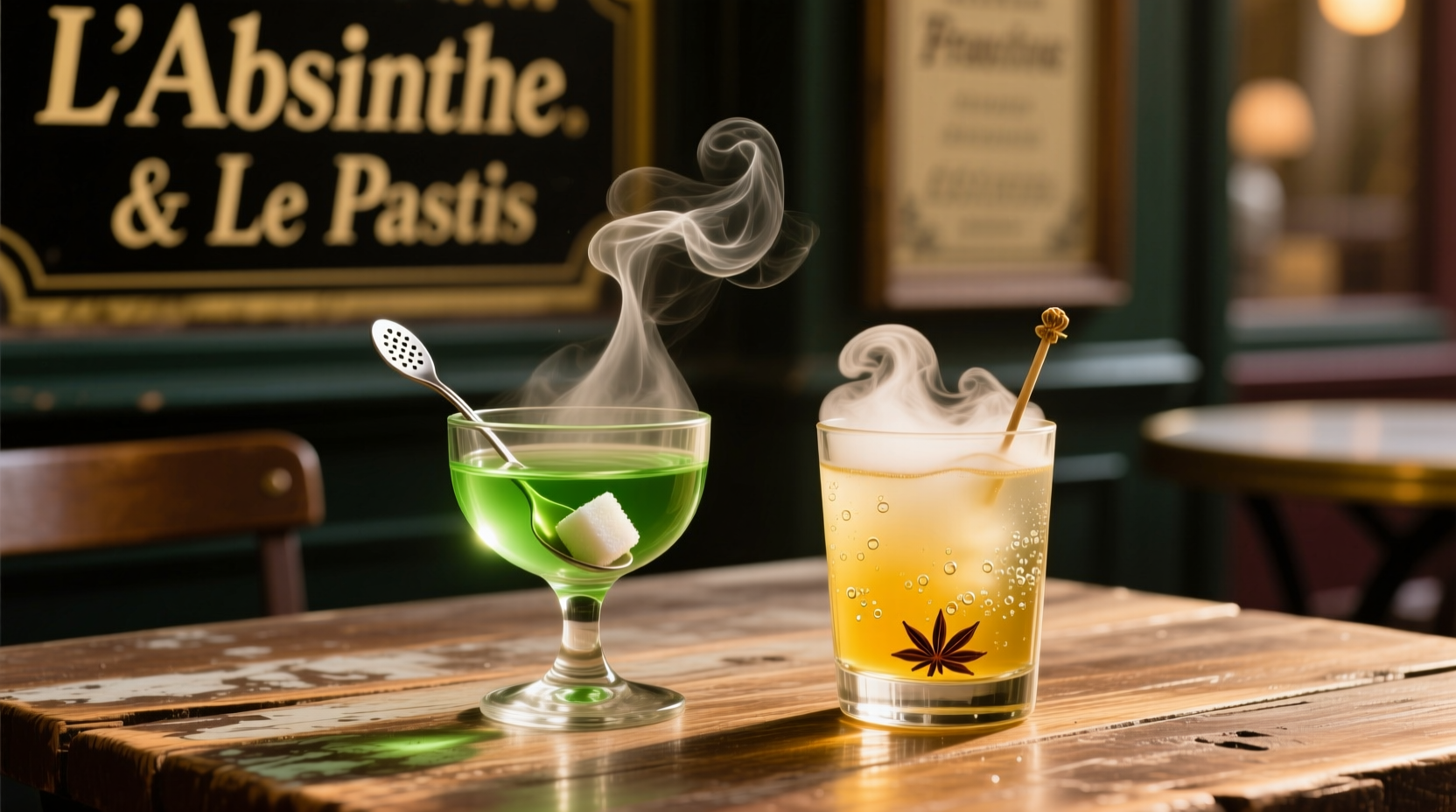
- For Absinthe: Chill a glass. Place a sugar cube on a slotted spoon over the glass. Slowly drip ice-cold water (3–5 parts) over the sugar until fully dissolved and the louche is complete. Stir gently. Sip slowly; do not rush.
- For Pastis: Fill a tall glass with ice. Pour 1 part pastis. Top with 5–7 parts cold water. Stir briefly. Garnish with a lemon twist or fresh fennel frond. Serve immediately.
- Never: Shake either with ice (dilutes unevenly), serve undiluted (harsh and unbalanced), or mix with soda (masks nuance—especially for absinthe).
Storage Essentials
- Absinthe: Store upright in a cool, dark place. Its high ABV and lack of sugar make it stable for years—even decades—unopened. Once opened, consume within 1–2 years for peak freshness.
- Pastis: Store upright, away from light and heat. High sugar content makes it more vulnerable to oxidation. Consume within 6 months of opening for optimal flavor.
FAQ: Clarifying Common Confusions
Is modern absinthe “real” absinthe if it’s legal?
Yes—when produced authentically. Modern EU-compliant absinthe adheres to traditional methods, uses grand wormwood, and meets strict botanical and thujone standards. The bans were political, not scientific. Today’s best examples (e.g., Jade Lally, St. George, La Clandestine) match or exceed pre-ban quality in fidelity and balance.
Can I make pastis at home by adding sugar to absinthe?
No. Adding sugar to absinthe creates a sweetened anise spirit—not pastis. Pastis’s flavor profile depends on its specific botanical blend (including licorice and citrus), maceration technique, and absence of wormwood. Sugar alone cannot replicate its structure or character.
Why does some absinthe taste sweeter than others?
Some artisanal absinthes use small amounts of naturally sweet botanicals (like hyssop or Melissa) or employ post-distillation techniques that enhance perceived roundness—but they remain legally unsweetened. Any detectable sweetness comes from terroir-driven botanicals, not added sugar.
Conclusion: Drink with Discernment, Not Dogma
Understanding absinthe versus pastis isn’t about gatekeeping—it’s about honoring craft, context, and clarity. Absinthe carries the weight of exile, renaissance, and meticulous distillation; pastis embodies resilience, accessibility, and Mediterranean joy. Both deserve appreciation on their own terms. Next time you reach for an aniseed spirit, pause before the pour. Consider the wormwood, the sugar, the history in the bottle, and the intention behind your glass. Serve it right. Taste it deeply. Name it accurately. In doing so, you participate in a living tradition—one where respect begins with knowing the difference, long before the water hits the glass.
💬 Have you tasted a standout absinthe or pastis that changed your perspective? Share your experience—and what made it memorable—in the comments. Let’s deepen the conversation, one thoughtful sip at a time.