Balancing richness and clarity in broth-based soups is one of the most refined skills in culinary tradition. At first glance, a clear soup may appear simple—perhaps even plain—but when executed properly, it delivers an intense, layered flavor within a transparent, shimmering liquid. This duality—deep savoriness without cloudiness—is the hallmark of mastery in French consommés, Chinese double-boiled soups, Japanese dashi, and Vietnamese pho. Achieving this balance requires understanding not just ingredients, but technique: how bones break down, how proteins coagulate, and how temperature controls extraction. For home cooks aiming to elevate their soup game, learning to craft a rich yet crystal-clear broth transforms everyday meals into something extraordinary.
The pursuit of clarity does not mean sacrificing body or depth. On the contrary, the clearest broths are often the most concentrated, their transparency a result of careful purification rather than dilution. This article explores the science, methods, and traditions behind creating a truly exceptional broth-based soup—one that is both luminous in appearance and profound in flavor.
Definition & Overview
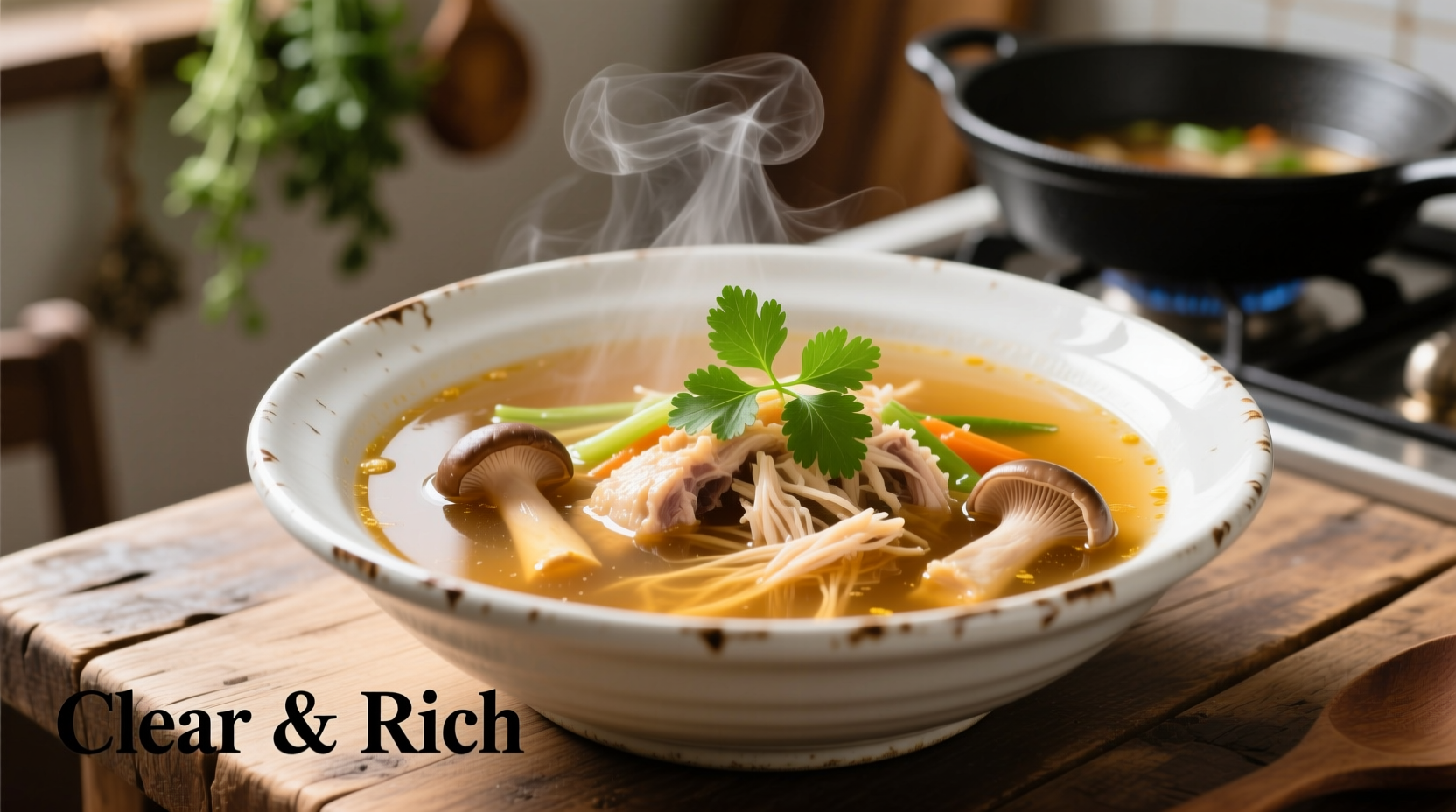
A rich and clear broth-based soup is a culinary preparation in which a flavorful liquid forms the foundation, achieved through prolonged simmering of aromatic ingredients such as meat, poultry, fish, bones, vegetables, herbs, and seasonings. The term “broth-based” distinguishes these soups from cream-based (like chowders), puréed (such as vichyssoise), or starch-thickened varieties. What sets a *clear* broth apart is its visual transparency—a quality achieved through precise control over emulsification, protein dispersion, and impurity removal during cooking.
Historically, clear broths have held esteemed positions across global cuisines. In 17th-century France, chefs developed the consommé method to refine stock into a jewel-like essence. In China, slow-simmered soups like lǔtāng (braising liquid) and nourishing double-boiled soups are prepared over many hours to extract nutrients and flavor while maintaining clarity. Japanese cuisine prizes dashi—not only for its umami intensity but also for its pale, translucent quality. These traditions share a common goal: maximizing flavor impact while minimizing visual distraction.
The defining paradox of this style is that clarity enhances perception of purity and refinement, yet achieving it demands significant labor and attention. A cloudy broth isn’t necessarily flawed—it may be delicious—but clarity signals intentionality, precision, and respect for ingredient integrity.
Key Characteristics
A successful rich and clear broth exhibits several measurable qualities:
| Characteristic | Description |
|---|---|
| Flavor | Deeply savory (umami-rich), well-balanced, with distinct notes from primary ingredients (e.g., roasted beef bones, chicken carcass, dried shiitake). No single element overwhelms; sweetness, salt, and acidity are harmonized. |
| Aroma | Fragrant but not overpowering—evokes roasted marrow, fresh herbs, or sea-kelp depending on base. Should invite appetite without sharpness. |
| Color | Translucent, ranging from pale gold (chicken) to amber (beef) to nearly colorless (white dashi). Color should be even and luminous, not muddy. |
| Texture | Light-bodied yet mouth-coating due to dissolved collagen (gelatin). Leaves a silky finish, not greasy or thin. |
| Clarity | Objects visible through the liquid. No suspended particles, fat droplets, or haze. When chilled, should gel slightly from natural gelatin content. |
| Culinary Function | Serves as base for soups, sauces (e.g., demi-glace), poaching liquids, or standalone sipping broths. Enhances other components without dominating. |
| Shelf Life | Refrigerated: up to 5 days. Frozen: up to 6 months. Clarity may degrade slightly upon reheating if stored improperly. |
Practical Usage: How to Make a Rich and Clear Broth
Creating a rich and clear broth hinges on three phases: ingredient preparation, controlled extraction, and clarification. Each phase must be approached deliberately.
Phase 1: Ingredient Selection and Preparation
The quality of your starting materials determines the ceiling of your final product. Use high-grade bones, meats, and aromatics.
- Bones: Marrow-rich bones (knuckle, neck, femur) yield more gelatin and body. Roast beef or veal bones at 400°F (200°C) for 45 minutes to deepen flavor via Maillard reaction. For white (unroasted) stocks, blanch bones first by boiling for 5–10 minutes and rinsing to remove blood and impurities.
- Meat: Lean cuts like chicken breast or veal shank add protein without excess fat. Avoid fatty scraps unless rendering and skimming meticulously.
- Aromatics: Onion, leek, carrot, celery, garlic, ginger, scallion—use whole or roughly chopped. Roast for brown stocks; use raw for white. Herbs like parsley, thyme, bay leaf, and peppercorns enhance complexity.
- Water: Always start with cold, filtered water. Never use hot tap water, which can contain dissolved metals or chlorine affecting taste.
Phase 2: Controlled Simmering
This stage extracts flavor and collagen while avoiding emulsification of fat and proteins, which causes cloudiness.
- Place blanched or roasted bones in a large stockpot. Cover with cold water by 2 inches (5 cm).
- Add aromatics. Bring to a gentle simmer—never a rolling boil. Bubbles should barely break the surface.
- Skim aggressively during the first 20–30 minutes. Foam and scum (denatured proteins) rise early; remove with a fine mesh skimmer or spoon.
- Maintain heat between 180–195°F (82–90°C). A thermometer helps. Boiling agitates particles and emulsifies fat, leading to haze.
- Simmer chicken or fish broth for 3–4 hours; beef or veal for 6–8 hours. Overcooking can lead to off-flavors or bitterness.
- Strain through a triple layer of cheesecloth-lined chinois or fine sieve. Do not press solids—this forces sediment into the broth.
Pro Tip: Chill the strained broth overnight. Fat will solidify on top, making it easy to remove. Any remaining cloudiness can be clarified further using an egg-white raft (see below).
Phase 3: Clarification (Optional but Professional)
For restaurant-level clarity, especially in consommés, use a clarification raft. This technique uses egg whites to trap impurities.
Classic Consommé Clarification Method:
- In a separate bowl, mix 3 beaten egg whites per quart (liter) of broth with 1 cup finely minced onions, carrots, celery, and lean ground meat (optional).
- Add mixture to warm (not hot) broth. Stir gently to distribute.
- Heat slowly, stirring occasionally, until mixture begins to coagulate (around 160°F/71°C).
- Stop stirring. Let raft form naturally on the surface as proteins trap suspended particles.
- After 20–30 minutes, carefully insert a ladle under the raft and withdraw clear broth from beneath.
- Final strain through dampened cheesecloth for mirror-like clarity.
The result is a broth so pure it reflects light, yet intensely flavorful—ideal for serving with delicate garnishes like julienne vegetables, tiny dumplings, or fresh herbs.
Variants & Types of Broth-Based Soups
Different culinary traditions have developed unique approaches to rich, clear broths. Understanding these variants helps inform technique and application.
| Type | Base Ingredients | Distinctive Traits | Best Used For |
|---|---|---|---|
| French Consommé | Beef or chicken stock, egg whites, mirepoix, sometimes tomato | Clarified with a raft; served hot or chilled (consommé glacé) | Elegant starters, formal dining, palate cleansers |
| Chinese Double-Boiled Soup | Chicken, pork, herbs (goji berries, astragalus), dried seafood | Cooked in sealed crock within boiling water bath; extremely clean, medicinal | Nourishing tonics, winter wellness, family meals |
| Japanese Dashi | Kombu (kelp), bonito flakes, sometimes shiitake | Quick extraction (20 min); subtle umami, pale yellow | Miso soup, noodle broths, simmering liquids |
| Vietnamese Pho Broth | Beef bones, charred onion/ginger, star anise, cinnamon | Rich but clear; spiced with warm aromatics; long simmer | Pho noodle soup, served with herbs and rice noodles |
| Italian Brodo | Beef or chicken bones, carrot, celery, onion, parsley | Simple, clean, gelatinous; used as base or sipped alone | Minestrone, risotto, stracciatella, convalescent meals |
Each variant prioritizes clarity differently. Dashi relies on speed and minimalism; consommé on purification; pho on controlled roasting and skimming. Yet all achieve the same end: a luminous medium that carries flavor with elegance.
Comparison with Similar Ingredients
Broth is often confused with stock, bouillon, and sauce bases. While related, they differ in purpose and preparation.
| Term | Definition | Clarity Level | Primary Use |
|---|---|---|---|
| Broth | Seasoned cooking liquid from meat/vegetables; ready to consume | High (when refined) | Drinking, soups, poaching |
| Stock | Unseasoned base made from bones; building block for sauces/soups | Medium (often slightly cloudy) | Culinary foundation, reduced into glazes |
| Bouillon | Concentrated dehydrated broth (cube, granules, paste) | Low (reconstituted version often dull or salty) | Quick seasoning, emergency base |
| Consommé | Clarified broth purified with egg whites and vegetables | Very High | Premium presentation, refined dishes |
| Gravy/Sauce | Thickened liquid, often with roux or reduction | Opaque | Coating proteins, enhancing dishes |
The key distinction lies in intent: broth aims for drinkability and clarity; stock for structural support; bouillon for convenience. Confusing them leads to imbalanced dishes—e.g., using salty bouillon in place of nuanced homemade broth.
Practical Tips & FAQs
How do I prevent my broth from turning cloudy?
Start with cold water and bring to a bare simmer. Avoid boiling. Skim foam early and often. Blanch bones before use. Strain gently without pressing solids.
Can I make a clear broth without meat?
Yes. Vegetable broths can be clear if made carefully. Use mushrooms, leeks, celery, and tomatoes sparingly. Avoid starchy vegetables like potatoes. Simmer gently and strain through cheesecloth. Add a small amount of agar or gelatin (if acceptable) to help clarify.
Why does my broth gel when chilled?
This is a sign of success. Gelation comes from collagen breaking down into gelatin during long cooking. A gelled broth indicates richness and body. It will liquefy again when heated.
How can I intensify flavor without losing clarity?
Reduce the finished broth slowly over low heat. Never reduce during initial simmering, as this concentrates impurities. Alternatively, make a secondary extraction using already-cooked bones with fresh water and aromatics.
Is it safe to reheat clarified broth multiple times?
Limited reheating is safe, but each cycle risks oxidation and flavor degradation. Store in small portions and reheat only what you need. Avoid boiling—warm gently.
What’s the best way to store clear broth?
Cool rapidly by placing the pot in an ice bath. Transfer to airtight containers. Refrigerate for up to 5 days or freeze for 6 months. Label with date and type.
Can I use a pressure cooker?
Yes—with caution. Pressure cooking speeds extraction (2–3 hours for beef broth), but increases risk of cloudiness due to turbulence. Use natural release only. Skimming is impossible, so blanch bones thoroughly beforehand. Results are rich but may lack the pristine clarity of stovetop versions.
Expert Insight: “Clarity is not about removing flavor—it’s about refining it. Every skim, every strain, every degree under boil brings you closer to the essence of the ingredient.” — Chef Laurent B., former sous chef at Le Bernardin
Summary & Key Takeaways
A rich and clear broth-based soup represents the pinnacle of foundational cooking. It is not merely a liquid, but a distillation of time, technique, and ingredient quality. To master it, remember:
- Clarity begins with preparation: Blanch or roast bones appropriately, use fresh aromatics, and start with cold water.
- Temperature is critical: Simmer gently—never boil—to avoid emulsifying fats and dispersing proteins.
- Skim diligently: Remove foam early to prevent it from reincorporating into the broth.
- Strain thoughtfully: Use fine filters without pressing solids to preserve clarity.
- Clarify when necessary: Egg-white rafts produce restaurant-quality results for consommés and formal presentations.
- Respect tradition: Learn from global models—French, Japanese, Chinese, Vietnamese—for different applications and flavor profiles.
- Store properly: Rapid chilling and portioning ensure longevity and consistent quality.
Ultimately, a great broth speaks quietly but profoundly. It doesn’t shout with salt or fat; instead, it reveals itself in layers—first aroma, then warmth, then depth. Whether served in a porcelain cup as a starter or forming the soul of a weeknight noodle bowl, a well-made clear broth elevates everything it touches.
Try This: Make a basic chicken consommé this week using leftover roast chicken bones. Focus on gentle heat and thorough skimming. Garnish with a single chive thread and serve in a clear bowl to appreciate its clarity. Notice how much flavor resides in simplicity.