Diamonds have long symbolized enduring love and luxury, but not all diamonds are created equal. While white (colorless) diamonds dominate engagement rings, yellow diamonds have surged in popularity for their bold character and rarity. A common question arises: does the color of a diamond—specifically yellow versus white—affect its sparkle and price? The answer isn’t as simple as brightness or cost alone; it involves science, market perception, cut quality, and personal taste.
Understanding the differences between yellow and white diamonds goes beyond aesthetics. It’s about how light interacts with carbon structures, how gemological grading systems assess value, and how consumer preferences shape pricing trends. This article breaks down the key distinctions in sparkle, durability, pricing, and emotional appeal to help you make a confident decision when choosing between these two dazzling options.
The Science Behind Diamond Color and Light Performance
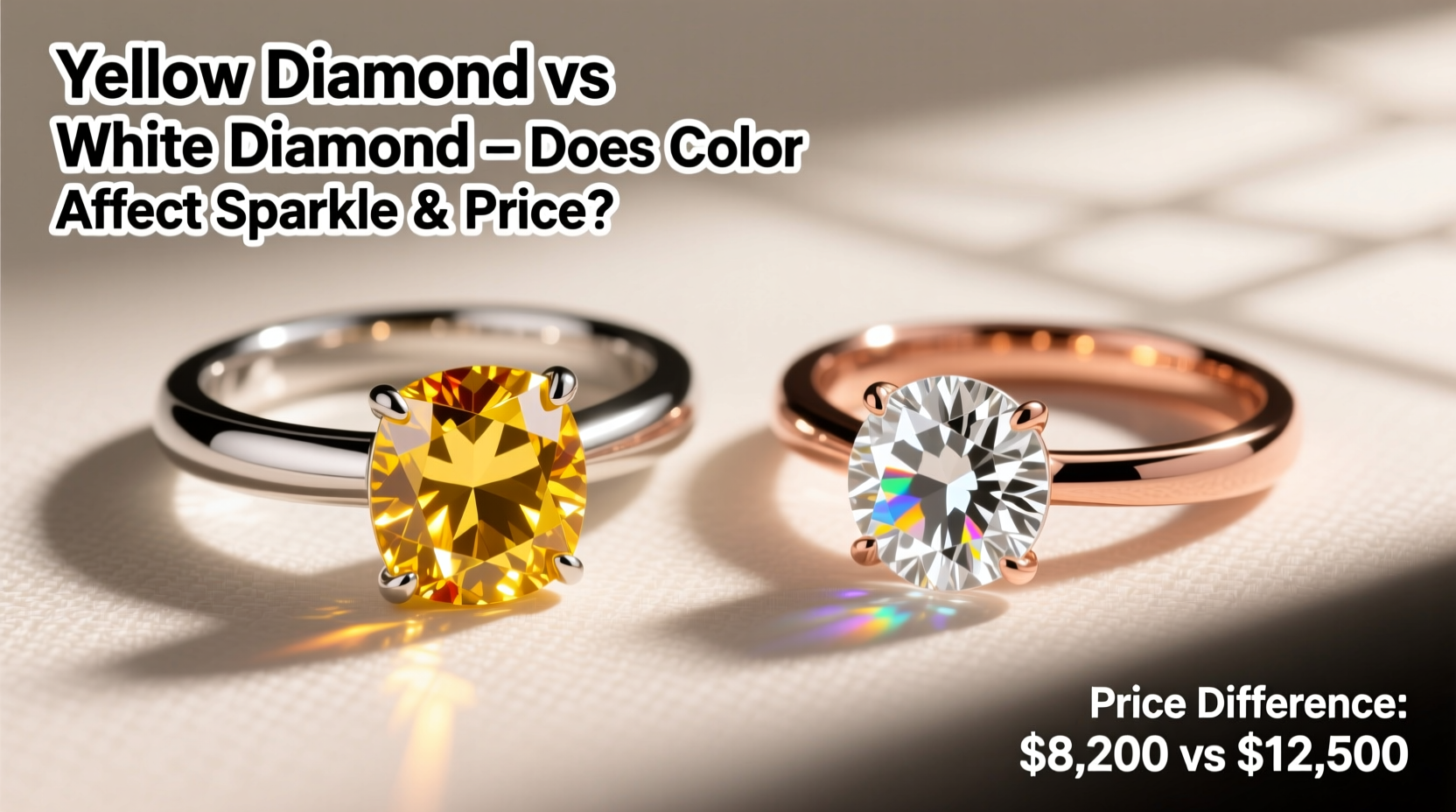
All diamonds are composed of carbon atoms arranged in a crystal lattice. The presence of trace elements during formation determines color. White diamonds are graded on a scale from D (completely colorless) to Z (light yellow or brown). These faint tints result from nitrogen impurities absorbing blue light, which can subtly warm the stone’s appearance. True colorless diamonds (D–F) reflect light evenly across the spectrum, maximizing fire and brilliance.
Yellow diamonds, however, are classified as \"fancy color\" diamonds when their hue is strong enough. Their vibrant color comes from higher concentrations of nitrogen atoms that absorb blue light, allowing yellow wavelengths to dominate. Unlike near-colorless white diamonds, where color is considered a flaw, intense yellow is celebrated as a feature. The Gemological Institute of America (GIA) grades fancy yellow diamonds based on hue, tone, and saturation—not absence of color.
Tip: A well-cut yellow diamond will still exhibit excellent sparkle, even if its color reduces some spectral dispersion compared to a colorless stone.Sparkle Showdown: Brilliance, Fire, and Scintillation Compared
Sparkle is determined by three optical effects: brilliance (white light reflection), fire (colored flashes), and scintillation (sparkle when moved). White diamonds typically outperform colored diamonds in fire due to greater contrast in light refraction. However, this doesn’t mean yellow diamonds lack sparkle—they simply express it differently.
A high-quality yellow diamond with an excellent cut can display remarkable brilliance. The key lies in proportions, symmetry, and polish. Because yellow diamonds absorb blue light, they may show less rainbow-colored fire than a D-color stone, but their warm glow creates a unique luminosity. In sunlight or under warm lighting, fancy yellows often appear radiant and lively, sometimes more so than icy white stones in low-light settings.
It’s also important to note that poorly cut yellow diamonds may look dull or oily, just like inferior white ones. Cut quality matters more than color when it comes to actual sparkle performance.
“Color doesn’t kill sparkle—it redirects it. A vivid yellow diamond can be just as captivating as a colorless one, but through warmth rather than neutrality.” — Dr. Lena Torres, GIA Certified Gemologist
Pricing Dynamics: Why Yellow Diamonds Can Be More or Less Expensive
Price comparison between yellow and white diamonds isn’t straightforward. Several factors influence cost:
- Rarity: Naturally occurring fancy yellow diamonds are rarer than white diamonds, especially in saturated hues like “fancy intense” or “fancy vivid.”
- Grading: Fancy color diamonds aren’t priced on the standard D-to-Z scale. Instead, intensity levels drive value.
- Size: Large fancy yellow diamonds command exponentially higher prices per carat than smaller ones.
- Trend Influence: Celebrity endorsements and designer collections have boosted demand for yellow diamonds in recent years.
Interestingly, while top-tier fancy vivid yellow diamonds can sell for tens of thousands per carat, lightly tinted yellowish-white diamonds (K–M range) are significantly cheaper than colorless ones. These are often marketed as “warm white” or “champagne” diamonds and offer budget-friendly alternatives without sacrificing beauty.
| Diamond Type | Avg. Price Per Carat (1ct, VS1 Clarity) | Primary Market Perception |
|---|---|---|
| White Diamond (D–F, Excellent Cut) | $8,000 – $15,000 | Classic, timeless, prestigious |
| Fancy Intense Yellow Diamond | $12,000 – $20,000 | Rare, luxurious, statement-making |
| Fancy Vivid Yellow Diamond | $20,000+ | Ultra-rare, collector-grade |
| Light Yellow (K–M Color) | $3,500 – $5,500 | Budget-friendly, warm-toned |
Real Choice: A Bride’s Perspective
Sophia, a graphic designer from Austin, wanted something distinctive for her engagement ring. She loved the idea of a yellow diamond after seeing one at a jewelry exhibition. “I didn’t want something everyone else had,” she said. “When I saw a cushion-cut fancy intense yellow diamond set in rose gold, it felt bold and joyful—like me.”
She worked with a jeweler to balance size and color, opting for a 1.2-carat stone with excellent symmetry. Though it cost slightly more than a comparable white diamond, she felt the uniqueness justified the investment. “People notice it immediately,” she shared. “And when I move my hand, it glows in a way no white diamond ever did for me.”
Her experience highlights a growing trend: consumers prioritizing individuality over tradition. For many, the emotional resonance of a yellow diamond outweighs minor differences in measurable sparkle.
How to Choose Based on Your Priorities
Selecting between a yellow and white diamond should align with your values, lifestyle, and aesthetic goals. Use this checklist to guide your decision:
Checklist: Choosing Between Yellow and White Diamonds- ✅ Define your preferred aesthetic: classic elegance (white) vs. bold personality (yellow)
- ✅ Set a realistic budget—remember that vivid yellows can exceed white diamond prices
- ✅ Prioritize cut quality regardless of color to maximize sparkle
- ✅ Consider metal pairing: yellow/rose gold enhances warm tones; platinum emphasizes cool clarity
- ✅ View stones in different lighting conditions before deciding
- ✅ Verify certification from GIA or AGS, especially for fancy color claims
Common Misconceptions Debunked
Myth: Yellow diamonds don’t sparkle as much.
Truth: Sparkle depends primarily on cut, not color. A well-proportioned yellow diamond can be exceptionally brilliant.
Myth: All yellow-tinged diamonds are valuable.
Truth: Only officially graded “fancy color” diamonds hold premium status. Slight yellow tints (K–Z) are typically discounted.
Myth: White diamonds are always higher quality.
Truth: Quality is measured by cut, clarity, carat, and color within category standards. A poorly cut D-color diamond can look lifeless next to a radiant fancy yellow.
FAQ
Do yellow diamonds increase in value over time?
Fancy vivid and fancy intense yellow diamonds have shown steady appreciation, particularly in larger sizes (over 2 carats). Their natural rarity and increasing demand support long-term value retention, similar to pink or blue diamonds.
Can I wear a yellow diamond every day?
Absolutely. Like white diamonds, yellow diamonds rank 10 on the Mohs hardness scale, making them ideal for daily wear. Just ensure the setting protects the stone and clean it regularly to maintain luster.
Will a yellow diamond look fake or like a cubic zirconia?
A genuine fancy yellow diamond has a rich, even hue and natural inclusions visible under magnification. Lab-grown alternatives exist, but certified natural stones provide authenticity and depth of color that imitations often lack.
Conclusion: Color Is a Statement, Not a Compromise
The choice between a yellow and white diamond ring ultimately reflects personal identity more than optical superiority. While white diamonds offer a timeless, neutral brilliance prized for centuries, yellow diamonds deliver charisma, rarity, and modern flair. The color does influence sparkle—but not necessarily diminish it. And yes, it affects price, but not always in predictable ways.
What matters most is selecting a diamond that resonates with you—cut to shine, chosen with intention, and worn with pride. Whether you’re drawn to the icy fire of a D-color stone or the golden glow of a fancy vivid yellow, both can represent love, commitment, and individuality in their own radiant way.
💬 Ready to explore your perfect ring? Share your thoughts or ask questions below—we’d love to hear what inspires your diamond journey.