
Chemistry is often called the \"central science\" for a reason. It bridges physics and biology, connects the microscopic world of atoms to the macroscopic reality we live in, and underpins countless aspects of modern life. From the medicine we take to the materials we use daily, chemistry shapes our existence. Yet many students question why they should invest time in understanding chemical reactions or atomic structures. The answer lies not just in academic requirements, but in the profound, practical, and transformative benefits that studying chemistry offers—personally, professionally, and globally.
The Role of Chemistry in Everyday Life
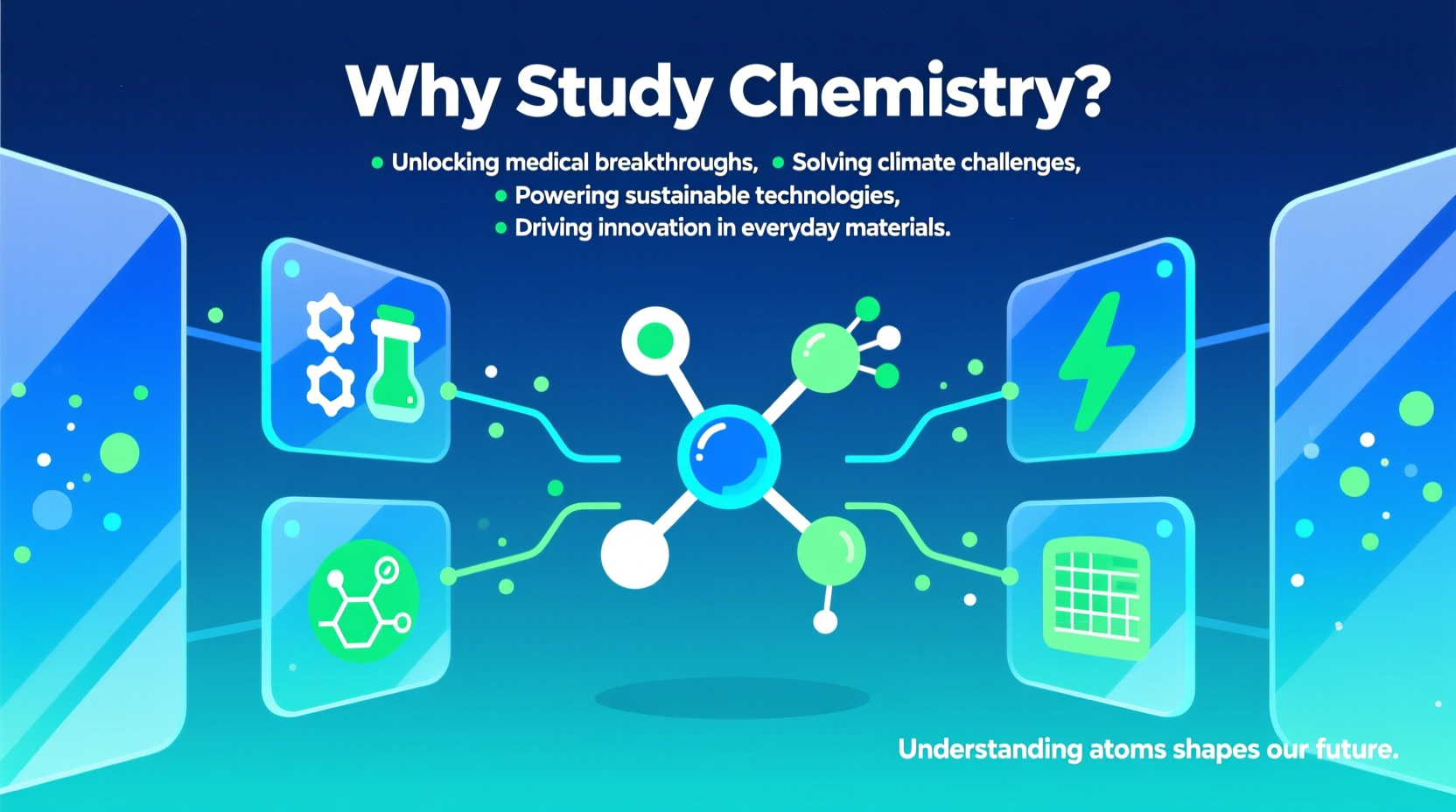
Every breath you take, every meal you eat, and every product you use involves chemistry. When you brew coffee, you're extracting compounds through solubility principles. When you clean your home, surfactants in detergents break down grease at a molecular level. Even the screen you’re reading this on relies on semiconductor chemistry developed over decades.
Understanding basic chemistry empowers individuals to make informed decisions. For example, knowing how ingredients interact helps in cooking more effectively. Recognizing the difference between organic and synthetic compounds can guide smarter choices in personal care products. Awareness of chemical safety—like not mixing bleach with ammonia—can prevent household accidents.
Tip: Read product labels with a critical eye. Understanding terms like “paraben-free,” “pH-balanced,” or “non-toxic” requires basic chemical literacy.Career Opportunities Rooted in Chemistry
Studying chemistry opens doors to diverse and high-impact careers. While some pursue traditional paths like pharmaceutical research or laboratory analysis, others find roles in unexpected fields such as environmental consulting, forensic science, food technology, or even patent law.
Industries ranging from energy to cosmetics rely heavily on chemists. With growing emphasis on sustainability, green chemistry experts are in demand to develop biodegradable plastics, cleaner fuels, and eco-friendly manufacturing processes. According to the American Chemical Society, employment in chemistry-related fields is projected to grow steadily, especially in renewable energy and biomedical research.
| Career Path | Typical Employers | Key Skills Developed |
|---|---|---|
| Medicinal Chemist | Pharmaceutical companies | Synthesis, drug design, analytical testing |
| Environmental Chemist | Government agencies, NGOs | Pollutant analysis, regulatory compliance |
| Materials Scientist | Tech firms, aerospace | Nanotechnology, polymer chemistry |
| Forensic Analyst | Crime labs, law enforcement | Toxicology, trace evidence analysis |
| Science Educator | Schools, universities | Communication, curriculum development |
Problem-Solving and Critical Thinking Development
One of the most underrated benefits of studying chemistry is its ability to sharpen analytical thinking. Chemistry demands precision, logical reasoning, and attention to detail. Balancing equations, predicting reaction outcomes, and interpreting spectroscopic data all train the mind to approach problems methodically.
This cognitive discipline extends far beyond the lab. Students who study chemistry often report improved performance in other STEM subjects, better decision-making skills, and enhanced capacity for complex problem-solving in non-scientific contexts—from managing budgets to evaluating public policy.
“Chemistry teaches you how to think, not just what to think. It’s a training ground for intellectual rigor.” — Dr. Linda Chen, Professor of Physical Chemistry, MIT
Contributing to Global Challenges
Some of humanity’s most pressing issues—climate change, clean water access, disease eradication—require chemical solutions. Studying chemistry equips individuals to contribute meaningfully to these efforts.
Consider water purification. Millions lack access to safe drinking water, but chemists are developing low-cost filtration systems using nanomaterials or solar-powered disinfection methods. In medicine, chemotherapy drugs, vaccines, and diagnostic tools are all products of chemical research. On the energy front, advancements in battery chemistry are accelerating the shift toward electric vehicles and renewable storage.
Even agriculture depends on chemistry. Fertilizers, pesticides, and genetically modified crops involve intricate biochemical engineering to increase yield while minimizing environmental harm.
Tip: Follow scientific journals like *Nature Chemistry* or *Journal of the American Chemical Society* to stay updated on breakthroughs with global impact.A Mini Case Study: Solving Urban Air Pollution
In Mexico City, air quality一度 reached hazardous levels due to vehicle emissions and industrial activity. Chemists played a crucial role in analyzing pollutants like nitrogen oxides and volatile organic compounds (VOCs). Using atmospheric chemistry models, they identified key reaction pathways forming ground-level ozone—a major component of smog.
Based on their findings, policymakers implemented targeted measures: reformulating gasoline to reduce sulfur content, introducing catalytic converters, and promoting public transportation. Over two decades, these science-driven interventions reduced peak ozone levels by nearly 50%. This real-world example illustrates how chemistry translates into tangible public health improvements.
How to Get the Most Out of Studying Chemistry
Success in chemistry doesn’t come from memorization alone. It requires engagement, practice, and application. Here’s a step-by-step guide to mastering the subject:
- Build a strong foundation: Master atomic structure, bonding, and stoichiometry early—they’re the building blocks of everything else.
- Practice consistently: Solve problems daily, even if it’s just balancing equations or naming compounds.
- Visualize concepts: Use molecular models or simulations to understand 3D structures and reaction mechanisms.
- Connect theory to reality: Relate topics like acids and bases to digestion, or redox reactions to rusting metal.
- Seek help early: Don’t wait until exams to clarify confusion. Use office hours, study groups, or online resources.
Checklist: Signs You’re Gaining Real Understanding in Chemistry
- You can explain a concept without relying on jargon.
- You predict reaction outcomes before seeing the answer.
- You notice chemistry in daily life—like fermentation in bread or emulsification in salad dressing.
- You ask “why” when observing phenomena, not just accept them.
- You feel confident tackling unfamiliar problems using logic, not just formulas.
Frequently Asked Questions
Is chemistry hard to learn?
Chemistry has a reputation for difficulty because it combines abstract concepts with mathematical calculations. However, with consistent effort, hands-on practice, and the right mindset, anyone can succeed. The key is persistence and seeking clarity when confused.
Do I need to be good at math to study chemistry?
While chemistry involves calculations—especially in areas like thermodynamics or kinetics—you don’t need advanced math to start. High school algebra is usually sufficient for introductory courses. As you progress, math becomes a tool, not a barrier.
Can I study chemistry without pursuing a lab career?
Absolutely. A chemistry background is valuable in science writing, policy advising, entrepreneurship, education, and even finance—particularly in sectors like biotech or clean energy investing. The analytical skills are transferable across industries.
Conclusion: Why Chemistry Matters Now More Than Ever
Studying chemistry is not merely an academic exercise—it's a gateway to understanding the world and shaping its future. Whether you're diagnosing diseases, designing sustainable materials, or simply making safer choices at home, chemistry provides the knowledge and tools to act with confidence and purpose.
In an age defined by rapid technological change and global uncertainty, scientific literacy is no longer optional. By embracing chemistry, you gain more than facts and formulas; you cultivate a mindset of inquiry, innovation, and responsibility.
🚀 Ready to explore the elements of your future? Start today—pick up a textbook, watch a documentary on chemical innovations, or join a local science club. Your journey into the heart of matter begins now.








