
If your kombucha has developed a sharp, boozy tang—reminiscent of hard cider or light beer—it’s not necessarily spoiled, but it *is* a signal. Ethanol is a natural byproduct of fermentation, and while trace amounts (0.5% ABV or less) are normal and legally required for “non-alcoholic” labeling in most regions, perceptible alcohol flavor means something in your fermentation process has shifted. This isn’t about failure—it’s about feedback. Kombucha is a living system, and its flavor profile reflects precise interactions between microbes, substrates, and environment. Understanding why alcohol becomes dominant helps you regain control—not to eliminate ethanol entirely (which is impossible), but to keep it subtle, balanced, and aligned with your taste goals: bright acidity, gentle effervescence, and clean finish—not intoxicating warmth.
How Alcohol Forms in Kombucha: A Microbial Partnership
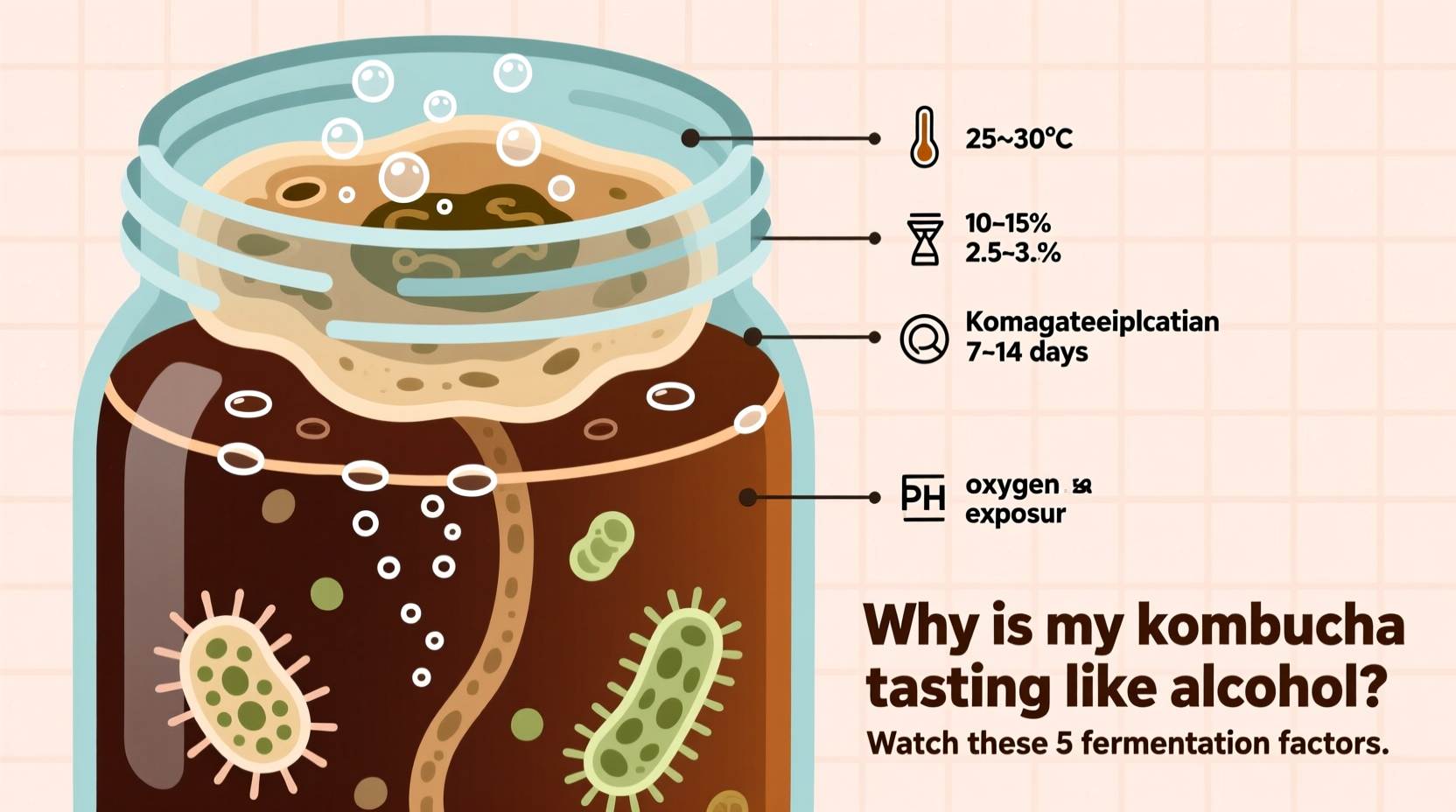
Kombucha fermentation relies on a symbiotic culture of bacteria and yeast (SCOBY). Yeast strains—including Saccharomyces cerevisiae, Brettanomyces bruxellensis, and Zygosaccharomyces bailii—consume sucrose and glucose, converting them into ethanol and carbon dioxide via alcoholic fermentation. Bacteria—primarily Acetobacter and Gluconobacter species—then oxidize that ethanol into acetic acid (vinegar) and other organic acids. This two-stage process creates kombucha’s signature tartness. When the bacterial phase lags or stalls, ethanol accumulates. When yeast dominates—due to excess sugar, warm temperatures, or low acidity—the drink tips toward alcoholic character before bacteria can fully convert it.
This delicate balance is why kombucha isn’t just “fermented tea”—it’s a dynamic, time-sensitive ecosystem. The alcohol you taste isn’t contamination; it’s an imbalance in microbial choreography.
5 Critical Fermentation Factors That Increase Perceptible Alcohol
1. Temperature: The Accelerator of Yeast Activity
Yeast thrives between 78–86°F (26–30°C). Within this range, sugar-to-ethanol conversion speeds up significantly—often outpacing bacterial acid production. At 84°F, fermentation may complete in 5–7 days, but ethanol peaks earlier and persists longer if acidity doesn’t rise concurrently. Cooler temps (68–75°F / 20–24°C) slow yeast while still allowing robust bacterial activity, yielding smoother, more acidic profiles with lower residual ethanol.
Tip: Use a reliable thermometer—not ambient room readings. Place it inside your fermentation vessel’s insulation (e.g., wrapped towel) to measure actual brew temperature. Even a 5°F difference shifts microbial dominance.2. Fermentation Time: The Window of Balance
Most home batches reach ideal balance between days 7–10. Beyond day 12, especially in warm conditions, ethanol accumulation often outpaces acetic acid synthesis. Longer ferments don’t always mean “tarter”—they can mean “boozy,” particularly if pH rises slightly (indicating bacterial slowdown) or if visible yeast sediment thickens at the bottom.
A simple pH test strip reveals much: healthy kombucha drops to pH 3.0–3.5 by day 7–8. If pH remains above 3.8 after day 10, bacterial activity is likely suppressed—leaving ethanol unconverted.
3. Sugar Concentration & Type: Fueling the Wrong Microbe
Standard recipes use 1 cup (200g) of cane sugar per gallon (3.8L) of tea. Exceeding 1.25 cups increases available substrate for yeast without proportionally boosting bacterial efficiency. More critically, using raw honey, agave, or fruit juice introduces fructose-dominant sugars that Acetobacter metabolizes poorly—while yeast readily ferments them into ethanol. Cane sugar (sucrose) breaks cleanly into glucose + fructose, both efficiently processed by the full SCOBY community.
| Ingredient | Effect on Ethanol | Why It Happens |
|---|---|---|
| Excess cane sugar (>1.25 cups/gal) | Moderate increase | More fuel for yeast; bacteria can’t scale acid production linearly |
| Raw honey or maple syrup | Significant increase | Enzymes and antimicrobials inhibit Acetobacter; yeast dominates |
| Fruit juice (in primary ferment) | High increase | Fructose overload + low pH tolerance limits bacterial conversion |
| White granulated cane sugar | Low/controlled | Optimal substrate for balanced SCOBY metabolism |
4. SCOBY Health & Age: When the Bacterial Brake Fails
An aged or stressed SCOBY shows thin, brittle layers, grayish discoloration, or sparse pellicle formation. These signs often reflect declining Acetobacter populations—meaning less ethanol-to-acid conversion. New SCOBYs (first 1–3 batches) may also underperform as bacterial colonies establish. Conversely, overactive yeast—visible as cloudy liquid, excessive fizz, or a yeasty “bready” aroma—signals microbial imbalance. Healthy SCOBYs produce a firm, creamy-brown pellicle with even texture and a clean, vinegary scent—not sweet, musty, or overly yeasty.
“Ethanol perception in kombucha is rarely about yeast overactivity alone—it’s almost always about acetobacter underperformance. If your brew smells more like baking bread than apple cider vinegar, check your SCOBY’s vitality and acidity development.” — Dr. Lena Torres, Food Microbiologist, Fermentation Research Institute
5. Oxygen Exposure During Primary Ferment
Acetic acid bacteria are obligate aerobes—they require oxygen to convert ethanol. While the SCOBY itself floats at the surface to access air, restricting airflow (e.g., sealing jars with airtight lids or over-tightening cloth covers) starves bacteria. Paradoxically, *too much* agitation or stirring reintroduces oxygen late in fermentation and can spur secondary yeast growth—especially if residual sugar remains. Ideal setup: breathable cover (tight-weave cotton or coffee filter secured with rubber band), undisturbed rest, and surface-level oxygen exchange only.
A Real-World Example: The Overlooked Garage Brew
Maya brewed kombucha consistently for 18 months in her climate-controlled kitchen—until she moved her operation to a detached garage during summer renovations. Unaware of the space’s fluctuating temps (62°F at night, 88°F by afternoon), she kept the same 10-day schedule. By batch #3, her kombucha tasted sharply alcoholic, with little tang and pronounced warmth on the finish. Testing revealed pH 4.1 after 10 days—far above the target—and visible yeast sediment three times thicker than usual. She adjusted: moved the jar to a north-facing closet (stable 72°F), reduced sugar to 1 cup/gal, and began checking pH daily. By batch #6, pH hit 3.3 on day 8, and the alcohol note vanished—replaced by crisp, layered acidity. Her takeaway? “I thought I understood my SCOBY—until I changed one variable I’d never measured: temperature consistency.”
Your Action Plan: Restoring Balance in 7 Days
- Day 1: Measure current pH and temperature. Record both. Taste and note alcohol intensity (mild, noticeable, strong).
- Day 2: Adjust environment: Move to stable 70–75°F zone. Ensure breathable cover is secure—not loose, not sealed.
- Day 3: Check for SCOBY health: Is pellicle intact? Any mold (fuzzy, green/black)? Discard if mold appears; otherwise, proceed.
- Day 4: Stir gently once—only to redistribute bacteria near the surface. Do not stir daily.
- Day 5: Test pH again. If ≥3.7, extend ferment by 1–2 days. If ≤3.4, proceed to bottling.
- Day 6: Bottle only if pH ≤3.5 and taste is balanced (tart, clean, no boozy heat). Reserve 1 cup of liquid as starter for next batch.
- Day 7: If pH remains >3.7, add 1 tbsp raw, unpasteurized apple cider vinegar (with mother) to boost acetic acid bacteria. Recheck pH in 24 hours.
What to Avoid: The Top 4 Missteps That Amplify Alcohol
- Adding fruit or juice during primary fermentation — Introduces fermentable sugars bacteria can’t efficiently process, spiking ethanol.
- Using metal utensils or containers — Reacts with acids, stresses SCOBY, and impairs bacterial function.
- Fermenting in direct sunlight or near heat sources — Causes thermal spikes that favor yeast proliferation over bacterial stability.
- Reusing starter tea from a boozy batch — Propagates imbalanced microbes; always start fresh with pH-tested, balanced starter (ideally pH ≤3.5).
FAQ: Addressing Common Concerns
Is alcoholic-tasting kombucha safe to drink?
Yes—if there’s no mold, foul odor (rotten eggs, ammonia), or slimy SCOBY. Elevated ethanol doesn’t indicate spoilage, only microbial imbalance. However, if you’re avoiding alcohol for health, religious, or legal reasons (e.g., pregnancy, recovery, workplace testing), discard batches where alcohol is clearly perceptible. Trace ethanol (<0.5% ABV) is unavoidable, but noticeable flavor suggests >0.8–1.2% ABV—well above non-alcoholic thresholds.
Can I fix a boozy batch after fermentation?
Partially. You can encourage further acidification by adding 1–2 tsp raw apple cider vinegar (with mother) and leaving covered at 72–75°F for 24–48 hours—but only if pH is still >3.6. Do not re-ferment beyond 48 hours, as risk of vinegar overload or off-flavors increases. For future batches, focus on prevention: temperature control, precise timing, and starter tea quality.
Does second fermentation increase alcohol?
Yes—modestly. Adding fruit or juice to bottles provides fresh sugar for residual yeast, raising ethanol by ~0.2–0.5% ABV. To minimize this, limit second ferment to 24–48 hours, refrigerate immediately after carbonation develops, and avoid high-sugar additions (e.g., dates, mango puree). Use lemon juice or ginger instead for flavor without significant ethanol impact.
Conclusion: Flavor Is Feedback—Not Failure
Your kombucha’s alcohol note isn’t a flaw in your process—it’s precise biochemical data. Each batch communicates what your environment, ingredients, and culture need: cooler temps, shorter timelines, cleaner sugar, or renewed bacterial vigor. Mastering these variables transforms inconsistency into intention. You’ll move beyond guessing “Is it done?” to knowing *exactly* when acidity and effervescence align—and when ethanol is held gracefully in the background, not pushed center stage. Start with one adjustment this week: monitor temperature with intention, test pH on day 7, and taste with attention. Small, informed changes compound into confident, repeatable results. Your ideal kombucha—bright, complex, and refreshingly non-boozy—isn’t theoretical. It’s waiting in your next batch.
💬 Have you tamed the alcohol note in your brew? Share your most effective adjustment in the comments—what changed, what you measured, and how your flavor transformed. Your insight could help dozens of fellow brewers find their balance.