It’s a familiar frustration: you spritz your favorite perfume in the morning, only to find the scent has all but disappeared by midday. You’re not imagining it—your skin is playing a crucial role in how long that fragrance lingers. While perfumes are crafted with precision, their performance varies dramatically from person to person. The culprit? Your skin type.
Fragrance longevity isn’t just about the quality of the perfume—it’s an interaction between chemistry, hydration, pH levels, and even lifestyle habits. Some people naturally wear scents longer than others, not because they use more, but because their skin supports better scent retention. Understanding this connection is key to unlocking lasting fragrance, no matter your skin type.
The Science Behind Scent Longevity
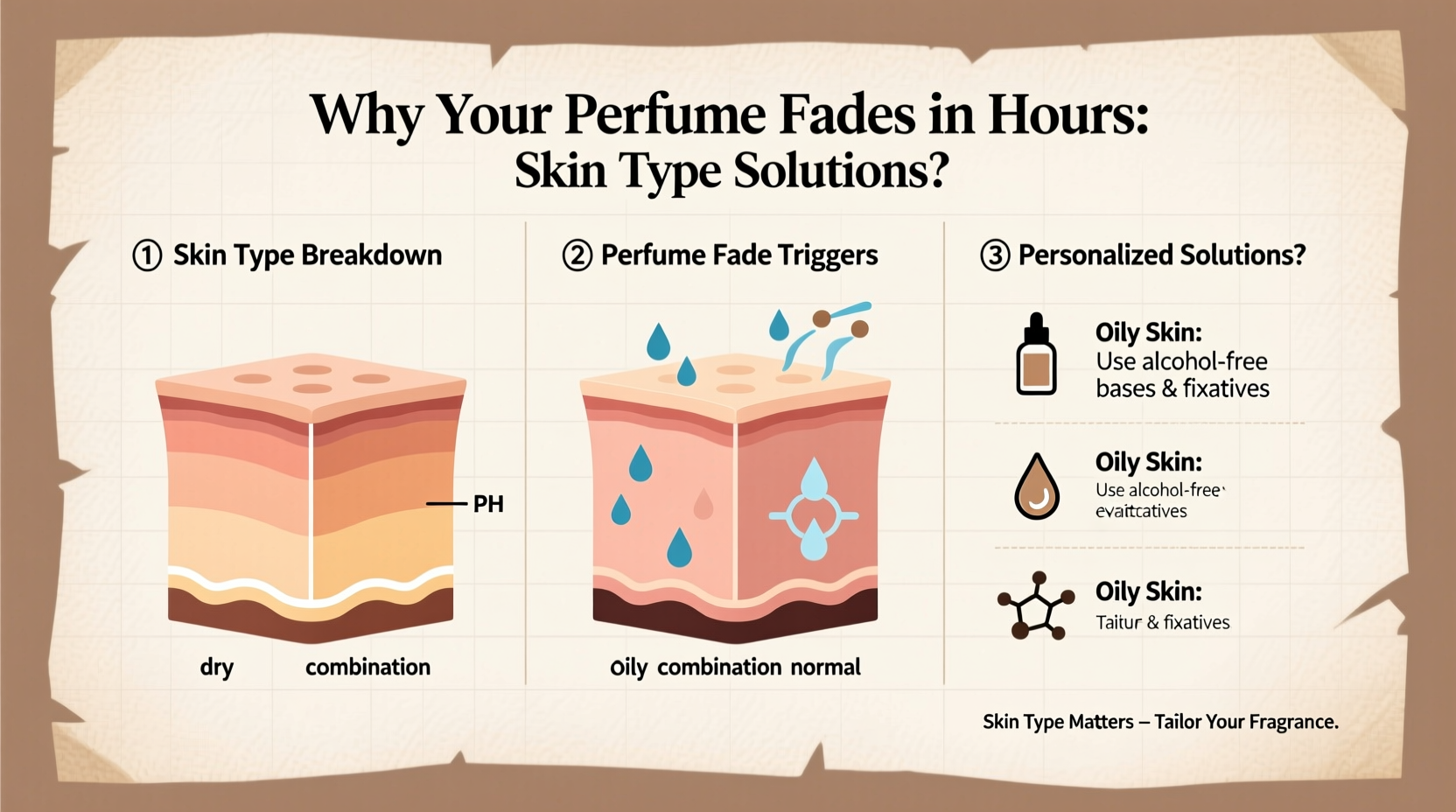
Perfume doesn’t simply evaporate off the skin—it interacts with it. When you apply fragrance, the top notes burst forth first, followed by heart and base notes that unfold over time. For this evolution to happen properly, the skin must act as a stable canvas.
The primary reason perfumes fade quickly lies in the skin’s ability to hold onto aromatic molecules. These molecules bind to oils and moisture on the skin's surface. Dry skin lacks sufficient sebum (natural oil), causing the scent to lift off too fast. Oily skin, rich in lipids, tends to anchor fragrance longer. However, overly oily or acidic skin can distort the scent profile, making it smell different than intended.
pH balance also plays a role. The average skin pH is slightly acidic (around 4.5–5.5). If your skin skews more alkaline due to harsh soaps or conditions like eczema, it may break down fragrance compounds faster, shortening the scent’s lifespan.
“Fragrance is not just a product—it’s a dialogue between chemistry and biology. Two people wearing the same scent will never experience it identically.” — Dr. Lena Moreau, Cosmetic Chemist & Perfume Formulation Specialist
How Skin Type Affects Fragrance Performance
Your skin type is one of the most significant factors in how a perfume behaves. Below is a breakdown of how each major skin type influences scent longevity and character.
| Skin Type | Effect on Perfume | Why It Happens |
|---|---|---|
| Dry Skin | Fades quickly; weak projection | Lack of natural oils means fewer binding sites for fragrance molecules |
| Oily Skin | Lasts longer; stronger sillage | Sebum helps trap and slowly release scent compounds |
| Combination Skin | Inconsistent longevity | Mixed oil distribution leads to uneven scent performance |
| Sensitive/Reactive Skin | Scent may alter or cause irritation | Higher pH or inflammation can chemically interact with fragrance ingredients |
| Mature Skin | Fades faster over time | Natural decline in oil production and skin thickness reduces scent retention |
It’s important to note that skin type isn’t fixed—it can change with seasons, hormones, diet, and skincare routines. This explains why a perfume that lasted all day in winter might vanish by lunchtime in summer.
Tip: Test new perfumes on your own skin, not paper strips. Paper doesn’t absorb oils or react chemically, so it gives a false impression of longevity.Practical Solutions by Skin Type
Regardless of your skin type, there are proven strategies to enhance fragrance staying power. The key is tailoring your routine to support your skin’s natural chemistry.
Dry Skin: Lock in Moisture First
Dry skin lacks the lipid layer needed to anchor fragrance. Without preparation, even the richest Eau de Parfum will dissipate rapidly.
- Apply an unscented body lotion or moisturizer immediately after showering while skin is still damp.
- Use a fragrance-free body oil (like jojoba or sweet almond) before applying perfume to create a sticky base.
- Avoid alcohol-based lotions—they dry the skin further and accelerate scent loss.
Oily Skin: Balance Is Key
While oily skin holds scent well, excess sebum can distort delicate floral or citrus notes, making them sour or musky.
- Cleanse gently with a pH-balanced facial wash to avoid over-stripping natural oils.
- Blot excess shine before applying perfume to prevent cloying intensity.
- Opt for lighter fragrances like citrus or aquatic scents, which resist becoming overpowering.
Combination Skin: Target Application Zones
Since oil levels vary across the body, focus on areas where your skin is naturally balanced—typically wrists, behind ears, and décolletage.
- Moisturize pulse points before spraying.
- Avoid applying directly to oily zones like the forehead or nose.
- Layer with a matching scented balm or cream for extended wear.
Sensitive Skin: Choose Wisely and Patch Test
Fragrance allergies or reactions aren’t just about irritation—they can alter how the scent develops on your skin.
- Stick to hypoallergenic or niche perfumes with transparent ingredient lists.
- Patch test behind the ear for 24 hours before full application.
- Consider alcohol-free perfumes (often labeled “extrait” or “oil-based”), which are gentler and linger longer.
Step-by-Step Guide to Maximizing Perfume Longevity
Follow this daily ritual to ensure your fragrance lasts from morning to night:
- Shower and exfoliate: Remove dead skin cells and buildup that can interfere with scent adhesion.
- Apply hydrating base: Use an unscented body lotion or oil on pulse points—wrists, neck, inner elbows.
- Wait 2 minutes: Allow the moisturizer to absorb slightly so the perfume bonds directly to skin, not surface residue.
- Spray, don’t rub: Apply 1–2 sprays per pulse point. Rubbing breaks down top notes and heats the alcohol, accelerating evaporation.
- Layer with matching products: Use a scented body wash or roll-on perfume oil to build a scent foundation.
- Reapply strategically: Carry a travel-sized atomizer for touch-ups at 3–4 PM when natural body heat peaks.
- Store perfume correctly: Keep bottles in a cool, dark place away from sunlight and humidity to preserve formulation integrity.
Real Example: Maria’s Scent Struggle
Maria, a 34-year-old teacher with combination skin, loved a popular vanilla-amber perfume. Every morning, she’d spray it generously, only to receive compliments by 9 AM and hear nothing by noon. Frustrated, she assumed she was buying low-quality fragrance.
After consulting a beauty chemist, she learned her dry forearms and oily neck were causing inconsistent performance. She began applying a lightweight body butter to her wrists and décolletage before spraying. She also switched to applying the perfume after her moisturizer had absorbed, rather than immediately after showering.
Within days, the scent lasted six hours instead of three. She added a matching scented balm for touch-ups and now enjoys her signature fragrance all day. “I didn’t need a new perfume,” she said. “I needed to understand my skin.”
Do’s and Don’ts for Lasting Fragrance
| Do | Don't |
|---|---|
| Moisturize before applying perfume | Rub wrists together after spraying |
| Store perfume in a drawer or cabinet | Keep it in the bathroom (humidity ruins formulas) |
| Use matching scented body products | Layer different brand fragrances (they clash) |
| Apply to warm pulse points | Spray directly onto clothes (can stain or alter scent) |
| Reapply with a rollerball or mist | Over-spray trying to compensate for fading |
Frequently Asked Questions
Why does my perfume last longer on my friend than on me?
Differences in skin chemistry—oil production, pH, hydration, and even diet—affect how fragrance molecules bind and evolve. What smells strong and long-lasting on one person may fade quickly on another, even if the same amount is used.
Does drinking water really help perfume last longer?
Indirectly, yes. Well-hydrated skin retains moisture better, creating a more stable surface for fragrance. Dehydrated skin feels tight and flaky, which reduces its ability to hold onto scent molecules. Drinking water supports overall skin health, improving its capacity to carry fragrance.
Are oil-based perfumes better for sensitive or dry skin?
Yes. Oil-based perfumes lack alcohol, which dries the skin and accelerates evaporation. They adhere closely to the skin, offering softer sillage but longer wear—ideal for dry or reactive skin types. They’re also less likely to cause irritation.
Expert-Backed Checklist for Fragrance Longevity
- Identify your skin type (dry, oily, combination, sensitive).
- Hydrate skin with fragrance-free lotion or oil before applying perfume.
- Apply perfume to pulse points after moisturizer has absorbed.
- Use matching scented body products to layer the fragrance.
- Avoid rubbing wrists together post-application.
- Carry a travel atomizer for midday refresh.
- Store perfume in a cool, dark place—never in direct sunlight or humid bathrooms.
- Reevaluate your fragrance choices seasonally (lighter scents in summer, richer ones in winter).
Conclusion: Make Your Perfume Work With Your Skin, Not Against It
Your perfume shouldn’t vanish by lunchtime. The solution isn’t to spray more—it’s to work smarter with your skin’s biology. By understanding your skin type and adjusting your routine accordingly, you can transform fleeting scents into all-day companions.
Start today: assess your skin, prep it properly, and apply fragrance with intention. Small changes yield dramatic results. Whether you have parched winter skin or oily summer complexion, there’s a method to make every spritz count.
🚀 Ready to unlock your longest-lasting scent yet? Try the 7-day fragrance enhancement challenge: moisturize, layer, and track your perfume’s performance. Share your results in the comments!