Walk into any well-stocked whiskey bar or browse a premium online retailer, and you’ll notice something subtle but consistent: bottles of the same age, distillery, and cask type often display markedly different hues—amber, tawny, deep mahogany, even burnt umber. Some expressions glow with a luminous copper; others look nearly black. Yet their tasting notes may be nearly identical. This visual dissonance points to one of the most quietly consequential decisions in whiskey production: the use of caramel coloring, known as E150a in the EU and simply “caramel color” in the U.S. It’s not about sweetness. It’s about consistency, perception, and tradition—and it sits at the intersection of regulation, craft, and consumer expectation.
What Caramel Coloring Actually Is (and What It Isn’t)
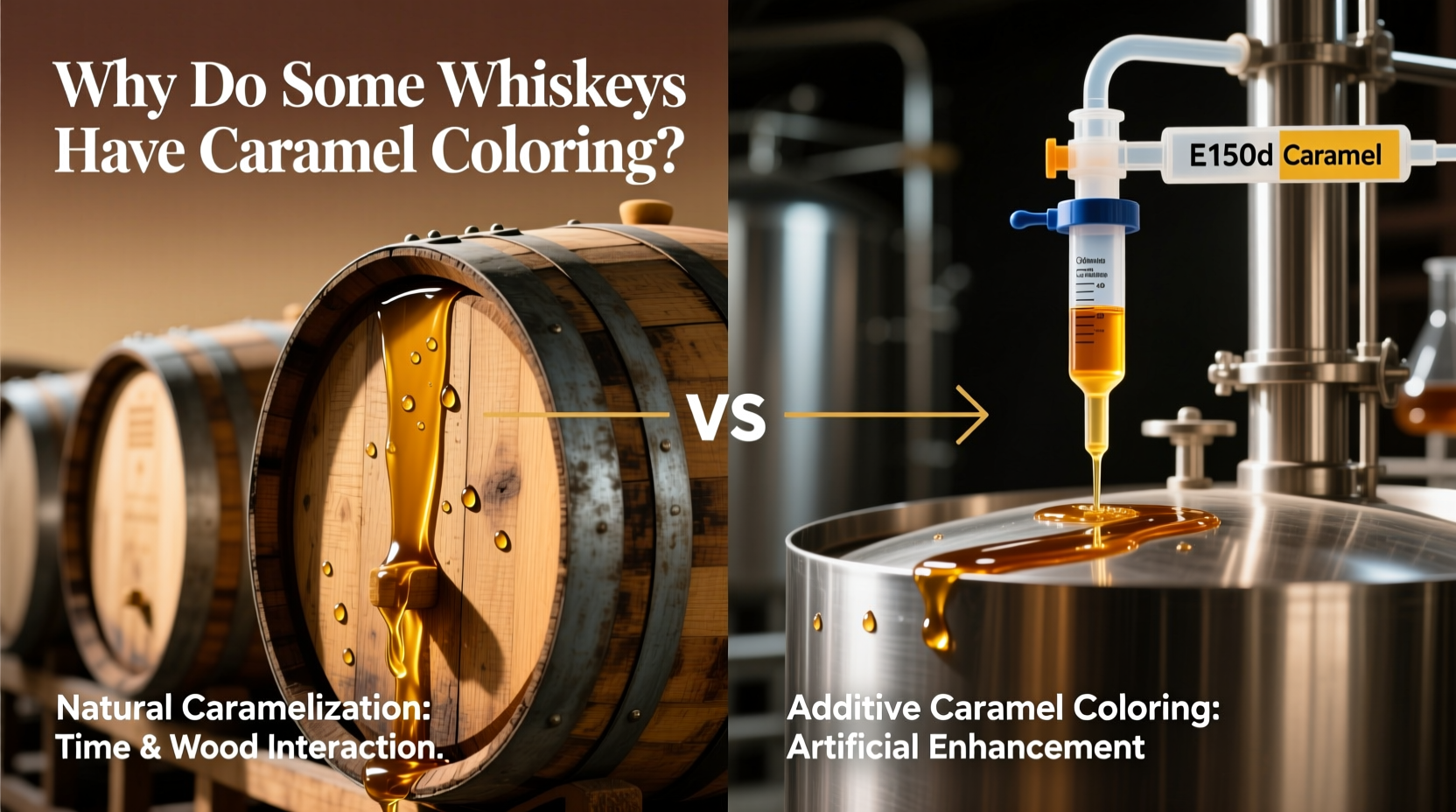
Caramel coloring is not sugar syrup or molasses. It’s a food-grade pigment produced by carefully heating carbohydrates—typically dextrose, invert sugar, or sucrose—in the presence of acids, alkalis, or salts. The Maillard reaction and controlled pyrolysis generate hundreds of compounds, including melanoidins, which impart color without significant flavor impact when used at typical dosages (usually under 100 parts per million). Four classes exist (E150a–d), but only Class I (plain caramel) is permitted in whiskey worldwide. Unlike artificial dyes like Red 40 or Blue 1, E150a contains no synthetic aromatic amines and is recognized as safe by the FDA, EFSA, and JECFA.
Crucially, caramel coloring is not a flavor enhancer, preservative, or stabilizer. Its sole functional purpose is chromatic standardization. A master blender may add 2–3 drops per liter—not to “improve” the whiskey, but to ensure that Batch #47 looks identical to Batch #46 on the shelf. That visual continuity matters more than many realize: studies in sensory science show consumers consistently rate uniformly colored spirits as higher quality—even when blind-tasted samples are identical.
Natural Color vs. Added Color: Origins and Implications
Whiskey’s natural color comes almost entirely from interaction with oak during maturation. Lignin breaks down into vanillin and syringaldehyde; hemicellulose yields furfural and hydroxymethylfurfural; tannins polymerize and oxidize. The resulting palette depends on multiple variables:
- Barrel char level: Heavily charred barrels (Level 4 “alligator char”) leach more color-producing compounds early in maturation.
- Wood origin & seasoning: American oak imparts faster, brighter color than slower-releasing European oak; air-drying versus kiln-drying alters extractable pigment profiles.
- Climate: Warmer, more humid environments (e.g., Kentucky, India) accelerate extraction and oxidation, yielding deeper hues in less time than cooler regions (e.g., Speyside, Tasmania).
- Proof at entry: Lower-barrel-entry proof (e.g., 115° vs. 125°) increases water solubility of wood compounds, intensifying color development.
Because these variables fluctuate batch-to-batch—even within the same warehouse—natural color is inherently inconsistent. A 12-year bourbon aged in a hot rickhouse corner may emerge near-black; its sibling barrel aged on a cool ground floor might be pale gold. Without intervention, shelf appeal suffers, brand recognition weakens, and retailers hesitate to reorder.
Tip: When comparing two whiskeys side-by-side, don’t assume darker color means older or richer. A pale 25-year Highland single malt may be uncolored and cask-strength; a dark 8-year Tennessee whiskey likely contains E150a for uniformity.Regulatory Realities: Where It’s Required, Restricted, or Unregulated
Global standards diverge sharply—and those differences reveal cultural priorities around transparency and tradition.
| Region | Legal Status of Caramel Coloring | Labeling Requirement | Key Rationale |
|---|---|---|---|
| United States (Bourbon, Rye, etc.) | Permitted in all categories except “Straight” whiskies aged under 4 years (which must be labeled with age) | Not required to disclose | Focus on safety over disclosure; historical precedent dating to pre-Prohibition blending practices |
| Scotland & EU (Scotch, Irish, etc.) | Permitted in all categories | Must declare “caramel color” or “E150a” if added | EU food labeling directive (1169/2011); emphasis on consumer right-to-know |
| Japan | Permitted, but increasingly avoided by premium producers | Required on ingredient list if used | Market preference for “natural” presentation; growing influence of craft ethos |
| Canada | Permitted; widely used in blended rye and corn whiskies | No disclosure requirement | Blending culture prioritizes consistency; minimal regulatory scrutiny on aesthetics |
The Scotch Whisky Regulations 2009 explicitly allow E150a—but also mandate that any added color be declared. This creates an interesting market dynamic: many independent bottlers proudly label “Natural Colour” on their releases, signaling both transparency and confidence in cask quality. Conversely, major blended brands rarely highlight it—because for them, consistency isn’t optional; it’s operational necessity.
Does It Affect Flavor? The Evidence and Expert Consensus
This is where myth and marketing collide most forcefully. Decades of distiller interviews, lab analyses, and sensory panels converge on one conclusion: at legal dosage levels, E150a contributes no perceptible flavor, aroma, or mouthfeel. Its chemical profile is dominated by high-molecular-weight melanoidins—compounds too large to bind effectively to olfactory receptors or taste buds.
“People taste with their eyes first. If a whiskey looks thin or washed-out, they’ll perceive it as lighter or weaker—even if the ABV and phenolic content are identical. Caramel coloring doesn’t change the liquid’s chemistry meaningfully. But it changes the drinker’s expectation—and that changes the experience.” — Dr. Rachel Kim, Sensory Scientist, Scotch Malt Whisky Society Research Panel
A 2022 double-blind study published in the Journal of Sensory Studies tested 87 experienced tasters on three identical 12-year Speyside single malts—one uncolored, one dosed with 50 ppm E150a, one with 100 ppm. No statistically significant difference emerged in perceived body, sweetness, oak intensity, or finish length. However, 78% rated the darkest sample as “more complex” and “better balanced”—demonstrating the power of visual priming.
That said, misuse *can* matter. Over-dosing (rare, but possible in low-cost blends) may introduce trace bitterness or a faint burnt-sugar note—especially when combined with heavy sherry cask influence. And crucially: adding color doesn’t mask poor distillation or flawed maturation. A badly made whiskey will still taste flawed, regardless of hue.
Real-World Impact: A Case Study from the Highlands
In 2019, Glenfiddich released its Experimental Series “Project XX,” a collaborative blend of 20 casks selected by 20 global ambassadors. Each ambassador chose a cask based solely on sensory evaluation—no color assessment involved. The resulting liquid ranged from light straw to deep amber. Initial consumer feedback was polarized: some praised its “honest, unvarnished character”; others complained it “looked diluted” or “cheap” on shelves next to the brand’s uniformly golden core range.
Glenfiddich responded not by adding color—but by launching a companion campaign titled “The Colour of Curiosity,” featuring side-by-side photos of casks, chromatography results, and distiller commentary on how wood, climate, and time shape hue organically. Sales of Project XX rose 34% year-on-year—not because people loved the color variation, but because the transparency built trust. Meanwhile, competitor Balvenie quietly introduced “The Week of the Distiller,” a limited release explicitly labeled “Natural Colour,” with batch-specific hue notes included on the back label (“Batch 12A: Honey Amber; Batch 12B: Old Copper”). Both approaches succeeded—not by denying caramel coloring’s role, but by reframing the conversation around intention and integrity.
Your Practical Guide: How to Read Labels, Taste Mindfully, and Choose Wisely
Understanding caramel coloring empowers informed choices—not just about what to buy, but how to appreciate what you already own. Follow this step-by-step approach:
- Scan the label first: In the EU or Japan, look for “E150a” or “caramel color” in the ingredients. In the U.S., absence of such language doesn’t guarantee absence—just non-disclosure.
- Check for “Natural Colour” claims: Legally binding in Scotland and the EU; voluntary but increasingly common in U.S. craft releases (e.g., Westland, Stranahan’s, Chattanooga Whiskey).
- Compare against context: A $30 blended Scotch almost certainly contains E150a. A $250 single cask independent bottling almost certainly does not. Price and provenance are strong proxies.
- Taste before you judge the color: Pour into a clear glass, swirl, observe—but then close your eyes. Note viscosity, alcohol warmth, initial aromas. Only then open your eyes and reassess whether your visual impression influenced your earlier notes.
- Track your own reactions: Keep a simple log: “Uncolored 12-yr Bowmore – pale gold, intense iodine, brine, smoke. Colored 12-yr Lagavulin – deep amber, same phenolics, slightly softer entry.” Pattern recognition builds palate literacy.
FAQ: Clearing Up Common Misconceptions
Does caramel coloring mean the whiskey is “fake” or “low quality”?
No. It indicates production intent—not quality. Most premium blends (Johnnie Walker Black, Chivas Regal 18, Crown Royal Northern Harvest) use E150a to deliver the exact shade consumers expect after decades of consistent branding. Removing it would risk alienating loyal customers who associate that hue with reliability and richness. Quality resides in distillation precision, cask selection, and maturation conditions—not chromatic uniformity.
Can I tell if a whiskey is colored just by looking at it?
Not reliably. While extremely dark liquids (near-black) often contain colorant, many uncolored whiskies achieve deep hues naturally—especially those finished in heavily charred new oak, PX sherry butts, or port pipes. Conversely, some lightly colored whiskies (e.g., young Japanese malts matured in mizunara) may contain E150a to avoid appearing “weak” or “thin.” Hue alone is an inadequate diagnostic tool.
Is caramel coloring unhealthy?
At the concentrations used in whiskey (typically 10–80 ppm), E150a poses no known health risk. Regulatory bodies globally classify it as safe. Concerns about 4-methylimidazole (4-MEI)—a potential carcinogen formed in some caramel classes—apply only to Class III and IV (used in colas, soy sauce), not Class I (E150a) permitted in spirits. Whiskey contains negligible 4-MEI.
Conclusion: Color Is a Language—Learn to Read It, Not Judge By It
Caramel coloring isn’t deception. It’s punctuation—a deliberate pause in the narrative of whiskey-making. Like a well-placed comma or em dash, it shapes rhythm, guides interpretation, and ensures continuity across chapters. To dismiss it as “artificial” is to misunderstand both the constraints of scale and the psychology of perception. To embrace it uncritically is to overlook the quiet artistry of natural cask expression—the slow alchemy of wood, time, and climate that yields color without intervention.
The most thoughtful whiskey drinkers don’t ask “Is it colored?” They ask “Why was it colored?” and “What does that tell me about the maker’s priorities?” They recognize that a bottle labeled “Natural Colour” signals confidence in cask quality—and perhaps a willingness to let batch variation shine. They understand that a uniformly golden blend reflects decades of blending mastery, not a lack of authenticity. They taste with curiosity, not prejudice.
💬 What’s your take? Have you noticed how color affects your first impression of a whiskey? Share your observations—or your favorite uncolored expression—in the comments. Let’s deepen the conversation, one honest pour at a time.