
Warmth in an extension cord isn’t just a minor inconvenience — it’s a visible warning sign that electricity is encountering resistance where it shouldn’t. When you plug in dozens of holiday lights, string lights for a patio party, or decorative LED strands across a backyard, the cord may feel warm to the touch, emit a faint hum, or even develop a distinct plastic odor. That warmth isn’t normal operation; it’s physics revealing a mismatch between demand and capacity. Understanding why this happens — and how to prevent it — isn’t about convenience. It’s about preventing melted insulation, tripped breakers, fire hazards, and costly equipment damage. This article explains the real-world electrical principles at play, identifies hidden risk factors many overlook, and delivers actionable, code-aligned solutions you can apply tonight.
The Physics Behind the Heat: Resistance, Amperage, and Power Dissipation
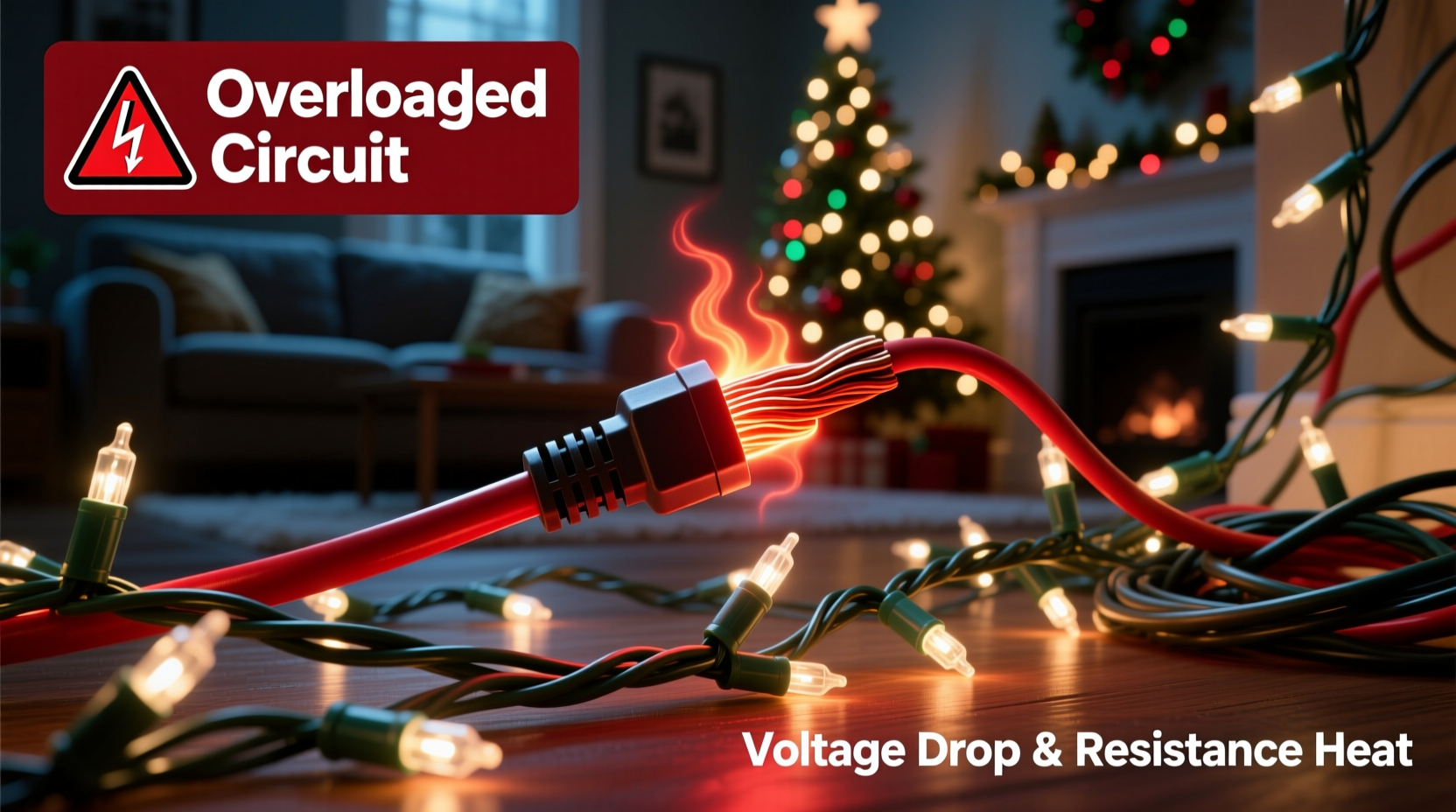
Electricity flows through conductors like copper wire, but no conductor is perfect. All wires resist current flow to some degree — measured in ohms per foot. When electrons push through that resistance, energy converts to heat. This is known as Joule heating, governed by the formula P = I² × R, where P is power dissipated as heat (in watts), I is current (in amperes), and R is resistance (in ohms).
Here’s the critical insight: heat generation rises with the square of the current. Double the amperage, and heat quadruples. A typical 50-light incandescent strand draws ~0.33 amps; 20 such strands draw ~6.6 amps. But modern LED strands draw far less — often 0.04–0.07 amps each. So why do LED-lit cords still overheat? Because resistance isn’t static. It increases with temperature, creating a dangerous feedback loop: initial warmth → higher resistance → more heat → even higher resistance. Add voltage drop over long runs (especially with thin-gauge cords), and the load on the cord’s internal wiring intensifies dramatically.
Most household circuits are rated for 15 or 20 amps. Yet a single 16-gauge extension cord — commonly sold in big-box stores — is only rated for 13 amps *at best*, and only if it’s under 50 feet and in open air. In practice, coiling it, running it under rugs, or using it outdoors in cold weather slashes its safe capacity by 25–40%.
Five Common Causes — and Why “Just Unplug One Strand” Isn’t Enough
Overheating rarely stems from one isolated flaw. It’s usually a cascade of compounding issues:
- Undersized gauge for the load and distance: A 16-gauge cord is adequate for a single 100-watt lamp at 10 feet — not for 300 LED bulbs strung across 75 feet of backyard fencing.
- Daisy-chaining multiple cords: Each connection point adds resistance and potential for arcing. Two 16-gauge cords linked together don’t equal one 16-gauge cord — they create two hotspots and increase total resistance by 30–50%.
- Poor terminations and worn outlets: Loose prongs, corroded receptacles, or bent blades increase contact resistance. A single bad connection can generate as much heat as several feet of undersized wire.
- Ambient conditions: Cords laid on hot asphalt, buried under mulch, or tightly coiled retain heat. UL testing assumes free-air cooling — not real-world installation.
- Hidden load stacking: You might think you’re only powering lights — but add a fog machine, speaker system, or inflatable display, and the cumulative draw pushes past safe thresholds without obvious warning.
Real-World Case Study: The Backyard Wedding Setup
At a summer wedding in Portland, Oregon, a couple used three 100-foot, 16-gauge extension cords daisy-chained to power 42 strands of warm-white LED fairy lights (rated 0.05A each), two 150W uplighters, and a 120W Bluetooth speaker system. Total calculated load: 42 × 0.05A + 1.25A + 1.0A = 4.35A — seemingly safe. Yet within 45 minutes, the middle cord’s female end began smoking. An electrician responding to the emergency found three root causes: (1) all cords were coiled beneath a wooden deck platform, trapping heat; (2) the outlet feeding the first cord was a 30-year-old GFCI with pitted, high-resistance contacts; and (3) one cord had been repaired with electrical tape over a cut jacket — exposing bare copper to moisture and corrosion. The low-amperage math was correct — but real-world resistance, thermal buildup, and aging infrastructure turned a 4.35A load into a 17A-equivalent hotspot. No fire occurred, but the incident prompted a full outdoor circuit upgrade and professional lighting layout review.
Actionable Safety Checklist: Before You Plug in Any Light Display
- ✅ Calculate total amperage: Add the amp rating (not wattage) of every device on the cord. Find it on the UL label or use: Amps = Watts ÷ Volts (e.g., 120W ÷ 120V = 1.0A).
- ✅ Select cord gauge by length and load: Use 14-gauge for loads >10A or runs >50 ft; 12-gauge for >15A or >100 ft. Never use 16- or 18-gauge for permanent or multi-strand displays.
- ✅ Inspect every inch: Look for cracked insulation, bent prongs, discoloration around plugs, or stiffness indicating internal damage.
- ✅ Uncoil completely: Never operate an extension cord while wound on a reel or bundled — heat cannot dissipate.
- ✅ Verify outlet condition: Test GFCIs monthly. Replace any outlet that feels warm, sparks, or has loose receptacles.
- ✅ Use a dedicated circuit: Avoid sharing the same breaker with refrigerators, microwaves, or HVAC systems — voltage sags increase cord strain.
Extension Cord Specifications: Gauge, Capacity, and Real-World Limits
Manufacturers list “maximum load” ratings — but those assume ideal lab conditions. The table below reflects conservative, field-tested limits used by licensed electricians for seasonal lighting applications:
| AWG Gauge | Max Load (Amps) | Max Safe Length (ft) for 10A Load | Max Safe Length (ft) for 15A Load | Typical Use Case |
|---|---|---|---|---|
| 18-gauge | 5 A | Not recommended | Not recommended | Single low-power device (e.g., phone charger); never for lights |
| 16-gauge | 10 A | 50 ft | Not recommended | Small indoor setups (≤5 strands, ≤25 ft) |
| 14-gauge | 15 A | 100 ft | 50 ft | Residential outdoor displays (up to 25 LED strands) |
| 12-gauge | 20 A | 150 ft | 100 ft | Commercial-grade displays, large patios, multi-zone lighting |
| 10-gauge | 30 A | 200 ft | 150 ft | Stage lighting, food truck setups, permanent landscape lighting |
Note: These distances assume ambient temperatures ≤25°C and open-air installation. Reduce max length by 30% for coiled use, 40% for use under mulch/rugs, and 25% for temperatures above 35°C.
Expert Insight: What Licensed Electricians See Most Often
“Ninety percent of overheating incidents I investigate aren’t caused by too many lights — they’re caused by using the wrong cord for the job, then ignoring early warnings. A warm plug is like a cough before pneumonia: subtle, easy to dismiss, but signaling something serious underneath. People trust the packaging — ‘Heavy Duty!’ — but UL doesn’t test for daisy-chaining, coil retention, or 15-year-old outlets. Real-world safety lives in the margins: gauge, length, termination quality, and thermal management.”
— Carlos Mendoza, Master Electrician & NEC Code Trainer, Portland, OR
Step-by-Step: How to Safely Power Multiple Light Strands Without Overheating
- Step 1: Audit your entire lighting plan. List every strand, fixture, and accessory. Note each device’s amp rating (check labels or manufacturer specs). Sum them.
- Step 2: Map your power sources. Identify which outlets feed which zones. Use a circuit breaker finder to confirm which breaker controls each outlet — and verify its rating (15A or 20A).
- Step 3: Choose cords by zone. For each zone, select cord gauge and length using the table above — always rounding up. Example: 12 strands @ 0.06A = 0.72A total. But add 20% headroom (0.86A) and choose 14-gauge for flexibility and longevity.
- Step 4: Install with thermal discipline. Run cords fully uncoiled. Elevate off hot surfaces. Use cord covers (not tape) for walkways. Keep connections elevated and dry — never on grass or concrete.
- Step 5: Monitor for 30 minutes. After powering on, check every plug, receptacle, and cord midpoint with the back of your hand (not fingertips — avoid burns). If any spot is noticeably warm, shut down and re-evaluate load or cord choice.
- Step 6: Schedule periodic checks. Re-inspect connections every 4–6 hours during extended use. Replace any cord showing discoloration, brittleness, or odor after one season.
FAQ: Addressing Your Most Pressing Questions
Can I use an extension cord rated for outdoor use indoors without risk?
Yes — outdoor-rated cords (marked “W” or “W-A”) have thicker, UV- and moisture-resistant insulation and are safe indoors. However, indoor-only cords (no “W” rating) must never be used outside, even temporarily. Their thinner jackets degrade rapidly in sunlight and humidity, increasing shock and fire risk.
Why does my cord heat up more at the plug than along the wire?
Heat concentrates at connection points because resistance spikes where metal meets metal. Corrosion, oxidation, loose screws, or incompatible plug types (e.g., polarized vs. non-polarized) create micro-gaps that force current through smaller contact areas — generating intense localized heat. This is why replacing old outlets and using high-quality, commercial-grade plugs matters more than cord length alone.
Will switching all my lights to LEDs solve the overheating problem?
LEDs reduce load significantly — but they don’t eliminate risk. Low-wattage devices can still overload undersized cords over long distances due to voltage drop, which forces the power supply (or transformer) to draw more current to compensate. Additionally, cheap LED drivers introduce harmonic distortion, increasing RMS current beyond nameplate ratings. Always verify total amperage — never assume “LED = safe.”
Conclusion: Heat Is Information — Not an Inconvenience
An extension cord warming up isn’t a quirk of holiday lighting — it’s precise, measurable feedback from your electrical system. It tells you the wire is working harder than it was designed to, that connections are degrading, or that your setup exceeds safe thermal limits. Ignoring it invites failure: insulation breakdown, arcing faults, or worst-case, ignition. But treating it with informed respect transforms risk into reliability. Choose the right gauge. Respect length limits. Inspect relentlessly. Prioritize termination quality over convenience. These aren’t restrictions — they’re the quiet disciplines of people who keep their lights bright, their spaces safe, and their holidays worry-free.
You don’t need an electrician’s license to make safer choices — just awareness, a little math, and the willingness to pause before plugging in. Start tonight: uncoil that cord, check its gauge, calculate your load, and replace anything that’s warm, worn, or guessed-at. Your future self — and your home — will thank you.
💬 Have you experienced cord overheating — and what did you learn? Share your real-world solution or near-miss in the comments. Your experience could help someone else avoid a dangerous mistake.