
At first glance, bats and dogs seem worlds apart—one is a nocturnal flying mammal often associated with myths and caves, the other a domesticated companion known for loyalty and daytime activity. Yet many people have noticed something uncanny: certain bat species bear an unmistakable resemblance to small dogs. From their elongated snouts to their expressive eyes and even their vocalizations, the parallels can be striking. This phenomenon isn’t just a trick of the imagination. There are biological, evolutionary, and perceptual reasons why some bats appear dog-like. Understanding these connections offers insight into both animal evolution and human cognition.
Anatomical Parallels: Why Bats Resemble Dogs
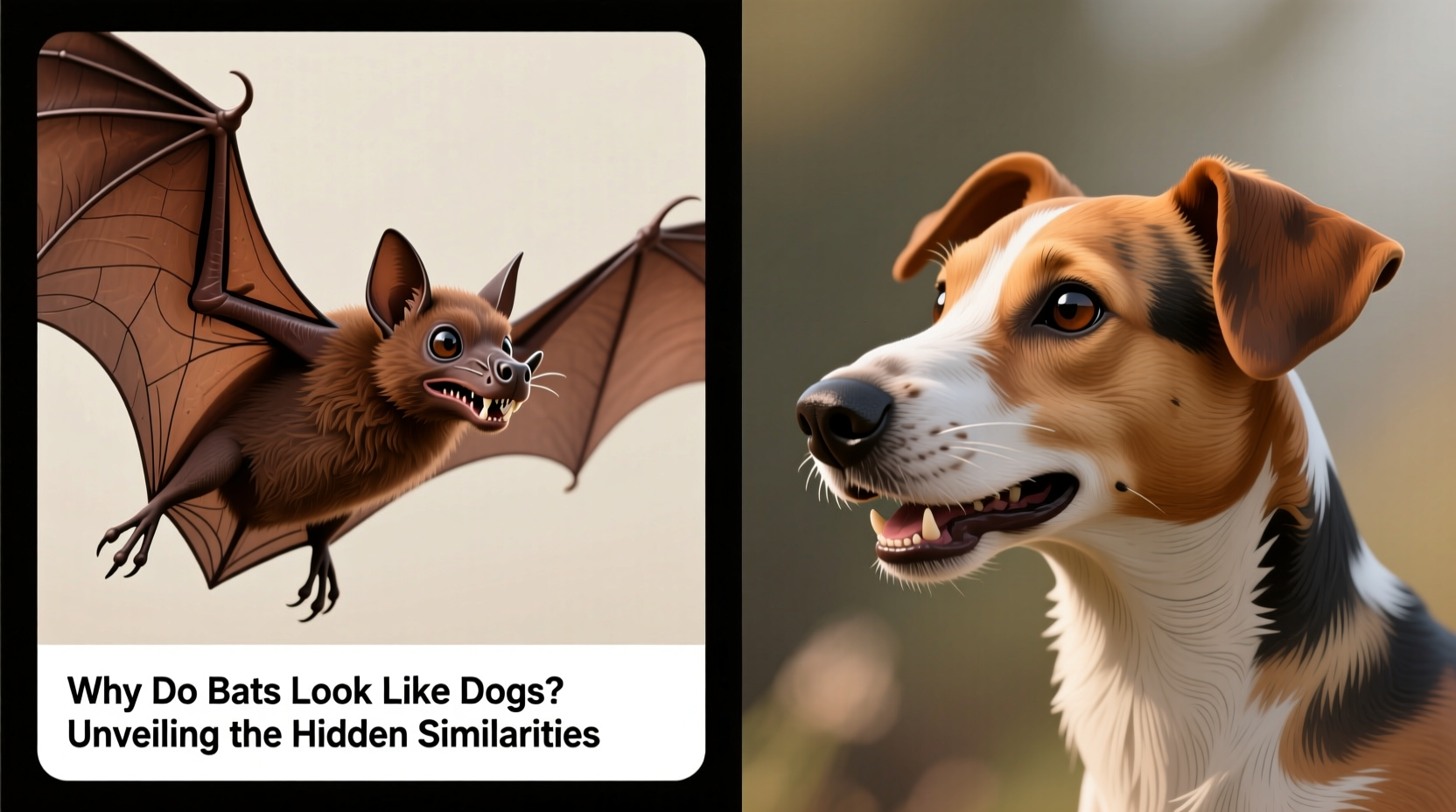
The most immediate reason bats may remind us of dogs lies in their cranial structure. Certain bat families—particularly fruit bats (Pteropodidae), also known as flying foxes—have evolved long muzzles, large eyes, and upright ears that closely mimic the facial features of canines. Unlike microbats that rely on echolocation and have shorter, broader faces, fruit bats depend more on sight and smell to locate food, leading to convergent evolution in sensory organ placement.
Their noses are often narrow and protruding, similar to those of terriers or spaniels. Their wide-set eyes give them a soft, almost puppy-like expression. When at rest, especially in photographs, these bats can appear startlingly like small lapdogs curled up asleep. This visual similarity is further amplified when they open their mouths—some emit high-pitched squeaks or barks that resemble yips or whimpers.
Tip: When observing bats in photos or videos, focus on facial proportions—muzzle length, eye position, and ear shape—to better understand why they trigger familiar canine associations.Evolutionary Convergence: Form Follows Function
Nature often arrives at similar solutions for unrelated species facing comparable environmental challenges. This process, known as convergent evolution, helps explain the bat-dog likeness. Fruit bats and dogs both rely heavily on olfactory cues. Dogs use scent for tracking prey, identifying territory, and social communication; fruit bats use it to locate ripe fruit and flowers in dense forests. As a result, both have developed prominent nasal regions to accommodate enhanced olfactory systems.
Similarly, their large, forward-facing eyes support improved depth perception and low-light vision—critical for navigating complex environments. In dogs, this aids nighttime movement and hunting; in bats, it supports flight through cluttered tropical canopies. These shared adaptive pressures have led to analogous facial morphologies despite millions of years of evolutionary divergence.
“Facial convergence between bats and dogs isn't about lineage—it's about ecological necessity. When two animals evolve to fill similar sensory niches, their faces start to mirror each other.” — Dr. Lena Torres, Mammalian Evolution Biologist, University of Queensland
Social Behavior and Vocal Expressions
Beyond appearance, some bat behaviors echo those of dogs, deepening the perceived resemblance. Many bat species are highly social, living in colonies that range from dozens to millions of individuals. Within these groups, they form close bonds, groom one another, and even adopt orphaned pups—traits commonly associated with pack animals like wolves and domestic dogs.
Vocal communication further strengthens this link. While bats are famous for ultrasonic echolocation, many also produce audible social calls. Flying foxes, for instance, bark, screech, and chatter in ways that sound eerily like excited or agitated dogs. Researchers recording colony interactions have noted how these vocalizations serve functions similar to canine barking: alerting others to danger, asserting dominance, or calling for attention.
| Feature | Dogs | Fruit Bats |
|---|---|---|
| Primary Senses | Smell, hearing, vision | Smell, vision, hearing |
| Social Structure | Pack-oriented | Colony-based |
| Vocal Range | Barks, whines, growls | Barks, screeches, chirps |
| Care for Young | Extended parental care | Mothers carry pups, nurse for months |
| Nocturnal Activity | Variable (often crepuscular) | Primarily nocturnal |
A Real-World Example: The Egyptian Fruit Bat
In urban areas of Israel and Egypt, Egyptian fruit bats (*Rousettus aegyptiacus*) frequently roost in abandoned buildings and date palm groves. Wildlife photographers capturing these bats at dusk have reported that locals often mistake them for “strange little dogs” clinging to walls. One documented case involved a tourist who called animal control after spotting a group of bats near a hotel balcony, convinced they were exotic pets that had escaped.
Upon investigation, the officers recognized them as bats but acknowledged the resemblance. Biologists later used this incident to launch a public education campaign about local wildlife, using side-by-side images of fruit bats and small dog breeds to illustrate how perception can blur taxonomic lines.
The Role of Human Perception and Pareidolia
Human brains are wired to recognize patterns, especially faces. This tendency, called pareidolia, explains why we see faces in clouds, toast, or electrical outlets. When applied to animals, it means we instinctively interpret unfamiliar facial structures through the lens of familiar ones—particularly those of mammals we know well, like dogs.
Fruit bats, with their symmetrical faces, defined jaws, and mobile lips, hit several key markers our brains associate with cuteness and familiarity. Their expressions—even when simply stretching or yawning—can be misread as panting or playful grins. This cognitive bias amplifies the dog-like impression, making it feel more real than it objectively is.
- We’re more likely to anthropomorphize animals with forward-facing eyes.
- Muzzles resembling those of dogs activate emotional responses tied to companionship.
- Media portrayals sometimes enhance the likeness by cropping images to emphasize facial features.
Debunking Misconceptions: Not All Bats Look Like Dogs
It’s important to clarify that only a subset of bats—primarily larger fruit-eating species—exhibit these dog-like traits. The vast majority of the over 1,400 bat species worldwide look nothing like dogs. Microbats, which make up the majority, have short noses, large ears, and wrinkled faces adapted for echolocation. They resemble rodents or aliens more than canines.
The misconception arises because fruit bats are more photogenic and commonly featured in documentaries, zoos, and viral social media clips. Their relative harmlessness and expressive faces make them popular subjects, skewing public perception of what bats “should” look like.
Checklist: How to Accurately Identify Bat Types
- Observe the face: Long snout and large eyes suggest a fruit bat.
- Check the diet: If it eats fruit or nectar, it’s likely not a microbat.
- Listen to sounds: Audible barks or screeches point to social fruit bats.
- Note the size: Flying foxes can have wingspans over 5 feet.
- Look at the nose: A simple, dog-like nose indicates Pteropodidae; complex leaf-shaped structures indicate echolocating species.
FAQ
Are bats related to dogs?
No, bats and dogs are not closely related. Bats belong to the order Chiroptera, while dogs are part of Carnivora. They diverged evolutionarily over 80 million years ago. Any similarities are due to convergent evolution, not shared ancestry.
Can bats bark like dogs?
Yes, certain fruit bats produce vocalizations that sound remarkably like barking. These calls are used for communication within colonies and can be mistaken for small dogs, especially at night.
Why do only some bats look like dogs?
Only fruit bats (flying foxes) have evolved facial features that resemble dogs due to reliance on vision and smell rather than echolocation. Most bats have shorter faces and specialized nose structures for high-frequency sound emission.
Conclusion: Seeing Beyond the Surface
The question “why do bats look like dogs?” opens a window into broader themes of evolution, perception, and human-animal relationships. While no bat will wag its tail or fetch a ball, the superficial similarities stem from real biological adaptations shaped by environment and survival needs. Recognizing these parallels doesn’t diminish scientific accuracy—it enriches our appreciation of nature’s creativity.
💬 Did you ever mistake a bat for a dog—or vice versa? Share your story or thoughts in the comments. Let’s explore how perception shapes our understanding of the natural world.








