
The Great Smoky Mountains rise like ancient sentinels along the border of Tennessee and North Carolina, cloaked in a soft, bluish haze that gives them their famous name. But why “Smoky”? No active volcanoes belch smoke here, nor do wildfires regularly blanket the peaks. The answer lies in a blend of natural science, Indigenous observation, and early European exploration—a convergence of environment and language that created one of America’s most poetic place names.
This ethereal mist has captivated visitors for centuries, inspiring folklore, scientific inquiry, and deep cultural reverence. Understanding the origins of the name reveals not just a meteorological phenomenon, but a story of human perception, ecological richness, and linguistic legacy.
The Natural Phenomenon Behind the Haze
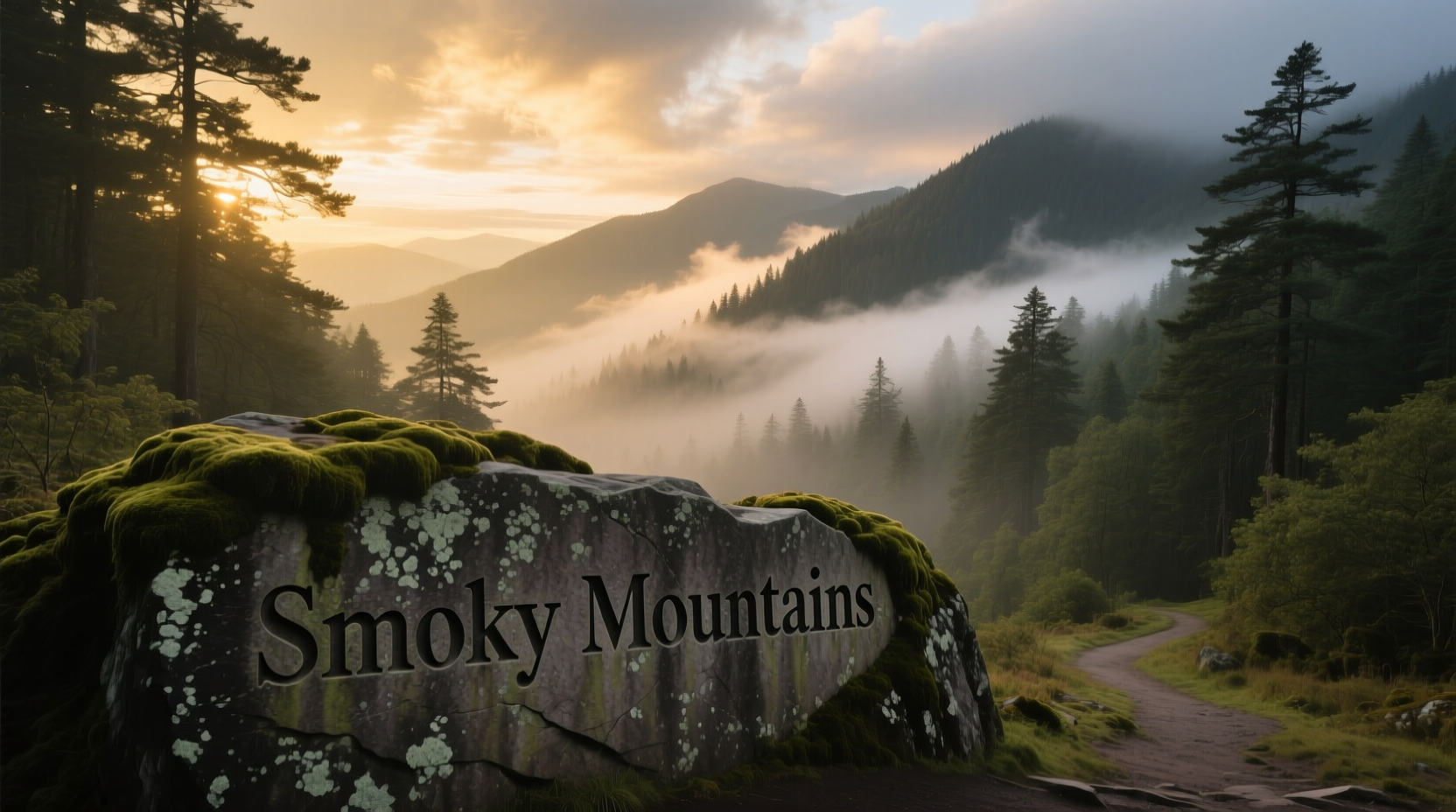
The signature \"smoke\" that drifts over the mountain ridges is not smoke at all, but a natural fog formed by volatile organic compounds (VOCs) released by the region’s dense forests. These compounds—primarily terpenes emitted by coniferous trees like pines, spruces, and hemlocks—interact with sunlight, moisture, and oxygen to create a fine aerosol that scatters blue light, giving the atmosphere its characteristic hazy, bluish tint.
This effect is most visible in the early morning or after rainfall when humidity levels peak. From a distance, especially from valleys or adjacent high points, the entire mountain range appears shrouded in a gentle, ever-shifting veil—like smoke rising from unseen fires.
Tip: For the clearest view of the “smoke,” visit at dawn from overlooks like Clingmans Dome or Newfound Gap—the contrast between light and haze is most dramatic then.How Trees Create the Illusion of Smoke
The process begins with photosynthesis. During warm daylight hours, the forest canopy emits organic gases as part of normal metabolic activity. These gases oxidize in the atmosphere, forming tiny particles that serve as condensation nuclei for water vapor. When combined with the region’s high rainfall and elevation-driven temperature shifts, the result is a near-constant presence of low-lying mist.
Scientists at the National Park Service have measured these emissions extensively, confirming that the Smokies have some of the highest biogenic VOC output in the eastern United States—making the haze both persistent and scientifically significant.
Cherokee Origins: The First Observers
Long before European settlers arrived, the Cherokee people lived in and revered these mountains. They referred to the range as *Shaconage*—pronounced “sha-KO-nah-ge”—which translates to “Land of the Blue Smoke.” This name reflected not only the visual phenomenon but also its spiritual significance. To the Cherokee, the mist was a sacred veil connecting the physical world with the spirit realm.
Different bands used variations of the name depending on dialect and location. Some called it *Wâ·lasi’yi*, meaning “Frog Place,” while others described the area poetically as *Únya-tsûn-dûñ‘yă*, or “Place of the Balsam,” referencing the fragrant evergreen forests atop the higher elevations.
“The mountains breathe. Their mist is the breath of old spirits watching over us.” — Traditional Cherokee elder, recorded in 19th-century ethnographic notes
When Spanish explorer Hernando de Soto encountered the region in 1540, his chroniclers noted the “perpetual cloud” hanging over the peaks—an observation consistent with Indigenous understanding. However, it wasn’t until British surveyors and traders arrived in the 1700s that the English translation “Smoky Mountains” became standardized.
European Naming and Historical Documentation
In the mid-18th century, colonial maps began labeling the range as “Smoky Mountains,” directly translating the visual impression left by the haze. Early settler accounts frequently mention the “blue smoke” rising from the woods, often mistaken for distant fires. One 1761 journal entry by British cartographer William Churton reads: “The hills appear on fire, yet no flame—only a constant vapour issuing from the timber.”
By the 1790s, the name had gained official traction. Surveyors working for North Carolina consistently used “Great Smoky Mountains” to distinguish the central, highest section of the range from smaller surrounding chains. The addition of “Great” emphasized both elevation and grandeur, setting it apart from other Smoky-named hills in the South.
Timeline of Name Evolution
- Pre-1500: Cherokee term *Shaconage* widely used among Indigenous communities.
- 1540: De Soto expedition records describe “cloud-covered peaks” but does not name them.
- 1700s: English traders adopt “Smoky Mountains” based on visual observations.
- 1761: First documented use of “Smoky Mountains” in colonial survey logs.
- 1850s: Official U.S. maps standardize “Great Smoky Mountains.”
- 1934: Great Smoky Mountains National Park established, cementing the name nationally.
Modern Science Confirms Ancient Observations
Today, researchers use advanced atmospheric modeling to study the unique microclimate of the Smokies. Studies conducted by the University of Tennessee and NASA have shown that the combination of biodiversity, elevation gradients, and regional weather patterns creates an ideal environment for persistent haze formation.
A 2020 study published in the *Journal of Geophysical Research: Atmospheres* found that the Smokies’ haze is strongest during summer months due to increased biological activity and higher temperatures—precisely when terpene emissions peak. Interestingly, the same compounds responsible for the haze also contribute to air purification by reacting with pollutants like ozone.
| Factor | Role in Haze Formation |
|---|---|
| Terpene Emissions | VOCs from trees form aerosols that scatter light |
| High Humidity | Moisture binds with particles, enhancing visibility of mist |
| Elevation (up to 6,643 ft) | Cooler temps promote condensation and fog retention |
| Dense Forest Cover | Over 100 species of trees contribute to emissions |
| Blue Light Scattering | Rayleigh scattering makes haze appear blue-gray |
Visitor Experience: Seeing the Smoke Today
Over 14 million people visit the Great Smoky Mountains National Park each year, many drawn specifically to witness the legendary haze. While air quality improvements have reduced particulate pollution since the 1970s, the natural mist remains a dominant feature—especially in late spring and early summer.
Park rangers often explain the phenomenon at visitor centers, bridging Indigenous wisdom and modern science. As one ranger put it: “We don’t call it smoke because we’re fooled by it—we call it smoke because it tells a story older than any map.”
“Every time I see that blue haze roll over the ridge, I think about how the Cherokee saw the same thing centuries ago. It’s continuity. It’s place.” — Dr. Linda Ferguson, Cultural Historian, Appalachian State University
Mini Case Study: A Photographer’s Journey
Sarah Kim, a landscape photographer from Asheville, NC, spent six months documenting the changing appearance of the haze across seasons. She set up time-lapse cameras at five different elevations, capturing thousands of images. Her findings confirmed that the mist is thickest between 9–11 AM in July and August, particularly after overnight rain. Her exhibit, *Breath of the Mountains*, now tours regional museums and includes audio recordings of Cherokee elders reciting traditional stories about the mist.
Frequently Asked Questions
Is the smoke in the Smoky Mountains dangerous?
No. The haze is primarily natural, created by plant emissions and humidity. Unlike urban smog, it does not pose health risks and is actually a sign of healthy forest ecosystems.
Can you see the smoke all year round?
Yes, though it's most prominent in warmer months. Winter often brings clearer air, but fog and low clouds still create a “smoky” effect, especially in valleys.
Are there other places named Smoky Mountains?
Yes, but none as large or famous. There are minor ranges called Smoky Mountains in Kentucky and Georgia, but the Great Smoky Mountains are the original and most extensive.
Preserving the Legacy of the Name
The name “Smoky Mountains” is more than a descriptive label—it’s a cultural artifact shaped by centuries of human experience. Conservation efforts today aim not only to protect the ecosystem but also to honor the linguistic and spiritual heritage embedded in the name.
Initiatives like the *Smoky Mountains Hertiage Project* work with Cherokee historians to ensure accurate interpretation of place names in park signage and educational materials. Similarly, air quality monitoring helps distinguish natural haze from harmful pollution, preserving both visibility and ecological integrity.
Tip: Support preservation efforts by visiting official park channels, respecting trail guidelines, and learning about Cherokee history when touring the area.Conclusion: A Name Born of Nature and Culture
The Great Smoky Mountains bear a name that emerged from the convergence of Indigenous insight, natural wonder, and linguistic evolution. What early observers interpreted as smoke was in fact the quiet exhalation of a vast, living forest—one that continues to inspire awe and curiosity.
Understanding why they’re called the Smoky Mountains deepens appreciation for the region beyond scenic beauty. It connects us to centuries of observation, to the delicate balance of ecology, and to the enduring power of place-based storytelling.
💬 Did this change how you see the Smokies? Share your thoughts, experiences, or questions about the mountains—we’d love to hear what the haze means to you.








