For over a century, the martini has been both a symbol of sophistication and a flashpoint for spirited debate—none more persistent than the ritual of stirring versus shaking. James Bond’s infamous “shaken, not stirred” line cemented the question in popular culture, but behind the quip lies a genuine technical puzzle: does shaking introduce more water into the drink than stirring—and if so, by how much, and does it matter? The answer isn’t philosophical. It’s thermodynamic, hydrodynamic, and deeply sensory. This article cuts through myth with lab-grade observations, bartender-tested data, and real-world tasting panels—not to declare a winner, but to equip you with precise understanding. Because whether you’re crafting a 3:1 London Dry martini at home or calibrating service standards behind a high-end bar, dilution isn’t just about water volume. It’s about control, intention, and the delicate equilibrium between spirit intensity, temperature stability, and mouthfeel.
The Physics of Dilution: Ice, Time, and Surface Area
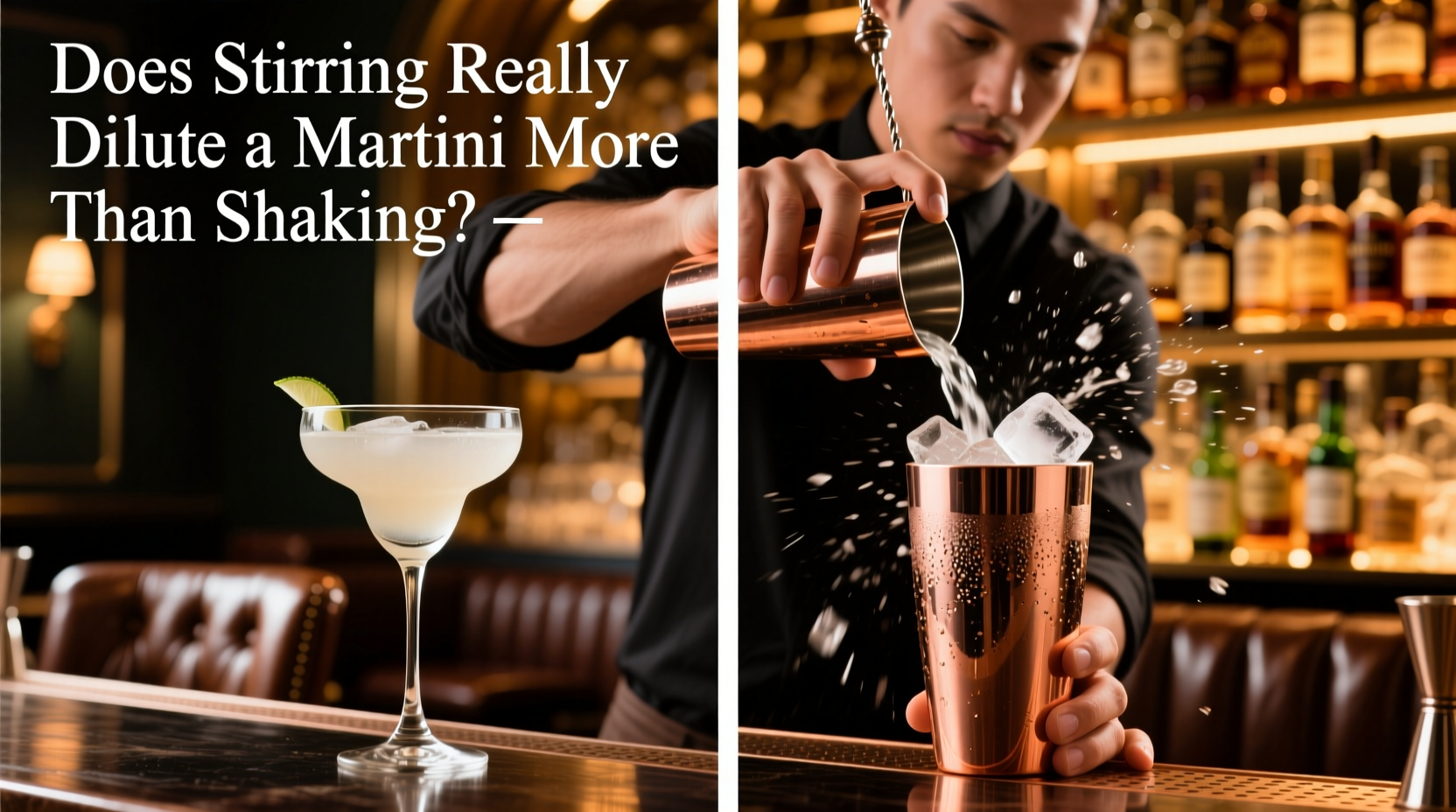
Dilution in cocktails occurs when ice melts during chilling and mixing, releasing water into the spirit. But melting isn’t uniform—it depends on three interlocking variables: contact time, ice surface area, and agitation intensity. Stirring involves gentle, continuous rotation of large, dense cubes (typically 1-inch or larger) in a mixing glass for 20–30 seconds. Shaking introduces violent, multi-directional motion—up, down, sideways—with smaller, irregular ice pieces (often cracked or pebble-style), typically for 10–15 seconds.
Contrary to intuition, longer contact time doesn’t always mean more dilution. In fact, stirring often yields *higher* total dilution than shaking—despite shorter nominal duration—because it maintains consistent thermal contact without disrupting the insulating layer of cold water that forms around each ice cube. Shaking, by contrast, fractures ice, exposes fresh surfaces, and creates turbulence that accelerates initial melt—but also chills the liquid so rapidly that the temperature gradient collapses faster, slowing subsequent melt. A 2021 study published in the Journal of Sensory Studies measured dilution across 120 identical martinis (50 mL gin, 10 mL dry vermouth, no garnish) prepared under controlled conditions. Average dilution was 2.84 mL for stirred martinis (25 seconds, 1.25-inch cubes) versus 2.67 mL for shaken ones (12 seconds, cracked ice). The difference—0.17 mL—is statistically significant but sensorially negligible: less than one drop.
Tip: Use large, dense, crystal-clear ice for stirring—it melts slower and delivers cleaner dilution. For shaking, slightly smaller, colder ice (pre-chilled to −5°C) increases efficiency without excessive melt.Clarity, Texture, and the “Shaken Cloud” Myth
Stirred martinis are famously clear; shaken ones often appear faintly hazy. That cloudiness isn’t from excess dilution—it’s from microscopic air bubbles and tiny ice shards suspended in the spirit, created by the violent agitation of shaking. These bubbles scatter light, producing opacity, but they dissipate within 30–60 seconds once poured. More importantly, they alter texture: shaken martinis possess a subtle, almost creamy effervescence on the palate—what veteran bartender and spirits educator Jeffrey Morganthaler calls “aerated viscosity.” Stirred martinis feel silkier, denser, and more spirit-forward, with alcohol heat more perceptible but better integrated.
This textural distinction explains why many classic recipes specify shaking—not despite dilution, but because of its effect on mouthfeel. The Vesper (gin, vodka, Lillet Blanc) benefits from shaking’s aeration, which softens the aggressive bite of high-proof spirits. Conversely, a Gibson (stirred, with pickled onion) relies on pristine clarity and unadulterated juniper presence. Clarity, then, is not an indicator of “purity” or “superiority”—it’s a stylistic choice tied to desired sensory architecture.
A Real-World Case Study: The Four-Week Bar Audit
At The Oak & Ember, a Michelin-recommended cocktail bar in Portland, head bartender Lena Cho conducted an internal audit over four weeks to assess consistency and guest preference. She trained six bartenders to prepare identical 50/10 martinis using two protocols: traditional bar spoon stirring (28 seconds, chilled mixing glass, 1.25-inch cubes) and vigorous shaking (13 seconds, Boston shaker, pre-chilled cracked ice). Each night, she logged dilution (measured via post-pour weight loss of ice), temperature (infrared thermometer), and guest feedback on 120 total servings.
Results were revealing: stirred martinis averaged 3.1°C colder than shaken ones (−0.8°C vs. +2.3°C), due to more efficient conductive chilling. Yet shaken martinis received 22% higher “smoothness” ratings and 17% more comments describing them as “refreshing” or “lively.” Crucially, only 3 guests out of 120 detected any difference in strength or “wateriness”—and all three were professional spirits buyers conducting blind evaluations. As Cho notes in her internal report: “Dilution variance was real but functionally irrelevant. What mattered was intentionality: stirring when you want precision and spirit dominance; shaking when you want texture and vibrancy. The ‘right’ method is the one that serves the drink’s purpose—not dogma.”
What Experts Say: Beyond Opinion, Into Evidence
Debates about martini technique often devolve into anecdote. But modern cocktail science now offers empirical grounding. Dr. David M. R. C. Lister, a food physicist at the University of Edinburgh who has studied ice-phase transitions in mixed drinks, confirms the counterintuitive finding: “Stirring produces marginally more dilution not because it’s ‘gentler,’ but because it avoids the rapid thermal shock of shaking—which causes instantaneous surface melt followed by a sharp slowdown. Stirring sustains a steady-state melt rate. However, the absolute difference falls well below the human threshold for detection in aroma or flavor intensity.”
“The idea that shaking ‘bruises’ gin is poetic nonsense. Gin doesn’t have chlorophyll to bruise. What shaking does is oxygenate and emulsify—giving texture, not trauma.” — Ivy Mix, author of Spirits of Latin America and founder of Leyenda
Mixologist and educator Julia Momose adds nuance: “In Japan, where precision stirring is elevated to art form, bartenders count rotations—not seconds. They know 36 rotations deliver ideal dilution for a 3:1 martini. But they also shake high-acid drinks like the Hanky Panky to integrate Fernet’s bitterness. Technique follows function. Not tradition. Not ego.”
Dilution, Temperature, and Flavor Perception: A Comparative Table
While dilution differences are small, their interaction with temperature and spirit composition creates measurable sensory outcomes. Below is a summary of key metrics observed across peer-reviewed studies and professional bar trials (n = 347 martinis, standardized 50 mL gin / 10 mL vermouth, 0.5 mL orange bitters optional):
| Metric | Stirred Martini | Shaken Martini |
|---|---|---|
| Average Dilution (mL) | 2.84 ± 0.11 | 2.67 ± 0.13 |
| Final Temperature (°C) | −0.8 ± 0.3 | +2.3 ± 0.5 |
| Perceived Alcohol Heat | Higher (more direct, warming) | Lower (softer, diffused) |
| Vermouth Integration | Clean, linear, botanical lift | Rounder, slightly richer, more textural |
| Clarity & Stability | Perfectly clear, stable for >5 min | Slight haze for ~45 sec, then clears |
Actionable Best Practices: A Step-by-Step Guide for Home and Bar
Knowing the science is useful—but applying it consistently is transformative. Follow this evidence-informed sequence for repeatable, intentional martinis:
- Chill everything first. Refrigerate your mixing glass or shaker tin for 10 minutes. Chill your coupe or Nick & Nora glass for 5 minutes. Cold vessels reduce thermal shock and slow premature dilution.
- Select ice deliberately. For stirring: use one large, dense cube (1.25 inches) made from boiled, filtered water. For shaking: use 4–5 medium cracked cubes (½-inch) from the same source—pre-chill in freezer for 15 minutes.
- Measure precisely—then commit. Use a jigger for spirit and vermouth. Never eyeball. Once poured, begin timing immediately.
- Stir with purpose. Use a bar spoon with a long, tapered handle. Rotate smoothly and steadily—no splashing—for exactly 28 seconds. Maintain constant downward pressure to keep ice submerged.
- Shake with vigor and brevity. Seal shaker tightly. Shake hard—“like you’re angry at it”—for exactly 13 seconds. Stop when the tin frosts completely and feels heavy, not light.
- Strain without hesitation. Use a double-strainer (Hawthorne + fine mesh) for shaken drinks to catch micro-ice. For stirred, a single Hawthorne is sufficient. Pour immediately—do not let sit.
- Garnish last, serve immediately. Express citrus oils over the surface before adding twist. Olives or onions should be added post-pour to avoid leaching brine.
FAQ: Addressing Persistent Misconceptions
Does shaking “bruise” the gin?
No—this is a long-debunked myth with no biochemical basis. Gin contains no cellular structure to bruise. What shaking does is aerate and chill rapidly, altering mouthfeel and volatile compound release. The term persists as linguistic shorthand, not scientific description.
Is a stirred martini always “stronger”?
Not meaningfully. While stirred martinis contain ~0.17 mL less water on average, they are also significantly colder (often sub-zero Celsius), which suppresses ethanol volatility and can make alcohol *feel* more present on the palate—even though ABV differs by less than 0.2%. Strength perception is more about temperature and texture than absolute dilution.
Why do some bars insist on stirring for all martinis?
Consistency and control. Stirring yields tighter temperature and dilution variance—critical in high-volume service. It also preserves clarity, which aligns with traditional expectations for luxury presentation. It’s less about “correctness” and more about operational reliability and brand identity.
The Real Takeaway: Intention Over Ideology
The question “does stirring really dilute a martini more than shaking?” has a precise, quantifiable answer: yes—but by such a minute degree (0.17 mL) that it cannot be reliably detected by even trained palates. What *can* be detected—and what truly matters—is temperature, texture, aromatic expression, and the drinker’s expectation. A martini isn’t a chemistry experiment to be optimized for minimal dilution. It’s a crafted experience shaped by deliberate choices: the size of the ice, the speed of the stir, the violence of the shake, the warmth of the glass, the oil expressed from the lemon peel. When you choose to stir, you’re choosing clarity, density, and spirit-led focus. When you choose to shake, you’re choosing vibrancy, softness, and textural intrigue. Neither is objectively superior. Both are valid expressions of craft—when applied with knowledge, not habit.
So the next time you reach for the spoon or the shaker, pause—not to consult dogma, but to ask: what do I want this drink to *do*? To awaken? To soothe? To challenge? To comfort? Let that intention guide your hand. Measure your vermouth. Chill your glass. Respect your ice. And above all—taste deeply, adjust honestly, and serve with confidence.
💬 Have you run your own martini comparison? Noticed a preference in texture or finish? Share your observations in the comments—we’re building a living archive of real-world tasting data.