When shopping for a moissanite engagement ring or fine jewelry, clarity is one of the most debated factors. Among the top-tier options, VVS (Very Very Slightly Included) moissanite stands out for its near-flawless appearance. But how does it truly compare to lower clarity grades like VS or SI? And more importantly—is the price difference justified by visible improvements in beauty and performance?
Unlike diamonds, where inclusions can significantly impact brilliance and durability, moissanite’s lab-created nature means even lower clarity grades often appear eye-clean. This raises a critical question: Does upgrading to VVS clarity deliver noticeable benefits, or is it simply paying for technical perfection that offers no real-world advantage?
Understanding Moissanite Clarity Grading
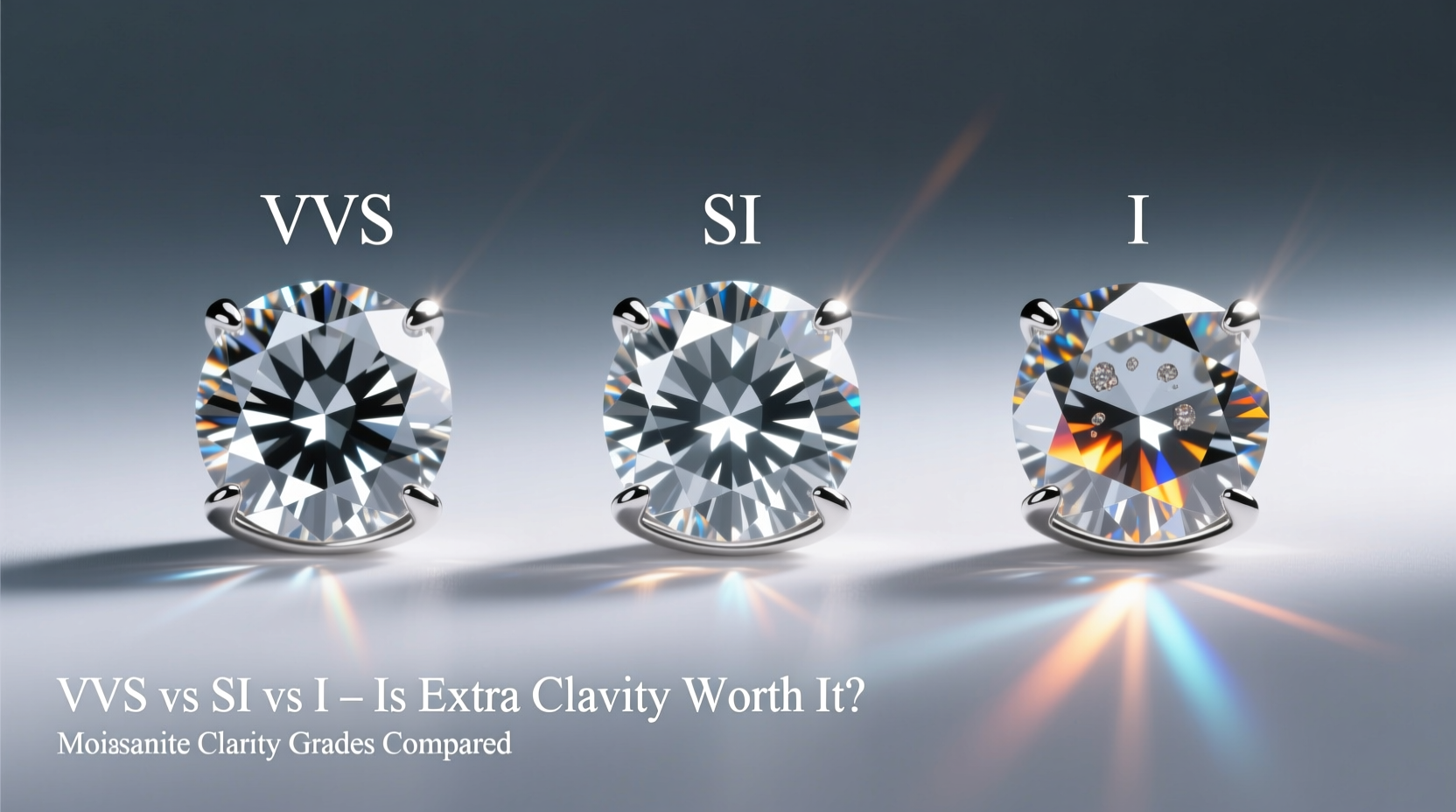
Moissanite clarity refers to the presence of internal characteristics (inclusions) and surface blemishes. Because moissanite is grown in controlled laboratory environments, it typically has fewer imperfections than mined diamonds. Still, not all moissanite is created equal.
The standard clarity grading scale used for moissanite mirrors that of diamonds:
- VVS (Very Very Slightly Included): Minute inclusions that are extremely difficult to detect under 10x magnification.
- VS (Very Slightly Included): Minor inclusions visible under magnification but rarely seen with the naked eye.
- SI (Slightly Included): Inclusions noticeable under magnification and occasionally visible to the unaided eye in larger stones.
In practice, however, most reputable moissanite brands—such as Charles & Colvard, Harrods, and Fire & Ice—produce stones starting at VVS quality. That said, some budget retailers offer “near-colorless” or “commercial-grade” moissanite labeled as SI or VS to cut costs.
Tip: Always request a certificate or lab report when purchasing moissanite. Reputable sellers provide documentation confirming clarity and color grade.Visual Differences: VVS vs Lower Grades
The core issue isn’t whether inclusions exist—it’s whether they affect what you see when you look at the stone. In this regard, VVS moissanite excels. These stones are engineered for maximum optical performance, with virtually no interference from internal flaws.
However, the distinction between VVS and VS/SI becomes nearly imperceptible once set in jewelry. Most consumers cannot discern clarity differences without a jeweler’s loupe. Even under bright lighting, well-cut SI moissanite often sparkles just as intensely as VVS, thanks to moissanite’s high refractive index (2.65–2.69), which enhances light return and masks minor imperfections.
“With moissanite, clarity matters less than cut and symmetry. A well-proportioned SI stone will outperform a poorly cut VVS in terms of fire and brilliance.” — Lena Torres, GIA-Certified Gemologist
Real-World Example: Two Rings, One Setting
Consider Sarah, who compared two 7mm round moissanite center stones—one VVS, the other SI—for her engagement ring. Both were white (D-E color range), same cut, same setting. She examined them side by side under natural daylight, indoor lighting, and magnification.
To her surprise, she could only spot a faint pinpoint inclusion in the SI stone under 10x magnification. With the naked eye, both sparkled identically. The VVS version cost $320 more. After consulting a jeweler, she chose the SI stone, allocating the savings toward a premium platinum band.
This scenario reflects a common experience: marginal visual gains do not always justify significant price premiums.
Price Comparison Across Clarity Grades
Clarity directly influences cost. Here's a realistic breakdown for a 6.5mm (approximately 1.25 carat equivalent) round brilliant moissanite:
| Clarity Grade | Average Price | Eye-Clean? | Best For |
|---|---|---|---|
| VVS | $240–$350 | Yes, consistently | Perfectionists, high-clarity seekers, resale value |
| VS | $180–$260 | Usually yes | Balanced buyers seeking quality and value |
| SI | $130–$190 | Sometimes, varies by batch | Budget-conscious shoppers, accent stones |
The data shows a 30–50% price increase from SI to VVS, despite minimal aesthetic differences. For many buyers, especially those prioritizing size or metal quality, investing in higher clarity may not be the optimal choice.
When VVS Clarity Is Worth the Investment
While not universally necessary, there are specific situations where choosing VVS moissanite makes clear sense:
- You plan to resell or pass down the piece: Higher clarity increases perceived value and marketability over time.
- You prefer solitaire settings: With no side stones to distract, the center gem is scrutinized more closely.
- You’re sensitive to imperfections: Some individuals notice tiny details others overlook—personal preference plays a role.
- You want maximum brilliance in large stones (7mm+): Larger facets can amplify internal features, making clarity more relevant.
Additionally, VVS moissanite often comes with better overall craftsmanship. Brands that guarantee VVS clarity usually maintain tighter quality control across color, cut, and polish—meaning you’re likely getting a superior product overall, not just in clarity alone.
Step-by-Step Guide: Choosing the Right Clarity for You
- Determine your budget: Decide how much you’re willing to spend on the center stone before comparing grades.
- Decide on ring style: Solitaires demand higher clarity; halo or pavé settings can hide minor flaws.
- View samples in person or via video: Ask vendors for close-up videos under different lighting conditions.
- Compare magnified images: Use 10x zoom to inspect for dark inclusions or clusters near the center.
- Weigh trade-offs: Could the price difference buy a better metal, larger stone, or custom design?
- Purchase from a trusted source: Ensure return policies and certification are provided.
Frequently Asked Questions
Can you see the difference between VVS and SI moissanite with the naked eye?
In most cases, no. Unless the SI stone has a prominent inclusion near the table, both grades appear equally brilliant and clean in normal viewing conditions.
Does clarity affect moissanite’s durability?
Not significantly. Moissanite ranks 9.25 on the Mohs hardness scale, making it highly resistant to scratches and wear regardless of clarity. Internal inclusions in moissanite are typically non-fracture extending and pose no structural risk.
Is VVS moissanite the same as VVS diamond?
No. While the grading terms are similar, moissanite is inherently more inclusion-resistant due to its lab-grown process. A VVS moissanite may have even fewer visible characteristics than a VVS diamond of the same size.
Final Verdict: Is the Extra Clarity Worth It?
The answer depends on your priorities. If you value technical perfection, long-term value retention, and peace of mind knowing your stone meets the highest standards, then VVS moissanite is a worthwhile investment. Its consistency, brilliance, and resale appeal make it the preferred choice for connoisseurs.
But for most buyers, the visual and functional benefits of VVS over VS or even SI are negligible. Given moissanite’s inherent brilliance and affordability, allocating funds toward a larger carat weight, superior cut, or finer metal often delivers greater satisfaction than chasing flawless clarity.
In essence: VVS moissanite is excellent—but not essential. The \"extra clarity\" is technically superior, but whether it's *really* worth it comes down to personal taste, budget, and how you define value in fine jewelry.
💬 Have you chosen VVS moissanite—or gone with a lower grade? Share your experience and help others make informed decisions about their next jewelry purchase.