Scrolling through Etsy’s vintage barware section feels like stepping into a time capsule: gleaming chrome Art Deco wonders, hammered copper Boston shakers, porcelain-handled French models, and mid-century stainless steel relics—all promising charm, character, and cocktail-making pedigree. But beneath the filtered photos and nostalgic captions lies a quiet dilemma: is that $48 “vintage shaker” a restorable heirloom—or a $48 paperweight disguised as a cocktail tool? Unlike mass-produced modern shakers, vintage pieces carry decades of use, storage neglect, and material-specific vulnerabilities. And unlike furniture or jewelry, their functionality hinges on precision engineering: tight seals, corrosion-free interiors, and structural integrity that withstand vigorous shaking—not just aesthetic appeal. Misjudging a listing can mean wasted money, safety hazards (leaching metals, cracked seams), or hours spent battling rust only to discover a compromised valve. This isn’t about nostalgia versus practicality. It’s about knowing *exactly* what you’re buying—and whether restoration serves your bar, your budget, or your patience.
What Makes a Vintage Shaker Restorable—And What Doesn’t
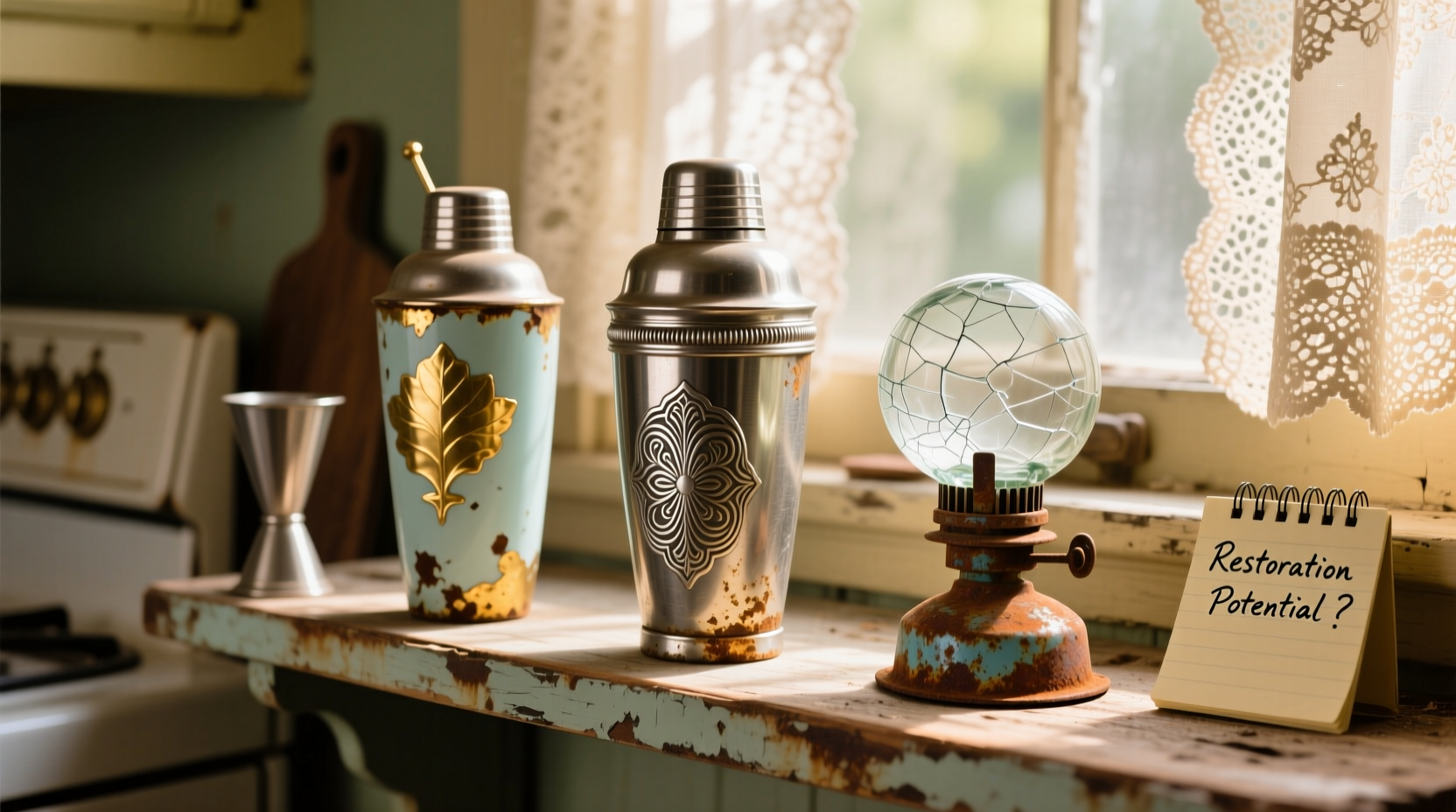
Restorability isn’t determined by age, brand, or even surface shine—it’s dictated by three interlocking criteria: material integrity, mechanical soundness, and chemical safety. A 1930s Cobbler shaker with light tarnish but an intact, non-porous inner tin liner is infinitely more viable than a 1950s stainless steel model with pitting inside its mixing cup. Why? Because interior corrosion compromises both function (leaking seals, metallic taste) and food safety (nickel or chromium leaching into acidic citrus juices). The most common fatal flaws aren’t obvious at first glance. Look past the exterior patina: check for hairline cracks around hinge points, warping in the base cup (a telltale sign of repeated thermal stress), and—critically—the condition of the gasket channel. Many vintage shakers used rubber or cork gaskets that degrade into brittle, crumbly residue; if the groove is deeply scored or the metal is corroded where the gasket sits, sealing becomes impossible without machining or replacement parts rarely available.
Tip: Before purchasing, message the seller and request photos of the shaker’s interior, seam welds, and the underside of the lid—especially the area where the strainer mechanism meets the cup.The Rust Spectrum: From Surface Tarnish to Structural Failure
Rust on vintage shakers isn’t binary. It exists on a spectrum with distinct implications for usability and safety:
| Type of Corrosion | Visual Clues | Restoration Feasibility | Functional Risk |
|---|---|---|---|
| Surface Oxidation (Tarnish) | Uniform dulling, matte gray or brown film, wipes off with light abrasion | High—easily removed with polishing compounds or vinegar soak | Negligible; purely cosmetic |
| Pitting Corrosion | Small, irregular craters visible under magnification; often clustered near seams or edges | Moderate—requires mechanical removal (steel wool, rotary tool); may weaken thin-walled areas | Medium—pits trap bacteria, accelerate further corrosion, compromise seal integrity |
| Crevice Corrosion | Dark, powdery residue hidden in hinge gaps, under strainer plates, or along welded seams | Low—nearly impossible to fully clean without disassembly; often indicates deep subsurface damage | High—leaks inevitable; metal ions migrate into drinks during shaking |
| Stress Corrosion Cracking | Thin, hairline fissures radiating from high-tension points (e.g., handle rivets, lid latches) | None—cracks propagate unpredictably under pressure; unsafe for use | Critical—shaker may burst or leak violently during shaking |
Crucially, stainless steel isn’t immune. Many mid-century “stainless” shakers were actually low-grade 430 or 409 alloys—prone to rust when exposed to salt, citrus, or improper cleaning. True 304 or 316 stainless is rare in pre-1970s barware. If a listing claims “stainless” but shows orange rust spots, assume it’s ferritic steel—not austenitic.
A Realistic Restoration Timeline: What 8 Hours of Work Actually Gets You
Restoring a vintage shaker isn’t a weekend project. It’s a deliberate, multi-phase process demanding patience and precise tools. Here’s how a typical restoration unfolds for a moderately tarnished, mechanically sound Cobbler shaker—no pitting, no gasket damage, but heavy surface oxidation:
- Phase 1: Assessment & Disassembly (1 hour) — Remove all removable parts (strainer, cap, jigger insert). Inspect threads for stripping, springs for fatigue, and internal surfaces with a flashlight and dental mirror.
- Phase 2: Chemical Soak (4–6 hours, unattended) — Submerge non-ferrous components in a 50/50 white vinegar–water solution; ferrous parts go into a citric acid bath (1 tbsp per cup water). Never use bleach or chlorine-based cleaners—they accelerate corrosion.
- Phase 3: Mechanical Cleaning (2 hours) — Use brass-bristled brushes (never steel wool on stainless) to scrub crevices. Polish exteriors with jeweler’s rouge on a soft cotton wheel. Hand-polish interiors with microfiber and aluminum oxide paste.
- Phase 4: Gasket Replacement & Reassembly (1 hour) — Install food-grade silicone gaskets (not rubber) cut to exact dimensions. Torque threaded components to manufacturer specs if known; otherwise, hand-tighten plus 1/8 turn.
- Phase 5: Functional Testing (30 minutes) — Fill with water, shake vigorously for 60 seconds, inspect for leaks at all joints. Repeat with ice water to test cold-induced contraction.
This timeline assumes no surprises. Add 3–5 hours if gasket channels require re-machining or if pitting demands electrochemical polishing. Skip Phase 2’s soak for chrome-plated items—vinegar dissolves chrome over time. Instead, use pH-neutral metal cleaners.
Expert Insight: When to Walk Away
“I’ve restored over 200 vintage shakers since 2008—and the biggest mistake I see buyers make is falling in love with the story, not the substance,” says Michael Thorne, a certified metal conservator and owner of Barware Heritage Restoration in Portland, Oregon. “A shaker isn’t a sculpture. Its job is to contain pressurized liquid, resist acidic corrosion, and seal reliably—every single use. If the metal is compromised below the surface, no amount of polishing changes that physics. I turn down 40% of inquiries because the cost of safe, ethical restoration exceeds the item’s functional value. That’s not pessimism—that’s stewardship.”
“Vintage shakers are functional antiques. Treat them like precision instruments—not decor. If you wouldn’t trust your espresso machine’s boiler after finding rust inside, don’t trust your shaker’s mixing cup.” — Michael Thorne, Metal Conservator & Barware Historian
Case Study: The “Perfect” 1947 Krups Shaker That Wasn’t
Sarah, a home bartender in Austin, bought a listed “mint condition” 1947 Krups stainless steel shaker for $62. The Etsy photos showed brilliant chrome, sharp engraving, and a tight-fitting lid. She paid extra for expedited shipping, excited to use it for her upcoming speakeasy-themed party. Upon arrival, she noticed faint orange specks near the base seam—dismissing them as “old polish residue.” During her first shake (with lemon juice and simple syrup), the shaker leaked steadily from the lid joint. She tightened it, shook again—this time, a fine metallic grit appeared in her drink. A closer inspection revealed deep crevice corrosion hiding beneath the chrome plating along the weld line. The “mint” finish was a veneer over 70 years of trapped moisture and acid exposure. Sarah contacted the seller, who refused a return (“as described”). She spent $38 on a professional ultrasonic cleaner and food-safe passivation treatment—only to confirm the weld had microfractures. The shaker now sits on her shelf as a paperweight. Her lesson? “Photos lie. Chemistry doesn’t. Next time, I’ll ask for a video of the interior being wiped with a white cloth—if it turns orange, I walk away.”
Practical Checklist: Before You Hit ‘Buy’ on Etsy
- ✅ Verify the shaker type (Cobbler, Boston, French, etc.) and confirm compatibility with your bar setup
- ✅ Demand interior photos—not just polished exteriors—especially of seams, strainer plates, and gasket grooves
- ✅ Search the seller’s reviews for keywords: “rust,” “leak,” “gasket,” “pitting,” “odor”
- ✅ Check if the listing discloses material (e.g., “nickel-plated brass,” “18/8 stainless,” “copper-lined”)—vague terms like “vintage metal” are red flags
- ✅ Confirm the shaker includes all original components (strainer, cap, jigger, gasket)—missing parts often can’t be replicated
- ✅ Estimate restoration costs: $25–$60 for professional cleaning, $15–$30 for custom gaskets, $100+ for welding repairs
FAQ: Your Top Questions, Answered Honestly
Can I use vinegar to clean a chrome-plated shaker?
No. Vinegar’s acetic acid attacks chrome plating, causing dulling, clouding, and eventual flaking. Use pH-neutral metal cleaners like Simichrome or Wenol instead. For stubborn grime, dampen a microfiber cloth with isopropyl alcohol (70%) and gently wipe—never soak.
Is it safe to drink from a shaker with light surface rust?
No—even light rust introduces iron oxide into cocktails. While small amounts aren’t acutely toxic, iron reacts with citrus acids to produce off-flavors and can accelerate oxidation in spirits. More critically, rust is a sign of deeper corrosion. Remove all rust before use, and passivate stainless components with a citric acid bath to rebuild the protective oxide layer.
Why do some vintage shakers have a “metallic taste” even after cleaning?
This almost always indicates residual corrosion products (iron, nickel, or copper oxides) embedded in microscopic pits or porous plating. It’s not “just flavor”—it’s leaching. If taste persists after thorough cleaning and passivation, the metal is compromised beyond safe restoration. Discard it for display only.
Conclusion: Choose Function Over Fantasy, and Restore With Respect
Vintage cocktail shakers hold undeniable allure—the weight of history in your palm, the whisper of Prohibition-era ingenuity, the satisfaction of reviving craftsmanship long abandoned by mass production. But honoring that legacy means respecting its limitations. A shaker isn’t valuable because it’s old. It’s valuable because it works—safely, reliably, and beautifully—for another generation of drinks. That requires discernment: seeing past Etsy’s curated lighting to the metallurgy beneath, understanding that “vintage charm” shouldn’t mean “compromised seal,” and recognizing that sometimes, the most responsible choice is passing on the listing and choosing a well-engineered modern alternative. If you do find a restorable gem—a solid brass Boston shaker with intact plating, a nickel-silver French shaker with clean threads, or a stainless model with verified 304 alloy—approach restoration not as a quick fix, but as conservation. Clean with chemistry, not force. Replace gaskets with food-grade materials, not duct tape and hope. Test relentlessly. And when it’s done, shake with intention—not just for the drink, but for the craft you’ve helped preserve.
💬 Have you rescued a vintage shaker—or learned the hard way what to avoid? Share your restoration wins, cautionary tales, or favorite Etsy seller recommendations in the comments. Let’s build a smarter, safer vintage bar community—together.