Selecting the right cuff bangle is more than a matter of aesthetics—it’s about fit, function, and long-term wearability. Unlike closed bangles, cuff bracelets feature an open design that wraps around the wrist, making proper sizing essential for both comfort and security. Too tight, and it pinches; too loose, and it slips off with every gesture. This guide delivers precise methods for measuring your wrist, understanding sizing standards, and selecting a cuff that fits flawlessly.
Why Cuff Bangle Size Matters
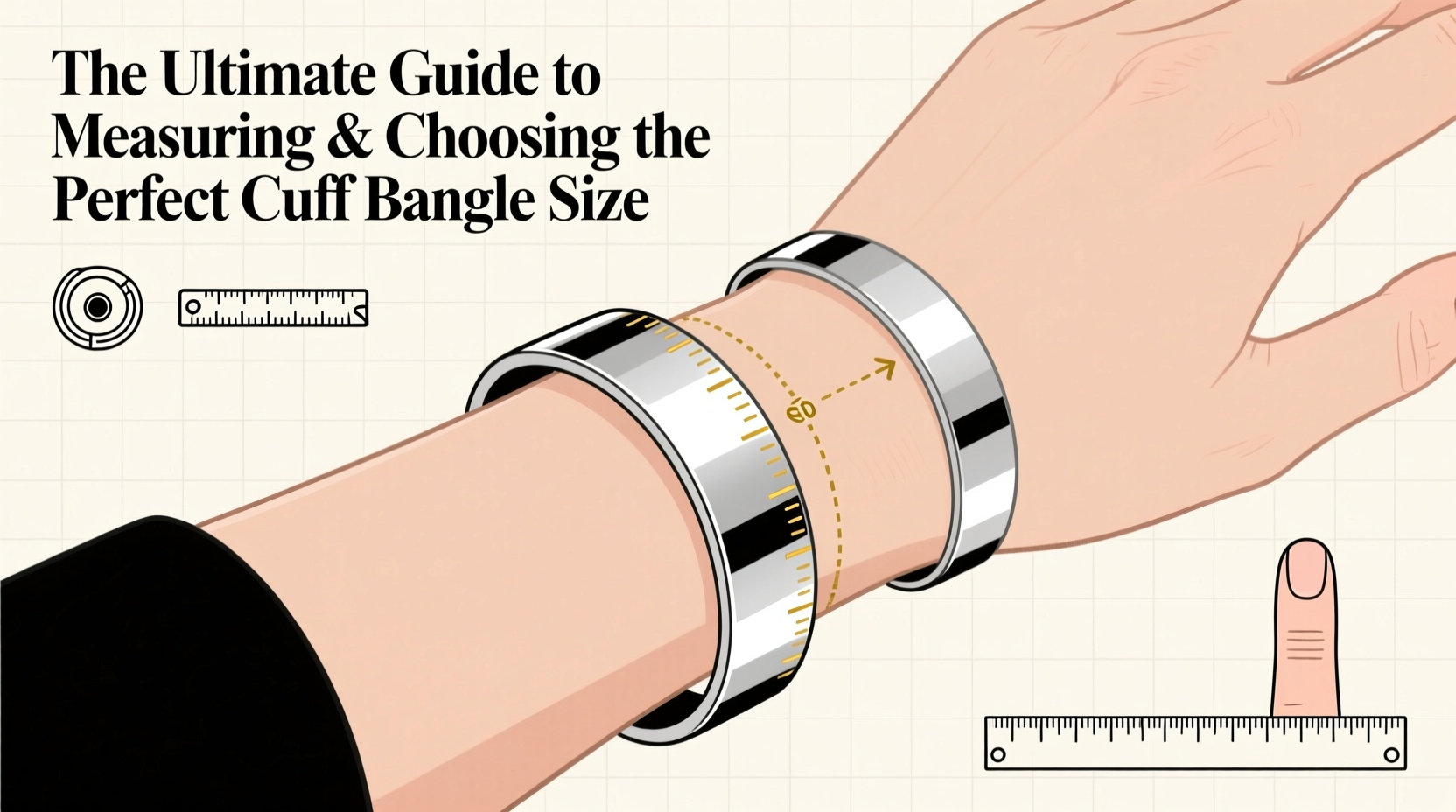
A well-fitting cuff bangle should feel secure without constriction. Because cuffs lack clasps, they rely on the gap between the ends and the curve of the metal or material to stay in place. An improperly sized cuff can lead to discomfort, restricted circulation, or accidental loss. Beyond practicality, correct sizing enhances the jewelry’s visual balance—neither overwhelming nor disappearing against your wrist.
Jewelers often use standard sizing ranges, but these vary by region and brand. Without accurate measurements, guessing based on ring size or average wrist charts leads to errors. Personal anatomy—wrist thickness, bone prominence, and hand proportions—plays a decisive role.
Tip: Always measure your wrist at the end of the day when slight swelling may occur—this ensures a more comfortable fit over time.How to Accurately Measure Your Wrist for a Cuff Bangle
The most reliable method involves direct measurement using a flexible tape measure or printable paper ruler. Follow this step-by-step process:
- Wrap a soft measuring tape around the widest part of your wrist—the area just below the wrist bone where a cuff naturally rests.
- Keep the tape snug but not tight. You should be able to slide a finger underneath for breathing room.
- Note the circumference in inches or centimeters.
- For cuff width adjustment: Add ¼ inch (6 mm) to the measurement if the cuff is wider than 1 inch. Wider cuffs require slightly more space due to surface contact.
- Determine the inner diameter or opening span: Subtract the wrist circumference from the total inner circumference of the cuff (if available), then divide by π (3.14) to estimate the gap width.
If you don’t have a tape measure, use a strip of paper or string. Mark where it overlaps, then measure the length against a ruler. Repeat twice for accuracy.
Understanding Cuff Sizing Standards
Cuff sizes are typically categorized as small, medium, large, or by inner circumference. Some brands list the “gap” size—the distance between the two open ends—while others provide inner diameter. Conversion between systems requires precision.
| Wrist Circumference (in) | Wrist Circumference (cm) | Cuff Inner Circumference | Typical Fit |
|---|---|---|---|
| 5.5 – 6.0 | 14 – 15.2 | 6.0 – 6.5 in | Small / Petite |
| 6.0 – 6.5 | 15.2 – 16.5 | 6.5 – 7.0 in | Medium / Average |
| 6.5 – 7.0 | 16.5 – 17.8 | 7.0 – 7.5 in | Large / Full |
| 7.0+ | 17.8+ | 7.5+ in | Extra Large / Custom |
Note: The cuff’s inner circumference should be ½ inch (1.27 cm) larger than your wrist measurement to allow for easy sliding and natural movement.
Choosing the Right Material and Design for Comfort
Material affects flexibility and fit. Sterling silver and gold cuffs tend to be rigid, while bronze or copper may offer slight malleability. Adjustable cuffs made from softer metals can be gently squeezed or widened at home—but only by small increments to avoid cracking.
Design elements like width and contour influence perceived tightness. A 2-inch wide cuff will feel tighter than a ½-inch one, even with identical inner diameters, due to increased surface pressure. Look for contoured interiors or rounded edges that conform to the wrist’s natural shape.
“Many customers overlook how width impacts comfort. A wide cuff needs a slightly larger opening to prevent binding during hand movements.” — Lena Torres, Artisan Jewelry Designer with 15 years of experienceTip: Try on similar-width cuffs before purchasing. If shopping online, check return policies and request sizing templates from the seller.
Real-Life Example: Choosing a Gift Cuff Without Measurements
Sophia wanted to surprise her sister with a hand-hammered brass cuff. Her sister had slender wrists but broad hands—a common challenge where the cuff must pass over the knuckles before settling on the wrist. Sophia didn’t know the exact size, so she used a workaround: she borrowed one of her sister’s existing bangles and measured its inner circumference. She also noted that it was narrow (0.6 inches wide), so she adjusted upward when selecting a 1.5-inch-wide cuff, opting for a medium-large (7.2-inch inner circumference).
The gift fit perfectly. By accounting for width and using an existing piece as a reference, Sophia avoided the common mistake of assuming all bangles fit the same.
Step-by-Step Guide to Buying the Perfect Cuff Bangle
- Measure your wrist accurately using a soft tape measure.
- Add ½ inch to the measurement for clearance and comfort.
- Consider the width—wider cuffs need slightly more room.
- Check the material—rigid metals require exact sizing; malleable ones allow minor adjustments.
- Review product specs for inner circumference or gap size, not just “one size fits most.”
- Contact the seller if details are unclear—they may provide a printable gauge.
- Verify return policy in case adjustments are needed post-purchase.
Common Mistakes to Avoid
- Using ring size as a proxy—finger and wrist bones differ significantly in proportion.
- Ignoring hand size—a large hand may struggle to get a cuff on, even if the wrist fits.
- Buying oversized “adjustable” cuffs—over-bending weakens metal and distorts design.
- Ordering based on photos alone—scale is deceptive without reference points.
Frequently Asked Questions
Can I adjust a cuff bangle at home?
Yes, but cautiously. Use padded pliers to gently squeeze the ends closer together to tighten, or pull them apart to loosen. Do this in small increments—no more than 1/8 inch at a time—to avoid breaking the metal. Avoid adjusting delicate engravings or brittle alloys.
What if my wrist size falls between two standard sizes?
Opt for the larger size, especially if the cuff is wide or made of rigid material. You can always slightly compress a larger cuff, but you cannot expand a smaller one beyond its structural limit.
Do cuff bangles stretch over time?
Rigid materials like stainless steel or thick sterling silver won’t stretch. Softer metals like fine silver or copper may gradually widen with prolonged wear, particularly if frequently removed by force. Store your cuff flat and handle it carefully to preserve its shape.
Final Checklist Before Purchase
- ✅ Measured wrist at peak size (evening)
- Ensures room for daily fluctuations.
- ✅ Confirmed inner circumference, not just width
- Prevents misjudging fit based on appearance.
- ✅ Accounted for cuff width and hand size
- Wide cuffs need extra clearance; large hands need adequate gap.
- ✅ Verified return or exchange option
- Provides safety net for sizing errors.
- ✅ Checked material flexibility
- Know whether minor adjustments are possible.
Conclusion
Finding the perfect cuff bangle comes down to precision, awareness of personal anatomy, and informed choices. Whether you’re buying for yourself or gifting to someone special, taking the time to measure correctly and understand design nuances transforms a simple accessory into a seamless extension of personal style. A well-fitted cuff doesn’t just stay on—it feels like it belongs.
💬 Have a favorite cuff that fits just right? Share your sizing story or tips in the comments—your insight could help others find their perfect match.