For individuals with wide feet, finding supportive, comfortable footwear is more than a matter of style—it's essential for daily mobility and long-term foot health. Among the most common choices are slip-on sneakers and traditional lace-up shoes. While both styles offer convenience and modern aesthetics, they differ significantly in how they accommodate width and deliver support. Understanding these differences can help you make an informed decision based on your activity level, foot shape, and biomechanical needs.
Wide feet often struggle with pressure points, pinching at the forefoot, and instability during movement—issues that poor shoe design can exacerbate. The debate between slip-ons and lace-ups isn't just about laces versus ease; it’s about structural integrity, adjustability, and long-term comfort. This article breaks down the functional advantages and limitations of each type, backed by podiatrist insights, real-user experiences, and biomechanical principles.
The Anatomy of Wide Feet and Support Needs
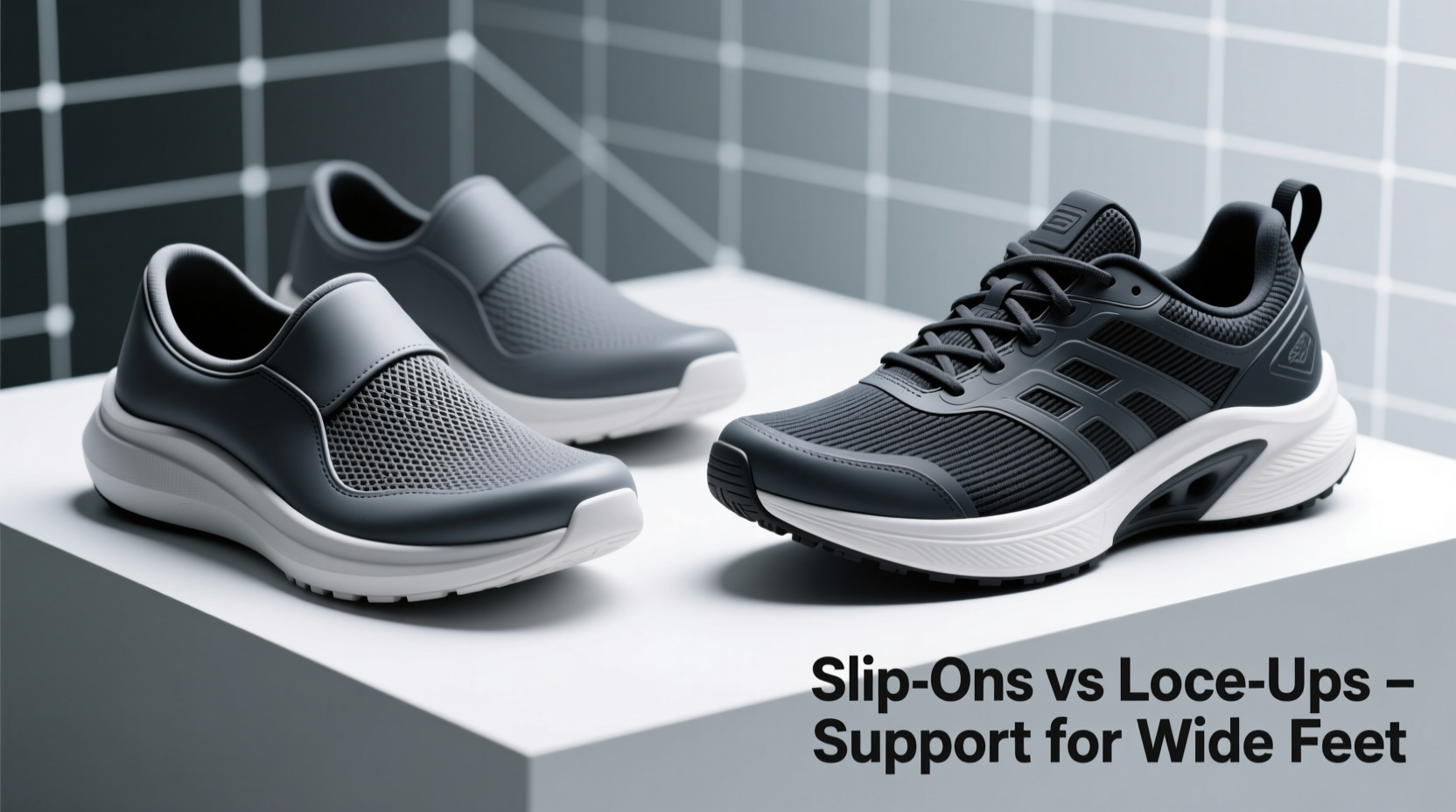
Wide feet are not simply larger versions of average-width feet—they often feature broader forefeet (the ball of the foot), lower arches, or splayed metatarsals. These anatomical traits mean that standard narrow toe boxes or rigid uppers can cause discomfort, calluses, and even contribute to conditions like bunions or neuromas over time.
Support for wide feet goes beyond roominess. True support includes:
- Stable heel counters – Firm backings that prevent heel slippage.
- Adjustable midfoot containment – Ensures the foot doesn’t shift laterally.
- Roomy yet structured toe boxes – Allow natural toe splay without constriction.
- Adequate arch support – Especially important if flat feet accompany width.
Footwear must balance volume and structure. Too much space without containment leads to instability; too little space causes compression. That’s where the distinction between slip-ons and lace-ups becomes critical.
Slip-On Sneakers: Convenience vs. Control
Slip-on sneakers have surged in popularity due to their effortless wearability. Brands like Vans, TOMS, and various minimalist styles dominate casual wardrobes. However, their design often prioritizes aesthetics over biomechanical function—especially for wider feet.
Most slip-ons rely on elastic goring, stretch fabric, or soft uppers to allow entry without laces. While this accommodates width initially, it frequently lacks dynamic support:
- Limited midfoot lockdown: Without lacing systems, the midfoot floats inside the shoe, increasing fatigue during walking or standing.
- Heel slippage: A common complaint, especially in flexible or shallow heels.
- Inconsistent sizing: Many slip-ons run narrow despite being marketed as “comfort” shoes.
That said, some modern slip-ons are engineered specifically for wide feet. Models from brands like Propét, Skechers, and New Balance feature wide widths (up to 4E), padded collars, and removable insoles. These address volume but still fall short in fine-tuning fit compared to laced alternatives.
Tip: If choosing a slip-on, look for models with heel stabilizers, firm heel counters, and dual-density midsoles for added support.Lace-Up Sneakers: Precision Fit and Customized Support
Lace-up sneakers inherently offer superior adaptability. The lacing system allows wearers to customize tension across different zones of the foot—a crucial advantage for those with irregular foot shapes or asymmetrical width distribution.
For wide feet, the benefits include:
- Zonal adjustment: Loosen the forefoot while tightening the midfoot to prevent sliding.
- Better heel lock: Secure lacing techniques reduce heel lift, improving gait efficiency.
- Enhanced stability: A snug midfoot reduces internal foot motion, lowering strain on ligaments and tendons.
- Broader size availability: Major athletic brands like New Balance, Brooks, and ASICS offer extended widths (2E, 4E, 6E) with structured lasts.
Moreover, lace-ups typically use sturdier materials and construction methods. Reinforced heel cups, medial posts for overpronation, and dual-density foams are more commonly found in performance-oriented lace-up designs. These features translate into better alignment and reduced risk of overuse injuries.
“Lacing allows for micro-adjustments that no slip-on can replicate. For someone with wide forefeet and a narrower heel, that control is non-negotiable for long-term foot health.” — Dr. Lena Torres, DPM, Podiatry Specialist
Comparative Analysis: Slip-Ons vs. Lace-Ups
| Feature | Slip-On Sneakers | Lace-Up Sneakers |
|---|---|---|
| Width Accommodation | Moderate to good (varies by brand) | Excellent (often available in multiple wide sizes) |
| Midfoot Support | Poor to fair (lack of adjustability) | Excellent (customizable via lacing) |
| Heel Stability | Fair (prone to slippage) | Strong (with proper lacing technique) |
| Arch Support Options | Limited (often flat insoles) | High (removable insoles, orthotic-friendly) |
| Best For | Casual wear, short durations, warm climates | Walking, standing, fitness, all-day use |
| Fit Adjustability | None | Full (eyelets allow differential tensioning) |
This table illustrates why lace-ups generally outperform slip-ons when support is the priority. While certain slip-ons can work for light-duty use, they lack the engineering depth needed for sustained activity or biomechanical correction.
Real-World Scenario: Office Worker with Wide Feet
Consider Mark, a 42-year-old office worker who commutes via subway and walks 3–4 miles daily between transit and his workplace. He has wide feet (size 11, 4E) and mild overpronation. Initially, he chose a popular canvas slip-on for its comfort and style. Within two weeks, he developed heel blisters and midfoot fatigue.
After consulting a podiatrist, he switched to a lace-up sneaker with a wide last and medial support. Using a “ladder lacing” technique to relieve forefoot pressure while securing the midfoot, he eliminated slippage and reported a 70% reduction in end-of-day foot pain within one week.
Mark’s experience highlights a key principle: support isn’t just about initial comfort—it’s about maintaining alignment and reducing micro-trauma over thousands of steps. His slip-ons failed to provide progressive support; the lace-ups succeeded through customizable fit.
Choosing the Right Shoe: A Step-by-Step Guide
Selecting between slip-ons and lace-ups for wide feet shouldn’t be arbitrary. Follow this process to ensure optimal support and comfort:
- Measure your feet professionally: Use a Brannock device to determine true length, width, and arch length. Do this at the end of the day when feet are slightly swollen.
- Identify your primary use case: Will the shoes be used for walking, gym sessions, or casual outings?
- Check for official wide sizing: Look for labeled widths (e.g., 2E, 4E). Avoid “roomy” shoes not officially designated as wide.
- Test heel stability: Walk on a smooth surface. Your heel should not lift more than 5mm with each step.
- Evaluate midfoot hold: Perform a lateral shuffle. Your foot should not slide side-to-side.
- Try different lacing techniques (if applicable): Skip-lacing or parallel lacing can relieve pressure on wide forefeet.
- Wear your typical socks: Test shoes with the same thickness of socks you plan to use daily.
This method ensures you’re evaluating function, not just feel. A shoe may seem soft and roomy but fail in dynamic support—something only testing under realistic conditions can reveal.
Expert Tips for Maximizing Support in Wide-Foot Footwear
Tip: Replace stock insoles with custom or high-support orthotics if you have flat feet or high arches—this dramatically improves stability regardless of shoe type.- Use heel grips in slip-ons to reduce slippage and friction.
- Look for triple-density midsoles—they combine cushioning with torsional rigidity.
- Avoid overly flexible soles; some bend too easily, compromising arch support.
- Break in shoes gradually; even well-fitting shoes need adaptation time.
Frequently Asked Questions
Can slip-on sneakers be supportive enough for all-day wear?
Some slip-ons designed for wide feet—particularly those with firm heel counters, structured midsoles, and orthotic-friendly interiors—can suffice for light all-day wear. However, for prolonged standing or walking, lace-ups remain superior due to their adjustable fit and enhanced stability.
Are there lace-up alternatives that are nearly as easy to put on?
Yes. Many brands now offer lace-up sneakers with elastic laces or zipper hybrids. These maintain the support of traditional lacing while reducing the need to tie and untie. Examples include the New Balance 623 v3 with dual zippers or Etnies’ lace-zip combos.
Do wide feet always need wide shoes?
Not necessarily. Some people have wide forefeet but average heel width, requiring a blend of volume and containment. In such cases, a regular-width shoe with stretchable upper material and a wide toe box may work—but only if it doesn’t compromise midfoot support. When in doubt, opt for a true wide size.
Final Recommendations and Action Plan
If support is your top priority—whether for walking, working, or managing foot conditions—lace-up sneakers are the clear winner for wide feet. Their ability to customize fit, stabilize the heel, and contain the midfoot makes them biomechanically superior. Slip-ons can serve as convenient secondary options for low-impact settings, but they should not be relied upon for activities demanding endurance or precision.
That said, advancements in footwear technology mean the gap is narrowing. Some premium slip-ons now integrate supportive elements once exclusive to lace-ups. Still, nothing replicates the control of a properly tied, wide-width lace-up sneaker.
To take action today:
- Visit a specialty running or orthopedic shoe store for a professional fitting.
- Try both styles back-to-back, focusing on heel lock and forefoot comfort.
- Invest in at least one pair of supportive lace-ups for daily use—even if you love the ease of slip-ons.
“The right shoe doesn’t just fit your foot—it works with it. For wide feet, that partnership starts with adjustability and ends with alignment.” — Dr. Rajiv Mehta, Biomechanics Researcher
Conclusion: Prioritize Support, Not Just Space
When it comes to wide feet, extra room is necessary—but it’s not sufficient. True comfort arises from balanced support across the entire foot. While slip-on sneakers offer undeniable convenience, they often sacrifice the structural integrity that wide-footed individuals need most. Lace-up sneakers, especially those built on wide lasts with thoughtful engineering, deliver the customization, stability, and long-term protection that active lifestyles demand.
Don’t let fashion override function. Choose shoes that honor both your width and your movement. Your feet will thank you with fewer aches, better posture, and greater freedom—one step at a time.
💬 Have experience with wide-fit sneakers? Share your favorite lace-up or slip-on model and help others find their perfect match!