Choosing between smartwatches isn’t just about brand loyalty—it’s about daily usability, health tracking, ecosystem integration, and long-term value. For users invested in either Samsung’s Tizen platform or Apple’s iOS environment, the decision to upgrade from a Samsung Gear Sport to an Apple Watch Series 4 (or vice versa) hinges on tangible improvements. The Apple Watch Series 4 marked a significant leap in design, health functionality, and processing power when it launched, but how does it truly stack up against the still-competent Gear Sport? This analysis cuts through marketing claims to deliver a practical, feature-by-feature breakdown that helps you decide if switching—or upgrading—is worth your investment.
Design and Build: Comfort Meets Durability
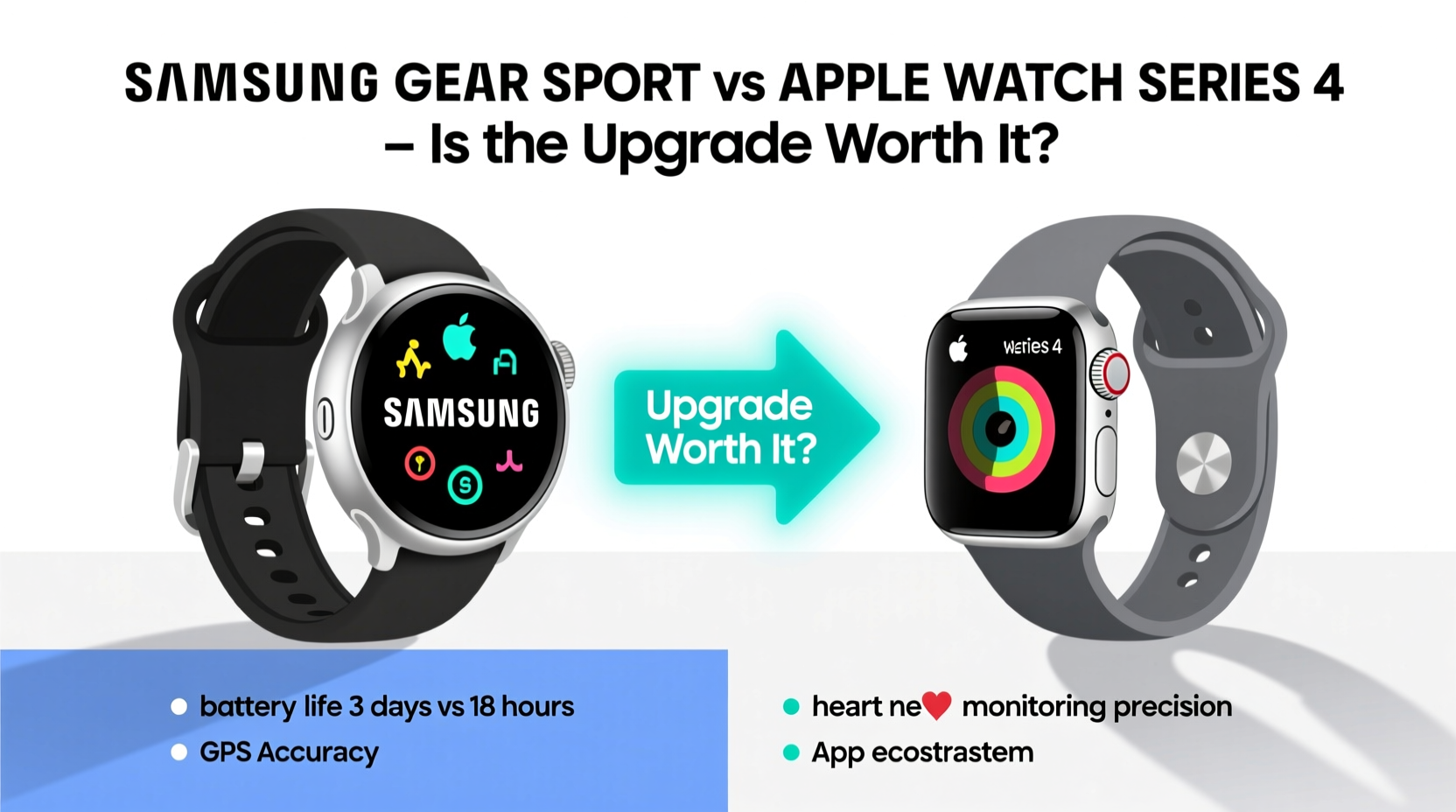
The physical experience of wearing a smartwatch matters more than specs alone. The Samsung Gear Sport, released in 2017, features a circular AMOLED display with a rotating bezel—a hallmark of Samsung’s design language. It’s built for durability with IP68 water resistance and MIL-STD-810G certification, making it ideal for swimmers and outdoor enthusiasts. Its aluminum body feels lightweight and comfortable during extended wear.
In contrast, the Apple Watch Series 4 introduced a larger, edge-to-edge OLED Retina display—30% bigger than its predecessor—with thinner bezels. The flat, rectangular design diverges from traditional watches but maximizes screen real estate. Available in aluminum, stainless steel, and titanium, it offers more material choices but lacks the Gear Sport’s rugged military-grade certification. While both are swim-proof, the Gear Sport’s deeper water resistance (up to 5 meters) gives it an edge for serious aquatic activity.
Tip: If you frequently swim or hike in extreme conditions, prioritize build quality and water resistance over screen size.Performance and Software Experience
Under the hood, the Apple Watch Series 4 runs on the S4 chip, a dual-core processor that doubled performance compared to the Series 3. Apps launch faster, animations are smoother, and voice commands via Siri feel more responsive. Paired exclusively with iPhones, it integrates seamlessly with iMessage, FaceTime, Health app data, and Apple Fitness+.
The Gear Sport, powered by Samsung’s Exynos 7 Dual processor and running Tizen OS, remains functional but shows its age. App loading times are slower, and third-party app support is limited. However, Tizen is lightweight and efficient, often delivering longer battery life than Apple’s watchOS. The Gear Sport can pair with both Android and iOS devices, offering broader compatibility—though full functionality requires a Samsung phone.
For iPhone users, the Apple Watch delivers a tightly integrated experience. Notifications appear instantly, calls can be answered directly from the wrist, and health data syncs automatically to the Health app. The Gear Sport, while capable, lacks this depth of integration on iOS, making it a less compelling choice for Apple ecosystem users.
Health and Fitness Tracking Compared
This is where the Apple Watch Series 4 pulls significantly ahead. It introduced advanced health monitoring features previously unseen in consumer wearables: an electrical heart sensor for ECG readings and an accelerometer-based fall detection system. These aren’t gimmicks—they’ve been clinically validated and have helped detect irregular heart rhythms like atrial fibrillation in real-world cases.
The Gear Sport offers standard fitness tracking: heart rate monitoring, GPS, sleep tracking, and workout modes including swimming. However, it lacks ECG capability and doesn’t monitor blood oxygen levels. Its heart rate sensor is accurate for general use but not medical-grade.
“Wearable technology is shifting from convenience to clinical relevance. Devices like the Apple Watch Series 4 represent a turning point in preventive health.” — Dr. Lena Patel, Digital Health Researcher at Stanford Medicine
| Feature | Samsung Gear Sport | Apple Watch Series 4 |
|---|---|---|
| Heart Rate Monitor | Yes (optical) | Yes (improved optical + ECG) |
| ECG | No | Yes (FDA-cleared) |
| Fall Detection | No | Yes |
| Blood Oxygen Monitoring | No | No (introduced later in Series 6) |
| GPS | Yes | Yes (improved accuracy) |
| Water Resistance | IP68 (5m, 30 mins) | WR50 (swimming OK) |
| Battery Life | 3–4 days | 18 hours |
Real-World Example: A Week in the Life of Two Users
Consider Mark, a 42-year-old project manager with a history of hypertension. He upgraded from a Gear Sport to an Apple Watch Series 4 after his doctor recommended better heart monitoring. One evening, while relaxing at home, he received an alert about an elevated resting heart rate. Later that week, another notification prompted him to take an ECG. The reading showed signs of atrial fibrillation, which he confirmed with his physician. Early intervention prevented a potential complication.
Meanwhile, Sarah, a triathlete using her Gear Sport for training, appreciates its swim-ready design and multi-sport tracking. She values the three-day battery life, which eliminates the need to charge mid-week. However, she occasionally misses seamless iPhone integration and wishes she could receive richer health insights beyond basic heart rate trends.
Their experiences highlight a key divergence: the Apple Watch excels in health intelligence and emergency readiness, while the Gear Sport shines in endurance and sport-specific durability.
Is the Upgrade Worth It?
For Samsung Gear Sport owners considering a switch to the Apple Watch Series 4, the answer depends on priorities:
- If you own an iPhone: Yes, the upgrade is likely worth it. The ecosystem synergy, ECG feature, and superior app performance offer meaningful improvements.
- If you rely on Android: No compelling reason to switch. The Apple Watch won’t work properly without an iPhone, negating any benefits.
- If battery life is critical: The Gear Sport lasts 3–4 days; the Apple Watch needs daily charging. This may be a dealbreaker for frequent travelers or those who dislike constant recharging.
- If health monitoring is a priority: The Apple Watch Series 4 provides actionable, medically relevant data the Gear Sport simply can’t match.
Checklist: Should You Upgrade?
- Do you use an iPhone as your primary phone? → Yes increases upgrade value.
- Are you interested in ECG or fall detection features? → Apple Watch wins.
- Do you need more than one day of battery life? → Stick with Gear Sport.
- Do you swim regularly and need durable water resistance? → Gear Sport has slight edge.
- Do you want access to a robust app ecosystem? → Apple Watch offers far more apps.
Frequently Asked Questions
Can the Apple Watch Series 4 work with Android phones?
No. The Apple Watch requires an iPhone 6s or later running iOS 12 or higher. It cannot pair with Android devices, severely limiting its appeal to non-iPhone users.
Does the Samsung Gear Sport support LTE?
No. The Gear Sport is Wi-Fi and Bluetooth-only. If standalone connectivity is important, consider later models like the Galaxy Watch LTE versions or Apple Watch with cellular.
Is the Apple Watch Series 4 still supported in 2024?
While it no longer receives major watchOS updates (latest compatible version was watchOS 8), it still functions well for core tasks. However, newer security patches and features are unavailable, reducing long-term viability.
Final Verdict and Next Steps
The Apple Watch Series 4 represents a substantial leap over the Samsung Gear Sport in health innovation, software polish, and iPhone integration. For iPhone users concerned about heart health, fitness tracking, and seamless daily use, the upgrade delivers real, measurable benefits—even if it comes at the cost of shorter battery life.
However, for Android users or those who prioritize battery longevity and rugged reliability over cutting-edge health sensors, the Gear Sport remains a capable device. Upgrading purely for aesthetics or marginally faster performance isn’t justified unless you’re already embedded in Apple’s ecosystem.
🚀 Ready to make the switch? Evaluate your current needs, check compatibility, and consider trying the Apple Watch at an Apple Store before committing. Your next smartwatch shouldn’t just look good—it should actively improve your health and simplify your life.